
How to Store an Electric Skateboard: Step-by-Step
This post contains affiliate links. As an Amazon Associate, we earn from qualifying purchases.
Store an electric skateboard by setting its lithium-ion battery to a partial charge (40-60%) for anything longer than a few days, keeping it in a cool, dry indoor space away from temperature extremes, and performing a monthly check on the charge level. Never store it fully charged (100%) or completely dead (0%), and never leave it plugged in after charging is complete.
That gap between a few days and a few months is where most battery damage happens. The cells degrade fastest when they’re sitting idle at the wrong voltage or in a hostile environment, not when you’re riding. For optimal care, you must know how to store an electric skateboard.
What follows: the exact charge numbers from five major brands, where they disagree and why it matters, a physical storage method that won’t stress your trucks, and the one monthly habit that adds years to your board’s life, all central to the topic of how to store an electric skateboard.
Key Takeaways
- Set the battery to a 40-60% charge before long-term storage; only Razor contradicts this, advising a full charge.
- Perform a monthly battery check during storage to prevent a deep discharge, which causes permanent damage.
- Always store the board indoors in a stable, room-temperature environment; garages and sheds often fail on temperature and humidity.
- Evolve Skateboards and ONSRA advise unplugging the charger when the battery is full, while Razor advises to continue charging even after the indicator turns green.
- Store the remote with some charge left and keep it with the board so you don’t forget it.
The Battery Charge Sweet Spot for Storage
Get the charge level wrong, and you’re buying a new battery next season. Lithium-ion cells hate two states: completely full and completely empty. Storing them at 100% voltage accelerates chemical aging inside the cells. Storing them at 0% risks a deep discharge, where the voltage drops so low the battery’s protection circuit permanently disables it—a bricked battery.
For storage longer than a month, Future Motion (Onewheel), Evolve Skateboards, Backfire Boards, and ONSRA all instruct users to set the battery charge between 40% and 60%. This range minimizes stress on the cells during idle periods.
The logic is consistent across these brands because it’s based on battery chemistry, a core principle in any guide on how to store an electric skateboard. The 40-60% storage voltage keeps the cells in a stable, mid-range state that slows degradation. It’s the same reason you’re told to store a laptop or drone at half-charge.
Where manufacturers disagree
One manual stands out. The RazorX Cruiser owner’s manual explicitly says to “fully charge battery before storing for extended periods of time.” This is a direct contradiction. I wouldn’t follow it. Razor’s advice likely stems from older battery technologies or an overly cautious approach to prevent a total discharge during very long, unsupervised storage. For a modern lithium-ion pack, a full charge is the more damaging choice.
So, what’s the rule? Ride or discharge your board down to that 40-60% range before you put it away. If your board lacks a percentage display, use the remote’s battery indicator lights as a guide—the middle two lights are your target.
Where and How to Physically Store Your Board
The environment matters as much as the charge. Think about where you wouldn’t store a laptop or a premium camera. Now apply that to your board.
Temperature is the silent killer
Extreme heat accelerates chemical reactions inside the battery, permanently reducing its capacity. Extreme cold isn’t much better; it can increase internal resistance and, if you charge in the cold, cause permanent damage. Evolve’s manual warns against storing in spaces that aren’t “within 12°Celsius / 10°F of room temperature.” A garage in summer or a shed in winter often swings far outside that band.
The fix is simple: store your board indoors where you live. A closet, under a bed, or in a spare room works. You’re not looking for a climate-controlled vault, just a stable, dry, room-temperature space. This single habit is the easiest way to extend your skateboard’s life.
Dealing with dampness and water
If you’ve ridden through puddles or in damp conditions, you have one job before storage: dry the board completely. Wipe down the deck, trucks, and wheels. Pay special attention to the charging port and any seam around the battery enclosure. Backfire notes its boards have an IP55 water resistance rating—that means they’re protected from low-pressure water jets, not immersion. Letting moisture sit invites corrosion on electrical contacts and inside bearings.
For a complete approach, our guide on electric skateboard waterproofing details how to seal vulnerable points.
Common mistake: Leaving the board in a damp garage or basement. The constant humidity corrodes metal parts and, over a season, can compromise battery seals. You’ll notice a white, powdery residue on axle nuts first.
To stand or not to stand?
Reddit threads are full of debate about leaning a board against a wall. Some worry it stresses the wheels and motors. Here’s the answer: the weight of your board is a fraction of the weight it supports when you ride. Leaning it is fine. If you prefer it flat, lay it deck-down on a mat or carpet to protect the graphic.
For a cleaner look, a simple guitar stand works perfectly. It cradles the board by the trucks, keeping it upright and off the floor. If you have multiple boards, a multi-tier floor rack is a worthy investment for storing them in a small space.
Your Pre-Storage Maintenance Checklist
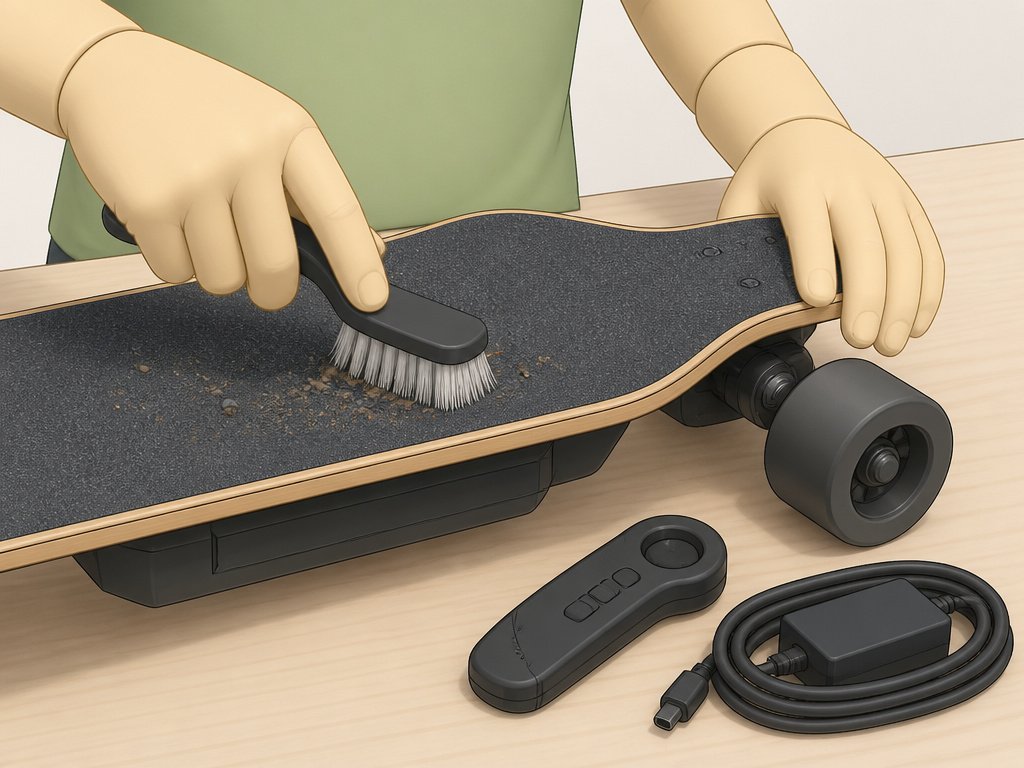
Storage isn’t just about the battery. A little prep prevents surprises when you pull the board out months later. Follow this sequence.
- Clean the board. Brush off dirt and debris from the deck, wheels, and truck assemblies. A clean board won’t attract moisture or grit that grinds down parts over time.
- Check tire pressure. If you have pneumatic (air-filled) tires, inflate them before storage.
- Set the battery charge. As outlined above, discharge or charge the battery to that 40-60% sweet spot. This is the most critical step.
- Store the remote. Evolve’s blog specifically advises to “store the remote with some battery life remaining, not fully flat.” A dead remote battery can sometimes be harder to revive than the board’s. Keep it with the board so you don’t lose it.
- Unplug everything. Remove the charger from the wall outlet and from the board. Store all cables neatly coiled.
This routine dovetails with general electric skateboard maintenance, keeping everything in riding shape.
The Monthly Storage Check (Non-Negotiable)
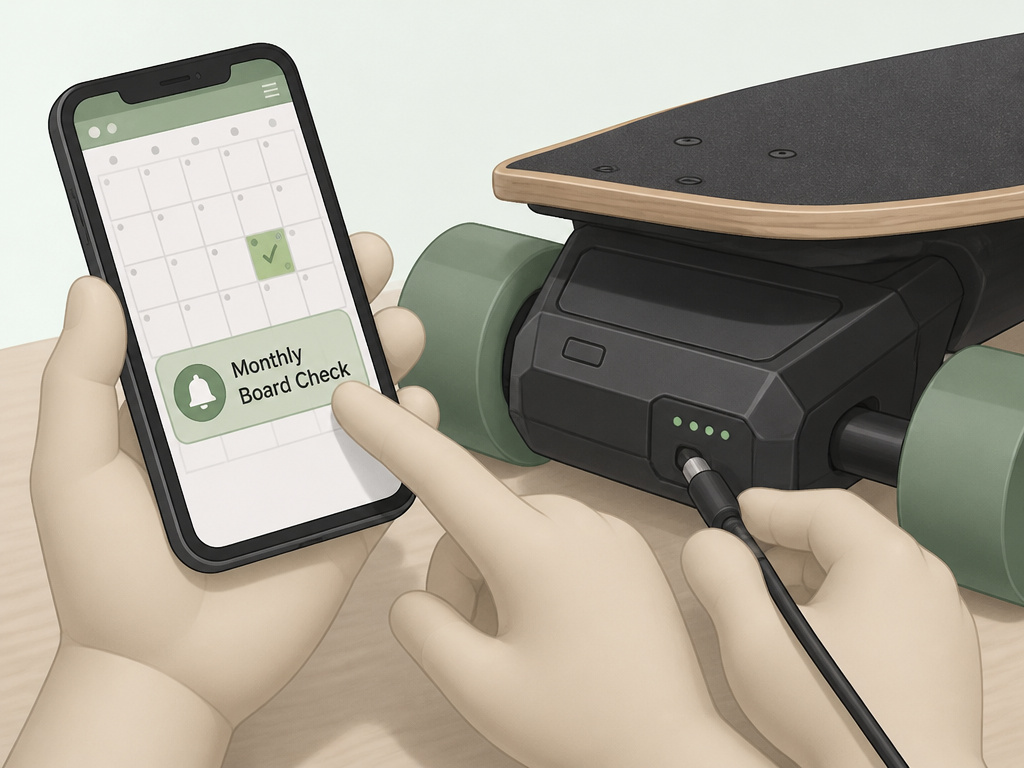
Batteries self-discharge. It’s slow, but over three or four months, a battery left at 50% can drift down to a damaging voltage level. Future Motion’s support article is blunt: “check this monthly.” Backfire instructs users to charge the battery once a month if stored for more than two months.
Mark a monthly reminder on your calendar (or every 90 days for ONSRA). The task takes two minutes: plug in the charger, let the board siphon enough power to bring it back to the recommended storage charge range, then unplug it. This topping charge resets the self-discharge clock and keeps the battery management system active.
Skipping this check is how you find a dead board in the spring. A deeply discharged lithium-ion battery isn’t just empty; it can be permanently damaged, requiring an expensive replacement. ONSRA’s manual states plainly that storing with an empty battery for more than 24 hours causes “irreparable damage.”
Charger Safety and Storage
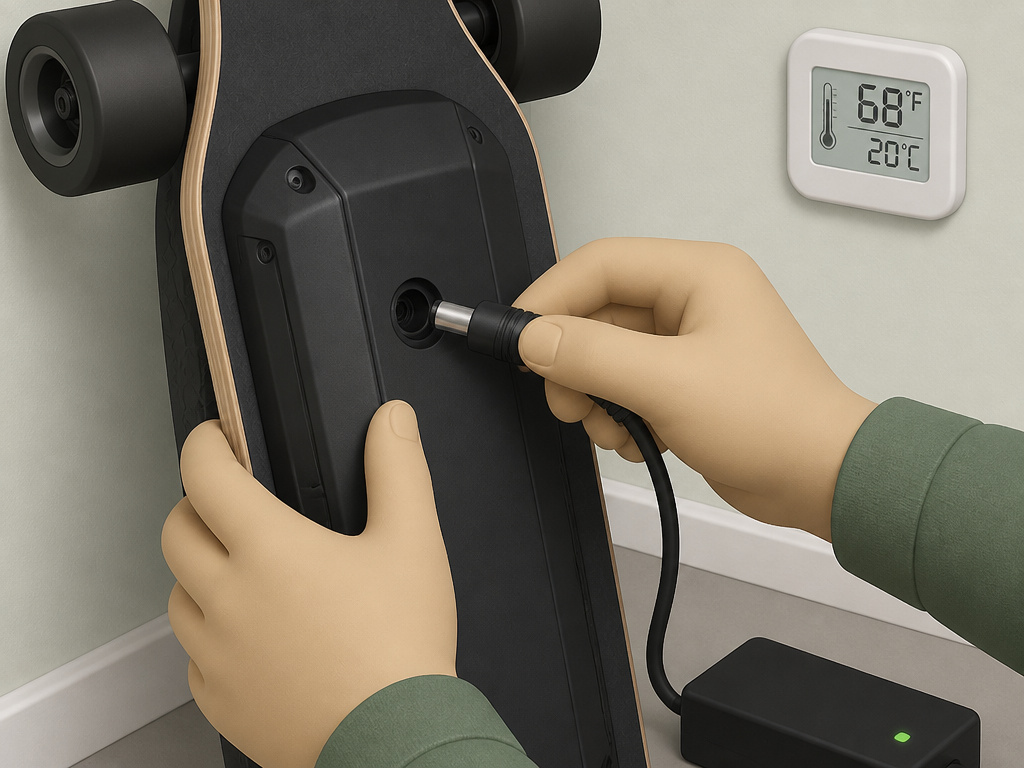
The charger itself needs care. It’s not a “set it and forget it” device.
Unplug when done
Both Evolve and ONSRA are adamant: don’t leave the board plugged in after it’s fully charged. Evolve says to “avoid leaving the charger plugged into the board when the battery is fully charged.” ONSRA warns not to leave the battery “on the active charger, or the charger in the socket, for more than 48 hours.” The reason is subtle but important: even a “green light” trickle charge can generate low-level heat and stress the battery’s management circuitry over weeks.
Mind the temperature
Evolve advises charging only “indoors in dry spaces that are not excessively hot or cold.” Razor’s manual has a specific, critical warning: “Do not charge at or below 32°F (0°C).” Charging a cold battery can cause lithium to plate onto the anode, creating microscopic shorts that permanently reduce capacity and increase failure risk.
Let it cool
After a long ride, the battery and motors are warm. Evolve’s manual insists you “allow board to cool for 30 minutes before charging.” Sticking a charger into a hot battery pack accelerates internal wear. It’s a easy step to skip, but your routine for battery care is built on these small disciplines.
| Brand | Storage Charge | Check Interval | Charger Warning |
|---|---|---|---|
| Future Motion | 40-50% | Monthly | Not specified |
| Evolve | 40-50% | Implied | Unplug when full |
| Backfire | 50-60% (for >2 months) | Monthly (for >2 months) | Not specified |
| ONSRA | 40-60% (for >1 month) | Charge/use every 90 days | Unplug after 48 hrs max |
| Razor | Fully charge | Not specified | Do not charge below 0°C (32°F) |
What to Do in an Emergency: Water Damage
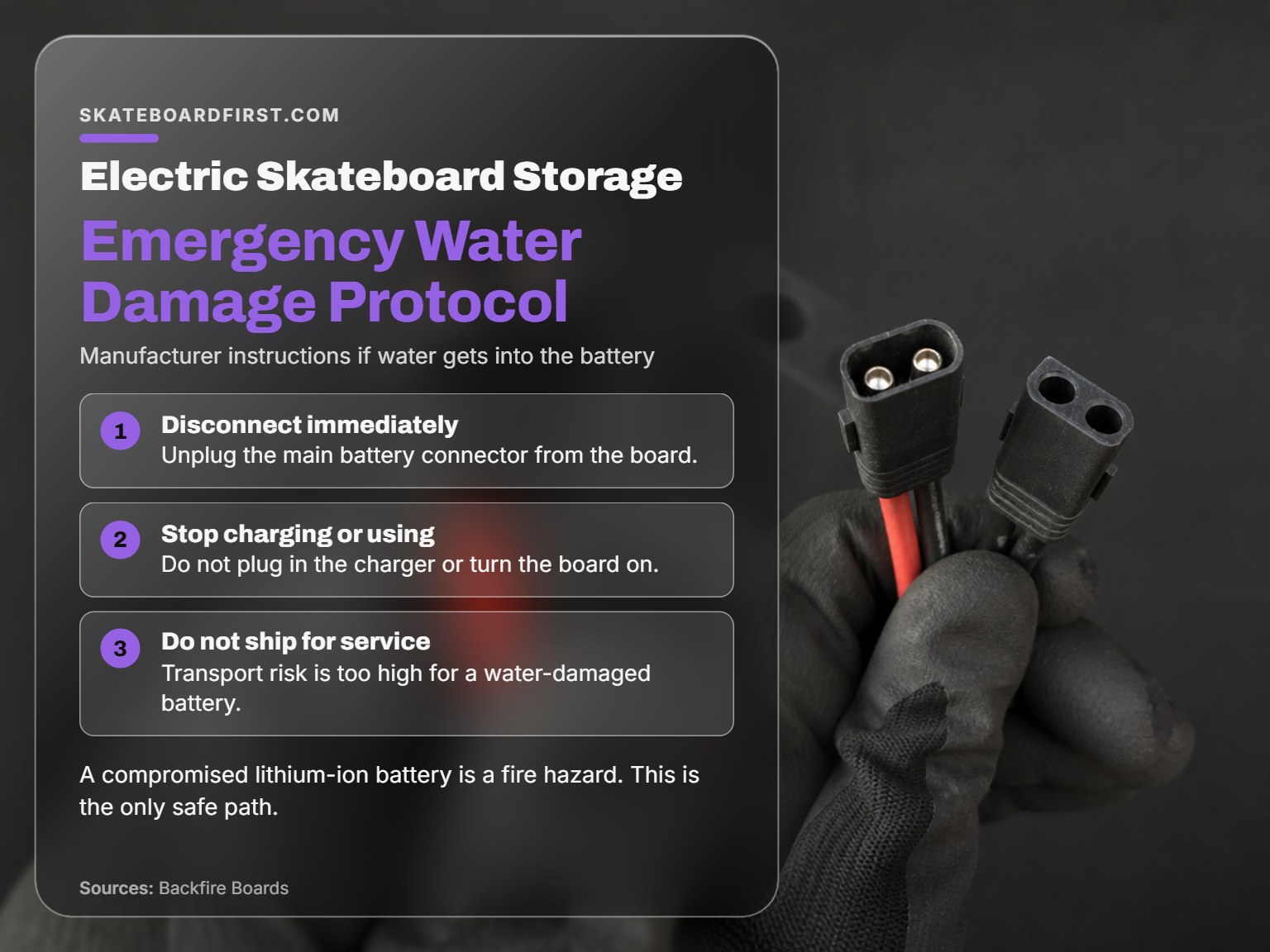
This isn’t scare talk. It’s a protocol from a manufacturer. Backfire’s FAQ has a stark, actionable section on water damage that every owner should read.
If you suspect water has gotten into the battery enclosure:
- Disconnect the battery from the board immediately. This usually means unplugging the main battery connector inside the enclosure.
- Stop charging it or using it. Do not plug in the charger. Do not turn the board on.
- Store the battery outdoors in a fire-resistant container, like a sealed metal bucket, away from structures. This is Backfire’s explicit instruction.
- Do not ship a water-damaged battery for service. The transport risk is too high.
This protocol exists because a compromised lithium-ion battery is a fire hazard. The electrolytes inside can react. Treating a water incident with this seriousness is the only safe path. For less severe moisture exposure, general advice on proper skateboard storage in a dry environment is your best defense.
How to Position Your Board for Storage
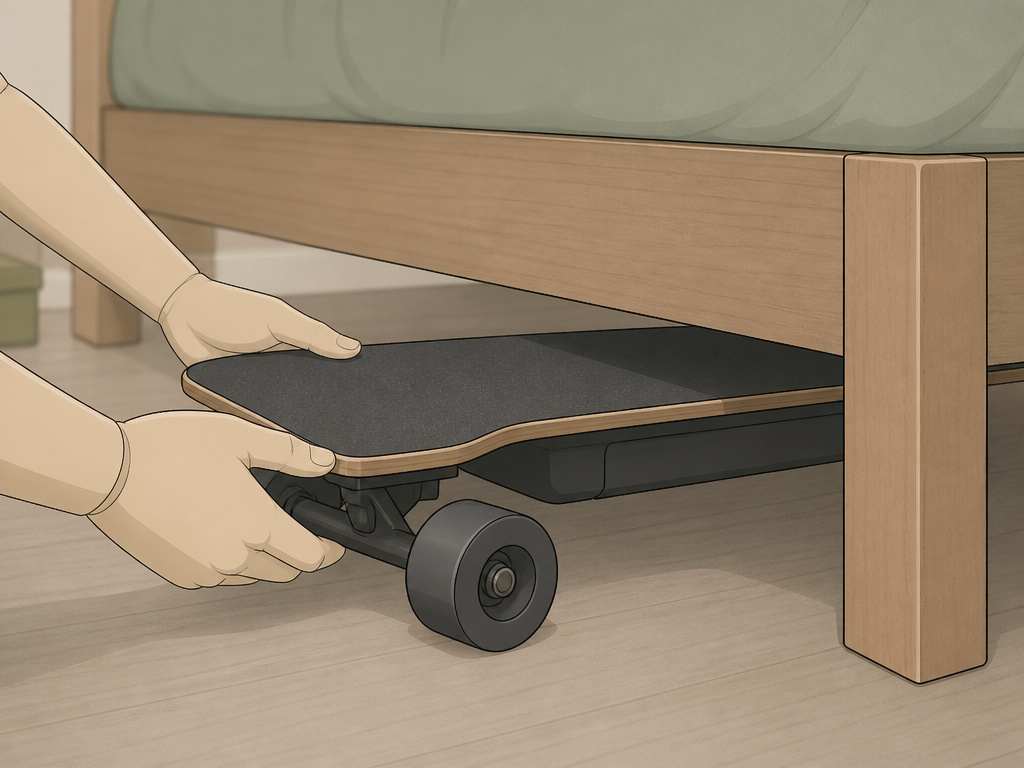
Store your board indoors in a dry space, away from direct sunlight and any sources of heat or flame. A closet or under a bed works well. Let the board cool down completely after a ride before putting it away. While the fact sheet doesn’t specify a particular orientation like upright or on its side, a practical approach is to store it in a stable position where it won’t easily fall over, as a tumble could damage the electronics or deck. Avoid hanging it by the trucks for long periods unless you’re certain the weight distribution won’t strain the mounting points. The goal is to keep it secure, dry, and at a mild room temperature.
Frequently Asked Questions
Is it okay to store an electric skateboard in the garage?
It depends entirely on your garage’s climate. If it experiences freezing winters, scorching summers, or high humidity, then no—it’s a poor choice. The temperature swings and dampness degrade the battery and promote rust. An insulated, climate-controlled garage is fine, but a typical one is a risk.
How long do electric skateboard batteries last?
Backfire states its battery life is 500 deep cycles. After 300-500 full cycles, the battery may still work but at about 70% of its original capacity. Lifespan in years depends heavily on storage habits.
Should I remove the battery for storage?
Most electric skateboards have non-removable, integrated batteries. For those with swappable packs (like some ONSRA models), removing the battery and storing it separately in a cool, dry place at 40-60% charge is an excellent idea. It also eliminates any phantom drain from the board’s electronics.
Can I leave the charger plugged in all winter?
No. Both Evolve and ONSRA specifically warn against this. Continuous trickle charging after the cycle is complete creates unnecessary heat and stress on the battery management system. Always unplug the charger from both the board and the wall outlet once the indicator light turns green.
What’s the biggest mistake people make with storage?
Storing the board at 100% charge because they think “full is best.” It’s the opposite. A battery sitting at full voltage for months ages faster than one sitting at half-charge. The second biggest mistake is forgetting the monthly check, allowing a slow self-discharge to brick the battery.
Before You Go
The rule that reframes everything: your board is most vulnerable when you’re not riding it. The habits you build for those idle weeks determine whether your battery delivers full range next season or needs a replacement.
Start small. After your last ride of the month, make a ritual of the five-step checklist. The twenty minutes it takes will save you two hundred dollars on a new battery. And if your garage is your only option, at least get the board up onto a shelf or into a sealed plastic bin—anywhere off the damp concrete floor.
One last thing everyone forgets: the remote. Give it a half-charge and leave it with the board. Wasting a sunny day because you can’t find a dead remote is the most frustrating way to end a storage period.
