
How to Choose Skate Shoes: 7 Steps
This post contains affiliate links. As an Amazon Associate, we earn from qualifying purchases.
To choose skate shoes, match three things: your skating style, your foot shape, and the shoe’s construction. For most beginners, a suede upper with a vulcanized sole offers the best balance of board feel and durability. The right shoe protects your feet, connects you to the board, and lasts more than a few sessions.
That board-feel connection isn’t just a nice bonus. It’s the difference between feeling every micro-adjustment of your foot for a kickflip and skating blind in a padded boot. Knowing how to choose skate shoes is key. A shoe that’s wrong for your style or foot shape drains confidence and cash, you’ll replace it twice as fast.
What follows is a seven-step filter for how to choose skate shoes. We’ll walk through materials, sole types, fit, and the budget trade-offs nobody likes to talk about. By the end, you’ll know exactly which specs to look for on the tag.
Key Takeaways
- Pick suede uppers for a balance of durability and feel; Nike states leather is the most durable, while DC Shoes notes suede is durable, affordable, and lightweight.
- Choose vulcanized soles for board feel and tricks; save cupsole construction for jumping down stairs and big gaps.
- DC Shoes recommends mid-tops and high-tops for wide feet and low-tops for narrow feet, while other sources base height choice on skating style and ankle support preference.
- A worn-out sole is a safety issue; replace shoes when the tread is smooth or you feel the ground through the insole.
- Budget shoes work for light cruising; if you skate daily, the better materials in a premium shoe cost less per session.
Step 1: Diagnose Your Skating Style First
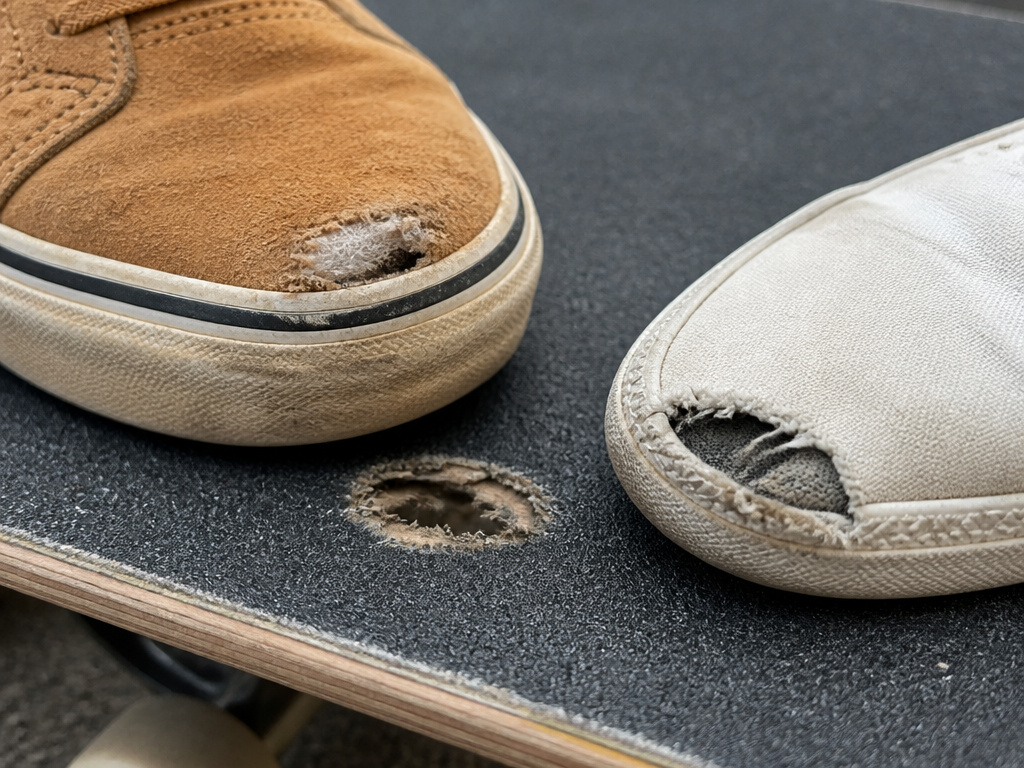
Your skating style dictates almost every other choice. Are you cruising to the store, learning flip tricks in a parking lot, or launching off a six-stair? The shoe that works for one will fail at another.
Common mistake: Wearing thick, cushioned cupsole shoes to learn flatground tricks. The extra padding kills board feel, so you can’t tell if your foot is in the right spot. You’ll struggle with timing and bail more often.
For non-trick cruising, DC Shoes suggests lightweight canvas shoes, a key point in how to choose skate shoes, while other sources note canvas is the least durable material. But the moment you start practicing ollies or kickflips, that griptape becomes a belt sander against your shoe. A thin canvas upper will develop a hole where you drag your foot within a few hours. The toe was gone by sunset.
For street skating, sources offer different advice: Decathlon says to pass up canvas for suede or PU, DC Shoes praises suede’s texture for tricks, and Nike states cupsole shoes are ideal for jumps and street skating. The texture matters, too. DC Shoes notes suede has the ideal feel: not too grippy, not too slick. It allows your foot to slide just enough for a flick, preventing it from sticking and throwing you off balance.
Step 2: Pick the Upper Material That Matches Your Abuse Level
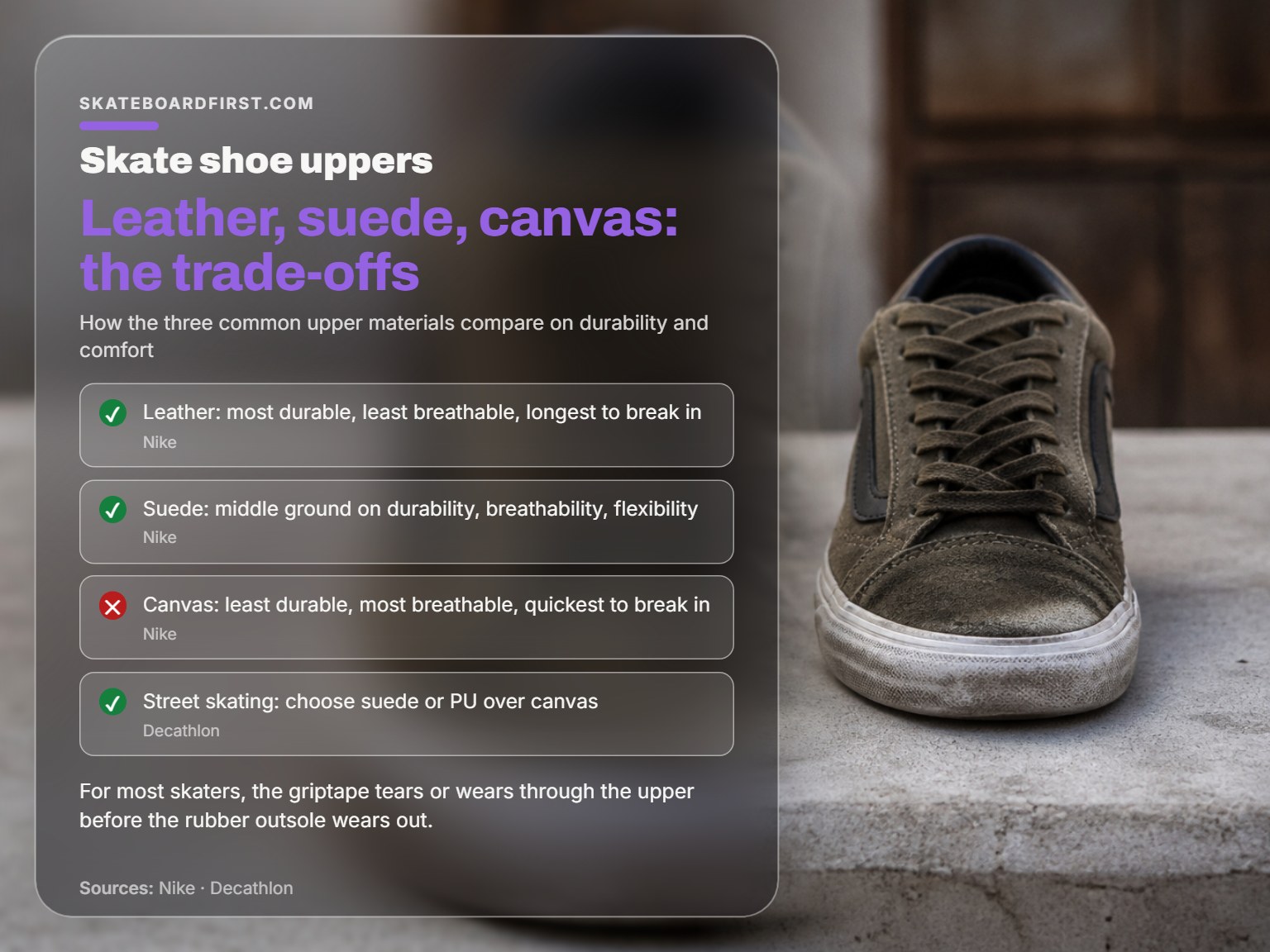
The upper is the part that touches the griptape. It decides how long your shoe lasts before your sock gets a new window. The trade-offs are durability, breathability, and break-in time.
| Material | Best For | Wears Out When | Break-In Time |
|---|---|---|---|
| Suede | Street skating, flip tricks | The toe cap abrasion point wears thin from repeated contact with griptape. | Moderate (a few sessions) |
| Leather | High-impact, durability-focused skaters | The stitches or seams fail from flexing | Longest (can take weeks) |
| Canvas | Casual cruising, very light trick practice | The ollie area tears through quickly from griptape abrasion. | Quickest (almost none) |
Nike’s fact sheet lays out the basics: leather is the most durable but also the least breathable. Suede is the middle ground. Canvas is the least durable but the lightest and most breathable.
Here’s the practical translation. If you’re at the park every day, suede is the default. It’s the most common material for a reason. Leather is overkill for most, it’s stiff, hot, and that long break-in period means blisters. I leaned toward leather early on, thinking “toughest is best.” Canvas is a trap if you’re progressing. It feels great day one, but it’s a disposable item if you’re actually skating.
Where this goes sideways: Choosing canvas because it’s cheap and comfortable. You’ll burn through the cost of a suede shoe in two replacements, and the board feel gets mushy as the material stretches and tears.
Step 3: The Vulcanized vs. Cupsole Decision That Changes Everything
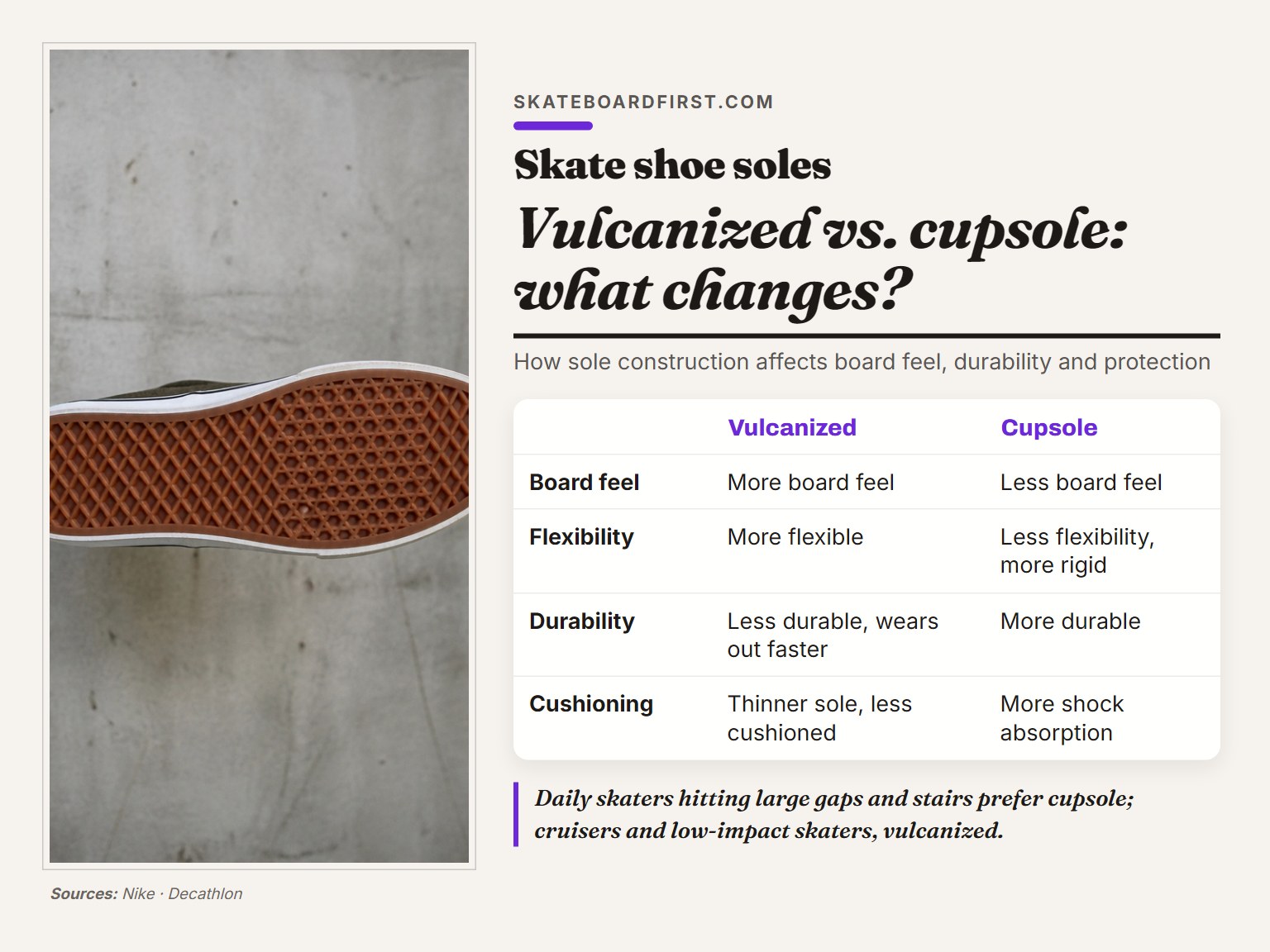
This is the big one. Sole construction determines how the shoe connects to the board. It’s the difference between a thin driving glove and a winter mitten.
Vulcanized shoes have a sole glued directly to the upper. The process, which adds sulphur to rubber under heat, creates a thin, flexible, one-piece feel. Cupsole shoes have a thicker, pre-molded rubber cup that’s stitched to the upper.
| Feature | Vulcanized (Vulc) | Cupsole |
|---|---|---|
| Board Feel | Excellent. Thin sole transmits board texture. | Muted. More material between foot and deck. |
| Flexibility | High. Breaks in quickly. | Low to moderate. More rigid. |
| Impact Protection | Low. Thinner sole, less cushion. | High. More padding, often with advanced foams. |
| Durability | Lower. Thinner sole wears faster. | Higher. Thicker, reinforced rubber. |
| Best For | Cruising, technical flip tricks, street skating. | Stair sets, big gaps, high-impact landings. |
Nike states vulcanized shoes are “less protective and durable, best for cruising and tricks on flat surfaces,” while cupsoles are “more supportive, ideal for jumps and street skating.” OutdoorGearLab’s testing refines this: a daily skater hitting gaps will prefer cupsole; someone skating low-impact obstacles or cruising prefers vulcanized.
My stance aligns with the sources here. For learning, I recommend vulcanized. That board feel is a teacher, it gives you feedback. But if you are hitting large gaps and stairs, listen to the testers and get a cupsole. The shock absorption is real.
What most people get wrong: Thinking “cupsole” automatically means “better.” For many skaters, a vulcanized sole is the better tool. It’s lighter, more responsive, and modern vulcs can have decent impact protection from thick insoles, as DC Shoes points out.
Step 4: Get the Fit and Height Right for Your Foot Shape
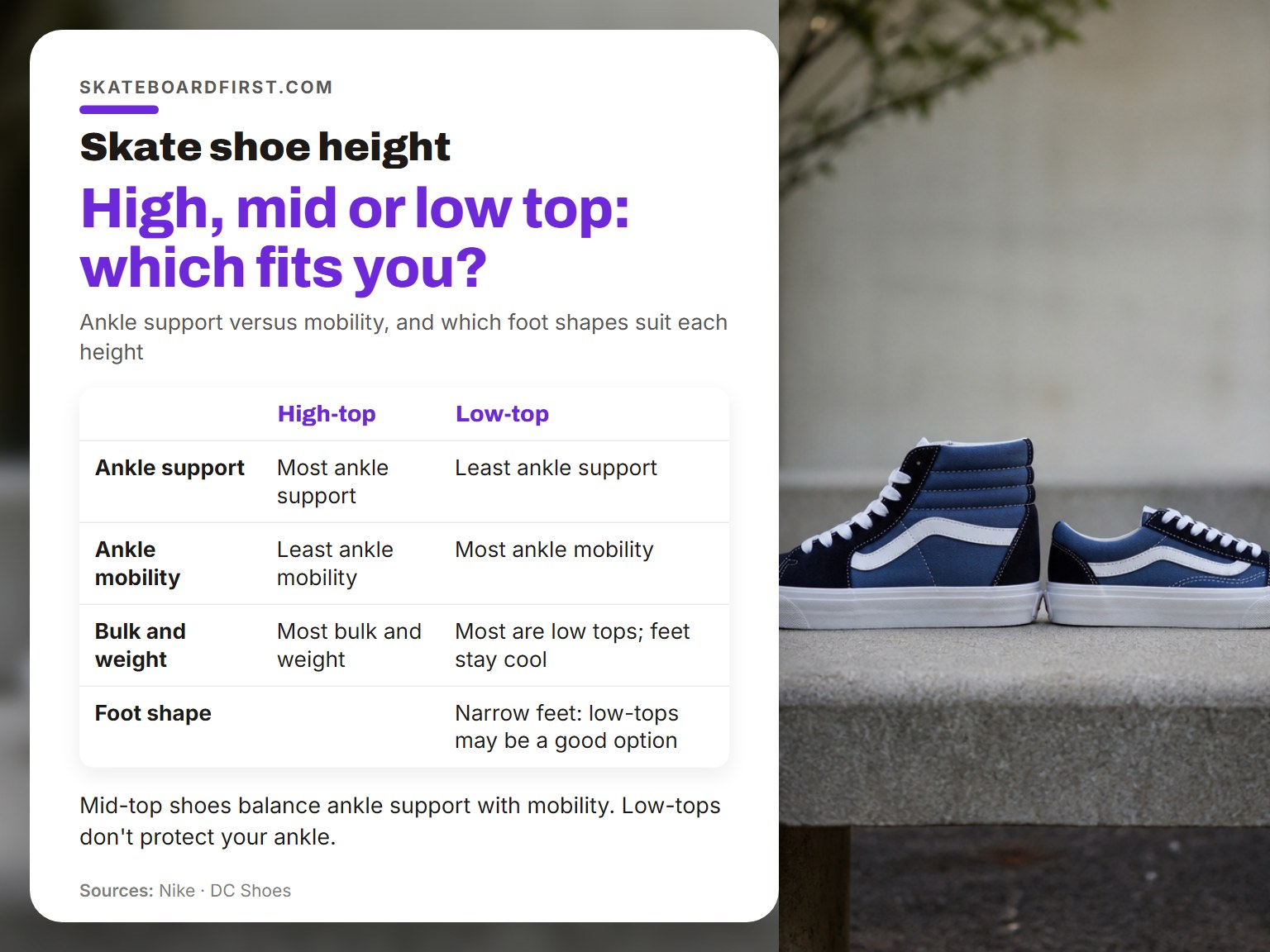
A shoe can have perfect specs but fail if it doesn’t fit your foot. This is where most generic guides stop. They’ll say “high-top for ankle support, low-top for mobility.” That’s true, but incomplete.
DC Shoes provides a crucial, non-commodity edge case: foot shape should influence height choice. They recommend mid-tops and high-tops with a rounded or square-shaped toe wrap for wide feet. For narrow feet, low-tops may be a better option. This makes sense, a high-top collar on a narrow foot can gap and rub, while a wide foot in a low-top might feel unsupported.
Ankle support vs. Mobility is the other axis. Nike’s data is straightforward: high-tops offer the most ankle support but the least mobility and most bulk. Low-tops are the opposite. Mid-tops balance the two.
- High-Top: Choose if you’ve had ankle injuries or are skating big transition where ankle rolls are common. They’re warmer and slower to put on.
- Mid-Top: The safe, versatile choice for most. Offers some support without sacrificing all mobility.
- Low-Top: The classic skate shoe. Maximizes ankle flex for flick tricks and keeps your feet cool. Offers zero ankle protection.
Try shoes on later in the day when your feet are slightly swollen. Wear the socks you skate in. There should be no heel slip, and your toes shouldn’t jam the front when you flex. A little room in the toe box is fine; a swimming pool is not.
Step 5: Don’t Ignore the Lifespan Extenders (Toe Caps & Lace Guards)
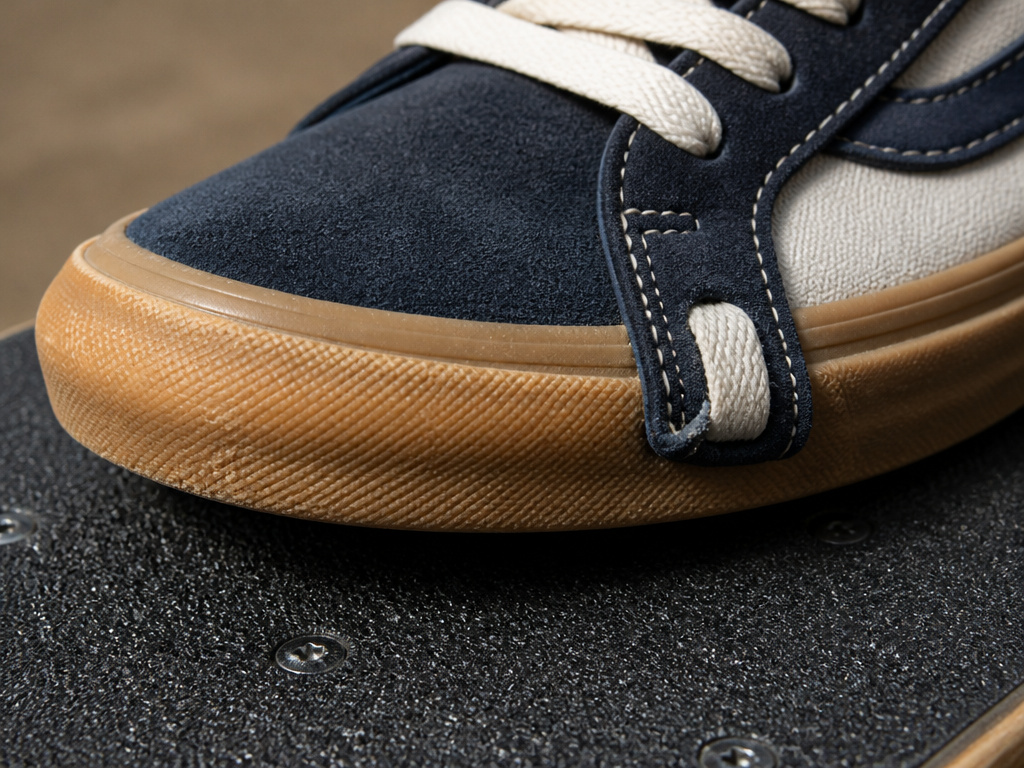
Griptape is abrasive by design. Your shoe will lose. But you can pick where it loses last.
A rubber toe cap makes a significant difference. DC Shoes says it lengthens lifespan because the toe wears out first. It also provides grip for flip tricks. Some shoes use a high-abrasion coating instead, lighter protection with no seams to split.
Lace protection is often overlooked. Laces rubbing on griptape snap fast. Look for shoes with “Ghillie” loops (lace loops that sit under the eyestay) or reinforced eyestays. RunRepeat’s testing found that shoes with wider lacing placement are prone to more frequent lace tearing. A simple design tweak can save you constant re-lacing.
Reinforced or hidden stitching in high-wear areas (like the ollie zone) is another pro detail. Exposed stitches get shredded quickly, opening up holes.
Slip-on shoes eliminate the lace problem entirely. DC Shoes notes they’re convenient and remove a wear zone, but they often have slimmer silhouettes with less protection. A slip-on with a rubber toe cap, though, can last a long time.
Step 6: Decode the Brand Landscape
Brands have personalities. Knowing them helps you shortcut to shoes that match your priorities.
- Nike SB & Adidas Skateboarding: The big sportswear tech transfer. Expect advanced cushioning (Zoom Air, Boost), structured support, and often a snugger, performance-fit. Great if you want modern athletic tech in your skate shoe.
- Vans & Converse: The classics. Built on vulcanized heritage, offering timeless silhouettes and pure board feel. For Vans, always look for the “Pro” or “Skate” line, the regular versions aren’t built for it.
- DC Shoes & éS: Skate heritage brands. Often focus on durability, practical protection features, and a skate-specific fit.
- New Balance Numeric: The runner’s crossover. Excellent comfort, unique tech, and often a focus on impact protection and support. A great choice if you prioritize cushioning.
- Last Resort AB, Hours Is Yours: The independent, skater-owned options. Minimalist design, focus on grip and board feel, often with a stripped-back, durable construction.
Skatewarehouse notes that higher-priced shoes usually offer better materials and tech, which translates to durability and comfort. Budget options exist for beginners or light use, but the cost-per-session math often favors spending a bit more upfront.
Step 7: Know When to Retire Them (It’s Sooner Than You Think)
Skate shoes are consumables. Riding them until they fall apart is a safety and performance issue.
Replace your skate shoes when:
- The tread on the ball of the foot is smooth. This kills traction for pushing and footing tricks.
- You can feel the ground through the insole. The impact protection is gone.
- There’s a hole that exposes your sock. You can see the damage right away, and even a small hole lets griptape sand your skin.
- The shoe collapses laterally when you stand. The structure is dead, and ankle support is zero.
RunRepeat’s durability testing uses a Dremel on the toebox and outsole, that’s the kind of abuse you’re delivering. The upper usually fails before the outsole. That’s your signal.
A tube of Shoe Goo can patch small holes in the suede and extend life a few weeks. It looks crusty, but it works. It’s the most underrated three dollars in skating.
Frequently Asked Questions
What are the most important features in skate shoes?
The upper material and sole construction. Suede or durable synthetic uppers survive griptape. Vulcanized soles give you board feel for tricks; cupsole construction gives you cushion for big impacts. Everything else, lace protection, ankle height, insole tech, supports those two core choices.
Should I size up or down for skate shoes?
Size for the socks you’ll wear and expect a break-in period. They should feel snug but not painful, with no heel slip. Don’t size up expecting them to stretch, a loose shoe is unstable. If you have wide feet, consider brands known for a wider fit (like some New Balance Numeric or DC Shoes models) or try a mid- or high-top as DC suggests.
Are expensive skate shoes worth it?
For a casual cruiser, no. For someone skating regularly, usually yes. The cost isn’t about a logo; it’s about denser suede, reinforced stitching, better rubber compounds, and proprietary cushioning. These features make the shoe last longer and perform better, which lowers your cost per session. A budget shoe you replace monthly often costs more than a premium shoe that lasts a season.
Can I use shoe glue to fix my skate shoes?
Yes, products like Shoe Goo are a skater’s secret weapon. They’re excellent for sealing small holes in the suede, especially at the ollie spot. It won’t restore the shoe’s structure or cushioning, but it can get you another few weeks of wear. Apply it to the inside of the hole for a cleaner look.
How long should skate shoes last?
There’s no fixed timeline, only wear states. A daily street skater will wear through the suede from griptape abrasion. A weekend cruiser’s shoes will last longer than those of a daily skater. The sole might last longer, but the upper will usually fail first from griptape abrasion. Judge by the condition, not the calendar.
The Bottom Line
Choosing skate shoes is about matching a tool to a job. Ignore the hype and look at the specs: suede over canvas, vulcanized for feel, cupsole for punishment. Your foot shape isn’t a suggestion, it’s a design constraint that should guide your height choice.
One final threshold: if you’re buying your first real skate shoe, spend the extra twenty bucks for a suede, vulcanized model from a core brand’s skate line. The difference in durability and performance isn’t incremental; it’s the difference between skating and fighting your gear. Everything above assumes you’re in a viable shoe. A shoe that’s wrong for the job is faster to replace than to suffer through.
