
How to Choose a Skateboard Helmet: The 5-Step Checklist
This post contains affiliate links. As an Amazon Associate, we earn from qualifying purchases.
To choose a skateboard helmet, you need a certified hard-shell model that fits snugly, sits level with your eyebrows, and passes a specific physical test. The required U.S. Standard is ASTM F1492. Fit is everything, a helmet that moves on impact offers almost no protection.
That certification isn’t just a sticker. It’s a tested threshold for impact energy absorption, measured against flat and hazard-shaped anvils. A key part of how to choose a skateboard helmet is understanding that a model meeting ASTM F1492 is designed to withstand more than one moderate impact, but its protection is finite.
What follows is a five-step checklist to verify fit, a breakdown of the standards conflict that trips up buyers of multi-use helmets, and the one storage mistake that degrades foam faster than any crash, all central to the how to choose a skateboard helmet process.
Key Takeaways
- Look for the ASTM F1492 or Snell N-94 certification label inside the helmet, never rely on marketing claims or a helmet’s name alone.
- A proper fit means the helmet does not move in any direction when you shake your head after fastening the chin strap.
- Use the CDC’s “big yawn” test: open your mouth wide; the helmet should pull down on your head, confirming strap tightness.
- Replace a helmet after any severe impact, visible damage, or within 5–10 years of purchase per CPSC guidance.
- Wrist guards are especially important protective gear alongside a helmet, as stated in CPSC safety materials.
The Standards That Actually Matter (and the Labels That Don’t)
You see helmets marketed for skateboarding everywhere. The only ones that count for a hard fall are the ones built and tested to a specific standard. In the U.S., the Consumer Product Safety Commission (CPSC) states the required performance standard is ASTM F1492. Snell N-94 is also applicable.
Common mistake: Buying a helmet based on its name or looks. The CPSC explicitly warns not to rely solely on the helmet’s name, appearance, or packaging claims. The certification label is inside, usually on the liner or chin strap.
What does ASTM F1492 cover? The ASTM F1492 skateboard helmet standard specifies test requirements for peak acceleration, time duration, and impacts against flat, cylindrical hazard, and triangular hazard anvils. This simulates impacts against various surfaces. A helmet meeting this standard has a hard shell with a foam interior, the CPSC is specific on that construction.
Here’s the conflict the top-ranking pages miss.
| Helmet Type | Look For This Standard | Can It Be Multi-Use? | Risk If Wrong |
|---|---|---|---|
| Skateboard-Specific | ASTM F1492 or Snell N-94 label inside | No — built only for skate/trick skating | Highest protection for typical impacts |
| Multi-Use (Bike/Skate) | ASTM F1492 label and explicit skate certification per CDC | Yes, but verify the label | May only be certified for single-impact bike falls, not multi-impact skateboarding |
The safe path in how to choose a skateboard helmet is simple. If you plan to skate, buy a helmet marketed and labeled specifically for skateboarding. The process of understanding helmet safety certifications is more straightforward when the helmet has one job.
The 5-Step Checklist for a Perfect Skateboard Helmet Fit
A certified helmet that doesn’t fit is a plastic hat. The CDC and CPSC materials agree on a core principle: once the chin strap is fastened, the helmet should not move in any direction, back-to-front or side-to-side.
Here is the physical, step-by-step verification that most guides gloss over.
1. Measure Your Head. But Trust the Brand’s Chart
Wrap a soft tape measure around your head, just above the eyebrows and ears. Keep it level. That number is your starting point. Now, here’s the part people skip. The CDC notes that helmet sizes often vary from brand-to-brand. Your head measurement in centimeters might correspond to a medium in one brand and a large in another. You must check the specific brand’s fit chart. Never assume.
2. Position It Level, Not Tipped
Place the helmet on your head. The front rim must align with your eyebrows. The back should not touch the top of your neck. If you see forehead, it’s too high. If the helmet tilts back, your forehead is exposed. This is the mistake I see most often at the park, a helmet worn like a baseball cap.
3. Adjust the Side Straps into a “V”
The side straps need to form a “V” shape under, and slightly in front of, your ears. This anchors the helmet laterally. If the straps meet below your ears, the helmet will rock side-to-side.
4. Perform the Chin Strap and “Yawn” Test
Center the chin strap and buckle it. You should fit no more than one or two fingers between the strap and your chin. Now, open your mouth wide in a big yawn. The helmet should pull down on your head. If it doesn’t, tighten the strap. This test, from the CDC Heads Up skateboard helmet fact sheet, is the best indicator of proper tightness.
5. The Final Shake Test
With the strap fastened, try to rotate the helmet forward, backward, and side-to-side using your hands. Then, shake your head vigorously “no” and “yes.” Any movement means it’s too loose. A helmet that shifts on your head in the shop will fly off on impact. This is essential.
Where this goes sideways: Trying on a helmet with the wrong hairstyle. The CDC advises trying it on with the hairstyle you’ll skate in. A long-haired skater who gets a short cut will find their helmet suddenly loose, breaking the snug fit.
Following a detailed fitting guide can turn this checklist into a habit. Fit is a skill you learn once.
Skateboard Helmet vs. Bike Helmet: It’s a Physics Problem
Can you use your bike helmet for skateboarding? Technically, maybe. Physically, it’s a bad idea. The standards differ because the impacts differ.
Bicycle helmets (CPSC 1203 standard) are single-impact devices. The foam liner crushes to absorb energy, and it must be replaced after a single fall, even with no visible damage. Helmets meeting ASTM F1492 are designed to withstand more than one moderate impact, but protection is provided for only a limited number of impacts.
| Impact Type | Bike Helmet (CPSC 1203) | Skateboard Helmet (ASTM F1492) |
|---|---|---|
| Design Goal | Single high-energy impact (pavement at speed) | Multiple moderate-energy impacts (repeated falls from standing height) |
| Foam Liner | Engineered to crush catastrophically | Engineered to rebound partially |
| Replacement Rule | Replace after any significant impact | Replace if visibly damaged or after a severe hit |
The CPSC states that ASTM F1492 helmets are designed to withstand more than one moderate impact, but protection is provided for only a limited number. A bike helmet offers no such multi-hit rating. For clarity on the skateboard helmet versus bike helmet choice, the rule is simple: match the helmet to the activity.
MIPS, Fit Systems, and What’s Worth the Money
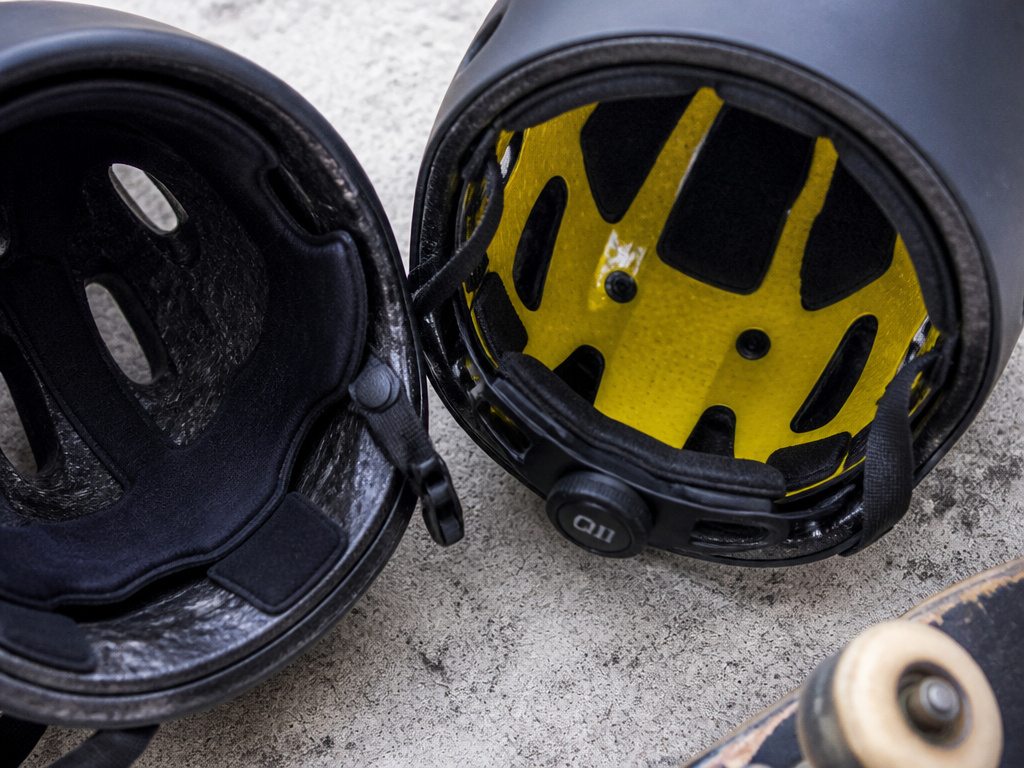
Walk into a shop and you’ll see helmets with MIPS liners, dial-fit systems, and exotic ventilation. Do you need them?
MIPS (Multi-directional Impact Protection System) is a low-friction liner inside the helmet designed to reduce rotational forces during an angled impact. No helmet can prevent concussions, as the CPSC bluntly states. However, for a technology that addresses a type of force common in oblique falls, it’s a sensible upgrade if your budget allows. Understanding MIPS technology can help you decide.
Fit adjustment systems (dial knobs, adjustable straps) are genuinely useful. They let you fine-tune snugness as your hair changes or as you add a beanie underneath. They are not a substitute for correct basic sizing.
What’s not worth the money? Novelty and toy helmets. The CPSC warns they offer little or no protection. Also avoid any helmet with nonessential protruding elements like horns or Mohawks, they can snag and prevent the smooth slide a helmet needs during a fall.
For most adult beginners, a certified helmet from reputable brands with basic padding is a common pick. They meet the standard, fit well, and don’t break the bank. If you want the latest safety tech, look for the best skateboard helmets with MIPS from brands that meet the standard.
When to Replace Your Skateboard Helmet

A helmet isn’t a lifetime purchase. The foam degrades, straps wear, and impacts add up invisibly. The CPSC gives clear signals.
Replace immediately if:
- The shell or liner is cracked, dented, or crushed.
- The shell is loose from the liner.
- Straps are frayed or buckles are broken.
- Any part is missing.
Replace after a timeline:
- After any severe impact, even without visible damage.
- Within 5–10 years of purchase if the manufacturer gives no guidance, as the CPSC suggests. Sunlight, sweat, and temperature extremes break down materials.
Easy to miss: Storage environment. The CDC warns against storing a helmet in a car. Heat and UV radiation degrade the foam and plastics faster than use. Store it indoors, out of direct sun.
Regularly checking your helmet for damage is part of gear maintenance. Knowing how often to replace a skateboard helmet can save you from guessing.
Frequently Asked Questions
Sources disagree on multi-use helmets: the CDC says a multi-use helmet must have an ASTM label certifying it for skateboarding, while the CPSC lists ASTM F1492 and Snell N-94 as applicable standards without mentioning a separate certification label. The safest path is to buy a helmet marketed and labeled specifically for skateboarding. Many multi-sport helmets are certified only for cycling (CPSC 1203). Using a bike-certified helmet for skateboarding means you lose the multi-impact design. Check the label inside.
How tight should a skateboard helmet feel?
It should feel snug without causing pressure points or headaches. The CDC notes a helmet that is too tight can cause headaches. Use the “big yawn” test and shake test. It should not move on your head but shouldn’t compress your skull.
Do I need a full-face helmet for skateboarding?
For most street and park skating, an open-face helmet is standard. A full-face helmet is designed for downhill longboarding or aggressive vert skating where face-first impacts are a higher risk. They’re heavier and hotter, so match the gear to your discipline.
Are expensive helmets safer than cheap ones?
Certified $50 helmet and a certified $150 helmet both meet the same ASTM F1492 minimum safety standard. The extra cost buys comfort features: lighter weight, better ventilation, MIPS, or premium fit systems. The safety floor is the certification.
Can I decorate my helmet with stickers?
The CDC advises against painting or applying stickers without checking with the manufacturer. Adhesives and paints can degrade the shell plastic, making it brittle. If you must decorate, use small stickers away from impact zones and avoid thick layers.
The Bottom Line
Choosing a skateboard helmet comes down to a certified label and a fit that passes the shake test. Ignore the marketing. Look inside for the ASTM F1492 sticker.
Then, wear it. Every session. The CPSC skateboarding safety fact sheet puts it plainly: wrist guards are especially important, and children under 8 need close supervision. Your helmet is the most important piece of that kit.
One rule most guides skip: if you ever feel silly wearing a helmet as an adult beginner, remember that looking awkward for five seconds beats being dizzy for five hours. I learned that the hard way. Now I check the fit every month.
