How to Dance on a Longboard: Step-by-Step for Beginners
This post contains affiliate links. As an Amazon Associate, we earn from qualifying purchases.
Longboard dancing involves stringing together multiple forms of footwork with rhythm to create a dance routine, distinct from freestyle’s isolated flip tricks. The foundation is even, rhythmic carving, and you start by mastering three core moves: the 180 Step, the Cross-Step, and the Pirouette, after being comfortable with basic cruising, pushing, and turning.
That distinction between dance and freestyle is where most beginners get tangled. Sources define it differently: Ghost Boards calls dancing a “routine” with the board planted, while the ILDFF frames it as a creative art combining steps, tricks, and carving. The difference isn’t just semantic, it changes what you practice first and how you judge your own progress. A common early question is how to dance on a longboard.
What follows is a path from zero to your first connected line, answering the core how to dance on a longboard question. This guide explains the exact gear specs that matter (and where the recommendations disagree), the three moves that build everything else, and the common mistakes that stall progress for weeks. By the end, you’ll know how to piece a routine together and where to go when you hit the first plateau.
Key Takeaways
- Longboard dancing is defined by flow and connected lines, while freestyle focuses on isolated flip tricks, knowing this difference shapes your entire practice.
- Your first board should be a symmetrical, top-mounted deck around 40-47 inches long; avoid drop-through setups as they limit footwork.
- Before attempting any dance steps, you must be comfortable cruising, pushing, and carving at a steady speed, momentum is your dance floor.
- Master the 180 Step, Cross-Step, and Pirouette in that order; they are the foundational vocabulary for every routine.
- The ILDFF rulebook states athletes must wear helmets “if applicable”, while Ghost Boards recommends treating a skate helmet and pads as essential safety gear.
What Longboard Dancing Actually Is (And Isn’t)
If you’ve watched a dancer flow down a path, it looks effortless. The board carves, their feet weave patterns, and the whole thing feels like a single, continuous motion, which is the essence of how to dance on a longboard. According to the International Longboard Dancing and Freestyle Federation (ILDFF), it’s “a creative art form combining elements of old school skating, longboard surfing, dancing steps, tricks, and carving.”
The Ghost Boards blog puts a finer point on it, stating longboard dancing involves “stringing together multiple forms of footwork with rhythm… To create an actual dance routine, while the board remains planted on the ground.” This is the core distinction from freestyle. Freestyle, as Ghost Boards and Fireball Supply Co. Note, involves doing isolated tricks that often require setups and may involve spinning or flipping the board itself.
Freestyle is focused on performing flip tricks, whereas Dance is more about the flow of the line. . Fireball Supply Co.
So if you’re imagining kickflips and board flips, that’s freestyle territory. Dancing is about the journey between the tricks, the steps you take on the deck itself, connected by the rhythmic carve of the board. The ILDFF calls this connected sequence a “dancing line.” Even their official rules allow for brief dismounts, noting that “even one or two steps off the board can be incorporated into a line while keeping the rhythm and flow alive.”
This means your focus shifts from landing a single trick to maintaining momentum and style through a series of maneuvers. It’s less about technical difficulty and more about variety, aesthetics, and control, the exact criteria the ILDFF uses for judging competitions.
The Right Board for Your First Dance Steps
You can technically dance on any longboard. But the wrong board makes it a fight against physics, and you’ll quit before the fun starts. The right one feels like an extension of your feet.
Sources disagree on the perfect beginner length. Ghost Boards recommends a board “at least 40″ long,” while Fireball Supply Co. Suggests “around 47”.” In practice, it depends on your height and comfort. A Reddit user who is 5’4″ noted, “there’s tricks I can’t do on my 45″ board that I can easily do on my [shorter board].”
More important than length is the shape and setup. Here’s what the consensus and the disagreements look like:
| Component | Consensus Recommendation | Where Sources Disagree / Key Detail |
|---|---|---|
| Deck Shape | Symmetrical (twin-tip) | Ghost Boards recommends a wide, symmetrical shape; Fireball specifies a top-mount with flex. |
| Deck Mount | Top-mounted | Fireball explicitly says to “avoid drop through longboards for this style.” Drop-throughs lower the board, which limits your leverage for deep carves and makes some footwork awkward. |
| Trucks | Reverse Kingpin (RKP) | Fireball recommends RKP trucks “if you are going to be mostly carving and turning.” They provide a smoother, more fluid turn than traditional kingpin trucks. |
| Wheels | Soft, large diameter | Fireball suggests “a softer 82a wheel around 60-65mm.” Softer wheels like the recommended 82a durometer absorb cracks and provide a buttery roll, crucial for maintaining flow. |
| Setup Path | Complete board for beginners | SkatePro and a Reddit user both recommend a complete board for beginners to avoid the overwhelm of a custom build. |
Common mistake: Choosing a board that’s too long and stiff. A Reddit user warned, “If it’s too long and heavy, you won’t be able to do tricks unless you have insane speed and insane strength.” A board with some flex absorbs your steps and makes the ride smoother.
For a named starting point, brands like Landyachtz and Loaded are consistently mentioned in the community. The Landyachtz Stratus and the Loaded Mata Hari are cited by Fireball Supply Co. As good examples of dedicated dancing decks due to their build quality and community involvement. A complete board from either of these brands removes the guesswork.
Before You Dance: The Non-Negotiable Prerequisites
You wouldn’t try to salsa before you could walk. The same logic applies here. The Ghost Boards blog is blunt: “Before learning to longboard dance, you need to be comfortable cruising, pushing, and carving.”
This isn’t a suggestion. It’s the foundation. Dancing requires you to manipulate the board with your feet while it’s in motion. If you’re still thinking about balance or how to stop, you have no mental bandwidth left for choreography.
Here’s your mandatory pre-dance checklist:
- Pushing: Can you generate and maintain speed comfortably with your push foot? Can you push switch (with your non-dominant foot)?
- Carving: Can you make smooth, linked S-turns by leaning your weight? Your dance moves will be timed to these carves.
- Stopping: Can you reliably slow down and stop using a foot brake or carve? Panic stops mid-routine are a guaranteed fall.
- Comfort Zone: Can you ride for 15-20 minutes without fatigue or fear? You need endurance to practice.
If you answered “no” to any of these, your next session is dedicated to that skill. Drilling these fundamentals for a week will save you a month of frustration later. Our guide to longboard basics covers this stage in detail.
The 3 Foundational Moves to Learn First
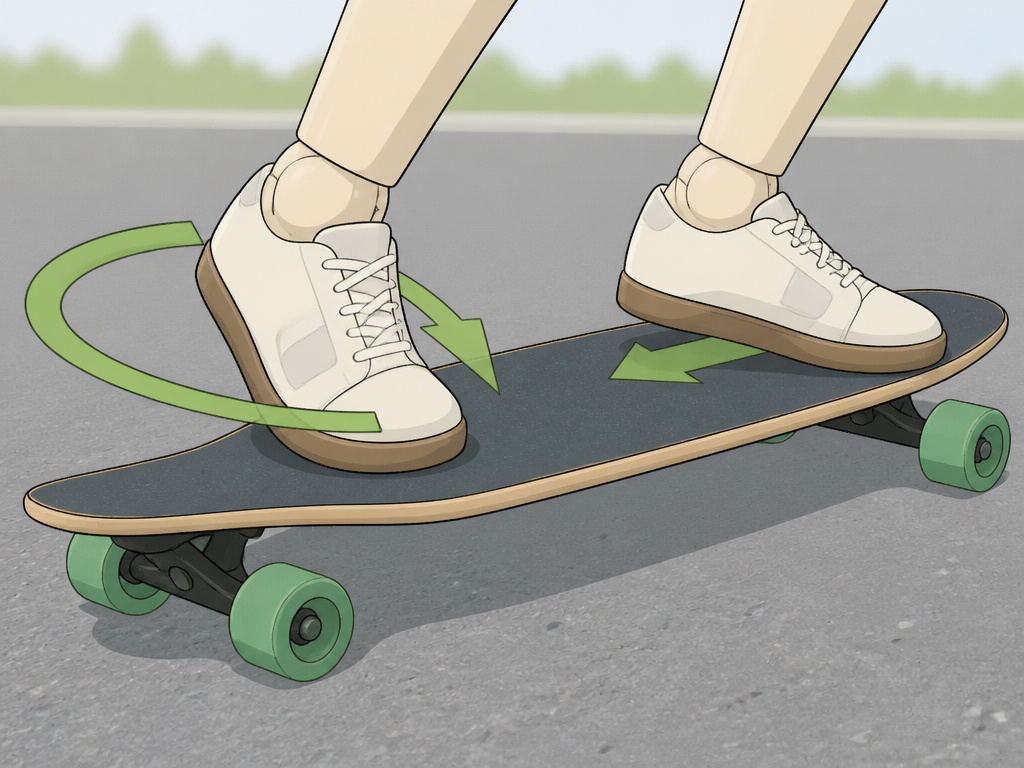
Once your fundamentals are solid, you start building vocabulary. Don’t try to learn everything at once. These three moves form the alphabet of longboard dancing. Learn them in this order.
1. The 180 Step
Ghost Boards calls this “the first move you should learn.” It’s a simple 180-degree pivot on the ball of your foot. Start with your feet in a comfortable cruising stance. Lift your front foot, pivot it 180 degrees so your toe points backward, and place it down. Then shift your weight and pivot your back foot to match. It feels awkward at first, but it teaches you to shift weight smoothly without losing balance or breaking your carve. The key is committing to the full rotation.
2. The Cross-Step
This is the quintessential longboard dance step. From a regular stance, step your back foot in front of your front foot, crossing over. Then step your (now) back foot out to the side to return to a regular stance, but you’ve now moved forward on the board. It looks elegant and is the primary way you travel up and down the length of your deck. Practice it going forward, then learn to cross-step backwards. Mastering the cross-step technique is a whole skill in itself.
3. The Pirouette (Peter Pan)
Fireball Supply Co. Lists the “peter pan” as a basic move. This is a one-foot spin. With most of your weight on your front foot, lift your back foot and use it to gently push off the deck, spinning your body 180 or 360 degrees before placing the foot back down. It feels terrifying until you realize the board’s momentum wants to keep going straight. Start with a half-turn (180) against a gentle carve.
Where this goes sideways: Practicing these static on grass or carpet. It doesn’t translate. You need the momentum of a rolling board to understand how the carve supports and guides each move. A motionless board will just tip over.
Practice each move individually until you can do it three times in a row without stumbling. Then start linking them: Carve right, 180 step, carve left, cross-step forward. That right there is the beginning of your first “line.”
From Single Moves to Your First Dancing Line
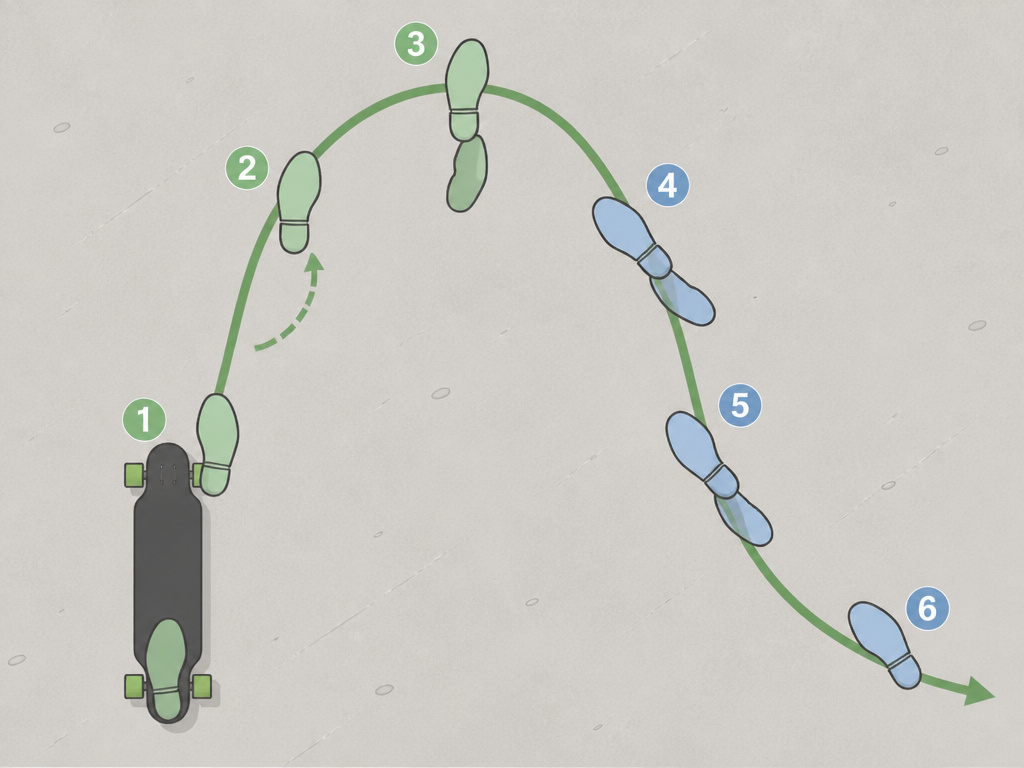
A collection of tricks isn’t a dance. The magic is in the connection. The ILDFF rulebook emphasizes that “connecting different elements fluently into each other while carving is called a (dancing) line.”
This is the “flow” everyone talks about. It’s not mystical. It’s mechanical. You use the momentum from one move to initiate the next. A rhythmic carve sets up the balance for a cross-step. The rebound from that step sets you up for a pirouette.
Start small. Your first line could be:
- Push to a comfortable, steady speed.
- Initiate a gentle toeside carve.
- Perform one 180 step in the middle of the carve.
- Come out of the carve, ride straight for a second.
- Initiate a heelside carve and perform two cross-steps.
- Ride away.
Did you maintain speed? Did you stumble between moves? Did the board feel like it was fighting you? If yes, your carves might not be committed enough, or your foot placement during the steps is killing your momentum.
This is also where safety becomes paramount. The ILDFF rulebook states athletes must wear helmets “if applicable, under their own responsibility.” When you’re learning and pushing your balance, “if applicable” means every single time. A skate helmet, knee pads, and wrist guards are the difference between a bruised ego and a broken wrist.
Common Beginner Mistakes and How to Fix Them
Everyone makes these errors. Recognizing them cuts weeks off your learning curve.
- Fighting the Carve: You try to dance on a perfectly straight line. The board wants to turn; you fight it and lose balance. Fix: Actively use carves. Time your steps with the turn. Let the board’s natural arc be part of the move.
- Looking Down at Your Feet: Your head is your primary balance tool. Look down, and you’ll drift off your line or wobble. Fix: Pick a point 20-30 feet ahead on your path. Practice your steps using your peripheral vision.
- Stiff Legs: Locked knees transmit every bump and make smooth weight shifts impossible. Fix: Keep a slight, athletic bend in your knees. Imagine you’re floating, not standing.
- Practicing Without Momentum: You try new steps from a near-standstill. Fix: Commit to a speed where you feel stable cruising. More speed often means more stability, not less.
- Skipping the Basics: You jump straight to complex lines before owning the 180 step. Fix: Revisit the prerequisite checklist. Can you do each foundational move on command, mid-carve? If not, go back.
The progression isn’t linear. Some days you’ll nail a new step, others you’ll regress. That’s normal. The goal is consistent, mindful practice. For a deeper dive on building advanced flow, our article on freeride techniques explores similar concepts of momentum and control.
Gear Maintenance for the Dancing Longboard
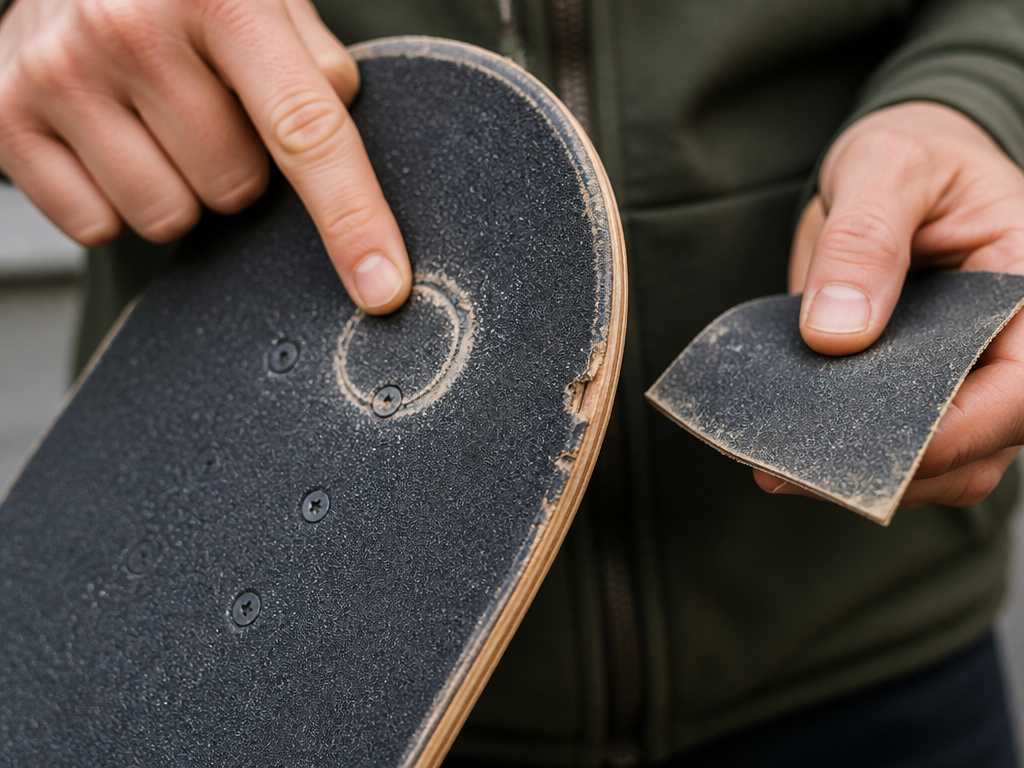
Dancing is hard on your gear. The repeated pivots and steps wear specific spots on your deck and wheels. Knowing what to watch for prevents surprises.
- Deck Wear: You’ll see circular scratches or “board burns” where you pivot on the ball of your foot, especially near the kicks. This is normal. Check for sharp splinters or delamination at the edges, which require sanding or repair.
- Wheel Wear: Dancing involves a lot of gentle slides and pivots, which can “cone” your wheels, wearing one side more than the other. Rotate your wheels periodically (swap front to back, flip them on the axle) to promote even wear.
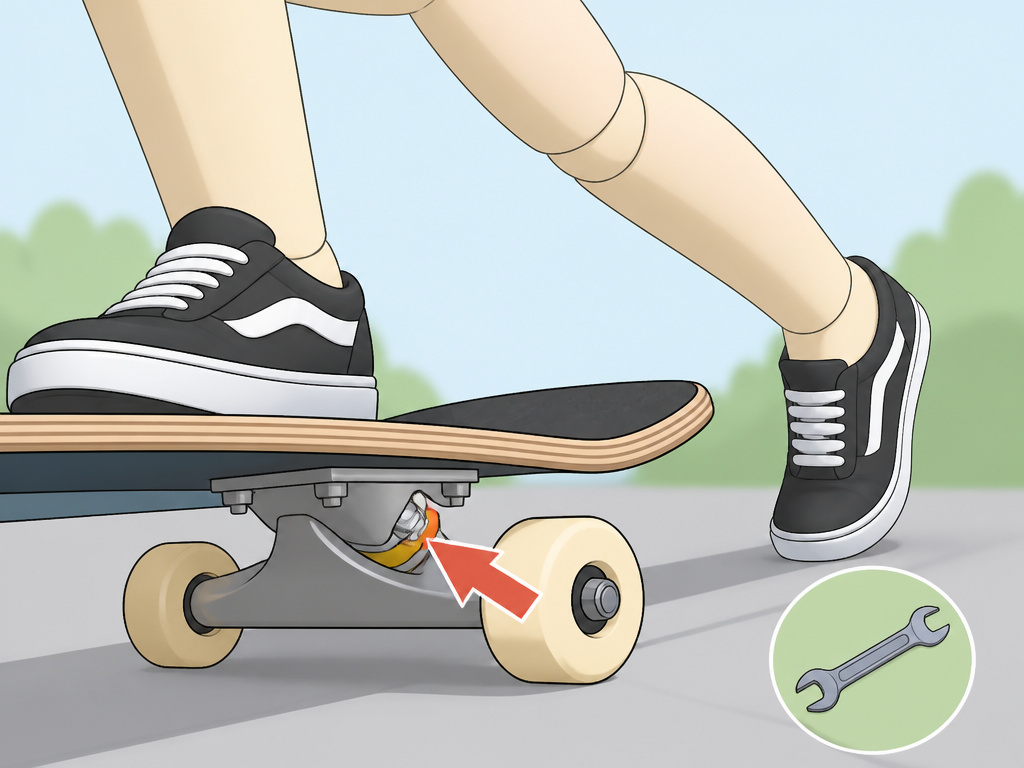
- Truck Bushings: The constant carving and weight shifts compress your bushings. Softer bushings give you the lean you need but wear faster. If your board starts feeling sloppy or doesn’t rebound from carves, it’s likely time for new bushings.
- Grip Tape: A Reddit user asked, “is it possible to dance on a longboard with a grip tape?” Absolutely. In fact, you need the grip. But dancing will wear it down faster in your step zones. Consider carrying a small grip tape cleaner or be ready to replace sections as they smooth out.
A well-maintained board is a predictable board. And predictability is the bedrock of confidence when you’re trying new steps at speed.
Frequently Asked Questions
What is the best longboard for dancing?
For beginners, a complete, symmetrical dancer longboard from a brand like Landyachtz or Loaded is best. Look for a top-mounted deck between 40-47 inches with some flex. The Landyachtz Stratus and Loaded Mata Hari are often recommended starting points. This guide to choosing a longboard breaks down the decision further.
What’s the difference between longboard dancing and freestyle?
Longboard dancing focuses on flow, connected footwork, and routines performed while the board stays planted. Freestyle focuses on isolated flip tricks, board spins, and technical maneuvers, often involving the board leaving the ground. Dancing is about the line; freestyle is about the trick.
How do I start learning to longboard dance?
First, master basic longboard riding: pushing, carving, and stopping. Then, on a symmetrical dancer board at least 40″ long, learn the three foundational moves in order: 180 Step, Cross-Step, and Pirouette. Practice each with momentum, then link two together to create your first simple line.
Do I need special shoes?
Any flat-soled skate shoe works. Brands like Vans or Emerica provide the board feel and grip you need. Avoid shoes with deep treads or thick, soft soles, as they can catch on the grip tape and reduce your sensitivity to the deck.
Before You Go
One rule most guides skip: if you haven’t touched your board in two weeks, don’t jump back in trying to nail the move you were struggling with. Your muscle memory has faded. Spend the first ten minutes of your session re-drilling the prerequisites, pushing, carving, and the most basic step you own. Recalibrate your balance and board feel. Those ten minutes of humility prevent ninety minutes of frustration and falls.
Everything above assumes you have a viable board and a body that’s ready to learn. If your setup is working against you, a dead, cheap complete with seized bearings and rock-hard wheels, no amount of practice will get you there. Investing in a symmetrical dancer board at least 40″ long isn’t about gear obsession; it’s about removing the biggest physical barrier between you and the flow. Start there, then take the small steps.
