
How to Skateboard at Night: Safety, Gear, and the Law
This post contains affiliate links. As an Amazon Associate, we earn from qualifying purchases.
To skateboard at night legally and safely, you need a white front light visible from 500 feet, a red rear reflector or light visible from 600 feet, reflective clothing, a certified helmet, and a clear understanding of your local ordinances, which may ban skating entirely in certain zones or after specific times. The U.S. Consumer Product Safety Commission and manufacturers like Evolve advise against night riding due to drastically reduced visibility and increased risk, while Portland City Code allows it with specific lighting.
That 500-foot front visibility rule is the legal minimum in cities like Portland, established to ensure drivers can see you from a safe distance. If your light doesn’t hit that mark, a driver literally cannot see you until it’s too late to stop. This is a crucial part of how to skateboard at night.
What follows is a breakdown of the essential gear, the specific laws you’re agreeing to follow by rolling after dark, and the adjustments to your riding that turn a risky idea into a managed activity, which is the essence of how to skateboard at night. This includes the exact lighting specs, the gear that actually works, and how to scout a route that keeps you out of trouble with both traffic and the law.
Key Takeaways
- Portland’s code mandates a 500-foot white front light and a 600-foot red rear reflector for legal night skating; skipping this risks a $115 minimum fine.
- Manufacturers like Evolve warn against night riding due to high speed and decreased reaction time; the Evolve Hadean hits 31 mph.
- Reflective clothing is a supplement, not a replacement, for active lighting, it only works when a car’s headlights are already on you.
- Scout your route in daylight first to memorize pavement cracks, slopes, and any all-times prohibited zones like downtown Portland sidewalks.
- Helmets are essential, and for riders under 16, they’re legally required in Portland with a $25 maximum fine for non-compliance.
The Legal Requirements: Lights and Reflectors
Forget “bright enough.” The law deals in measurable distances. According to Portland City Code 16.70.410, if you’re on a skateboard between sunset and sunrise or in limited visibility, you need two specific things: a white light on the front visible from at least 500 feet, and a red reflector or light on the rear visible from all distances up to 600 feet when hit by a car’s low beams.
The Portland skateboard ordinance is precise: during limited visibility conditions, a skateboard must show a white light visible from 500 feet to the front and have a red reflector or lighting device visible up to 600 feet to the rear. This aligns the skateboard with bicycle lighting standards for roadway visibility.
This is about matching the sightlines of automotive traffic, a fundamental part of how to skateboard at night. A driver needs significant distance to stop, and your 500-foot light provides a crucial margin. Your 500-foot light gives them over four times that margin. A simple LED bike light strapped to your front truck often meets the spec, but you must check its advertised beam distance. A red reflector sticker on the rear of your deck is a passive start, but a dedicated red LED tail light is better and removes any doubt.
The penalty for ignoring these rules is a minimum $115 fine. More importantly, you’re gambling with the one variable you can control: being seen.
Where the Law Says “Don’t Skate at All”
Lights won’t save you here. The same Portland code has absolute bans. You cannot skateboard at any time on sidewalks within the downtown core bounded by SW Jefferson, Naito Parkway, NW Hoyt, and 13th Avenue. The same goes for SW 5th or 6th Avenue between SW Lincoln and Burnside, and NW 5th or 6th Avenue between Burnside and Union Station.
Other areas, like listed streets in Washington Park and West Burnside Street from Skyline Boulevard to SW Vista Avenue, have a curfew: no skating between 10:00 p.m. And 7:00 a.m., lights or no lights. If your planned route through street spots cuts through these zones, you need a different path.
Gear Up for Visibility
Lights satisfy the law; everything else keeps you alive. Reflective clothing only works when a light source hits it. That means a car’s headlights must already be on you. An active light, like a headlamp or wheel-gap lights, makes you the source of illumination. This is the core principle behind any serious setup for skateboard lights.
What to wear and why it matters:
- Helmet with a mounted light: A headlamp lights where you look. It’s crucial for spotting pavement cracks and debris ahead. The U.S. Consumer Product Safety Commission states a skateboarding-specific helmet (hard shell with foam interior) should fit snugly with the chin strap fastened.
- Reflective vest or ankle bands: This is the “wear reflective clothing at night” advice from the Evolve manual. It turns you into a large, moving silhouette in headlights.
- Wrist guards: The CPSC calls these “especially important.” A night fall onto unseen rough asphalt is a guaranteed palm scrape at best, a broken wrist at worst.
- Sticky, grippy shoes: Visibility helps you see hazards; shoe grip helps you survive them when you need to bail or slide a foot to stop.
The sensory reality is simple: at night, your ears work overtime. You’ll hear the grit under your wheels long before you see it. The sound changes from a smooth hum to a sandy shhhh, that’s your cue to slow down and scan.
Adjust Your Riding Technique
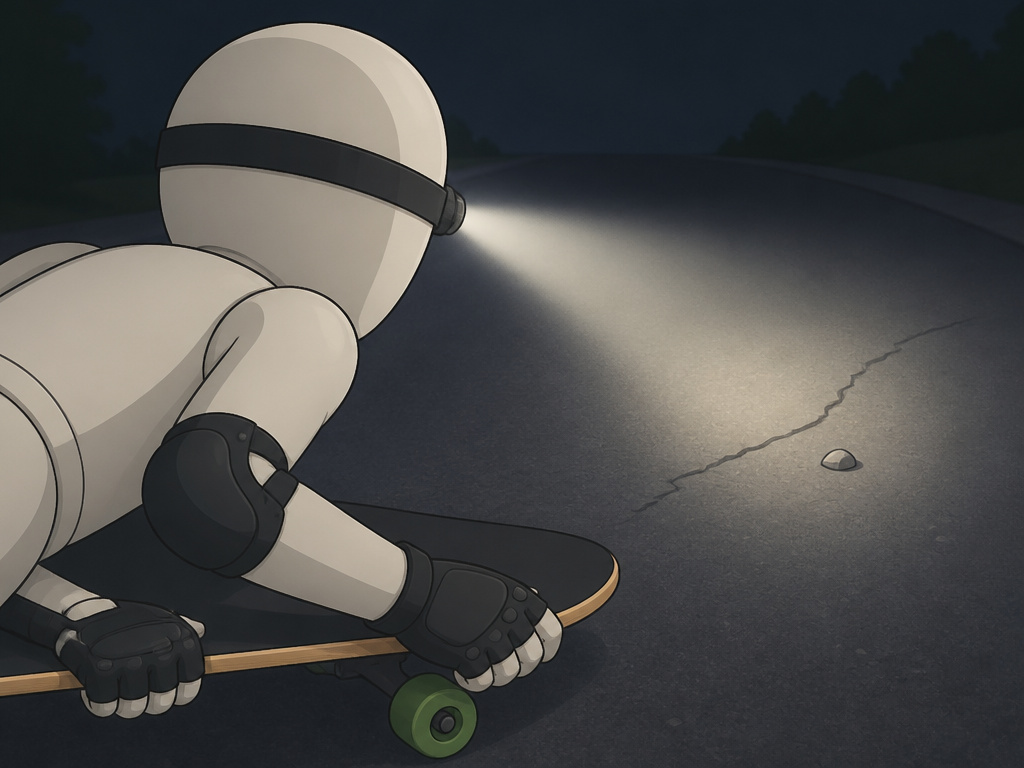
Night skating isn’t day skating with lights. Your perception of speed, distance, and texture is off. The ground is a uniform dark grey, hiding seams, pebbles, and cracks. You must ride defensively, as if every shadow contains a potential board-stopper.
Brake sooner and look farther ahead. The Evolve Hadean manual explicitly warns, “Look ahead and brake sooner. You may be moving faster and your electric skateboard is heavier.” This applies to any board. Your reaction time is slower because your brain processes less visual information. If you normally brake a certain distance from an intersection, give yourself significantly more distance at night.
Stick to known, smooth routes. This is where planning your skateboarding session pays off. Use daylight to scout your intended night path. Memorize the location of manhole covers, the texture changes from asphalt to concrete, and the pitch of any hills. A route perfect for a skateboard commute by day can be treacherous at night if it includes a steep hill with poor sightlines.
Reduce your speed and avoid tricks. This isn’t the time for practicing ollies or kickflips. Your focus should be 100% on navigation and stability. Ride in a lower, more stable stance, and keep your weight centered. If you hit an unseen bump, being balanced gives you the best chance of riding it out or bailing safely, using safe falling techniques you’ve practiced.
Where this goes sideways: Assuming your daytime route is safe at night. A smooth hill you love carving down by day can become a black funnel with invisible drainage grates at the bottom after sunset. Scout it first.
Electric Skateboards: Special Night Risks
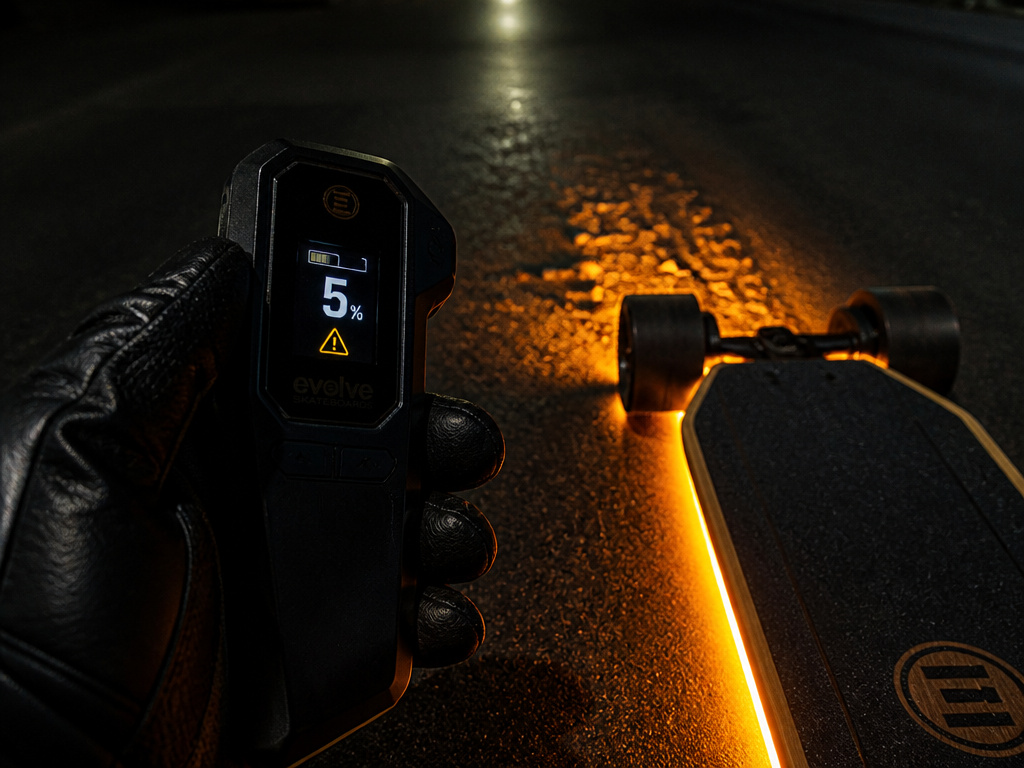
Electric skateboards amplify every night-skating hazard. The Evolve Hadean and PHZ models have a maximum speed of 31 mph (50 kph). At that speed, even with perfect lights, your stopping distance is dramatically longer, and a small patch of unseen sand can be catastrophic.
Manufacturer manuals are unambiguous. Evolve’s Hadean manual states, “Avoid riding at night due to decreased visibility.” The CPSC’s broader skateboarding safety fact sheet advises avoiding riding at dusk and dawn or in other low-light conditions. This isn’t a conspiracy; it’s a liability calculation based on physics. The board is heavier, the motors can overheat on hills, and the remote control requires visual attention you don’t have to spare.
Critical electric board specifics for any night ride:
- Battery warnings are your lifeline. On an Evolve board, at 10% battery the remote vibrates once and board lights go amber. At 5%, it vibrates every 5 seconds, forces SPORT mode, and the lights pulse amber. Running out of power in the dark is more than an inconvenience.
- Mode sensitivity is a real threat. SPORT and CORSA modes are “very powerful and the remote acceleration and brakes are highly sensitive,” per the manual. A twitchy thumb in the dark can throw you.
- Hill braking can fail. The manual warns that heavy braking on steep hills can overheat the motors, causing you to lose braking assistance, a terrifying prospect on a dark decline.
If you must ride an electric board at night, treat it like piloting a slow, silent motorcycle. Your route planning must account for battery range with a large safety margin, and you must be hyper-vigilant when skateboarding in traffic.
Finding Safe Locations and Riding with Others
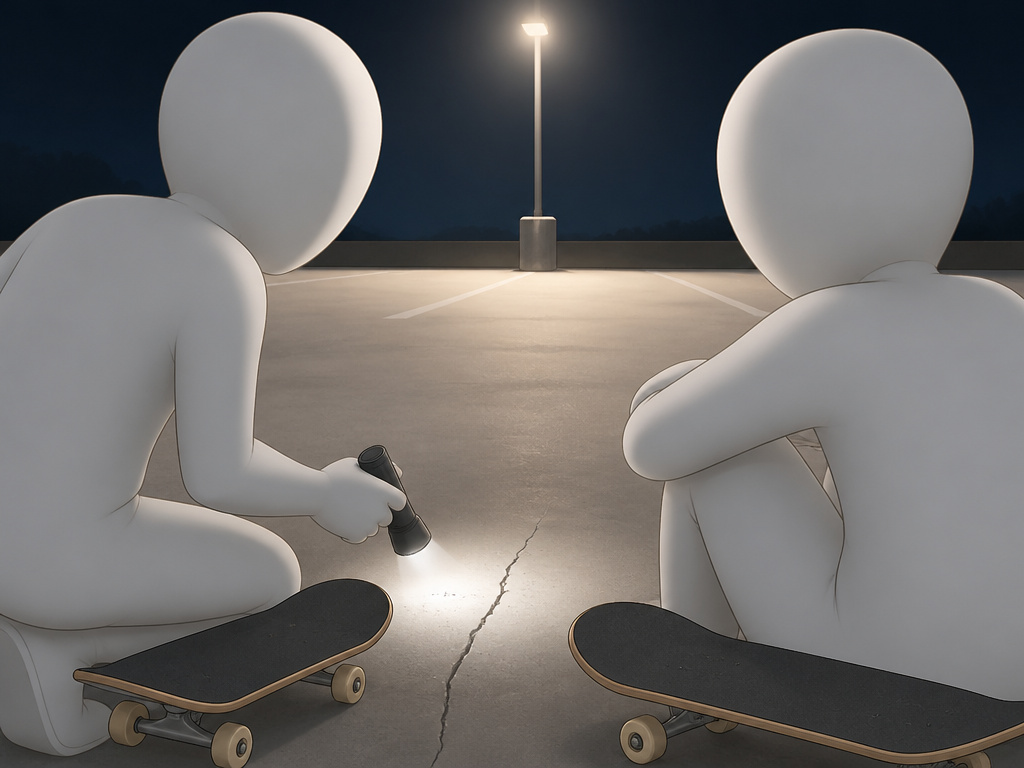
The “empty spots” benefit of night skating is real, but an empty, poorly lit industrial park can be more dangerous than a busy street. You need light to see the surface, and you need a surface smooth enough to not need constant light. It’s a paradox.
Good night spots share three traits: They have consistent, even artificial light (street lamps), they have smooth, known pavement (tennis courts, new parking lots), and they are isolated from moving vehicle traffic. A school parking lot after hours might work; a winding, unlit bike path does not.
Never ride alone at night. The CPSC fact sheet is direct: “Never ride alone. Accidents happen. Ride with friends and bring a phone.” A friend can spot hazards you miss, help if you crash, and deter unwanted attention. Your night skateboarding session is a group activity, not a solo mission.
If you’re exploring new street spots after dark, the rule is simple: if you wouldn’t feel safe walking there alone, don’t skate there. The board doesn’t make you faster than a threat, and a fall makes you vulnerable.
The Headgear Law and Penalties

For skaters under 16, the law is even stricter. Portland City Code 16.70.410 requires all persons under 16 to wear protective headgear when skateboarding on any street, sidewalk, or bridge. The penalty for failure is a maximum $25 fine.
This law exists to protect young skaters from head injuries. A helmet is the single most effective piece of protective gear. The CPSC stresses it should be designed for skateboarding, a hard shell with a foam interior, and fit snugly with the chin strap fastened. A loose helmet is as good as no helmet in a crash.
For adults, it’s not a legal requirement, but it’s the first thing any emergency room doctor will ask if you show up with a head injury. The argument that “it looks uncool” holds zero weight against the permanent reality of a traumatic brain injury.
| Rule | Who It Applies To | Penalty | Source |
|---|---|---|---|
| White front light (500 ft visibility) | All skaters at night | $115 minimum fine | Portland City Code 16.70.410 |
| Red rear reflector/light (600 ft visibility) | All skaters at night | $115 minimum fine | Portland City Code 16.70.410 |
| Protective headgear | Skaters under 16 years old | $25 maximum fine | Portland City Code 16.70.410 |
| No skating in designated zones (e.g., downtown sidewalks) | All skaters, at all times | $115 minimum fine | Portland City Code 16.70.410 |
Frequently Asked Questions
Is it legal to skateboard at night?
It depends entirely on your local municipal code. In Portland, it is legal if you equip your board with a white front light visible from 500 feet and a red rear reflector or light visible from 600 feet. However, many cities lack specific skateboard lighting laws, falling back on bicycle or pedestrian codes, and some may prohibit it outright. Always check your city code on skateboarding first.
What are the best lights for night skateboarding?
Look for LED bike lights that advertise a beam distance of at least 500 feet for the front (white) and a flashing or steady red tail light rated for 600 feet. Brands like Cygolite, Planet Bike, or even a powerful headlamp (Petzl, Black Diamond) work. The key is a secure mounting system that won’t shake loose from board vibrations. Our guide on choosing lights for night riding covers specific models and mounting solutions.
Can I use my phone’s flashlight?
No. A phone flashlight is designed for illuminating objects within 10-20 feet, not for making you visible to traffic from 500 feet away. It’s also a terrible idea to hold your phone while skating, as the Evolve manual explicitly says, “Never use headphones or a mobile phone to talk or text when riding.”
Why do electric skateboard manuals warn against night riding?
Electric skateboards are heavier and faster than traditional boards. The risks associated with low visibility, unseen obstacles, reduced reaction time, difficulty judging speed, are magnified at 20-30 mph. Manufacturers like Evolve issue these warnings to limit liability, but the physics behind them is sound.
How do I handle rough pavement at night?
You don’t, you avoid it. If your route for skateboarding on rough roads is challenging in daylight, it’s a no-go at night. The uniform darkness masks potholes, cracks, and texture changes that can catch a wheel. If you encounter an unexpected rough patch, slow down immediately, keep your weight back, and prepare to step off if the board stops abruptly.
The Bottom Line
Skateboarding at night is a regulated activity, not a forbidden one. The formula is clear: legal lighting first, defensive gear second, and hyper-cautious riding third. Your margin for error shrinks to almost nothing after dark.
The one action to take this week is to look up your local municipal code on skateboards or bicycles. Find the specific lighting and reflector requirements. If they don’t exist, the safe assumption is that the Portland standard, 500 feet front, 600 feet rear, is the bare minimum for being seen in traffic.
Then, with the right lights mounted and a helmet on, try a short, familiar loop in a well-lit parking lot. Feel how different the world looks at 10 mph when your eyes can’t see the cracks. That feeling, not the law, is the final and best guide.
