
How to Skateboard Responsibly in Traffic: Rules and Safety
This post contains affiliate links. As an Amazon Associate, we earn from qualifying purchases.
To skateboard responsibly in traffic, treat every car as a potential threat, wear a certified helmet and wrist guards, know your local laws, and never assume a driver sees you. Ride defensively, plan your route to avoid high-speed roads, and communicate your intentions clearly.
This isn’t just about following rules; it’s about a mindset shift. On a board, you’re unprotected and often unexpected. The difference between a close call and a collision comes down to your awareness and predictability. Learning how to skateboard responsibly in traffic is a key part of this.
What follows is a breakdown of the essential safety rules, the gear that actually works, and the legal gray areas you need to navigate when learning how to skateboard responsibly in traffic. This includes how to read traffic, where you’re legally allowed to be, and what to do when things go wrong.
Key Takeaways
- Treat every driver as blind, assume they do not see you and never will.
- A snug, certified helmet is essential; the CPSC notes a loose helmet can come off on impact.
- Wrist guards are especially important, according to federal safety guides.
- Local laws trump state rules; a sidewalk legal in one town can be illegal in the next.
- If you must ride on a road, positioning is everything, and the law disagrees on which side to use.
The #1 Rule: You Are Invisible

Assume every car door is about to open, every driver is distracted, and no one expects a skateboarder. This is the baseline, not paranoia.
The New York DMV driver’s manual explicitly tells drivers to look before getting out of your parked vehicle; avoid opening your door into the path of an oncoming bicyclist. Drivers are taught to look for bikes, not skateboards. You are an anomaly.
Common mistake: Assuming a driver sees you because you made eye contact. They might be looking through you, at their phone, or at the traffic behind you. Trust your position, not their glance.
Your entire strategy for how to skateboard responsibly in traffic should be built on this. It changes how you approach intersections, parked cars, and merging traffic. You move predictably, signal early, and always have an escape route.
Gear Up: Your Minimum Legal & Physical Shield
The U.S. Consumer Product Safety Commission is blunt: wearing a helmet can mean the difference between life and death. This conclusion comes from analyzing collisions, not marketing.
The CPSC’s Skateboarding Safety fact sheet specifies the details most riders miss: the helmet must fit snugly with the chin strap fastened because it can come off upon impact if it’s too loose. It should sit level on your head, not tilted back.
Wrist guards are especially important. The CPSC singles them out. When you fall, and you will, your instinct is to put your hands out. Wrist guards channel that impact away from the small bones in your wrist, which are a nightmare to heal.
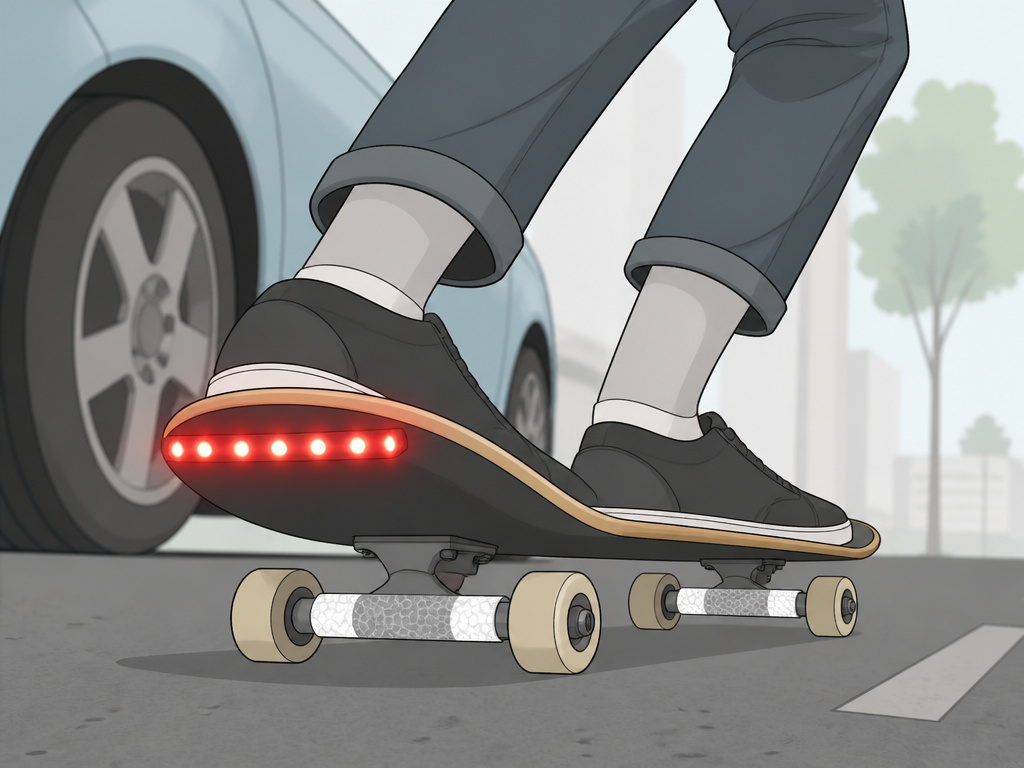
For visibility, add reflective tape to your helmet and board. A small LED blinky light on your backpack isn’t for “looking cool.” It’s for being seen at dusk, which the CPSC says you should avoid altogether.
| Gear | Why It’s Non-Negotiable | The Fit That Actually Works |
|---|---|---|
| Helmet | Prevents fatal head trauma. Loose helmets fail. | Snug all around, level on head, chin strap fastened. |
| Wrist Guards | Most common impact point; prevents fractures. | Straps secure but not cutting circulation; plastic splint aligns with forearm. |
| Knee/Elbow Pads | Prevents road rash and joint damage on slides. | Cup the joint snugly without slipping when you bend. |
| Reflective/Lights | Makes you visible in low light. Drivers can’t avoid what they don’t see. | Reflective tape on moving parts (ankles, wheels); a solid or blinking white light in front, red in back. |
Where to Ride and Where Not To

This is where theory meets pavement, and the law gets fuzzy. You have three basic options: sidewalk, bike lane, and road. Each has its own rulebook.
Sidewalks are the default for beginners. Your speed must match a walking pace. The real danger is driveways and intersections where cars pull in or out without looking for anything faster than a walker.
Bike lanes seem ideal, but they’re designed for bicycles moving in a straight line at higher speeds. As a skateboarder, your skateboarding in bike lanes requires extra caution. You are a guest. Stay to the right, signal before any turn, and be hyper-aware of cars crossing the lane to turn or park. The New York DMV notes these are dedicated spaces for cyclists, and drivers are prohibited from operating in them, but that doesn’t stop them from drifting over.
If you have no sidewalk or bike lane, the law on where to position yourself is not universal.
Where sources disagree: The California Highway Patrol states that if there are no sidewalks, you should “use the extreme left-hand edge of the road, facing oncoming traffic.” Meanwhile, New York’s traffic safety advice for bicyclists is to “drive with traffic, not against it.” This is a direct conflict. When in doubt, check your local ordinances.
Places to Never Skate:
- High-speed roads: Avoid roads with high-speed traffic.
- Bridges & Overpasses: Sources disagree on legality. The California Highway Patrol advises not to ride on a bridge or highway overcrossing unless there is a sidewalk and a permission sign, noting many cities forbid it. Other sources, like the New York DMV, do not specify such a prohibition.
- Parking Lots: They look empty, but cars back up without warning, and drivers look for other cars, not skaters.
Reading Traffic and Riding Defensively

Skating in traffic is a dynamic puzzle. You’re not just riding; you’re predicting. The NY DMV driver’s manual warns drivers that a bicyclist “can react to road hazards… With sudden changes of speed, direction, or lane position.” As a skateboarder, you have even less stability. Your goal is to be so predictable that drivers can anticipate you.
Scan ahead, not down. Your eyes should be scanning well ahead, reading the pavement for cracks, drain grates, and the dreaded pebbles. You need to see that pebble or crack early enough to step, hop, or steer around it. This is where practicing on rough roads pays off.
The Escape Route. Always know where you’ll go if a car drifts close, a door opens, or you hit debris. The shoulder, a driveway, even a controlled fall onto grass is better than a collision. This is an active, constant assessment: “If that white car swerves, I’m jumping onto the curb there.”
Intersections are kill zones. The NY DMV tells drivers to “stop completely and look left-right-left and behind before turning right on red.” Assume they won’t. As you approach, make eye contact if possible, slow down, and be prepared to stop or carve away. Your line of travel should never be a mystery. Signal your intent early.
Communication: How to Signal and Be Seen
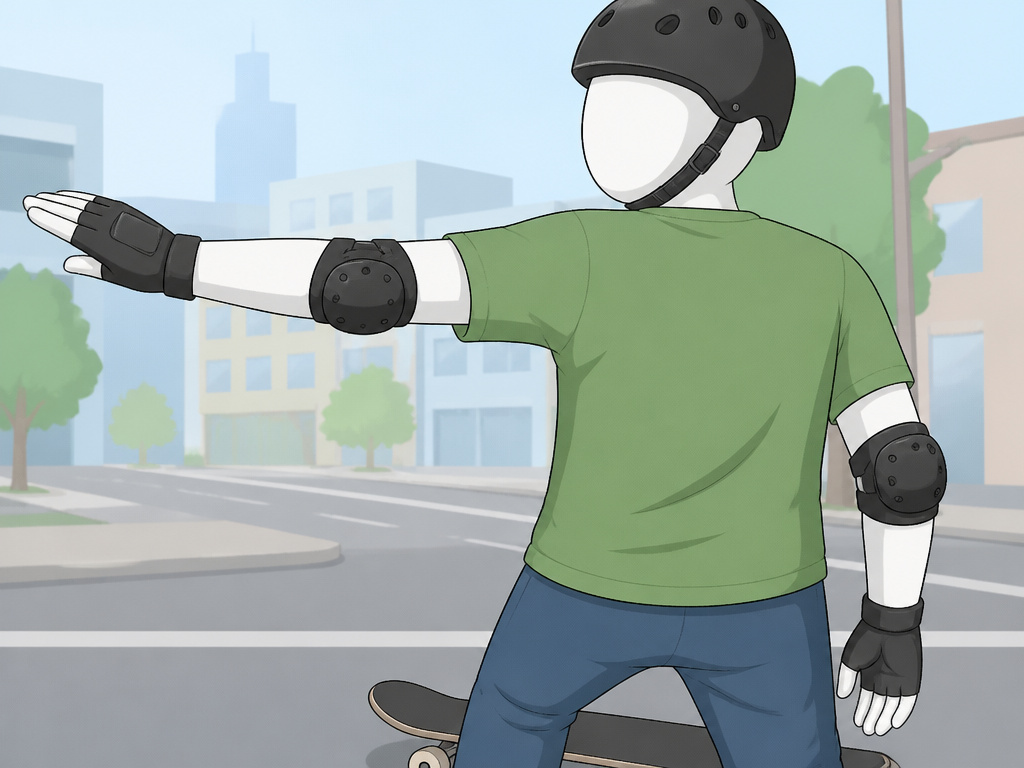
You have no blinkers, no horn. Your tools are your arms and your positioning. The hand signals used by cyclists are your best bet for being predictable.
- Left Turn: Extend your left arm straight out to the side.
- Right Turn: Extend your right arm straight out, or (less commonly) lift your left arm up at a 90-degree angle.
- Slowing/Stopping: Extend your left arm down at a 45-degree angle, palm facing back.
Use these signals early, hold them for a couple of seconds, and then execute your move. Clear, simple communication prevents most conflicts.
For drivers, your position on the road is a signal. Riding in a straight line in the bike lane signals you’re continuing straight. Moving to the left side of the lane and pointing indicates a left turn. Don’t make sudden, unsignaled moves.
Speed and Control: Avoiding the Wobble
Speed wobble happens when a skateboard “begins to shimmy from side to side unexpectedly.” It feels like the board is trying to buck you off. Within seconds, it can throw you to the ground.
It happens when speed amplifies tiny imbalances in your trucks, wheels, or weight distribution. To reduce the risk:
- Crouch low. Lower your center of gravity.
- Focus weight on your front foot. This stabilizes the steering.
- Keep trucks, wheels, nuts, and mounting screws tightened properly. Loose parts magnify wobble.
- Don’t panic and jump. If it starts, gradually carve to slow down, or step off smoothly if you have space.
The faster you go, the less room for error. The CPSC’s advice is simple: Don’t ride faster than you can handle. You can lose control at any speed.
What to Do When It Goes Wrong
Despite all precautions, accidents happen. The CPSC advises to never ride alone and to bring a phone. Here’s the sequence if you’re in a collision or near-miss:
- Get to Safety. If you’re in the road, move yourself and your board to the sidewalk or shoulder immediately.
- Check Yourself. Adrenaline hides pain. Do a quick systems check: can you move everything? Is there serious bleeding?
- Call for Help. If anyone is injured, call 911. For property damage or a hit-and-run, call the police to file a report. This creates a legal record.
- Exchange Information. Just like a car accident, get the driver’s name, phone number, license plate, and insurance info. Take photos of the scene, their car, your board, and any injuries.
- Seek Medical Attention. Even if you feel “fine,” see a doctor. Some injuries, like concussions or soft tissue damage, show up later.
Having a plan removes the panic. It turns a chaotic moment into a series of steps.
How to get over the fear of skating near cars
Fear is a rational response when mixing with traffic. Start by building confidence away from cars. Practice your basic riding, stopping, and turning until they are second nature. Inspect your board before you ride, checking for any loose parts. Ride with friends and bring a phone for support. Choose quieter streets initially and ride during the day when visibility is best. Keep your eyes wide open at intersections and check behind you regularly. If you ever feel uncomfortable, you can always just walk a bit and continue. The goal is to build your skills and awareness gradually so you can predict hazards and react calmly.
Frequently Asked Questions
Is it illegal to skateboard on the road?
It depends entirely on your city and state laws. Many municipalities have no specific law against it, but you are typically bound by the same rules as bicycles. However, local ordinances can override this. Always check your city’s municipal code. Our guide on skateboarding laws dives deeper into this.
What’s the safest time of day to skate in traffic?
Daylight hours are safest. The CPSC explicitly says to avoid riding at dusk, dawn, or in low-light conditions “where you cannot see or be seen easily by vehicles.” If you must ride at night, you are invisible without lights and reflective gear. Our guide on skateboarding at night covers the essential gear.
Should I skate with or against traffic?
This is the biggest legal disagreement. California law says to ride facing traffic on the left edge if no sidewalk exists. Most other traffic safety principles (like those for bikes) say to ride with traffic. The only universal answer is: know your local law. When in doubt, check your local law, as sources disagree on whether to ride facing traffic or with traffic.
How do I deal with aggressive drivers?
Do not engage. Your goal is to de-escalate and get away safely. Make eye contact if you can (to confirm they see you), give a neutral wave or nod, and create space. If someone is truly threatening, dismount, get to a sidewalk, and if necessary, call the police. Your board is not a tool for confrontation.
Before You Go
Responsible skating in traffic is a habit you rebuild every time you step on your board. It starts with the absolute acceptance that the rules of the road were not written for you, and the responsibility for safety lands squarely on your shoulders.
Commit to the gear. Commit to the scan-ahead, escape-route mentality. Most of all, commit to knowing the rules that apply where you actually skate. The local ordinances in your town are the final word, not a generic online guide.
Your first move before skating a new route shouldn’t be pushing off. It should be a five-minute search of your city’s website for “skateboard” or “skating” in the municipal code. That’s the single most responsible thing you can do. Everything else, the helmet, the signals, the defensive riding, flows from that foundation.
