
Sealed vs Open Skateboard Bearings: Which Should You Buy?
This post contains affiliate links. As an Amazon Associate, we earn from qualifying purchases.
Sealed skateboard bearings have a physical shield (rubber or metal) that protects the internal components from dirt and moisture, while open skateboard bearings lack this shield, exposing the balls and races for easier cleaning and lubrication. Transworld Skateboarding recommends sealed bearings for outdoor skating due to lower maintenance and better contamination resistance, while Jenkem Magazine notes open bearings allow optimal lubrication customization in clean environments. The International Slalom Skaters Association prefers open bearings for slalom racing, while Transworld Skateboarding states sealed bearings are superior for park skating.
That shield, or the lack of one, changes everything about how you maintain your board and how it feels under your feet. The choice between sealed vs open skateboard bearings is a commitment to a specific type of skating lifestyle.
What follows is a breakdown of the mechanics behind each type, the real-world maintenance they demand, and clear recommendations based on where and how you skate. By the end, you’ll know exactly which bearing belongs on your board and why the marketing hype around precision ratings often misses the point.
Key Takeaways
- The physical shield on a sealed bearing blocks grit and water, making it the default for street and outdoor skating.
- Open bearings require regular cleaning and re-lubrication but let you fine-tune speed with specific oils or greases.
- The ABEC rating is a tolerance standard for precision machining; for skateboarding, higher ABEC ratings offer negligible real-world benefit for most skaters.
- For a reliable, low-maintenance start, pick a sealed bearing like Bones Reds. Only switch to open bearings if you skate in clean environments and enjoy gear maintenance.
- All bearings, even “maintenance-free” sealed ones, eventually need service when performance drops or noise increases.
The Core Physical Difference: Shields
Look at the business end of a bearing. A sealed bearing has a thin, colored rubber or metal ring pressed into the outer race. An open bearing looks like a metal ring with tiny metal balls visible inside a cage. That visible ring is the shield.
Technical Snippet: A standard skateboard bearing is a 608-series bearing: 8mm inner diameter, 22mm outer diameter, 7mm width, as defined by ISO 15:1998. Sealed versions incorporate a shield (often non-contact removable rubber) pressed into a groove on the outer race. Open bearings omit this shield, exposing the ball retainer and raceways for direct access.
This isn’t just cosmetic. The shield is a physical barrier. For a sealed bearing like the Bones Reds, that shield is a non-contact removable rubber component. It sits close to the inner race but doesn’t touch, minimizing friction while still deflecting most street grime, sand, and water spray. An open bearing has nothing between the outside world and its precision-ground steel balls and races. A grain of sand that lands on an open bearing can get pressed between a ball and the race, creating a permanent dent you’ll feel as a gritty spot in the rotation.
The consequence is direct: a sealed bearing will spin quietly through puddles and dusty lots for weeks. An open bearing in the same spot will start to sound like a pepper grinder within a few sessions, its lubricant fouled by contaminants. Your choice here dictates your cleaning schedule.
How Performance and Feel Actually Differ
The myth is that open bearings are inherently faster. The difference mainly involves friction consistency. A brand-new, perfectly lubricated open bearing has marginally less internal drag than a sealed one, the shield creates a tiny bit of air resistance. But that advantage vanishes the moment real-world dust enters the equation.
Sealed bearings trade that theoretical top-speed ceiling for consistency. The factory-applied lubricant, like the Speed Cream in Bones Reds, is protected and stays cleaner longer. Your board feels the same on Monday as it did on Friday. Open bearings can feel lightning-fast after a fresh clean and a drop of thin oil, but that performance degrades faster as the oil attracts dust or dries out.
Where this goes sideways: Assuming a higher ABEC-rated bearing is automatically faster for skateboarding. The Bearing Specialists Association notes the ABEC scale is a formal ANSI/AFBMA standard (ANSI/AFBMA Std 20) grading tolerances for precision, not for the side-loads and impacts of an ollie. A well-made ABEC 3 bearing with good seals will outlast and outperform a poorly sealed ABEC 9 bearing on a skateboard every time.
The International Slalom Skaters Association prefers open bearings for slalom racing, while Transworld Skateboarding states sealed bearings are superior for park skating. Why? Racers can clean them meticulously and lubricate them with ultra-thin oils to minimize all drag for that single race run. It’s a specialist’s choice. For the rest of us doing kickflips and cruising streets, the sealed bearing’s protected consistency wins.
Maintenance Reality: Time vs. Control
This is the trade-off that decides it for most people. Sealed bearings are marketed as “low-maintenance,” not “no-maintenance.” Open bearings are a hands-on project.
Sealed Bearing Care:
You ride them until they don’t sound or feel right, a rough grumble or a noticeable slow-down. Then, you can often pop off the rubber shield (if it’s the removable type), rinse the bearing in solvent, let it dry, add a drop of lubricant, and snap the shield back on. The process is straightforward because the shield has kept the worst gunk out. The internal components are usually still in good shape.
Open Bearing Care:
This is a full teardown. You’re committing to a cleaning process that involves removing the bearings from the wheels, taking out the retainer (the cage holding the balls), and degreasing every part. The payoff is you can inspect each ball and race for damage and apply exactly the lubricant you want.
Common mistake: Pressing bearings into wheels crooked or over-tightening the axle nut. This side-loads the bearing, pinching the inner and outer races together. You’ll feel a gritty drag immediately, and no amount of cleaning will fix a deformed race.
I learned this the clumsy way. More than three times, a beginner told me their board felt slow, and each time the bearings had seized up from water or grit. A quick clean and some fresh lubricant brought the board back to life. Now when someone says the board feels slow, I check the bearings first. For an open bearing, that cleaning needs to be thorough.
A Step-by-Step Guide to Cleaning Open Bearings
If you choose open bearings, here’s the fundamental process. Skipping steps leaves contaminant residue, which mixes with new lube to form an abrasive paste.
- Remove the bearings from your wheels. Use a bearing tool or a skate tool with a bearing-pulling slot.
- Pop off the C-ring or retainer. Use a sharp tool like a razor blade or small flathead screwdriver under the edge of the retainer cage.
- Degrease. Soak all parts (outer race, inner race, balls, retainer) in a solvent like isopropyl alcohol or citrus-based degreaser. Agitate gently.
- Dry completely. Let all parts air-dry on a paper towel. Any leftover solvent will dilute your new lubricant.
- Relubricate & reassemble. Apply your chosen lubricant sparingly to the raceways, reassemble the retainer and balls, and press the bearing back into the wheel.
| Lubricant Type | Best For | Trade-Off |
|---|---|---|
| Thin Synthetic Oil (e.g., Bones Speed Cream, sewing machine oil), recommended by Bones Bearings for speed | Maximum speed, slalom racing, indoor parks | Requires frequent re-application; attracts dust more quickly |
| Lithium-based Grease, recommended by Skateboarder Magazine for wear protection | Longevity, street skating, low-maintenance riders | Slightly higher rolling resistance; slower top speed |
Making the Choice: Sealed or Open?
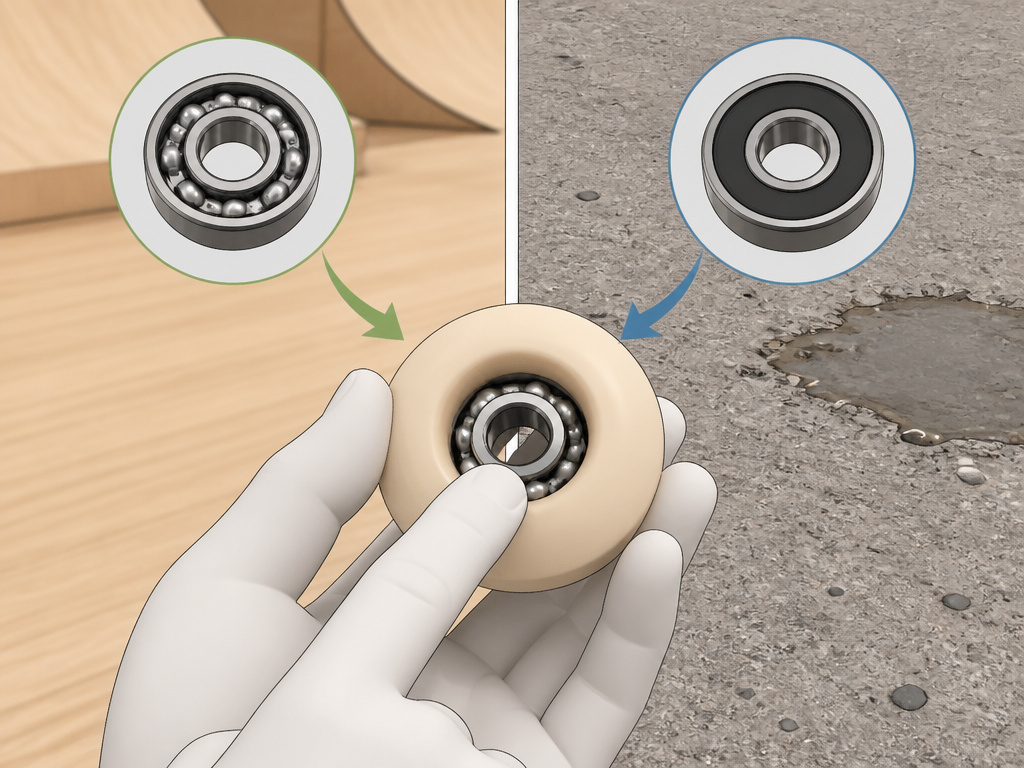
Your skating environment is the biggest factor in the sealed vs open skateboard bearings decision. Choose a bearing type based on the ground you ride.
| Skating Environment | Recommended Bearing Type | Why It Wins |
|---|---|---|
| Street & Outdoor Parks (concrete, dust, occasional water) | Sealed | Shields block the constant grit and moisture. Consistency beats peak speed. |
| Indoor Wooden Parks (clean, controlled) | Open (per Jenkem Magazine) or Sealed (per Transworld Skateboarding) | Jenkem Magazine notes open bearings allow optimal lubrication customization in clean environments, while Transworld Skateboarding states sealed bearings are superior for park skating. |
| Slalom / Speed Racing | Open (per International Slalom Skaters Association) or Sealed (per Transworld Skateboarding) | The International Slalom Skaters Association prefers open bearings for slalom racing, while Transworld Skateboarding states sealed bearings are superior for park skating. |
| Beginner Learning | Sealed | One less maintenance task while you focus on riding fundamentals. |
For most skaters, the answer is sealed. The protection outweighs the minor maintenance advantage of open bearings. A set of Bones Reds, which use a nylon retainer, AISI 52100 high carbon chromium steel, and come with Speed Cream, is the benchmark for a reason. They work and last.
If you skate primarily in a clean, indoor wooden park and you enjoy tinkering with your gear, then open bearings let you chase that perfectly quiet, fast roll. You become your own bearing technician.
What most people get wrong: Thinking you can’t clean sealed bearings. Even the “maintenance-free” ones eventually need service. When your sealed bearings start to sound gritty, those rubber shields can often be pried off with a thumbtack for a clean and re-lube, extending their life by months.
The ABEC Rating Distraction

You’ll see ABEC 7, ABEC 9, even ABEC 11 on packaging. According to the American Bearing Manufacturers Association (ABMA), the ABEC rating is a tolerance standard for bearing precision. Tighter tolerances matter for industrial spindles spinning at 20,000 RPM. A skateboard wheel spins at a relatively low RPM compared to industrial machinery.
The forces are completely different. A skateboard bearing deals with massive side loads from carving and the impact of landing tricks. A precision-machined ABEC 9 raceway won’t help if the bearing material is soft or the seal fails on the first gritty grind. Factors like seal design, lubricant quality, and material hardness, like the AISI 52100 steel in quality bearings, have a far greater impact on skate performance.
Spend your money on bearings from a reputable skate brand known for good seals and durable materials, not on the highest ABEC number, when evaluating sealed vs open skateboard bearings. An ABEC 3 bearing from Bones will outperform a no-name ABEC 9 bearing in the real world every single day.
Rubber vs. Metal seals: contact and non-contact
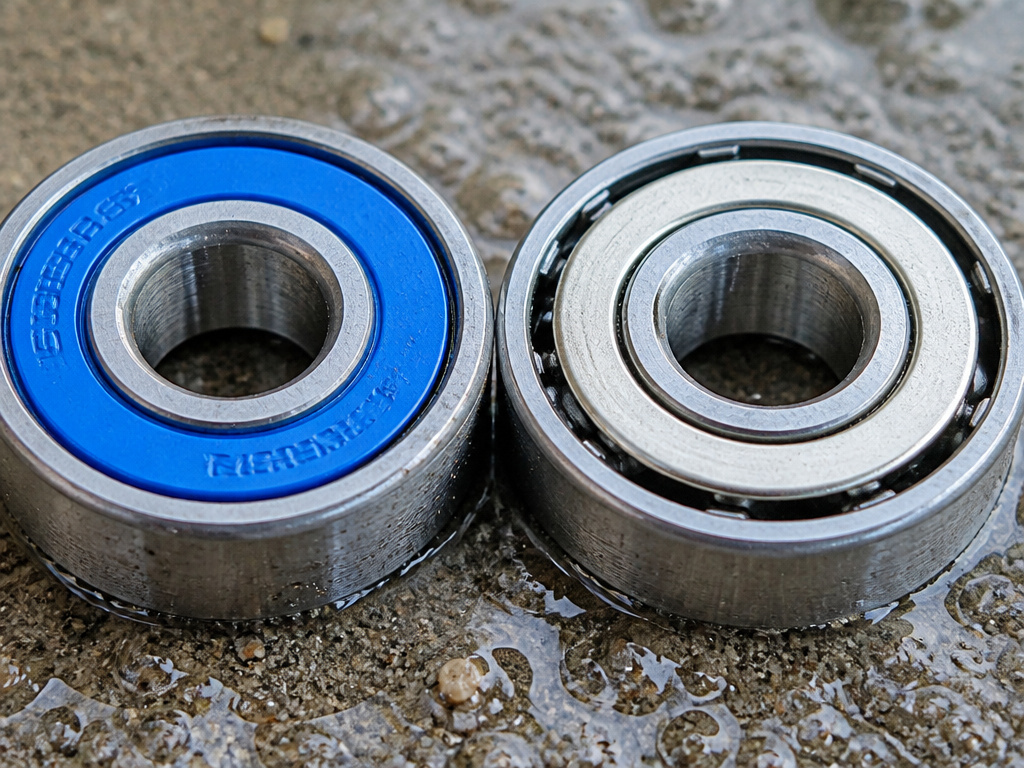
The material and design of a bearing’s seal directly affect its performance. Rubber seals, often colored, can provide a tighter seal against grit and moisture. Metal seals, typically made from thin steel, are very durable. More critical is whether the seal is contact or non-contact. A contact seal physically touches the inner race, creating a very effective barrier but adding slight friction. A non-contact seal, like those found on some popular skate bearings, floats close to the race without touching, reducing friction while still deflecting most contaminants. Your choice depends on prioritizing absolute protection or minimal resistance.
Frequently Asked Questions
Are sealed bearings better than open bearings?
“Better” depends on your priorities. Sealed bearings are better for durability and low maintenance, especially in dirty or wet conditions. Open bearings are better for skaters who want maximum speed in clean environments and don’t mind regular cleaning.
Do sealed bearings last longer?
In real-world skateboarding conditions with exposure to dirt and moisture, sealed bearings typically last longer. Their shields prevent contaminants from causing premature wear on the internal balls and races. In a perfectly clean lab, an open bearing might have a longer theoretical lifespan.
Can you clean and lubricate sealed skateboard bearings?
Yes. Many sealed bearings, especially those with removable rubber shields like Bones Reds, can be serviced. You can carefully pop the shield off, clean the internals with solvent, apply fresh lubricant, and snap the shield back on. Metal-shielded bearings are often non-removable and harder to service.
Are ABEC 9 bearings faster than ABEC 3 bearings for skateboarding?
Not in any meaningful way for street or park skating. The ABEC rating measures manufacturing tolerances, not speed. A high ABEC rating does not account for seal quality or lubricant, which are the main factors affecting rolling resistance and longevity on a skateboard.
Why do my new bearings feel slow?
This is almost never the bearing’s inherent speed. Check that the axle nut isn’t over-tightened, pinching the inner races. Also, ensure your wheels aren’t rubbing against the truck hangar or speed ring. True bearing “break-in” is minimal; a slow roll usually points to a setup issue.
Before You Go
The best bearing is the one you don’t have to think about. For most skaters, that’s a sealed bearing from a trusted skate brand. Install them with a spacer and speed rings, tighten the axle nut until there’s no wheel wobble but the wheel still spins freely, and then go skate.
Save the open bearings and lubrication experiments for when you’ve mastered the fundamentals and your local spot’s concrete is as smooth as glass. Your board should feel like an extension of your feet, not a science project. Start with sealed, master your push and turn, and upgrade only when you can genuinely feel what you’re missing.
