
Steel vs Ceramic Skateboard Bearings: Performance Face-Off
This post contains affiliate links. As an Amazon Associate, we earn from qualifying purchases.
Steel skateboard bearings use chrome steel balls and races, offering durability and impact resistance at a low cost. Ceramic skateboard bearings use silicon nitride ceramic balls in steel races, reducing friction for higher sustained speeds, but at a higher price and with a risk of brittle fracture. For most street and park skaters, quality steel bearings are the better buy; ceramic bearings show their worth in downhill and long-distance pushing where every bit of rolling efficiency counts.
That cost difference isn’t just about materials. It’s about where the performance actually lands under your feet versus what gets written on the box, a key example being the debate over steel vs ceramic skateboard bearings. A set of bearings that cracks on a missed landing changes the math faster than any lab test for friction.
This guide walks through the specs, the real-world failure modes, and the maintenance trade-offs. You’ll get a clear breakdown of speed, durability, and cost, plus specific recommendations for street skaters, longboarders, and everyone in between.
Key Takeaways
- The universal 608 bearing size (8mm bore, 22mm outer diameter, 7mm width) fits all standard skateboard and longboard wheels.
- For street and park skating, where impacts are high, many sources and community reviews argue steel bearings are the more durable and cost-effective choice, though some OEM/pro-shop reviews claim ceramics offer a noticeable edge for all serious skaters.
- For downhill and long-distance pushing, hybrid ceramic bearings provide a measurable reduction in rolling resistance that compounds over distance.
- The ABEC scale defines tolerances for precision, not speed or durability; however, sources disagree on its relevance, with Bones Bearings calling it ‘not applicable’ while precision manufacturers like Boca Bearing maintain ABEC ratings are valid indicators of manufacturing precision.
- All bearings, even ceramics with steel races, require protection from water and grit; proper use of spacers and speed washers extends their life.
The 608 Standard: What You’re Actually Buying
Every skateboard bearing on the market, from a toy-store pack to a professional ceramic set, shares the same core dimensions. This is the 608 series bearing, defined by the international standard ISO 15:1998. SKF, a foundational bearing manufacturer, lists the exact specs: an 8 mm bore (inner diameter), a 22 mm outer diameter, and a 7 mm width.
The 608 deep-groove ball bearing is the universal size for skateboard and longboard wheels. Its dimensions (8x22x7 mm) are standardized globally, meaning any 608 bearing will physically fit your trucks, regardless of its internal material or price tag.
This standardization is why compatibility is rarely an issue. Your decision isn’t about fit; it’s about what happens inside that 22-millimeter metal ring. The differences come down to the material of the balls and races, the precision of their machining, and the quality of the seals that keep grit out.
Material Showdown: Steel vs. Ceramic Construction
The industry standard is 52100 chrome steel. Brands like Boca Bearing specify this AISI/SAE grade for the inner race, outer race, and balls in their steel lines. It’s a ductile, tough material that deforms under impact rather than shattering.
Ceramic skateboard bearings are almost always hybrid constructions. Brands like Bones Bearings and Bronson Bearings use silicon nitride (Si3N4) ceramic balls housed within steel inner and outer races. Full-ceramic bearings, with ceramic races and balls, exist but are rare and explicitly marketed as such.
The ceramic ball is the central difference in the steel vs ceramic skateboard bearings debate. Silicon nitride is harder and smoother than steel, and it generates less heat from friction at high speeds. But it’s also more brittle. The steel races, however, mean the bearing isn’t immune to rust. You’re buying a performance part, not a maintenance-free miracle.
| Component | Steel Bearing | Hybrid Ceramic Bearing |
|---|---|---|
| Balls | 52100 Chrome Steel | Silicon Nitride Ceramic |
| Inner/Outer Races | 52100 Chrome Steel | 52100 Chrome Steel |
| Primary Advantage | Impact resistance, cost | Reduced friction, heat resistance |
| Primary Weakness | Susceptible to rust | Brittle balls can fracture |
Performance Face-Off: Where Each Material Wins
The performance gap in the steel vs ceramic skateboard bearings question isn’t theoretical; it’s situational. Your skating style dictates which bearing’s traits are assets and which are liabilities.
Steel bearings win in high-impact environments. Their ductility means they can survive the lateral loads and shocks of missed kickflips, ledge slaps, and stair sets. As Skateboarder Magazine notes, this impact resistance makes them the reliable choice for street and technical skateboarding. The trade-off is rolling resistance: steel-on-steel contact creates more friction, which subtly saps speed and generates more heat over long, fast runs.
Ceramic bearings win in sustained-speed disciplines. The reduced friction of silicon nitride balls becomes tangible when you need to carry momentum. For downhill longboarding, where maintaining coasting speed is critical, or long-distance pushing (LDP), where efficiency per push matters, the ceramic advantage compounds. The Silverfish Longboarding archive notes ceramic bearings are beneficial for maximizing efficiency in LDP.
Where this goes sideways: Assuming ceramic bearings are “maintenance-free.” The steel races and shields can still rust, and grit will still jam the mechanism if it gets past the seals. That “low maintenance” claim is heavily disputed by owners in forums, who say the real benefit is speed, not reduced upkeep.
My own test was less scientific but telling. I once had a set of Bones Swiss Ceramics and a set of their standard Six Balls on two identical cruiser setups. Pushing around my neighborhood, the difference was imperceptible. The ceramic benefit only appeared on a long, smooth hill where I could coast without pushing for a hundred yards, the ceramic board rolled noticeably farther. For flat-ground street skating, the extra cost bought me nothing but a lighter wallet.
Durability, Maintenance, and the Rust Question
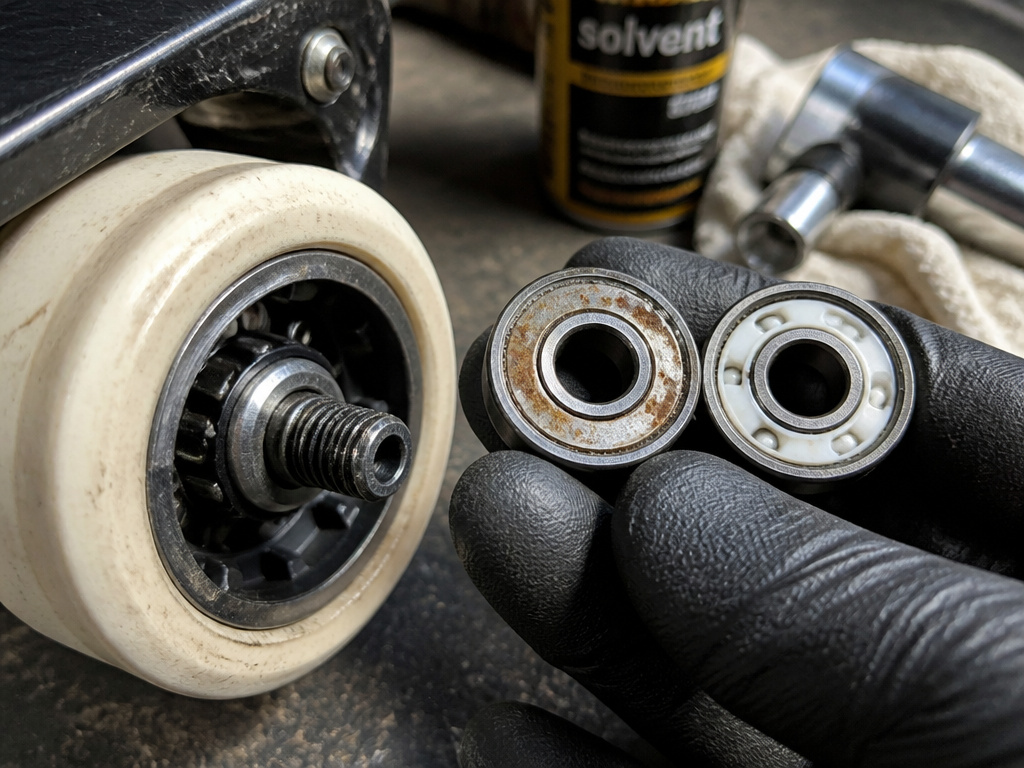
Durability isn’t just about how long a bearing spins; it’s about how it fails.
Steel bearings fail gradually. Grit ingress makes them sound and feel gritty. Water exposure leads to rust, which starts as a rough spot in the spin and progresses to a seized wheel. The fix is often a thorough cleaning and re-lubrication, which can bring a steel set back from the brink multiple times.
Ceramic bearings can fail catastrophically. The silicon nitride balls are hard but brittle. Under extreme impact, think a missed landing from a significant height, they can chip or crack. As noted in the research, a broken ceramic ball can disintegrate into a powder, causing immediate, total failure. A steel bearing in the same situation might just develop a flat spot or become noisy.
Maintenance is mandatory for both. The idea that skateboard bearings are “sealed” is disputed. As a Reddit user in r/NewSkaters pointed out, many bearings lack true waterproof seals, while other sources note high-quality bearings with effective sealing (e.g., rubber contact seals) are recommended for wet environments. Water, and the dirt it carries, gets in.
- For steel: If they get wet, open them up, clean with a bearing-safe solvent (not water, which accelerates rust), dry thoroughly, and re-lube. A set of Bones Reds treated this way can have their life significantly extended.
- For ceramic: The same rules apply. You must protect the steel races from rust. The ceramic balls won’t corrode, but a corroded race will ruin the bearing just as fast.
Here are the undeniable signs your bearings, regardless of material, need attention or replacement:
- Reduced roll distance – A fresh push doesn’t carry you as far.
- Audible grinding or clicking – Especially over cracks or rough pavement.
- Visible rust – On the bearing shield or inside if you remove it.
- Uneven wheel spin or wobble – The wheel doesn’t spin true on the axle.
- Persistent noise after cleaning – If a full clean and lube doesn’t silence them, they’re done.
The ABEC Rating Distraction

This is where the skate world and the industrial bearing world talk past each other. The ABEC scale (from the Annular Bearing Engineers’ Committee) defines tolerances for precision, how perfectly round and smooth the bearing components are. A higher ABEC rating (like 7 or 9) indicates tighter tolerances.
Common mistake: Choosing bearings based solely on a high ABEC rating. The ABEC scale measures precision under high-speed, radial loads in machinery, not the lateral loads and impacts of skateboarding. It says nothing about durability, sealing, or lubrication.
Bones Bearings states the ABEC system is “not applicable” to skateboarding and uses its own “Skate Rated” system. Conversely, precision manufacturers like Boca Bearing maintain ABEC ratings are valid indicators of quality. In practice, a high ABEC rating generally means better machining, but it’s no guarantee of skateboard performance. For the average skater, the shield type (rubber contact seals vs. Metal shielded) and the reputation of the brand are far more practical buying criteria.
Cost, Value, and Who Should Buy What
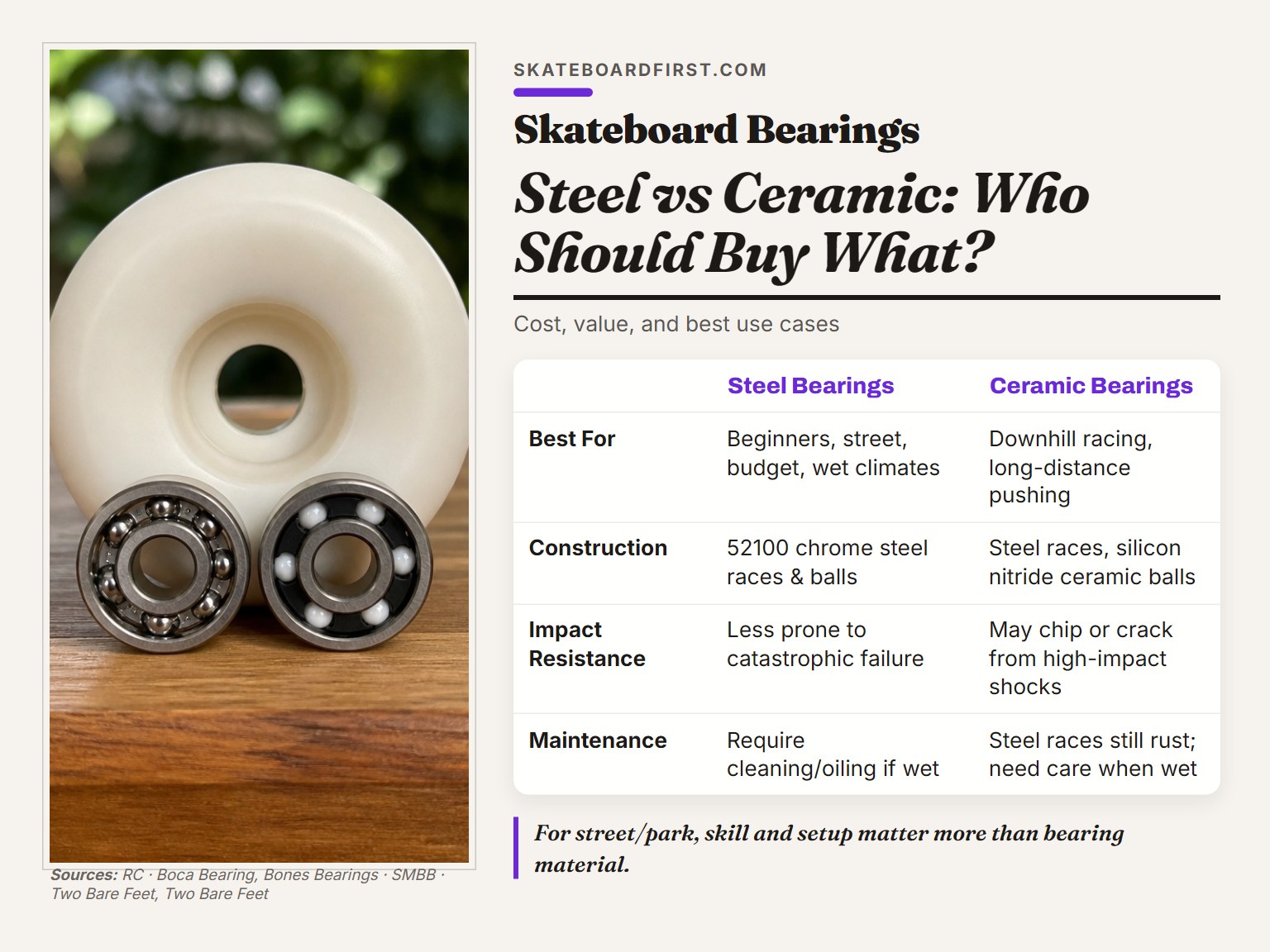
We can cut through the hype with a direct cost-benefit analysis.
Steel Bearings (e.g., Bones Reds, Bronson G3s):
- Cost: Low.
- Value Proposition: High durability per dollar. Ideal for learning, street skating, and park sessions where bearings are consumables that get battered.
- Best For: Beginners, street skaters, anyone on a budget, skaters in wet climates (with diligent maintenance), though sources note high-quality steel bearings with effective sealing are a recommended, cost-effective choice for wet environments.
Hybrid Ceramic Bearings (e.g., Bones Swiss Ceramics, Bronson G4 Ceramics): * Cost: Significantly higher than quality steel bearings.
- Value Proposition: Measurable performance gain in specific, speed-focused disciplines. A long-term investment only if you skate in a way that benefits from the reduced friction.
- Best For: Downhill racers, long-distance pushers, competitive slalom skaters, skaters with a dialed setup looking for the last 5% of performance.
The community is split on value. OEM and pro-shop reviews often claim ceramics benefit all serious skaters. Meanwhile, pro skater interviews and community forums argue that for street and park, the difference is negligible compared to skill and board setup. I lean toward the latter. Replacing a $20 set of steel bearings twice a year often yields better real-world performance than a $150 ceramic set that you baby and still worry about cracking.
Installation Notes: Spacers and Washers Matter

A bearing’s performance is only as good as its installation. This is where many riders, eager to try their new ceramics, go wrong.
Most bearing sets come with spacers and speed washers (also called speed rings). The spacer is a small cylinder that fits inside the wheel core between the two bearings. It aligns them and allows you to tighten the axle nut fully without pinching the bearings, which would kill their spin. The speed washers are thin metal rings that go on the axle between the hanger and bearing, and between the bearing and the nut. They reduce friction at these contact points.
Always use the spacers and speed washers provided. Skipping them to save a few seconds of install time transfers stress directly to the bearing races, leading to premature wear and a loss of speed. Some modern bearings, like Zealous, have built-in spacers and integrated speed rings, simplifying the process.
Are ceramic bearings lighter than steel?

Ceramic bearings are often marketed as lighter, but the practical difference in a skateboard setup is minimal for most riders. This is because the vast majority of ceramic skateboard bearings are hybrid construction, meaning only the balls are ceramic while the inner and outer races remain steel. Since the races make up the bulk of the bearing’s mass, the overall weight savings is slight. For casual and street skating, this difference is negligible. The benefit compounds over very long distances, like in long-distance pushing, where reduced rotational mass can help maintain momentum, but for general use, weight is not a primary factor in choosing between steel and ceramic.
How heat resistant are ceramic bearings?
Ceramic bearings are more heat resistant than steel bearings and create less friction at high speeds. This makes them a recommended choice for disciplines like downhill longboarding, where sustained high speeds generate significant friction heat in the bearing. The ceramic material’s properties allow it to maintain performance where steel might degrade. However, for the vast majority of skating, especially street and park sessions with frequent stops and starts, heat buildup is not a major concern. For the vast majority of skating, especially street and park sessions with frequent stops and starts, heat buildup is not a major concern, and high-quality steel bearings are a common choice.
What’s the difference between hybrid and full ceramic bearings?
There are two main types of ceramic skateboard bearings: hybrid and full ceramic. Hybrid ceramic bearings are the standard and most common type. They use silicon nitride ceramic balls housed within standard steel inner and outer races. This construction aims to combine the low friction of ceramic with the durability and cost-effectiveness of steel. Full-ceramic bearings, with both ceramic balls and ceramic races, are rare and explicitly marketed as such. They are rare and explicitly marketed as such. For nearly all skaters considering an upgrade, the discussion is about hybrid ceramic bearings versus standard all-steel bearings.
Frequently Asked Questions
Are ceramic bearings worth it for skateboarding?
For the vast majority of skateboarders, no. The performance difference is only noticeable in speed-focused disciplines like downhill or long-distance pushing. For street, park, and casual cruising, a steel bearing like Bones Reds offers the best balance of performance, durability, and cost.
Do pro skaters use ceramic bearings?
Some do, particularly in downhill racing. However, many professional street and vert skaters use high-quality steel bearings. The consistency, durability, and lower replacement cost of steel often outweigh the marginal speed gain of ceramics for their style of skating, where bearings are frequently subjected to high impacts.
Can ceramic bearings rust?
Yes. Hybrid ceramic bearings have steel inner and outer races and steel shields. These components are just as susceptible to rust as a full steel bearing. The ceramic balls themselves will not corrode, but rust on the races will ruin the bearing’s performance.
What is the best skateboard bearing for beginners?
Mid-priced steel bearing with good seals, such as Bones Reds or Bronson G3s, is the best starting point. They provide smooth, reliable performance at a low cost, allowing you to spend your budget on more impactful parts like good wheels and properly fitted trucks. Avoid the cheapest ABEC 1 or 3 rated bearings, as noted by the Two Bare Feet guide for their poor performance.
How long do ceramic skateboard bearings last?
Their lifespan is highly dependent on use and maintenance. In a clean, dry, downhill racing context, they can have a long lifespan. In street skating, where they face impacts, dirt, and moisture, their lifespan may not justify the high upfront cost compared to replacing cheaper steel bearings more frequently. A chipped ceramic ball will end their life immediately.
The Bottom Line
Stop looking at the ABEC number and start looking at your skating. Your bearings are a tool, not a trophy.
If your session ends with slams, ledge grinds, and park obstacles, buy steel. The money you save on bearings can go toward better wheels, a fresh deck, or a helmet that actually gets used. A set of Bones Reds or Bronson G3s, installed correctly with spacers and washers, will serve you perfectly.
If your session is measured in miles per hour and coasting distance, ceramic hybrids have a real claim. For the downhill racer or the long-distance pusher, that reduction in rolling resistance is a legitimate competitive edge. Just know you’re buying a precision instrument that dislikes impacts and still fears rust.
For everyone else, the answer is simple. Get a reliable set of steel bearings, learn how to clean and lube them, and put your effort into the push, not the parts. Your board will roll just fine.
