
Skateboard Deck Width for Shoe Size: Chart and Fit Guide
This post contains affiliate links. As an Amazon Associate, we earn from qualifying purchases.
Skateboard deck width for shoe size is a starting point, not a rule. Your foot should cover most of the deck width, with toes and heels just slightly off the edges. The right width gives you control for tricks or stability for cruising, and your skating style matters more than your shoe size alone.
That visual check, foot covering the deck, is what makes a board feel locked in or sketchy. It’s the physical reason width matters at all. A deck that’s too narrow for your foot feels tippy; one that’s too wide feels sluggish to flip. Shoe size charts get you in the ballpark, but your feet on the board decide the game.
What follows: the official shoe-size charts from major retailers (and where they disagree), a clear breakdown of how street skating and transition skating pull you toward different widths, and the one ten-minute test that shows you if a deck fits before you buy it. By the end, you’ll know how to read any sizing guide and walk out with a board that actually works for your feet.
Key Takeaways
- Start with an 8.0 to 8.5 inch deck if you’re an adult beginner, it’s the most common range and offers a balance of stability and flick.
- Use shoe size as a guide, not a guarantee. Charts from CCS, Skate Warehouse, and Opera Skateboards provide overlapping but conflicting recommendations, especially for sizes 7–9.
- Match your truck axle width to your deck width, a mismatch of more than a quarter inch hurts stability and wheel bite risk.
- If you mostly do street tricks, lean toward 8.25″ or narrower. If you skate transition (ramps, bowls), lean toward 8.5″ or wider for a more stable platform.
- Stand on the deck before you buy. Your back foot should cover the tail comfortably, with your toes near one edge and your heel near the other.
The Shoe Size to Deck Width Chart (And Why It’s Messy)
Every major skate shop publishes a shoe-size-to-width chart. They all look definitive. Then you put them side by side and the numbers don’t line up. That’s a half-inch spread of “right” answers.
The charts exist because they’re a safe, simple starting line for a new skater who has no reference; see our detailed skateboard deck size chart for a visual guide. They correlate a number you know (shoe size) with a number you need to know when you compare a skateboard deck width for shoe size. But they are averages, not prescriptions. Here is the consensus data, compiled from the major guides:
| US Men’s Shoe Size | US Women’s Shoe Size | Recommended Deck Width (CCS) | Recommended Deck Width (Skate Warehouse) |
|---|---|---|---|
| 4.5 or smaller | 6 or smaller | 7.00” – 7.38” | 7.0″ to 7.75″ |
| 5.0 – 6.5 | 6.5 – 8 | 7.50” – 8.00” | 7.75″ to 8.0″ |
| 9.0 – 10.5 | 10.5 – 12.0 | 8.25” – 8.50” | 8.0″ to 8.25″ |
| 11.0+ | 12.5+ | 8.50”+ | 8.25″ and above |
A deck width should cover the majority of your foot, with your toes and heels hanging just slightly off the edges. This visual and physical check is more reliable than any chart.
The disagreement for mid-range sizes (7–9) tells you everything. It means thousands of skaters in that range are happily riding decks across that full spectrum. The chart gets you off the couch and into the shop. Your foot on the board does the rest of the work.
How Your Skating Style Changes the Width Equation
The skateboard deck width for shoe size question tells you what might fit. Your skating style tells you what will work. This is where the charts stop and real decision-making starts.
Street skating, tricks on flat ground, ledges, stairs, rewards a narrower, quicker board, a topic explored in our size for street skating article. Transition skating, ramps, bowls, pools, rewards a wider, more stable platform. The physics are simple: a smaller lever flips faster; a bigger platform lands more predictably at speed.
For street and technical tricks, the sweet spot is 7.5 inches to 8.25 inches. Skate Warehouse notes that 8.25 inches is the most popular street size. The narrower end of this range (7.5”–7.75″) is often recommended for skaters focused on kickflips and other technical street tricks. The board flicks faster and requires less foot force to spin. The trade-off is landing space: a 7.75″ deck leaves less room for error than an 8.25″ if your foot placement isn’t perfect.
For transition, vert, and cruising, aim for 8.5 inches and up. CCS states decks 8.50” and above are good for vert riding and cruising because they are more stable. Opera Skateboards categorizes decks 8.625” to 9.125” for park and bowl skating, and 9.5” to 10” for transition and pools. That extra width gives you a confident, locked-in feel when carving a bowl or dropping in on a ramp. It’s the difference between feeling secure and feeling like you’re balancing on a tightrope at 15 miles per hour.
Where this goes sideways: Choosing a wide deck because you have big feet, then trying to learn kickflips. The board will rotate slowly, demand more leg power, and generally frustrate you. If technical street tricks are your goal, err on the narrower side of your comfortable range.
Your first deck won’t be your last. Most skaters go through two or three widths before they settle on a favorite. Start with the style you want to learn most, not the style you think you should learn.
The 10-Minute Fit Test: How to Know a Deck is Right Before You Buy
Charts and style guides are theory. Standing on the board is practice. You can do this in any shop, and it costs nothing.
First, find a deck in your target width range. Place it on a flat, solid surface, the shop floor is fine. Put your front foot on the deck, right over the front truck bolts (or where they would be). Your toes should be near one edge, your heel near the other. Now shift your weight onto that foot. Does the deck feel solid under you, or does it tip toward your toes or heel? A little taper is normal; a pronounced wobble means the deck is likely too narrow for your natural stance.
Next, slide your back foot onto the tail. This is the critical test Opera Skateboards highlights: Your back foot should cover the tail comfortably. Can you feel the edges of the tail under the ball of your foot and your heel? If your foot hangs off so much that you’re standing on the edge, the deck is too narrow. If the tail feels like a park bench under your foot, it’s probably too wide.
This test solves the “women’s size” gap most charts create. Women’s shoe sizes are often listed as a conversion, but foot shape and proportion vary. A physical test bypasses the conversion table entirely. If you wear a Women’s size 10, don’t just cross-reference to a Men’s size 8.5. Grab an 8.25″ deck and an 8.5″ deck and stand on both. One will feel noticeably more planted.
He started on the recommended 8.5″ deck but his feet hung so far over the edges he couldn’t find a stable stance. We moved him to a 9″ deck, and in the first session his pushing and turning were visibly more controlled. The chart said one thing; his balance said another.
Matching Trucks to Your Deck Width (The Step Everyone Forgets)
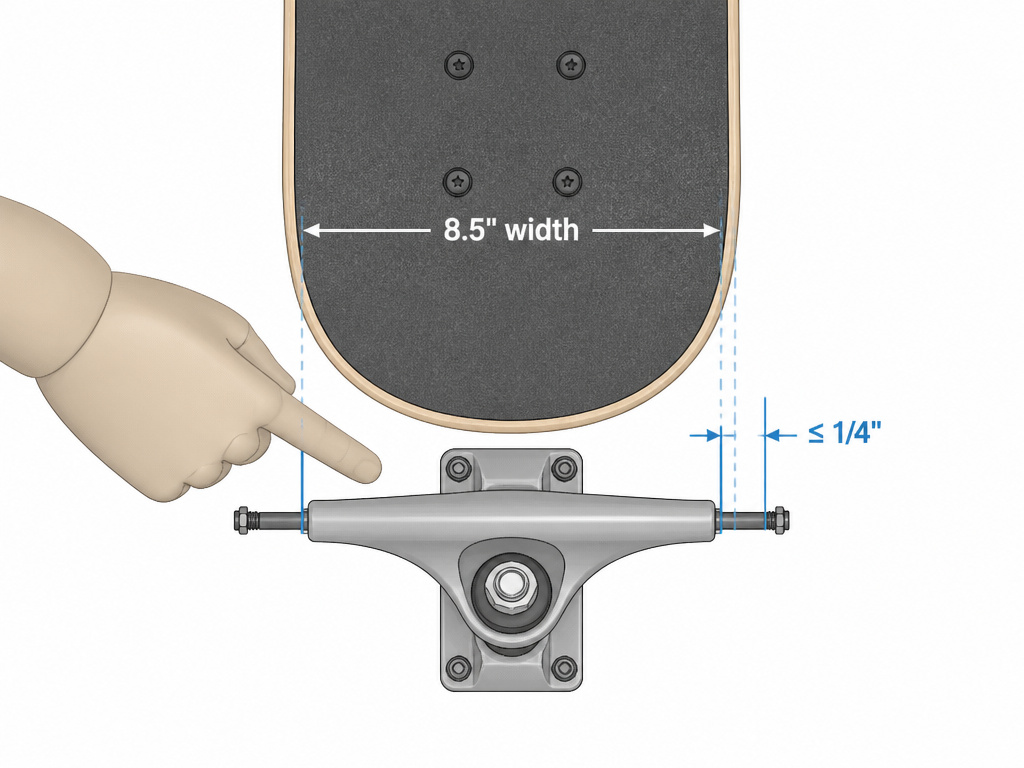
Buying a deck is half the setup. The trucks, the metal T-shaped parts that hold the wheels, have to match. A width mismatch is the most common beginner mistake, and it makes a deck feel terrible.
The rule is straightforward: your truck axle width should be within a quarter inch of your deck width. Independent, Thunder, Venture, and other major brands list their truck sizes by axle width. An 8.5″ deck pairs with trucks that have an axle width near 8.5″. An 8.0″ deck uses trucks with an axle width near 8.0″.
Match your trucks to the deck: axle width within about a quarter inch of deck width. This isn’t a minor detail, it’s what keeps your wheels from sticking out too far or sitting too far in, which directly affects stability and the risk of wheel bite.
Get this wrong and two things happen. If the trucks are too narrow for the deck, the wheels sit inboard, reducing your effective standing platform and making the board feel tippy. If the trucks are too wide, the wheels stick out past the deck. This can be a style choice for some, but for a beginner it increases the chance of catching a wheel on a curb or during a push, and it absolutely increases wheel bite in tight turns.
The hardware matters too. You’ll need bolts to attach the trucks. The most common bolt lengths are 7/8 inch (for no riser pads) and 1 inch (for 1/8” risers), as noted by evo. Using bolts that are too short means you can’t tighten the nut properly; bolts that are too long need to be cut down or they’ll snag on your grip tape.
Special Cases: Mini Decks, Wide Cruisers, and Kids’ Sizes
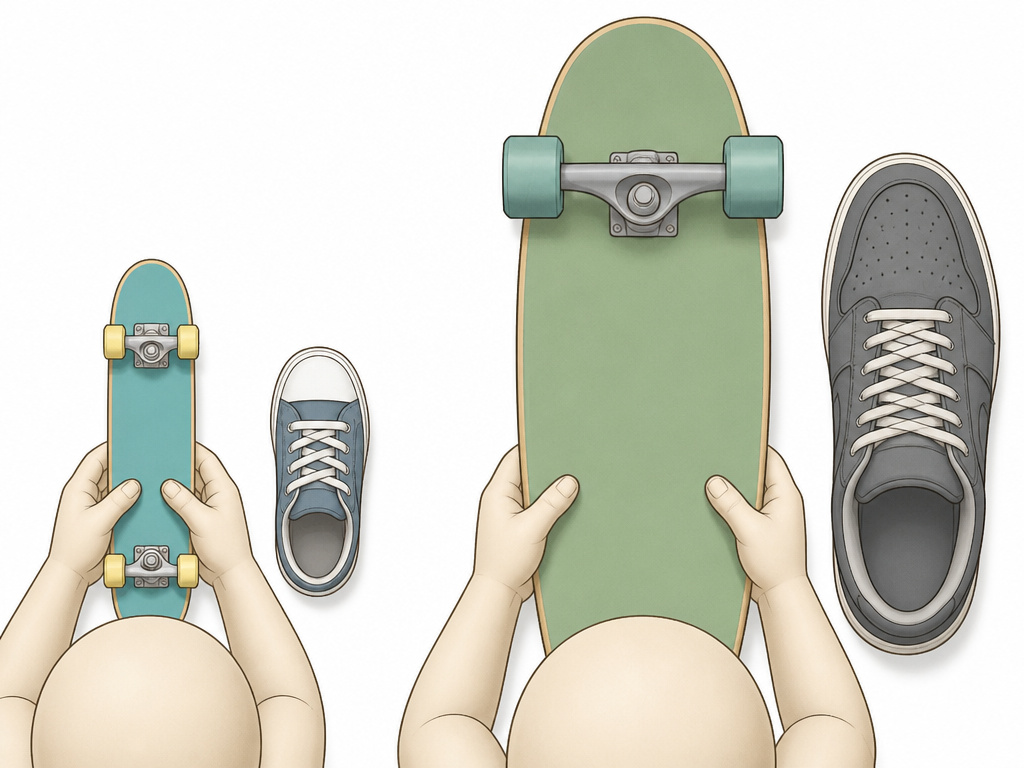
The standard popsicle-shaped deck from 7.5″ to 8.5″ covers most skaters. But the edges of the sizing spectrum have their own rules.
Mini skateboards are defined by CCS as decks 7.38 inches or less in width. They are recommended for younger skaters with a US Men’s Size 5 shoe or smaller. These are not just shrunk-down adult boards; they have a shorter wheelbase and are lighter, making them easier for small kids to maneuver and learn on. If your child is under about 10 years old and has small feet, a mini deck is likely a better fit than the smallest “standard” deck.
Wide cruisers and transition decks live at the other end. Opera Skateboards makes decks up to 12 inches wide, meant for “cruising, carving and maximum-stability transition.” These are niche boards for specific purposes like cruising, carving, and maximum-stability transition, and they fall outside standard sizing guides. You don’t choose a 12″ deck because you wear a size 14 shoe; you choose it because you want the most stable platform possible for a specific type of riding.
For children and youth skaters, the standard charts can be misleading. A kid with a Men’s size 4 shoe isn’t just a small adult; their height, weight, and strength are different. In this case, the mini deck category exists for a reason. It’s better to get a properly proportioned mini board that a child can control than to force them onto a standard deck that’s too long and heavy for them to turn or ollie.
What other skaters say about deck width and shoe size
Skate shop charts give a starting point, but experienced riders often refine the numbers. The common thread is that your skating style matters as much as your shoe size.
Frequently Asked Questions
What size skateboard deck should I get for my shoe size?
Use your shoe size as an initial guide. For most adult beginners, a deck between 8.0 and 8.5 inches wide is a safe starting point. Refer to the charts from CCS or Skate Warehouse for specific ranges, but plan to stand on a few decks at a shop to feel the difference.
Is an 8.25 board too wide?
For street skating, an 8.25 inch deck is the most popular size and is not considered too wide. It offers a great balance of flick for tricks and landing space for stability. If you have smaller feet (Men’s size 8 or below) and want a very fast, technical board, you might prefer 8.0″ or 7.75″. For transition skating, 8.25″ is on the narrower side.
What shoe size is an 8.25 skateboard for?
Sources disagree on the exact fit: CCS recommends an 8.25″ deck for sizes 7.0–8.5, Opera Skateboards lists it for sizes ~6.5–9.5, and Skate Warehouse places it in the 8.5–9 range. CCS recommends it for sizes 7.0–8.5, Opera Skateboards lists it for sizes ~6.5–9.5, and Skate Warehouse places it in the 8.5–9 range. This spread shows it’s a versatile, middle-ground width.
What size skate deck for size 13 feet?
For size 13 feet, start at 8.5 inches or wider. CCS recommends 8.50”+ for size 11.0+, and Skate Warehouse says 8.25″ and above for size 9 and larger. Many skaters with size 13 feet find 8.5″ comfortable, but some prefer 8.75″ or even 9.0″ for the extra platform, especially if they skate transition. The fit test is crucial here.
Before You Go
If you take one thing from all the charts and advice, let it be this: stand on the deck. Your body’s feedback is more valuable than any published number. An 8.25″ deck that feels perfect to you is the right deck, even if a chart says you should be on an 8.0″.
Start with the width that matches the skating you want to do most right now, street or transition. Get trucks that match that width within a quarter inch. That setup will give you a fair shot at learning. Your preferences will change as you skate more, and your next deck choice will be informed by experience, not just a chart. That’s how it’s supposed to work.
