
Skateboard Size for Street Skating: A Practical Guide
This post contains affiliate links. As an Amazon Associate, we earn from qualifying purchases.
The right skateboard size for street skating is a deck width between 8.0 and 8.5 inches, paired with trucks whose axle width matches the deck, and wheels in the 52-55mm range at a hard durometer (typically 95a to 100a). This setup balances flick for tricks with stability for landings, and it fits the majority of adult skaters.
That width range is the modern sweet spot for the skateboard size for street skating. A decade ago, the standard advice was narrower, but today’s street skating incorporates more transition and demands a stable platform for bigger gaps and ledges. The shift from 7.75″ to 8.25″ as the default reflects that change.
What follows: a breakdown of why width matters more than length, how to match your trucks, where shoe-size charts disagree, and the one field test that beats any online guide.
Key Takeaways
- Start with a deck between 8.0″ and 8.25″ wide – it’s the most common adult range and a stable foundation.
- Match your truck axle width to your deck width within a quarter inch; mismatched trucks hurt performance.
- For wheels, a 54-55mm diameter at a hard durometer (95a to 100a) rolls over street cracks and still slides for tricks.
- Shoe size is a starting point, not a rule; a skater with size 11 feet might prefer an 8.0″ for flip tricks, while another chooses 8.5″ for stability.
- The only way to know for sure is to stand on decks in a shop; your feet will tell you what feels balanced.
Why Deck Width Drives Everything
Forget length for a second. When you walk into a shop and they ask what size you ride, they mean width. Deck length is tied to width; a wider board is almost always longer. For example, a REAL Skateboards 8.06″ deck is 31.8″ long, while their 8.38″ deck stretches to 32.43″. That extra length comes from the wider platform.
Wider decks increase stability at speed, according to the U.S. Consumer Product Safety Commission. Their safety sheet notes that “boards with wider hangers (wheels that are farther apart) give riders greater control.”
A narrow board, say 7.75″, flicks faster for flip tricks. It also gives you less room to land. A wider board, like 8.5″, feels like a welcome mat under your feet after a big stair set, but it takes more effort to spin. Your style decides the trade-off.
I bought 52mm wheels once because pros use them. On my neighborhood’s chewed-up asphalt they felt like riding on marbles. Every crack sent a jolt up my legs. I was back on my trusty 54mm wheels within two weeks. That experience taught me that specs on paper mean nothing if your local pavement disagrees.
The Core Street Range: 8.0″ to 8.5″
If you read one section, make it this one. Most street skating happens on decks between 8.0 and 8.5 inches wide, which defines the core skateboard size for street skating. Here’s how the major guides break it down.
| Source | Recommended Street Deck Width | Notes |
|---|---|---|
| Opera Skateboards | 8.0″ – 8.25″ | “All-round street: ledges, flip tricks, technical skating.” |
| Tactics Buying Guide | 7.75″ – 8.25″ | Street skaters “usually prefer boards on the narrower side of the spectrum.” |
| Element Brand | 7.75″ – 8.5″ | “Those who prefer street skateboarding usually opt for a deck with a smaller width.” |
| CCS | 8.25″ – 8.50″ | “Good for all-around skating, or if you want to do a little of everything.” |
Notice the overlap? It’s between 8.0″ and 8.5″. The “narrower side” argument from Tactics still tops out at 8.25″, and CCS calls 8.25″-8.5″ the all-around sweet spot. For a beginner or someone who skates both street and park, leaning toward the wider end of this spectrum (8.25″-8.5″) is a safe bet. You get stability without sacrificing too much flick.
Where this goes sideways: Picking a deck based solely on a pro’s setup. I’ve seen new skaters grab an 8.5″ because their favorite pro rides it, only to struggle with the heavier flip. Start in the middle, then adjust.
How Shoe Size Fits In (And Where Guides Disagree)
Most size charts use shoe size as a starting point. It makes sense, your feet need to fit on the board. But these charts don’t always agree, which tells you how much preference is involved.
For example, if you wear a US Men’s size 9. Where do you start?
- CCS recommends 8.25″ – 8.50″.
- Skip Skateboards suggests 8.0″ – 8.375″.
- Element Brand says 8.0″ – 8.25″.
That’s a spread of half an inch. Who’s right? They all are, for different people. A size 9 skater who loves technical flip tricks might pick the 8.0″ end. Someone who skates faster and focuses on ledges might choose 8.25″ or 8.38″. The chart gives you a ballpark; your skating style chooses the exact lot.
Here is a consolidated look at the general recommendations, which you should treat as a launch pad, not a destination.
| Shoe Size (US Men’s) | Tactics Recommendation | CCS Recommendation | Notes |
|---|---|---|---|
| 6.5 – 9.0 | 7.5″ – 8.0″ | 8.0″ – 8.25″ | Tactics starts narrower; CCS puts this size in the low end of the all-around range. |
| 9.5 or larger | 8.0″ – 8.5″ | 8.25″ – 8.50″+ | Both agree on moving wider, but the starting point differs by a quarter inch. |
The essential point is in the footnotes: “These are just general guidelines your own personal preference should be taken into consideration.” I tell new skaters to use their shoe size to narrow the field to two widths, then stand on both.
Matching Trucks is Non-Negotiable

This is the step most beginners miss, and it makes a huge difference. Your trucks are the metal T-shaped parts that hold the wheels. Their axle width must match your deck width.
I won’t recommend a deck without talking trucks. Pairing a wide deck with narrow trucks hurts wheel clearance and makes the board feel tippy. The opposite makes the board harder to flip.
The rule is simple: your truck axle width should be within a quarter inch of your deck width. Retailers like Tactics provide specific pairings. For an 8.25″ deck, they recommend trucks with an axle width of 8.0″ to 8.5″. This ensures the wheels sit just inside or flush with the edge of the deck, giving you proper control for turning and preventing wheel bite.
Here’s a quick reference:
- Deck: 8.0″ → Trucks: ~7.75″ – 8.25″ axle (e.g., Independent 139, Thunder 147)
- Deck: 8.25″ → Trucks: ~8.0″ – 8.5″ axle (e.g., Independent 149, Thunder 149)
- Deck: 8.5″ → Trucks: ~8.25″ – 8.75″ axle (e.g., Independent 151, Thunder 151)
Getting this match right is more important than agonizing over a 0.125-inch deck difference. A proper street setup starts here.
Wheels and Feel: The Street Skater’s Signature
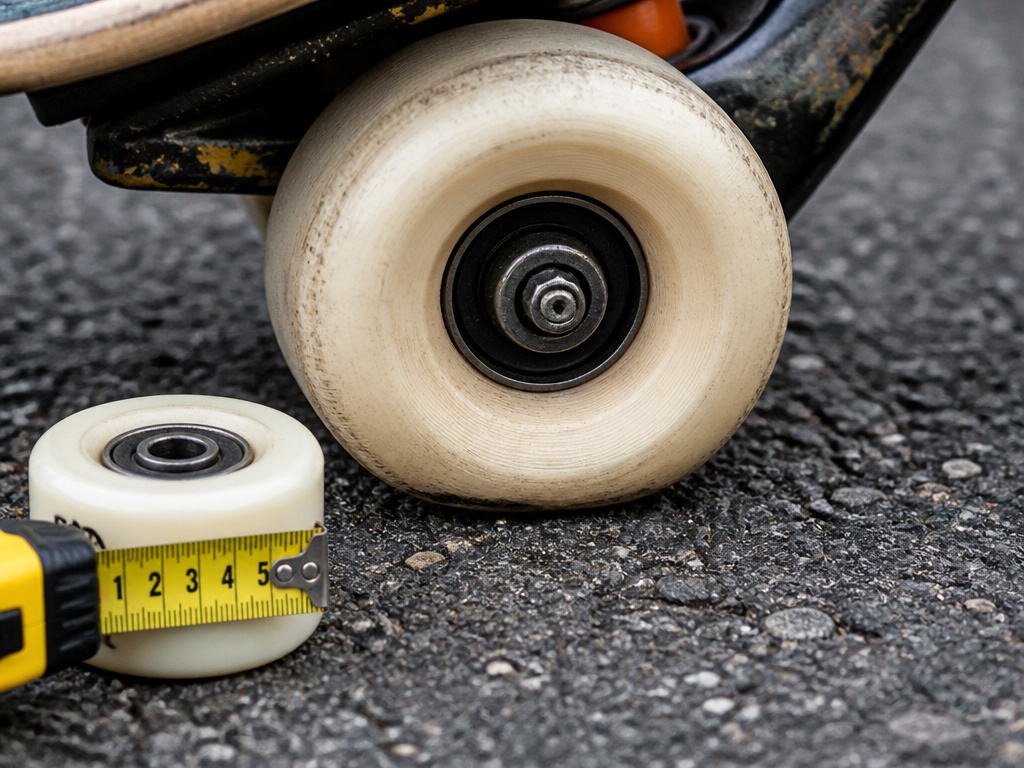
Wheels connect you to the ground. Their size (diameter) and hardness (durometer) change everything. For street, you want a balance of speed, slide, and crack tolerance.
- Diameter: The evo guide states the most common range for street and park is 50mm to 60mm. The evo guide notes that smaller wheels (50mm to 54mm) are slower and more prone to getting caught on cracks or rocks. Larger wheels (56mm+) roll faster and smoother. Tactics recommends 52-55mm wheels for an 8.25″ deck, while evo notes that smaller wheels (50mm to 54mm) are slower and more prone to getting caught on cracks or rocks. Many skaters find wheels in the 54-55mm range at a hard durometer (95a to 100a) to be a sweet spot, as they roll over parking lot cracks and still slide fine.
- Durometer: This is hardness, measured on the ‘A’ scale. Evo notes harder wheels (95a to 100a) are most common for street. A wheel in the 95a to 100a range slides predictably on concrete and provides a fast, responsive ride. Softer wheels (under 95a) grip too much for most street tricks.
Common mistake: Choosing the smallest, hardest wheel because it’s “pro.” If your streets are rough, you’ll feel every pebble. A mid-range wheel (54-55mm, 99a) forgives more and lets you focus on skating, not vibrating.
Your wheel size chart is a useful tool, but remember the surface you skate on has the final vote.
The Evolution of Street Deck Sizing
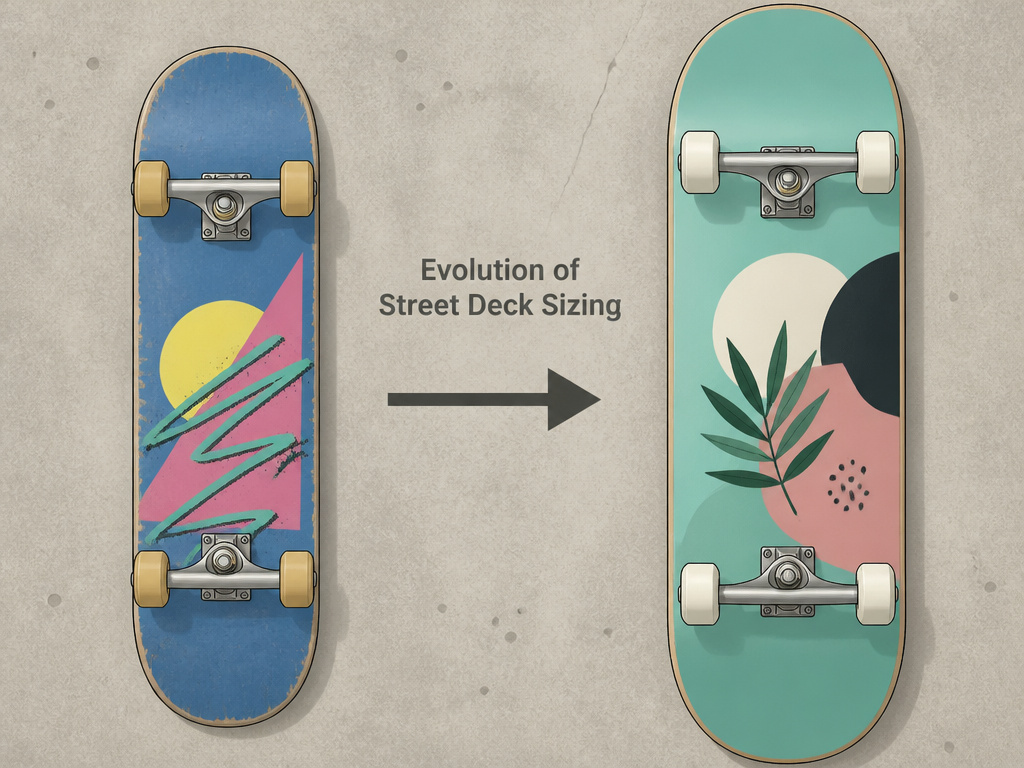
If you’ve ever wondered “What size board did Tony Hawk ride?” you’re asking about history. In the 80s and 90s, decks were much narrower, often in the 7.5″ to 7.75″ range. Skating was primarily technical flip tricks on flat ground.
As street skating incorporated more gaps, stairs, and transition elements from parks, the need for a stable landing platform grew. Over the past 15 years, the average pro street deck width has steadily increased. Today, it’s common to see top street skaters on 8.25″ to 8.5″ decks. The gear evolved with the sport.
This is why a modern deck size chart might suggest wider sizes than an older one. It’s not that your feet got bigger; the skating did.
The Final Test: Stand On It

You can read every guide and cross-reference every chart, but your body will give you the best answer. If you have access to a skate shop, this is the single most valuable thing you can do.
Ask if you can stand on a few different decks. Don’t even worry about the graphic. Close your eyes if you have to. Feel where the ball of your back foot sits on the tail. Can you feel the edges under your toes and heel? Does it feel secure, or like you’re balancing on a tightrope?
I learned this the hard way by ordering a 7.75″ online years ago because it was “the street size.” When it arrived, my size 10 feet hung off so much I felt unstable just standing still. I skated it for a month trying to make it work before switching to an 8.0″, and my progress immediately accelerated.
That physical test cuts through the noise of shoe-size debates and conflicting brand recommendations. Your comfort and confidence are the ultimate metrics for choosing a deck for street.
How body height/weight influences size choice
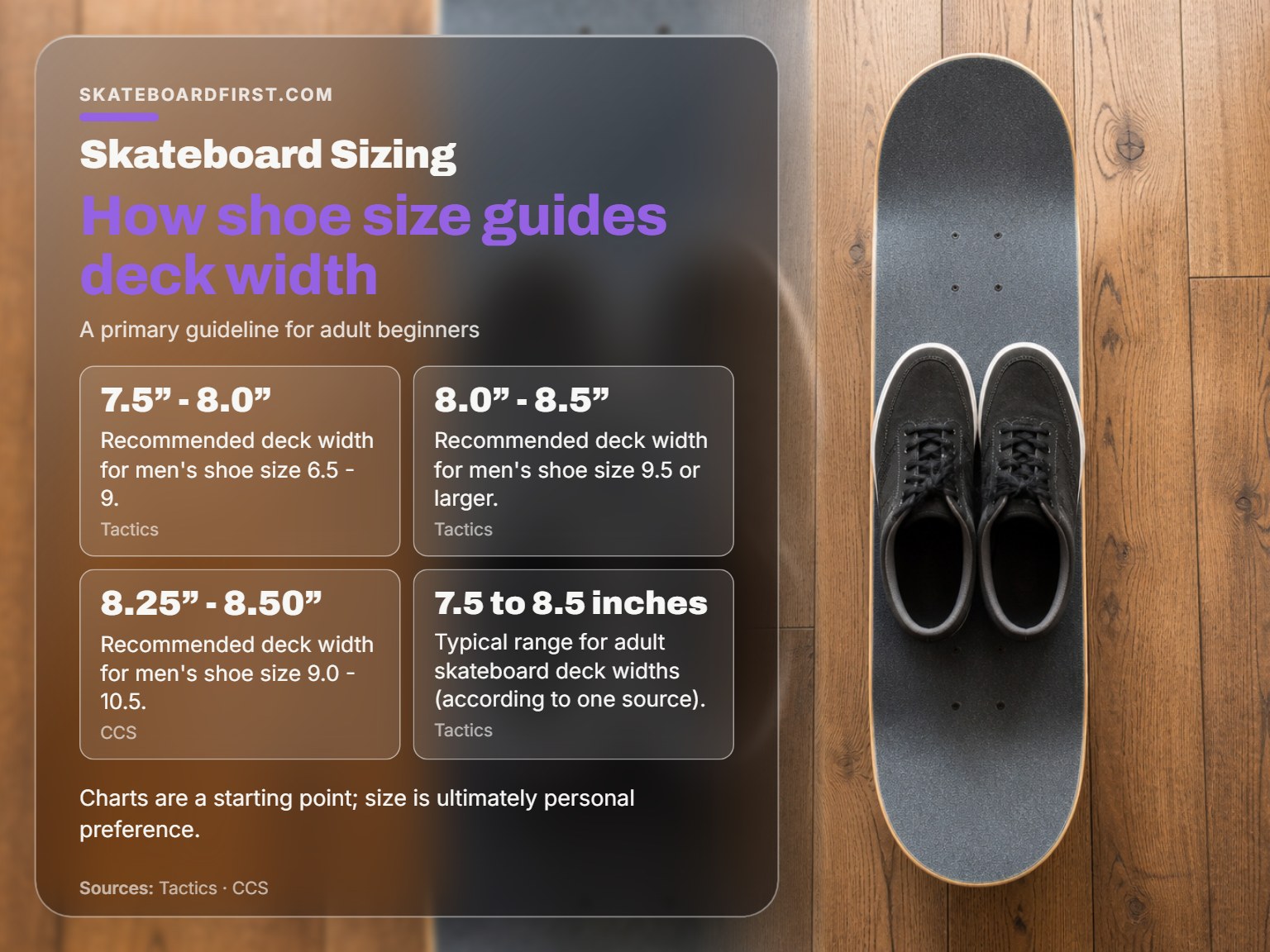
Your body size guides your board choice, but shoe size is a more practical starting point than height or weight. CCS advises that if a skater’s shoe size is smaller than a US Men’s Size 5, a mini-skateboard is a great option, and defines mini skateboards as having a deck width of 7.38” or less. For those with a shoe size between a US Men’s 6.5 and 9, Tactics recommends starting with a deck width between 7.5 and 8.0 inches. If you wear shoes size 9.5 or larger, Tactics recommends a deck between 8.0 and 8.5 inches, while CCS recommends 8.25″ – 8.50″ for shoe size US Men’s 9.0 – 10.5. A board that matches your stance and foot size will feel more stable and responsive, giving you greater control.
Specific width recommendations for technical/flip tricks
For technical street skating focused on flip tricks, some guides recommend narrower decks. CCS states narrower decks (7.5” to 8.25”) are good for tricks like kickflips because they are more responsive, while Opera Skateboards recommends 8.375″-8.6″ for street and park, and Element Brand suggests a range up to 8.5″. If you mostly flip the board, the general advice is to go narrower. This makes the board quicker to spin and easier to flick, though it offers a smaller landing area. Street skaters usually prefer boards on the narrower side of the spectrum.
Frequently Asked Questions
What size skateboard is best for street skating?
For most adult skaters, a deck width between 8.0″ and 8.25″ is the best starting point for street skating. It offers a balance of flick for flip tricks and stability for landing. Skaters with larger feet or a focus on stability may prefer up to 8.5″.
Is 8.5 too big for street skating?
No, an 8.5″ deck is not too big for street skating. While it’s on the wider end of the spectrum, it provides excellent stability for gaps, stairs, and skating transition elements. Many modern street skaters use 8.5″ decks. It may feel slightly slower to flip than an 8.0″ board, but many prefer the added control.
Is an 8.25 skateboard too big?
An 8.25″ skateboard is not too big; it’s currently one of the most popular sizes for street skating. It sits perfectly in the middle of the common range, offering a versatile platform that works for both technical tricks and more powerful skating. It’s an ideal “do-everything” size for many.
What size board did Tony Hawk ride?
As ramp skating and board technology evolved, he moved to wider decks. This historical note highlights how much preferred deck widths have expanded across all disciplines, including street, over the decades.
Before You Go
Ignore anyone who says there’s only one right size. The conflicting recommendations in the guides prove it’s a personal dance between your feet, your style, and the board.
If you take one action from this, let it be this: next time you’re near a shop, go stand on a 8.0″, an 8.25″, and an 8.5″. The one that feels like a solid extension of your feet, not a diving board, not a toothpick, is your starting point. Everything else, from matching truck size to dialing in your street wheels, builds from that foundation. Now go roll.
