
Skateboard Wheelbase Explained: The Two Key Definitions
This post contains affiliate links. As an Amazon Associate, we earn from qualifying purchases.
Skateboard wheelbase is the distance between the front and rear axles, which determines how stable or agile your board feels. The industry-standard measurement is the center-to-center distance between the innermost truck mounting holes, but the true ‘actual wheelbase’ includes a truck-dependent offset. Shorter wheelbases (13.5″–14.5″) are more agile and spin faster, while longer wheelbases (14.5″–16″) are more stable and reduce speed wobbles.
That axle-to-axle distance is the lever you stand on. It decides whether your board carves like a sports car or tracks like a limousine.
This guide explains the two ways wheelbase is measured, how truck geometry changes the number you feel, and the practical trade-offs between short and long. You’ll also get the numbers for fine-tuning your setup, from truck offsets to deck-drilling jigs.
Key Takeaways
- The deck wheelbase (hole-to-hole) is the industry standard, but the actual wheelbase (axle-to-axle) is what you feel under your feet.
- Swapping from Independent Standard trucks to ACE Classics on the same deck reduces your actual wheelbase by 0.64 inches, a change noticeable on your first push.
- For street skating and quick flip tricks, aim for a shorter wheelbase (13.5″–14.5″). For transition skating and downhill stability, choose a longer wheelbase (14.5″–16″).
- You can adjust your deck’s wheelbase by using alternate mounting holes or a drill jig, a cheaper fix than buying a new deck.
- If your board feels unstable at speed, increasing wheelbase helps; if it feels sluggish in spins, decreasing wheelbase sharpens response.
The Two Definitions of Wheelbase
You’ll see two numbers for the same board. The first is printed on the deck’s sticker or website spec sheet. The second is what you ride.
The industry-standard measurement, per the Skateboard Manufacturing Guide and the SK8CAD standard, is the deck wheelbase: the distance between the innermost truck mounting holes (the Skateboard Manufacturing Guide measures hole-to-hole, while Open Source Skateboards specifies center-to-center). Manufacturers use this because it’s a fixed property of the deck, easy to measure and advertise.
The wheelbase is the measure of distance between one inside truck hole and another.. Skateboard Manufacturing Guide
But your wheels aren’t mounted to those holes. They’re mounted to the truck axles, which sit forward of the holes. The actual wheelbase, the distance between the front and rear axles, center-to-center, is what your feet use for turns and stability. This is the definition used in the ASME conference paper “The Skateboard Speed Wobble” and emphasized by technical riding communities.
This gap between marketing spec and riding reality is why two riders with the same deck can have different experiences, a key point in any skateboard wheelbase explained guide. One might use Independent Standards, the other ACE Classics. The deck wheelbase is identical, but the actual wheelbase differs by over half an inch. That’s enough to change the board’s character from stable cruiser to twitchy street machine.
When you’re measuring your skateboard deck, you’re checking the deck wheelbase. When you’re riding, you’re feeling the actual wheelbase. Both numbers matter, but for different reasons.
Truck Offsets: The Hidden Variable
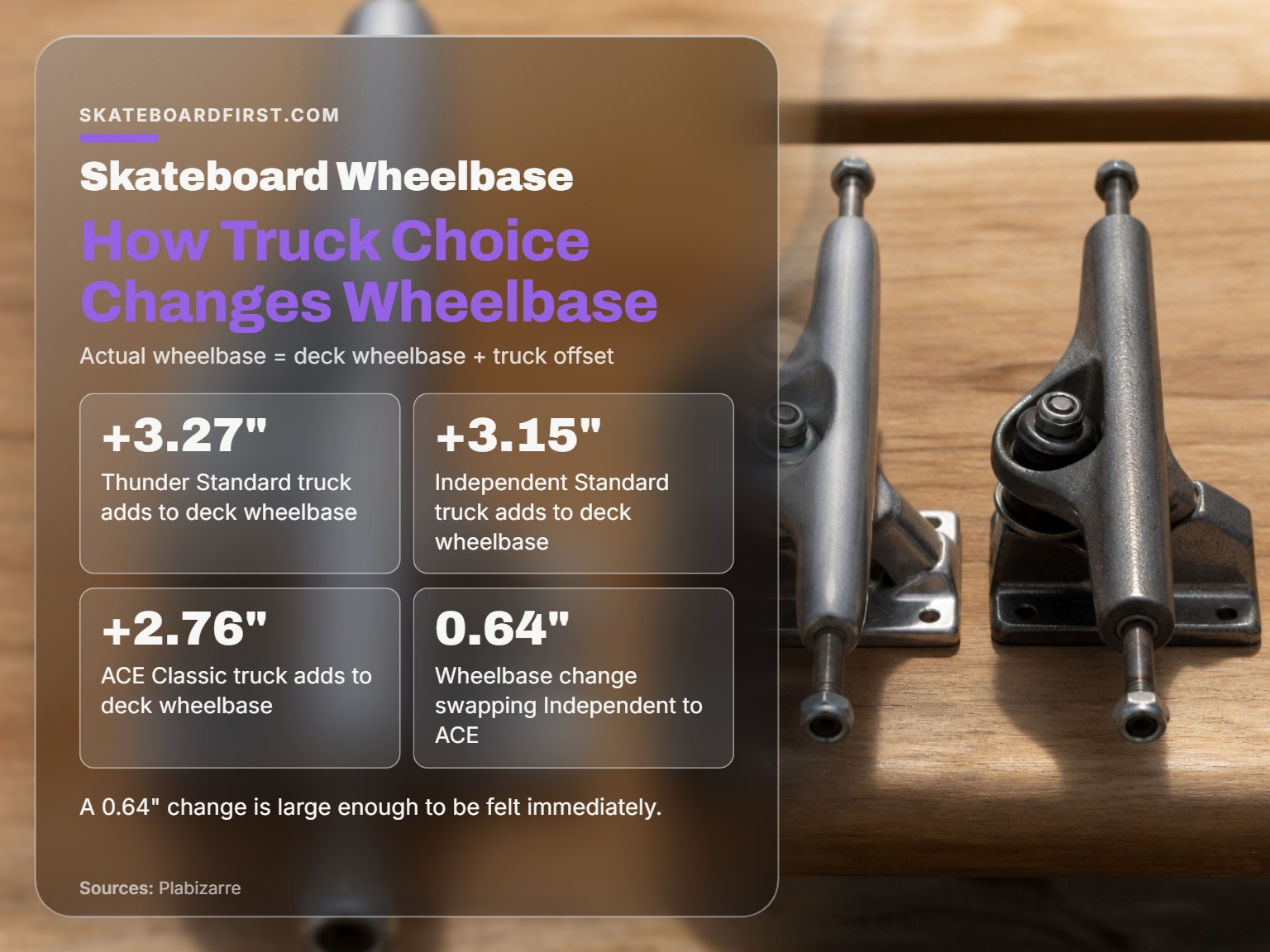
Your trucks aren’t just hinges; they’re geometry modifiers. The distance from the inner mounting hole to the axle center is a fixed offset for each truck model. This offset gets added twice, once per truck, to your deck wheelbase to create your actual wheelbase.
Community tech guides, citing data from Freedomskateshop, have pinned down exact numbers for popular models. This isn’t theoretical. It’s printed in the geometry specs if you know where to look.
| Truck Model | Offset Added per Truck | Total Added to Deck Wheelbase |
|---|---|---|
| ACE Classic | 1.38″ | +2.76″ |
| Independent Standard | 1.575″ | +3.15″ |
| Thunder Standard | 1.635″ | +3.27″ |
Those few extra inches are the difference between a board that flips easily and one that feels planted, a crucial detail in the skateboard wheelbase explained. For example, you might have a deck with a 14.25″ wheelbase. Pair it with Independent Standards, and your actual wheelbase is the deck wheelbase plus 3.15″. Swap to ACE Classics, and it becomes the deck wheelbase plus 2.76″.
That’s a 0.64-inch reduction. About the width of your pinky finger. It feels like switching from a longboard to a street deck on your first push. The board spins quicker, carves tighter, and might feel less stable until you recalibrate your foot pressure.
Where this goes sideways: Buying a new deck without considering your current trucks. You might chase a shorter wheelbase by buying a 14″ deck, but if you switch from ACE to Independent trucks at the same time, you could accidentally lengthen your actual wheelbase and get the opposite of what you wanted.
This is why understanding truck geometry matters. Explore truck geometry. The offset isn’t a secret, but most spec sheets don’t shout it. You have to dig.
How Wheelbase Changes Your Ride
Wheelbase is a lever. Shorten it, and you increase mechanical advantage for quick movements. Lengthen it, and you spread force over a longer span for stability. The WVU skateboard science guide frames it as a basic physics problem.
Shorter Wheelbases (13.5″–14.5″) are the default for street skating. With the trucks closer together, the board has less rotational inertia. This means:
- Spins and shuv-its require less effort.
- The nose and tail feel longer relative to the trucks, giving you more power for ollies.
- The board flicks faster for kickflips and heelflips.
- Turning feels twitchier and more immediate.
Longer Wheelbases (14.5″–16″) are the go-to for transition skating and downhill. The increased distance between axles creates a wider base.
- The board resists speed wobbles because lean inputs are dampened over a longer lever.
- It feels more stable at high speeds and on steep ramp transitions.
- The nose and tail are shorter relative to the trucks, which can make popping feel heavier but can also generate a higher arc.
- It creates a wider platform to disperse impact, which the Pinewskis source notes can reduce the chance of breaking your deck on big drops.
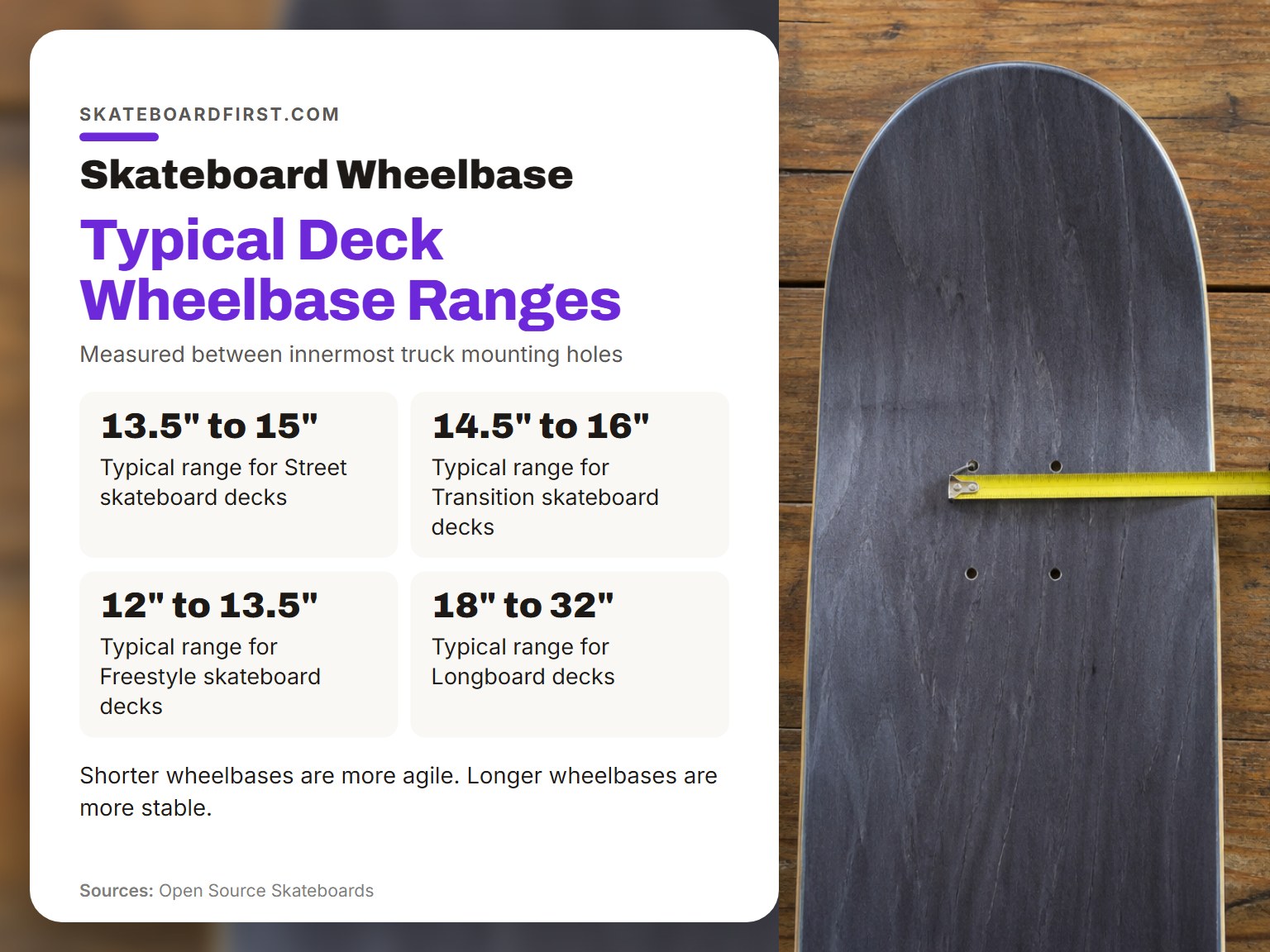
The SK8CAD standard provides typical ranges: Street decks run 13.5″–15″, Transition decks run 14.5″–16″, and Longboards stretch from 18″ to 32″. Your deck length and wheelbase are related but independent; a long cruiser deck can have a moderate wheelbase if the kicks are elongated.
Matching Wheelbase to Your Style and Body
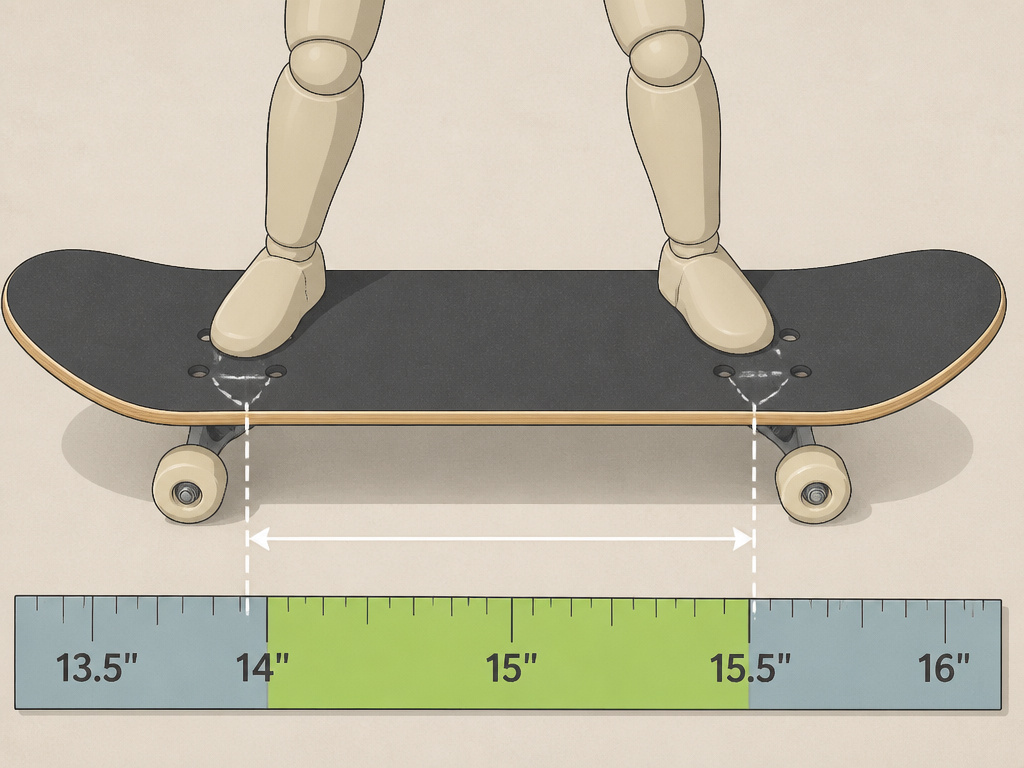
Your height, shoe size, and what you want to do on the board all push you toward a wheelbase range. This is where the “right” answer lives.
For street and technical flip tricks, lean shorter. If you’re under 5’8″ or have a smaller stance, a 14″ or 14.25″ deck wheelbase is a solid start. It makes the board feel snappier underfoot.
For transition, bowl skating, or cruising, go longer. If you’re over 6′ tall or have a wide, powerful stance, a 15″ or 15.5″ wheelbase gives you room to move. The extra stability helps when you’re pumping for speed or carving a deep bowl.
Here’s a quick decision table. Use a deck size chart for width, then apply this for wheelbase. Consult a size chart.
| Your Primary Style | Suggested Deck Wheelbase | Feels Like |
|---|---|---|
| Street / Flip Tricks | 13.5″ – 14.5″ | Quick, flickable, agile |
| All-Around / Park | 14.25″ – 15″ | Balanced pop and stability |
| Transition / Bowl | 14.5″ – 16″ | Stable, predictable, carvy |
| Cruising / Commuting | 15″ – 17″+ | Smooth, dampened, comfortable |
If you’re just starting out and measuring for a skateboard, pick the middle of the range for your style. You can adjust later.
Fine-Tuning Your Setup: Adjustments and Fixes
You aren’t locked into your deck’s printed wheelbase. There are three ways to tweak it without buying a new board.
1. Use Alternate Mounting Holes
Many decks have multiple inner mounting holes, often spaced a small distance apart. Moving your trucks to a different set of holes is the easiest adjustment. It’s free and reversible. A quarter-inch change is subtle but noticeable over a session, the board will spin slightly faster or feel a touch more stable.
2. Redrill Your Deck
For bigger changes, you can permanently redrill the mounting holes. Dedicated drill jigs clamp onto your deck and guide a drill bit to create new holes aligned with the old ones. One community guide details using a jig to decrease a deck’s wheelbase to resurrect a wide deck as a more responsive cruiser. This is a more advanced mod, but it costs less than a new deck.
3. Swap Your Trucks
As the offset table shows, changing truck brands is a stealth wheelbase adjustment. Going from Independent Standards to ACE Classics shortens your actual wheelbase by over half an inch. Going to Thunder Standards lengthens it. This is a great option if you also want to experiment with different truck turning feels.
Common mistake: Cranking your trucks tighter to fix speed wobbles without checking wheelbase. Tightening adds damping, but a longer wheelbase addresses the root cause of instability at high speed. The Raith Skateboards technical guide notes that lowering your rear truck angle relative to the front also helps, as does increasing bushing hardness.
If your board feels unstable, first try a longer wheelbase (or a truck setup that creates one). If it feels unresponsive or slow to spin, shorten it. And always watch for wheel bite when making changes, a lower ride height or softer bushings might be needed. Understand wheel bite.
The Pro Edge: Split-Angle Setups and Speed
Once you’re comfortable with wheelbase, you can layer in another variable: split-angle truck setups. This is where the front and rear trucks have different pivot angles.
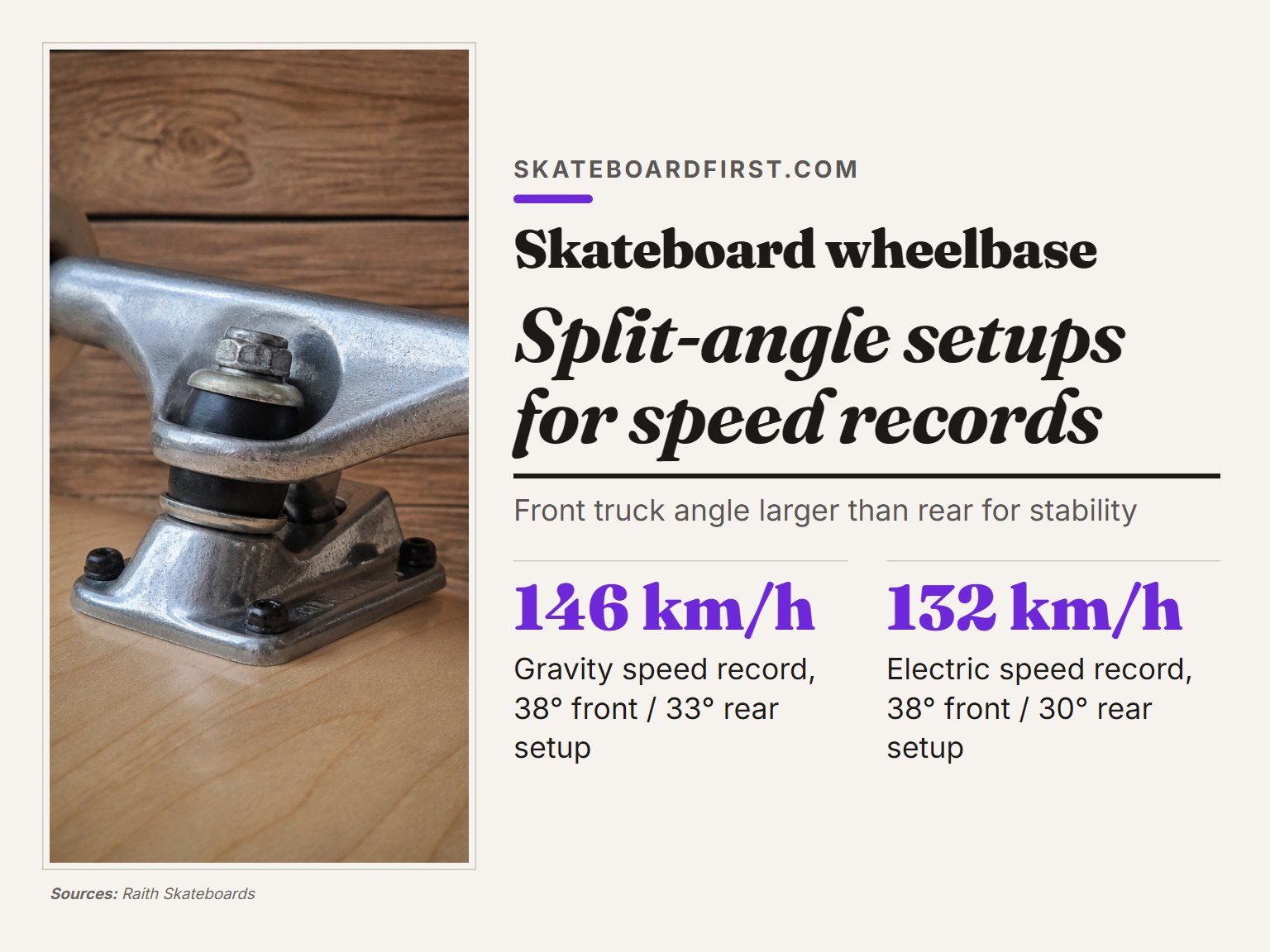
The ASME conference paper explicitly models separate front and rear pivot angles, noting that sometimes different truck configurations are used. The Raith Skateboards guide states it’s always recommended that your front truck angle be larger than your rear.
Why? For speed stability. The world record for fastest gravity-powered skateboard speed (146 km/h) was set with a 38-degree front / 33-degree rear setup. The electric skateboard record (132 km/h) used a 38/30 split. The lower rear angle reduces the steering input from the rear truck, which is a primary cause of speed wobbles at high velocity.
A longer wheelbase amplifies the stabilizing effect of a split-angle setup. It’s advanced tuning, but it shows how the variables interact. You can have a relatively short wheelbase for agility but use a split-angle setup to keep it stable when you point it downhill.
How to Choose Wheelbase Based on Your Height
There are no strict rules linking rider height to a specific wheelbase measurement, as personal preference and riding style play a huge role. However, the general principle is that a longer wheelbase provides more stability, while a shorter one increases agility. If you feel cramped on your board or find it unstable at speed, a longer wheelbase might help. If your board feels slow to turn or unresponsive for technical tricks, a shorter wheelbase could be the fix. Your stance width and comfort are the best guides. Experimenting within the typical ranges for your preferred style, like street or transition skating, is the most practical approach.
How Wheelbase Relates to Deck Length and Width
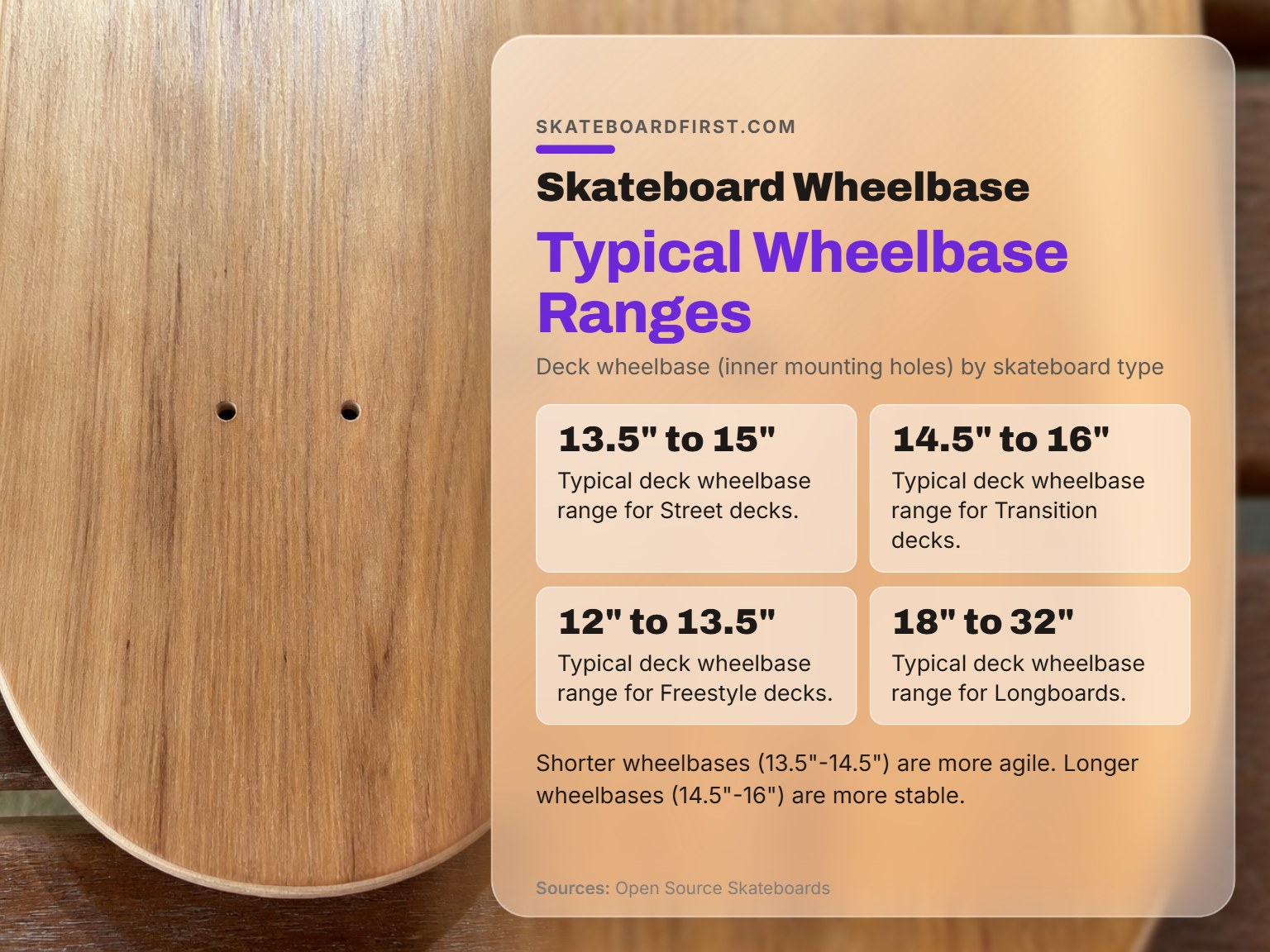
The wheelbase is a key part of a deck’s overall plan shape. For a given deck length, a shorter wheelbase means longer nose and tail sections, which can make the board feel more poppy and easier to lift for tricks. A longer wheelbase shortens the nose and tail and requires more effort to lift the board. A longer wheelbase also creates a wider base to disperse impact forces, contributing to stability. Deck width and wheelbase work together; a wider deck with a longer wheelbase generally feels very stable, while a narrower deck with a short wheelbase will be highly maneuverable. The relationship between these dimensions defines the board’s core feel.
Frequently Asked Questions
What is a normal wheelbase for a skateboard?
For a standard street skateboard deck, the typical deck wheelbase range is 13.5″ to 15″ (per Open Source Skateboards) or 14″ to 15″ (per Pinewskis). The SK8CAD standard cites 13.5″ to 15″ for street decks.
Is a 14.5 wheelbase good?
14.5-inch deck wheelbase is an excellent middle-ground choice. It’s agile enough for most street tricks yet stable enough for basic transition skating. It suits most riders between 5’6″ and 6′ tall.
Is it better to have a longer or shorter wheelbase?
It depends on your skating style. Choose a shorter wheelbase (13.5″–14.5″) for street skating, flip tricks, and quicker spins. Choose a longer wheelbase (14.5″–16″) for transition skating, bowl riding, cruising, and high-speed stability. There’s no universal “better,” only better for what you’re doing.
What is the difference between a 14 and a 14.25 wheelbase on a skateboard?
Quarter-inch difference in deck wheelbase is subtle but noticeable. On the board, a 14.25″ wheelbase will feel slightly more stable and give you a bit more foot space than a 14″ wheelbase. The 14″ board will spin a touch faster. It’s a fine-tuning adjustment, not a major shift.
Does wheelbase affect ollie height?
Indirectly, yes. A shorter wheelbase makes the nose and tail longer relative to the trucks, which can give you more power for the pop. However, a longer wheelbase can create a steeper board angle during the pop, which some riders find launches the board higher. Your technique and foot placement matter more than the measurement.
The Bottom Line
Wheelbase isn’t just a spec; it’s the foundation of your board’s personality. Start with the deck wheelbase that matches your primary style, then remember your trucks add their own offset to create the actual wheelbase you ride.
If your board feels sluggish, first try a shorter wheelbase or trucks with a smaller offset like ACE Classics. If you’re fighting speed wobbles, lengthen the wheelbase and consider a split-angle truck setup.
One rule most guides skip: if you change your deck wheelbase by more than half an inch, give yourself a full session to adjust. Your muscle memory is tuned to a specific lever length. It’ll feel wrong for the first hour. Then it’ll feel like a new tool.
Go check your deck’s inner mounting holes. See if you have options. That’s your first, free step toward tuning your setup.
