
Skateboard Deck Length Guide: Wheelbase Matters More
This post contains affiliate links. As an Amazon Associate, we earn from qualifying purchases.
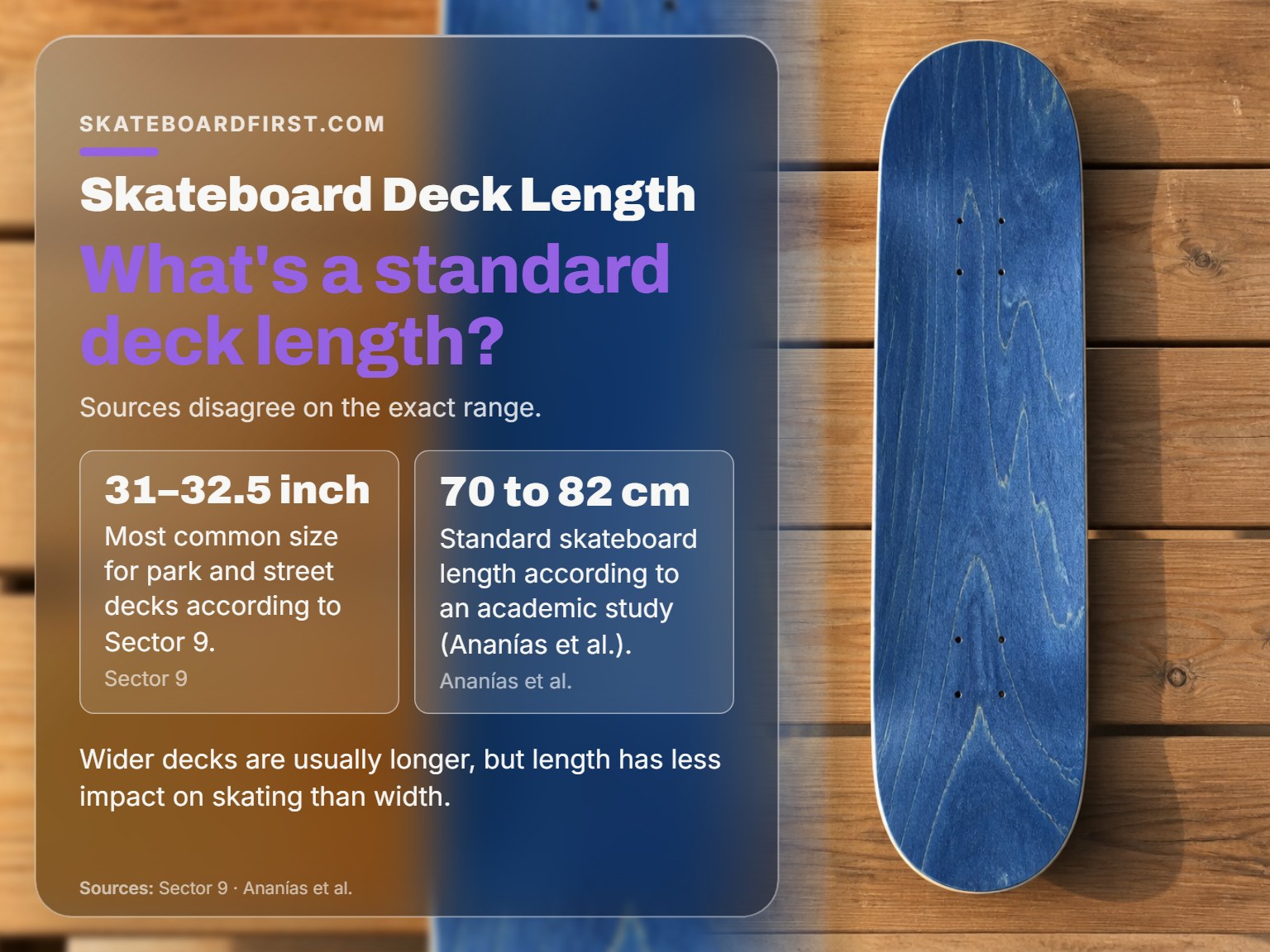
Standard skateboard deck length falls between 28 and 33 inches for most street and park boards, but the exact number is tied to the deck’s width; for example, DGK’s specs show an 8.0″ wide deck is 31.848″ long, while their 8.5″ width is 32.2″ long. The academic definition is 70 to 82 cm (27.6–32.3 inches). For most street skating, width is the critical choice; length follows along.
That 5-inch range in the answer covers a lot of ground. It means a “31-inch deck” isn’t a single size but a cluster of specific lengths that change with every quarter-inch of width. You don’t shop for length independently, which is why a skateboard deck length guide is essential.
This skateboard deck length guide walks through the sourced numbers: the academic baseline, the brand-specific correlations from DGK and others, and the real performance trade-offs that kick in only when you step outside the standard street range. We’ll also cover how deck length connects to your wheelbase and why a deck size chart is a starting point, not a final answer.
Key Takeaways
- The standard deck length for street/park skating is 28–33 inches, but most fall between 31–32.5 inches.
- Deck width dictates length, wider decks get longer to maintain proportions and a stable wheelbase.
- For street skating, width impacts feel far more than length; a few inches in length won’t change your trick ability.
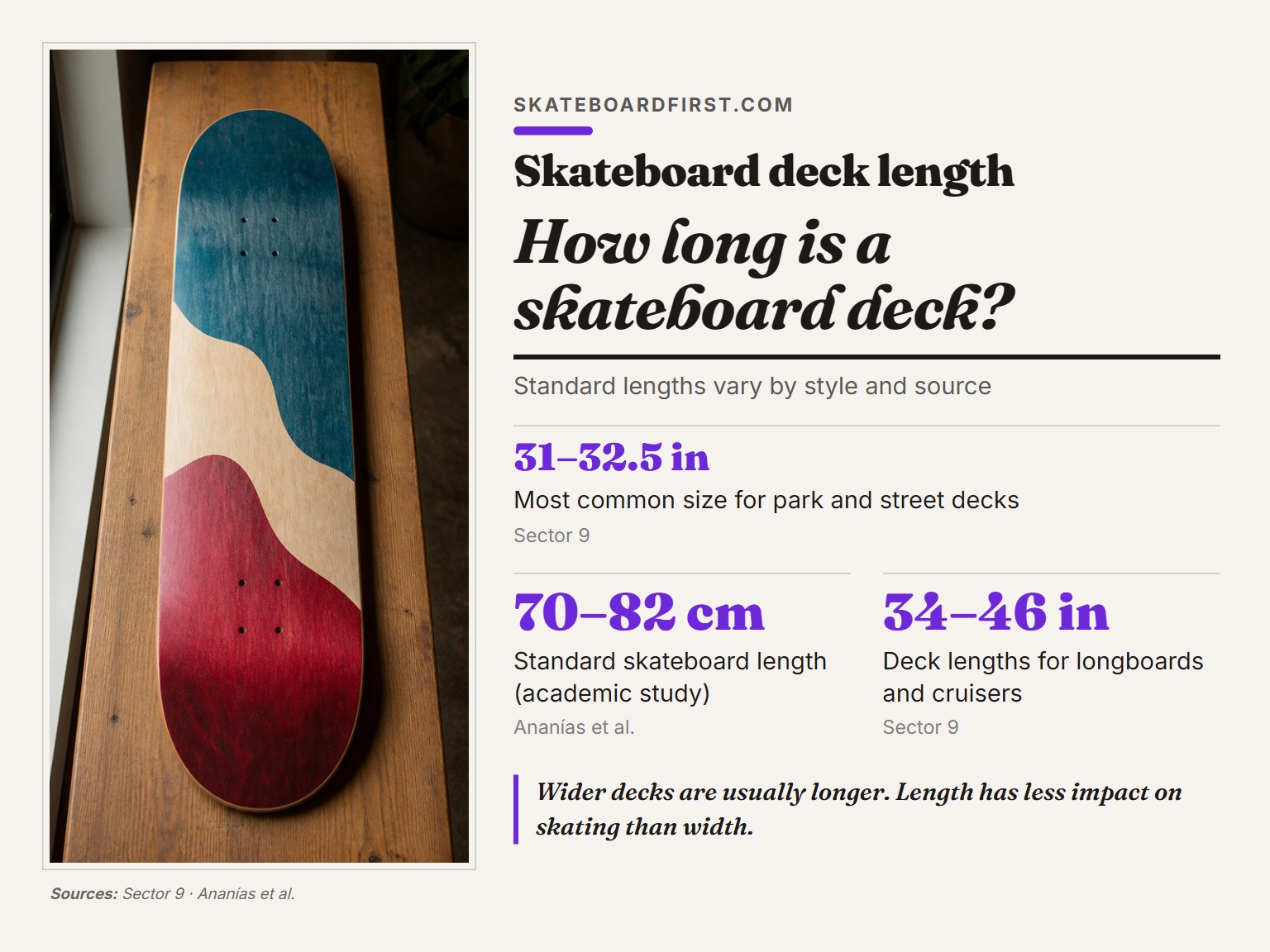
- Longboards and cruisers break the rule, with lengths from 34–46 inches for stability at speed.
- Always check a brand’s specific deck measurement table; two 8.0″ decks can vary by half an inch in length.
The 28–33 Inch Standard (And Why It’s Misleading)
Open any retailer guide and you’ll see the 28–33 inch range. Skate Warehouse says standard lengths run 28 to 32 inches. Element Brand says most street boards are about 28 to 33 inches. An academic paper from the University of Bío-Bío defines the standard skateboard length as 70 to 82 cm, which converts to roughly 27.6 to 32.3 inches. They all agree on the band, but not the edges.
The 2022 academic review “Keeping Feet on the Wood” states the standard skateboard length is about 70 to 82 cm. This range, established from an analysis of materials and engineering in skateboard manufacturing, serves as the baseline from which commercial deck dimensions are derived.
The reason the range feels broad in a skateboard deck length guide is because “standard” encompasses every common street and park deck. The meat of the range, where most adults shop, is tighter. Sector 9 specifies the most common size for park and street decks is 31 to 32.5 inches. That’s a more useful target.
Where does your deck fit? You can’t pick a length off a menu. It’s a consequence of your width choice. The Skate Warehouse guide notes the length usually corresponds with the width: wider decks are longer. This isn’t a suggestion; it’s a manufacturing reality to keep the board’s proportions and wheelbase balanced. A deck designed for an 8.5″ truck needs a longer wheelbase than a 7.75″ deck, so the overall length stretches.
| Deck Width (inches) | Typical Length (inches) | Common Use Case |
|---|---|---|
| 7.75 – 8.0 | ~31.1 – 31.8 (per DGK specs) | Technical street, smaller riders |
| 8.0 – 8.25 | ~31.8 – 32.2 (per DGK specs) | All-around street & park |
| 8.25 – 8.5 | ~31.8 – 32.2 (per DGK specs) | Park, transition, larger riders |
| 8.5+ | Typically longer (e.g., 32.2″+ per DGK) | Transition, cruising |
This correlation means your search for the right street skating size starts with width. The length comes with it. Trying to force a specific length without respecting width leads to a board that feels off, too twitchy or too sluggish, because the wheelbase is mismatched.
How Length Actually Plays Out: Width vs. Length Debate
Here’s where sources directly contradict each other, and both are right in their own context. Skate Warehouse states a deck’s length “impacts balance, maneuverability, and weight distribution.” Element Brand claims “the length of your skateboard isn’t going to have much impact on your skating – much unlike the width.”
Element Brand’s view that length has little impact is often cited for street skating within the standard range, while Skate Warehouse states length impacts balance, maneuverability, and weight distribution. A 31-inch deck versus a 32-inch deck, assuming the same width and wheelbase, feels nearly identical underfoot for kickflips and ollies. The difference is academic. Your foot placement and the board’s pivot point are governed by the wheelbase, the distance between the trucks, not the total nose-to-tail measurement.
The Skate Warehouse point becomes critical when you step outside that standard range. Length dramatically impacts performance in two specific scenarios:
- Longboards/Cruisers (34–46 inches): Sector 9 notes these longer decks are for “flowy carves and stability at speed.” The extended wheelbase and platform change the riding dynamic completely.
- Very Short Decks (sub-28 inches): These are niche, often for young children or specific micro-decks. The shortened wheelbase makes them extremely twitchy and unstable at speed.
For the 99% of skaters looking at a popsicle street deck, the Element advice holds. Obsessing over a quarter-inch difference in length is a distraction. The energy is better spent dialing in your deck width selection and truck tightness. Your board’s “feel” comes from width, concave, and wheelbase. Length is just the envelope it all arrives in.
Decoding Brand Specs: What DGK’s Numbers Really Tell You
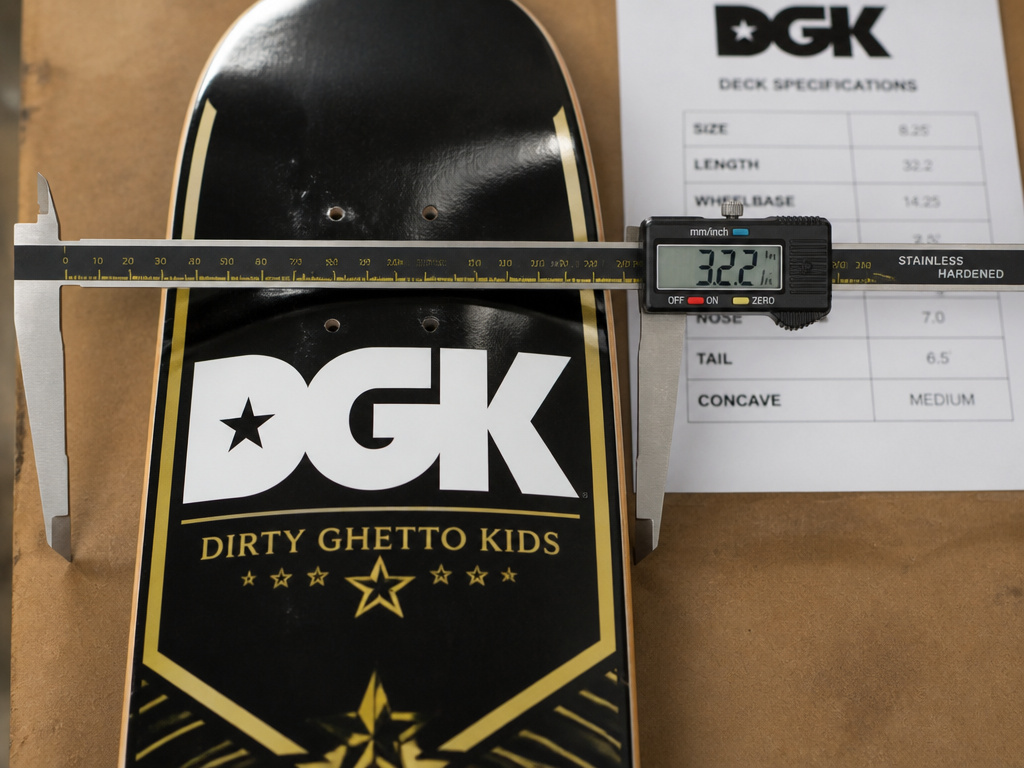
General ranges are useful, but real buying decisions happen with specific decks. Brand specification sheets are the non-commodity gold mine most guides ignore. Look at DGK’s published deck dimensions. They don’t just say “8.0 inches wide.” They give you the exact length, wheelbase, nose, and tail for every width.
A few examples from their table:
- 8.0″ width: Length is 31.848 inches.
- 8.25″ width: Length is 31.848 inches (identical to the 8.0″ in this case).
- 8.5″ width: Length is 32.2 inches.
- 9.0″ width: Length is 32.2 inches.
Notice the pattern? Length increases with width, but not in a neat, linear way. The jump from 8.25″ to 8.5″ width comes with a nearly 0.35-inch length increase. The 9.0″ cruiser-width deck keeps the same length as the 8.5″ but has a completely different shape and purpose.
Common mistake: Assuming a wider deck is automatically much longer. According to DGK’s specs, a 7.75″ deck is 31.5″ long, while an 8.5″ deck is 32.2″ long, a difference of only 0.7 inches over a 0.75-inch width increase. The change is subtle.
This is why a generic deck sizing chart is a starting point. The final word is on the manufacturer’s product page or spec sheet. Two brands might both call a deck “8.0 inches,” but one could be 31.5″ long and the other 31.8″. That 0.3-inch difference is meaningless for performance, but it shows how precise the manufacturing is. If you’re matching a deck to a specific rider height sizing need, these fine details matter.
Wheelbase: The Hidden Length That Actually Matters
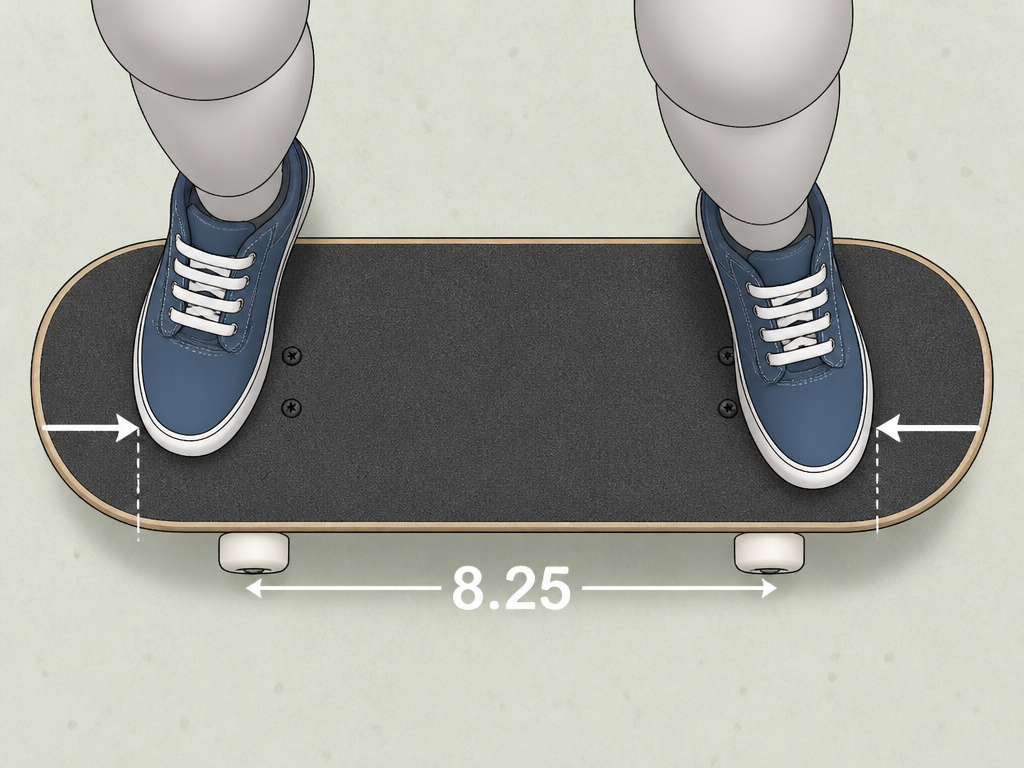
If total length is the headline, wheelbase is the article. Wheelbase is the distance between the inner mounting holes of your trucks, determining how far apart your wheels are. This measurement, more than overall length, dictates how a board steers and feels.
A longer wheelbase (typically 14.5 inches or more) feels stable, predictable, and better for higher speeds and carving. A shorter wheelbase (around 14 inches) makes the board turn quicker and feel more responsive for technical street tricks. Wheelbase scales with deck width. You can’t have a wide, stable deck with a tiny wheelbase, it would be unrideable.
DGK’s chart shows their 8.06″ deck has a specific wheelbase, while their 8.5″ deck has a longer one. That 0.374-inch change is what you feel when you lean into a carve. The longer overall length of the wider deck accommodates this longer wheelbase while keeping enough nose and tail for tricks.
When you’re looking at a deck’s stated length, you’re indirectly seeing its wheelbase. A 32.2-inch deck is almost certainly built around a wheelbase over 14.25 inches. A 31.2-inch deck like DGK’s JK01 model has a specific wheelbase. This is the mechanical “why” behind the width-length correlation. The trucks need room.
TL;DR: Don’t stress over total length. Find your preferred width, and the wheelbase, the real performance driver, will be appropriate for that size. If a deck feels too sluggish or too twitchy, the wheelbase is the likely culprit, not the inch difference in nose-to-tail measurement.
Choosing Your Deck Length: A Practical Guide for Different Styles
So how do you apply this? Your skating style points to a width, and the length comes as part of the package. Here’s how it breaks down.
Street & Technical Park Skating
- Target Width: 7.75″ to 8.25″. Element recommends 7.75 to 8.5 inches for street.
- Resulting Length: Typically in the range of approximately 31 to 32.2 inches, depending on the specific brand and model.
- Why: Narrower widths flip faster. The accompanying shorter wheelbase gives a snappier, more responsive feel for flip tricks. The length is sufficient for a stable platform without being cumbersome.
Transition, Bowl, & Vert Skating
- Target Width: 8.25″ and over. Element says 8.25″+ for pool/ramp. Skate Warehouse notes 8.5″ to 10″+ are common.
- Resulting Length: Typically longer, often landing in a range like 32.2–32.5 inches according to some brands like Sector 9.
- Why: Wider decks provide more stability when landing from airs and carving at speed. The longer length and wheelbase that come with the width prevent the board from feeling twitchy in deep bowls.
Cruising & Transportation
- Target Width: 8.5″ and wider, often with softer wheels.
- Resulting Length: Can start around 32.2 inches but quickly jumps into the 34–46 inch range for dedicated longboards.
- Why: Longer decks (like Sector 9’s 32.5–34 inch “flowy carve” category) provide a stable, comfortable platform for pushing long distances. The extended wheelbase smooths out vibrations and improves roll.
Beginners & Younger Skaters
- Target Width: Start narrower (7.75″ or 8.0″) for easier control.
- Resulting Length: Will be on the shorter end of the standard spectrum.
- Why: A smaller, lighter board is easier to maneuver and less intimidating. It also better fits a smaller stance. Our guide on skateboard size for adults has more specifics for older beginners.
Where this goes sideways: Choosing a deck based solely on the graphic or because a pro rides that size. A 5’4″ beginner on an 8.5″ deck meant for transition will struggle with basic ollies for months. Match the tool to the job and your body.
The best method is still the old-school one: go to a skate shop and stand on decks. Feel how the width fits your feet and how the concave feels. The length will be what it needs to be. If you’re between sizes, the modern trend is to size up slightly, an 8.125″ or 8.25″ deck offers a great blend of stability and flick for most riders.
Deck width recommendations based on shoe size
Shoe size can be a practical starting point for choosing deck width, though it’s not a strict rule. The core idea is that a deck should provide a stable platform for your feet. If you have larger feet, a narrower deck might feel unstable and make it harder to land tricks cleanly. Conversely, a very wide deck can feel cumbersome for someone with smaller feet, affecting flick and control. Most street decks fall within a specific width range, which accommodates a variety of foot sizes. The best approach is to stand on different widths to see what feels most natural and secure for your stance and foot placement.
Deck width recommendations based on rider height
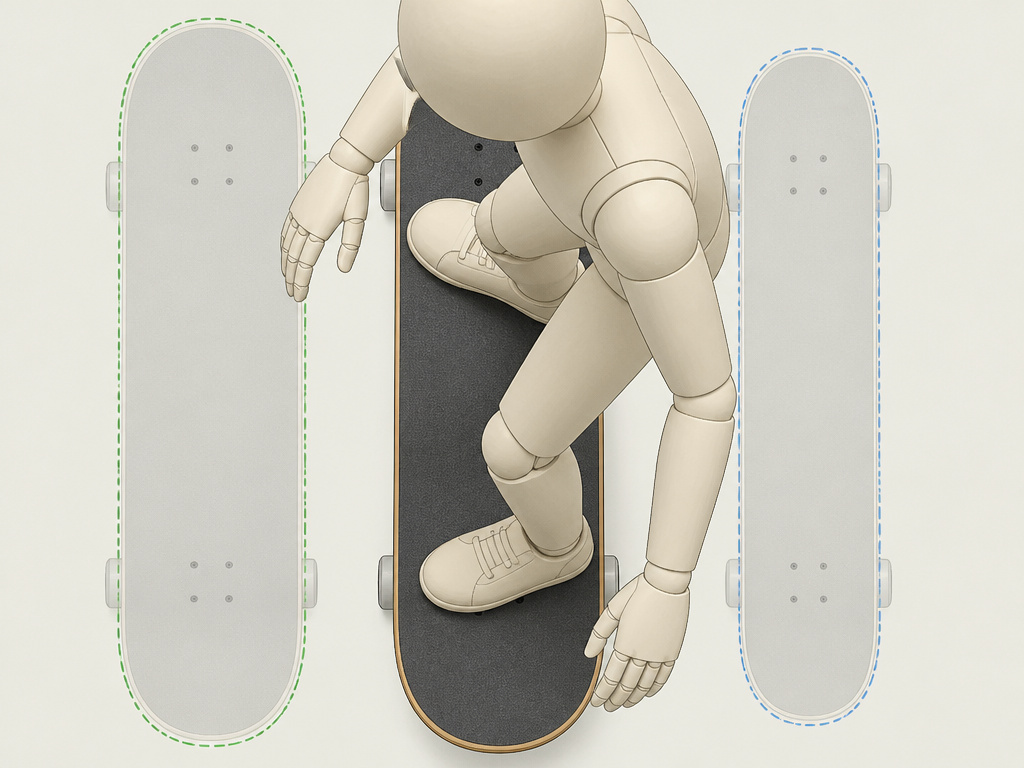
Your height is a general guide for deck width, as it often correlates with your overall stance and foot size. Taller riders typically benefit from a wider deck for better stability and a more comfortable foot platform. Shorter or younger skaters often find narrower decks easier to control and flip. Wider decks are also the go-to choice for transition or pool skating and cruising, which can suit riders of any height focusing on that style. Your skating style and personal preference are more decisive than height alone. Trying out different widths is the most reliable way to find your fit.
Deck length recommendations based on rider height
Deck length has less impact on performance than width, but rider height can inform your choice within the standard range. Taller riders might prefer a deck at the longer end of the spectrum for a more comfortable stance and better weight distribution, while shorter skaters often find a shorter deck easier to maneuver. Standard deck lengths for street and park skating fall within a common band. Wider decks are usually longer, so if you choose a width based on your height or style, the length often follows. The key is to ensure the board’s wheelbase and overall length feel balanced under your feet when you stand on it.
Frequently Asked Questions
What length skateboard deck should I get?
For street and park skating, aim for a length between 31 and 32.5 inches. This corresponds with the most common deck widths (7.75″ to 8.5″). Don’t choose length directly; choose your width based on your shoe size and skating style, and the length will be appropriate. Use a deck size chart as a starting point.
Is an 8.25 deck good for street?
Yes, an 8.25-inch deck is excellent for street skating. It’s in the recommended range (7.75–8.5 inches) and offers a great balance of stability for landing and enough narrowness for a confident flick on flip tricks. For example, DGK lists the length for an 8.25″ deck as 31.848 inches.
How long should my skateboard be if I’m 5’7″?
At 5’7″, you’re well within the range for a standard adult deck. Your height matters less than your shoe size and preference. A deck width between 8.0 and 8.25 inches will likely feel best, resulting in a length of roughly 31.5 to 32 inches. Refer to a guide on deck size for your height for more nuanced advice.
Does deck length affect performance?
Within the standard 28–33 inch street range, the effect is minimal compared to width and wheelbase. When you compare a 31-inch street deck to a 34-inch cruiser, the performance difference is massive, the longer deck is built for stability and carving, not technical tricks.
Are wider decks always longer?
In almost all cases, yes. As deck width increases, manufacturers extend the wheelbase and overall length to maintain proper board geometry and ride stability. DGK’s specs show one brand’s upward trend: 7.75″ wide = 31.5″ long, 8.5″ wide = 32.2″ long.
Before You Go
The real takeaway isn’t a magic number. It’s that deck length is a dependent variable. You lock in your width for your style and shoe size, perhaps using a size by age chart if you’re shopping for a kid, and the industry’s standard designs will deliver a length that works.
If you remember one thing, let it be this: the difference between a 31.5-inch deck and a 32-inch deck is imperceptible mid-ollie. The difference between a 7.75-inch width and an 8.25-inch width is not. Spend your mental energy on width, concave, and finding a 7-ply maple construction. The length will sort itself out. Then go break it in.
