
Skateboarding Injury Prevention Exercises: How to Choose
This post contains affiliate links. As an Amazon Associate, we earn from qualifying purchases.
Skateboarding injury prevention exercises focus on four areas: leg strength (single-leg squats, lunges), core stability (planks, dead bugs), balance (single-leg stands, wobble board), and mobility (hip and ankle stretches). The goal is to build the specific stability that lets you absorb impacts and recover from slips without tearing ligaments. A PubMed abstract notes that skateboarding is not as dangerous as it might appear if appropriate risk management steps are taken.
The data shows where the weak links are. Novice skaters suffer about 14 percent of all injuries, and one-third of all skateboard injuries happen in the first week of learning. That’s not bad luck; it’s a fitness gap. Your board control is only as good as the body controlling it.
What follows is a full-body plan of skateboarding injury prevention exercises built from orthopedic recommendations and skater-tested routines. This plan details the essential exercises, how often to do them, and the one warm-up mistake that sets you up for a strain before you even push off.
Key Takeaways
- Build leg strength with single-leg exercises like lunges and squats to protect knees and ankles from twisting on uneven landings.
- Dedicate time to a dynamic warm-up before every session, as cold muscles increase the risk of preventable strains.
- Wrist guards reduce wrist injuries by 87%, elbow pads cut elbow injuries by 82%, and knee pads lower knee injuries by 32%, gear works, but strong joints work harder.
- Balance training like single-leg stands directly improves your ability to recover from a wobbly landing, turning a potential slam into a saved trick.
- Pair your skating with a consistent stretching routine for hips and ankles; tight joints limit your range of motion and increase injury risk on impacts.
Why Off-Board Training Isn’t Optional
You don’t get strong for skating by skating. That’s the first counterintuitive truth. Skating builds skill and endurance, but it’s a repetitive, one-sided motion. You push with one foot, you ollie with a dominant side, you catch flip tricks with the same leg. Without balanced off-board training, you create muscle imbalances that pull joints out of alignment.
The medical data backs this up. A PubMed abstract notes that skateboarding is not as dangerous as it might appear if appropriate risk management steps are taken. Conditioning is a primary step.
Think of your body as the board’s suspension system. Hit a crack with loose trucks and weak legs, and the energy goes straight into your knee. Hit that same crack with strong, stable legs and engaged core muscles, and your body absorbs the shock. The board might still wobble, but you stay on top of it.
The 4-Pillar Exercise Framework
A complete prevention plan needs four types of skateboarding injury prevention exercises. Skip one, and you leave a vulnerability open. This isn’t about bodybuilding; it’s about creating a resilient system.
1. Leg Strength: The Foundation of Every Landing
Your legs are your primary shock absorbers. Strong quads, hamstrings, and glutes control descent on drops, stabilize the knee during pivots, and power you out of a low crouch. Weak legs buckle.
Essential Exercises:
- Bulgarian Split Squats: This single-leg exercise is the king. It builds unilateral strength and highlights imbalances between legs. Do 3 sets of 8-10 reps per leg.
- Single-Leg Romanian Deadlifts: Targets the hamstrings and glutes while challenging your balance. Crucial for controlling the board when it gets ahead of you. Do 3 sets of 10-12 reps per leg.
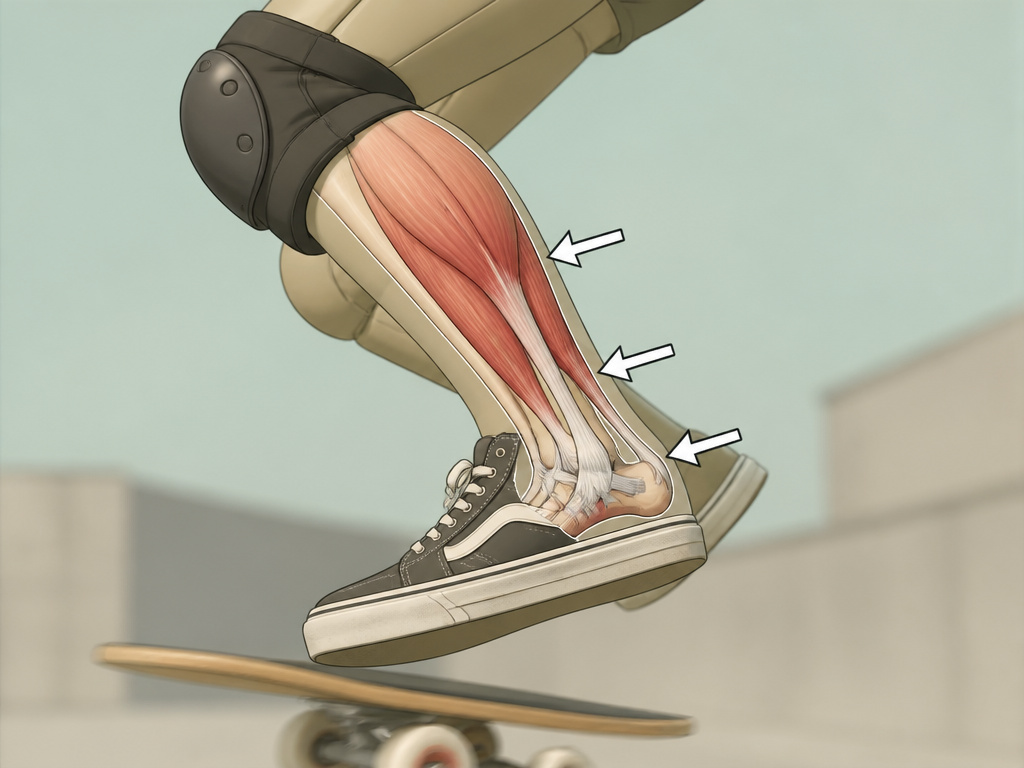
- Calf Raises: Often neglected, strong calves help with ankle stability and the pop of your ollie. Do 3 sets of 15-20 reps.
Where this goes sideways: Skipping single-leg work. If your dominant leg is significantly stronger than your other, that imbalance can pull your hips and knees out of line on impact. The weaker leg gives way first.
2. Core Stability: Your Center of Gravity Manager
Your core is the entire muscular corset around your torso, including the abs, obliques, and lower back. A strong core keeps your upper body stable so your legs can work independently. It’s the difference between crumpling on a bail and rolling out of it.
Essential Exercises:
- Dead Bugs: Teaches you to stabilize your spine while moving your limbs, exactly what happens when you skate. Do 3 sets of 10-12 reps per side.
- Plank Variations: Standard planks, side planks, and plank with shoulder taps build endurance. Hold each variation for a sustained period.
- Bird-Dogs: Another anti-rotation exercise that builds lower back stability. Do 3 sets of 8-10 reps per side.
Integrating these core exercises twice a week makes a noticeable difference in how “connected” your board feels.
3. Balance & Proprioception: The Neural Net
Balance is a skill, not just a strength. Proprioception is your body’s awareness of where it is in space. Training these systems improves your reaction time when the board slips.
Essential Drills:
- Single-Leg Stands: Stand on one leg for 30-60 seconds. Close your eyes to make it harder. Do this daily.
- Wobble Board or Balance Disc: Standing on an unstable surface forces tiny stabilizer muscles in your ankles and knees to fire. Aim for regular practice.
- Lateral Hops: Hop side-to-side over a line, landing softly on one foot. Improves dynamic stability for board catches.
This type of balance training has the fastest carryover to skating. You’ll feel more “locked in” within a couple of weeks.
4. Mobility & Flexibility: The Range of Motion Guardrail
Tight muscles are brittle muscles. They restrict your joint’s natural movement, and when forced beyond their limited range, like in an awkward fall, they strain or tear. Hip and ankle mobility are essential.
| Area | Key Stretch | Frequency | Why It Matters |
|---|---|---|---|
| Hips | 90/90 Stretch, Pigeon Pose | Daily, post-skate | Tight hips limit your ability to squat low and absorb impact, transferring force to the knees and back. |
| Ankles | Banded Ankle Dorsiflexion, Calf Stretch | Daily, pre- & post-skate | Restricted ankle mobility is a direct cause of rolled ankles on uneven terrain. |
| Hamstrings | Single-Leg Romanian Deadlift (light) | 3x/week | Tight hamstrings pull on the pelvis, contributing to lower back pain on long pushing sessions. |
A consistent flexibility routine is the best defense against chronic overuse injuries.
Pre- and Post-Skate Routines
What you do immediately before and after skating matters more than your weekly gym session. This is where you prepare the body for work and help it recover.
The 10-Minute Dynamic Warm-Up (DO NOT SKIP):
- Leg Swings (forward/back and side-to-side): 10 reps each direction per leg.
- Walking Lunges with a Twist: 10 reps per leg.
- High Knees: 30 seconds.
- Butt Kickers: 30 seconds.
- Ankle Circles: 10 circles each direction per ankle.
- Light Jumping Jacks or Skip: 60 seconds.
This warm-up routine increases blood flow, elevates muscle temperature, and primes your nervous system. Skating cold is asking for a pulled muscle.
The 5-Minute Post-Skate Cooldown:
- Light Walk: 2-3 minutes.
- Key Static Stretches: Hold each stretch. Quad stretch, Hamstring stretch, Hip flexor stretch, Calf stretch.
- Foam Roll: Glutes, quads, IT band.
Common mistake: Skating hard for two hours with no warm-up, then wondering why your calves are tight and knees ache. The first 10 minutes of your session should be gradual. Your body isn’t a light switch.
How Protective Gear and Conditioning Work Together
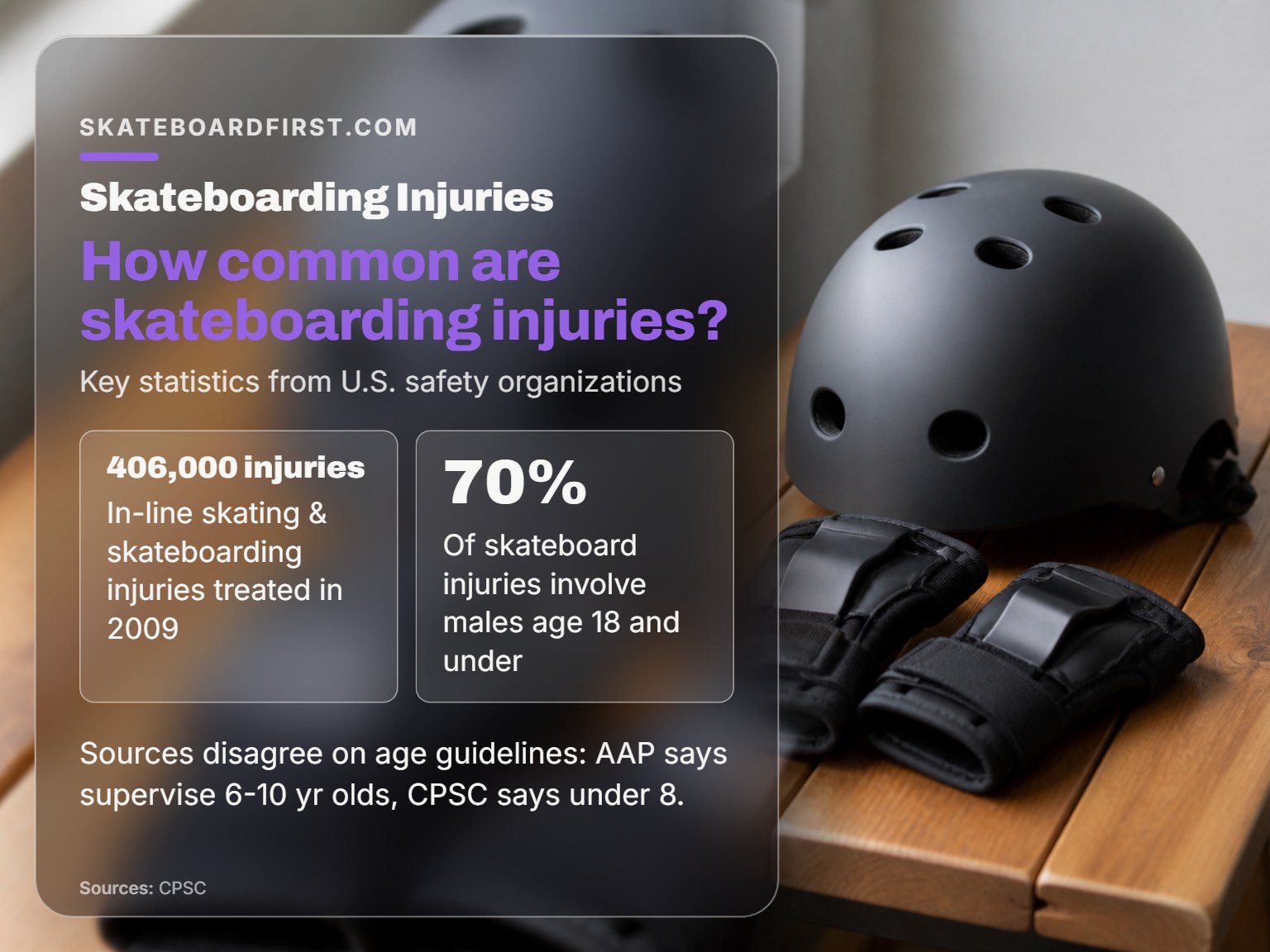
Wearing pads is passive protection. Getting strong is active protection. You need both. The data from the American Orthopaedic Society for Sports Medicine is crystal clear: wrist guards reduce injuries by 87%, elbow pads by 82%, and knee pads by 32%. A helmet is essential for preventing catastrophic head injury.
But gear has limits. A wrist guard can prevent a fracture, but strong forearms and stable shoulders can prevent the fall that leads to the fracture. Conditioning improves your reaction speed and control, so you encounter fewer high-risk situations.
Think of it this way: your leg strength and ankle injury prevention work builds a stronger “bone,” while pads are the bumper that disperses the final impact. You want both layers.
Special Considerations: Electric Skateboards & Beginners
The standard advice gets rewritten for electric skateboards and brand-new skaters. The risks are different, and so is the conditioning focus.
Electric Skateboards (Like Onewheel):
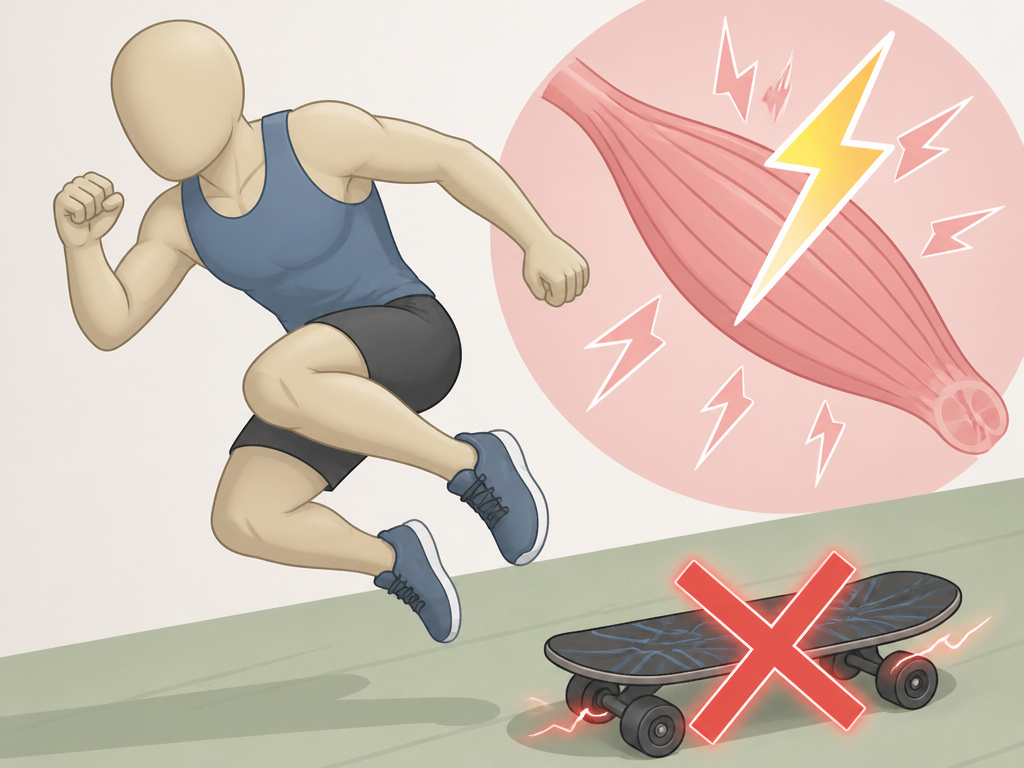
The CPSC recall of all Onewheel models (Recall #24-077) in September 2023 highlights a unique risk: catastrophic electronic failure leading to a sudden loss of balance. Conditioning can’t fix a software fault, but it can improve your chance of a safe bailout. For e-skate riders, explosive plyometric exercises like box jumps and lateral bounds are critical. They train the fast-twitch muscle response needed to jump clear of a board that suddenly stops.
Beginners (First 6 Months):
One-third of all skateboarding injuries occur in the first week. Your body isn’t used to the demands. For beginners, joint preparation is important. Focus on the warm-up and cooldown routines religiously. Add in balance drills and very light bodyweight leg exercises. The goal is to gradually toughen the tendons and ligaments, not to max out your squat.
Sample Weekly Exercise Schedule
This schedule is designed to complement regular skating. It’s designed to complement your skating, not exhaust you.
| Day | Activity | Focus | Duration |
|---|---|---|---|
| Skate Day | Dynamic Warm-Up → Skate Session → Cooldown Stretch | Skill & Fun | Include a warm-up and cooldown. |
| Strength Day (Non-Skate) | Leg Strength + Core Workout | Injury Prevention | 30-45 min |
| Skate Day | Dynamic Warm-Up → Skate Session → Cooldown Stretch | Skill & Fun | Warm-up: 10 min / Cooldown: 5 min |
| Active Recovery | Balance Drills + Full-Body Mobility/Stretching | Regeneration | 20-30 min |
| Skate Day | Dynamic Warm-Up → Skate Session → Cooldown Stretch | Skill & Fun | Warm-up: 10 min / Cooldown: 5 min |
| Strength Day (Non-Skate) | Full Body or Upper Body Focus + Core | Injury Prevention | 30-45 min |
| Rest Day | Complete Rest or Light Walk | Recovery | – |
The strength days should include exercises from the leg, core, and balance pillars. Listen to your body, if you’re sore, shift a strength day to another active recovery day.
Frequently Asked Questions
What are the most important muscles to strengthen for skateboarding?
The most important muscles are the quads, hamstrings, glutes, and core. These muscle groups control landing impact, board stability, and overall balance. Single-leg exercises like lunges and split squats are particularly effective because they mimic the unbalanced demands of skating and correct strength imbalances.
How can I prevent ankle injuries while skateboarding?
Preventing ankle injuries requires a combination of strength, mobility, and technique. Strengthen your calves and the muscles around your ankles with calf raises and balance drills. Improve ankle mobility with daily banded stretches. Most importantly, learn to fall by relaxing and rolling rather than sticking a stiff leg out, which hyperextends the ankle.
Do I need to go to the gym to prevent skateboarding injuries?
No, you don’t need a gym. A effective prevention routine can be done at home with bodyweight exercises, a resistance band, and a towel or cushion for balance work. Exercises like split squats, lunges, planks, and single-leg stands require no equipment and target the key stability muscles.
How does learning to fall safely prevent injuries?
Learning to fall safely is one of the most effective injury prevention skills. It teaches you to relax your body, roll with the momentum, and disperse impact across muscle instead of concentrating it on bone. The American Academy of Orthopaedic Surgeons specifically advises skaters to “try to relax, rather than remaining stiff when falling.” A stiff, braced limb is far more likely to fracture.
Can stretching alone prevent injuries?
No, stretching alone is not enough. A complete approach requires strength and balance training alongside flexibility. Static stretching is best done after skating or as part of a separate mobility session. Dynamic stretching (moving stretches) is the correct choice for your pre-skate warm-up to prepare muscles for activity without reducing their power output.
What’s the best knee protection for skateboarding?
The best knee protection is a combination of strong leg muscles and properly fitted hard-shell knee pads. The pads absorb the direct impact, while strong quadriceps and hamstrings stabilize the knee joint during the movements that lead to falls. Knee pads are shown to reduce the number of knee injuries by 32%.
The Bottom Line
Skateboarding injury prevention is applied mechanics. Strong, balanced, mobile bodies get hurt less often and recover faster when they do. The federal CPSC Skateboarding Safety Fact Sheet recommends a helmet designed for skateboarding (hard shell with foam interior), while the AAOS/POSNA position statement recommends a bicycle or multi-sport helmet meeting CPSC or Snell/ANSI standards.
Start small. Pick one pillar, maybe it’s adding a 10-minute dynamic warm-up, or doing three sets of split squats twice a week. Let that habit stick for a month. Then add the next piece. The data shows the risk is manageable. Your job is to build the body that manages it.
