
Skateboarding Injury Statistics: Key Data and Safety Tips
This post contains affiliate links. As an Amazon Associate, we earn from qualifying purchases.
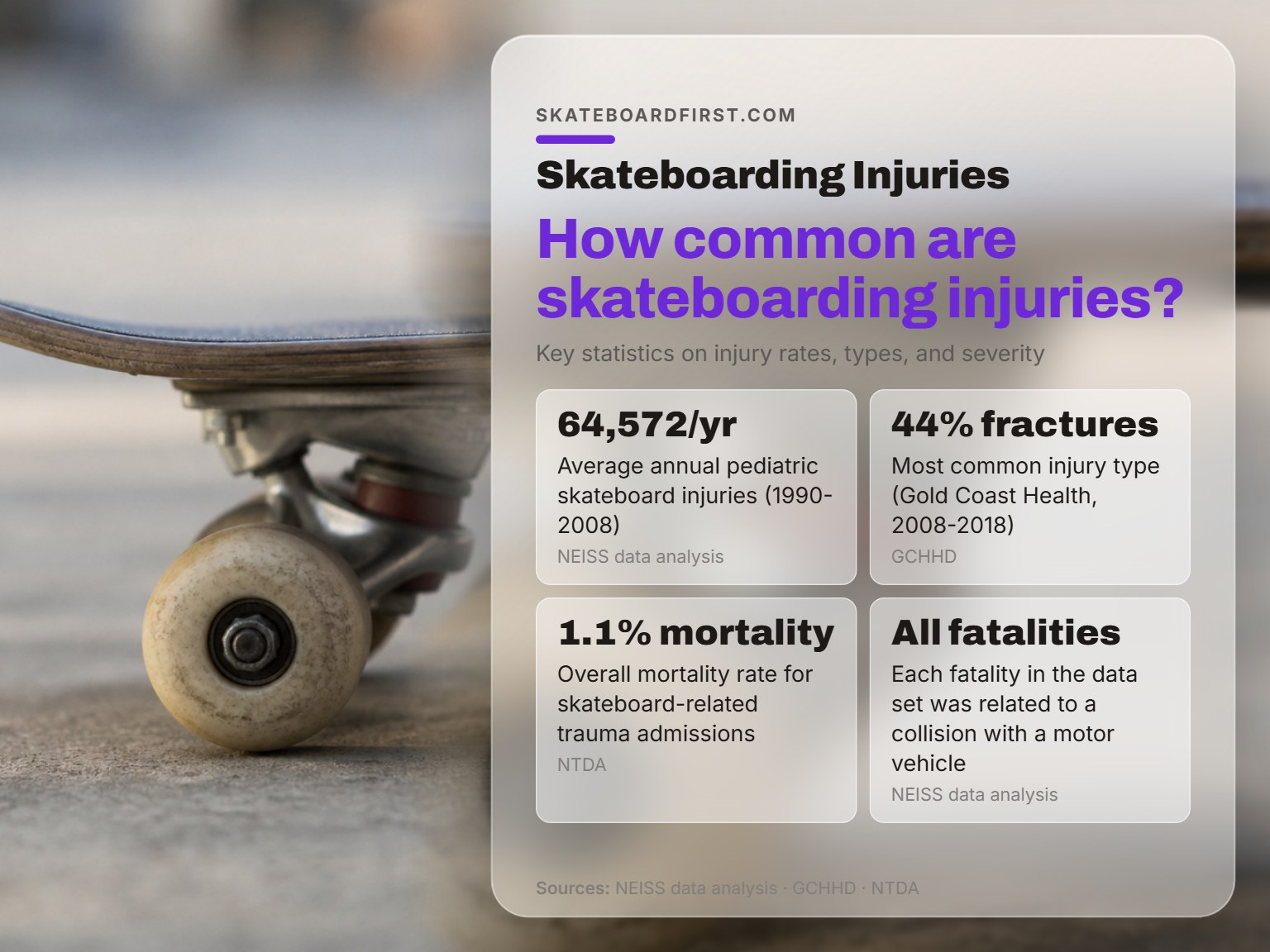
Skateboarding sends an estimated 64,572 kids and teens to US emergency rooms each year, with fractures (44%) being the most common injury and the wrist, ankle, and head taking the hardest hits. The risk isn’t evenly spread; the incidence of severe trauma (ISS ≥16) is 23.7% for those over 16, while for those under 10 it is 5.4%. Children under 10 are significantly more likely to suffer femur fractures than older age groups.
The gap between those numbers is where most safety advice falls apart. A 15-year-old pushing a big stair set and an older skater face different risks; the data shows severe trauma incidence and mortality rates increase with age. This isn’t about scaring you off the board; it’s about matching the protection to the real, documented patterns, informed by skateboarding injury statistics, so the fun doesn’t end in the ER.
What follows: a breakdown of where and how skateboarders actually get hurt, pulled from hospital intake logs and trauma registries, not guesswork, grounded in skateboarding injury statistics. You’ll see why age dictates the injury, how a helmet cuts the odds but doesn’t make you invincible, and the one place you should never skate.
Key Takeaways
- Fractures dominate injury logs, making up 44% of cases in a major Australian study, with the wrist and hand accounting for over half of all upper limb trauma.
- Age predicts injury patterns. Among trauma admissions, the incidence of severe trauma (ISS ≥16) jumps from 5.4% for those under 10 to 23.7% for those over 16. Children under 10 are significantly more likely to suffer femur fractures than older age groups.
- Helmets are a statistical lifesaver. Not wearing one increases the odds of a head injury by 70%, and using a skatepark (not the street) is a documented protective factor.
- Most fatalities involve cars. Every skateboarding death in a national dataset was due to a collision with a motor vehicle.
- Recovery is often orthopedic. At least 48% of injured skaters needed follow-up bone and joint care, meaning many injuries have lasting effects beyond the initial ER visit.
The Raw Numbers: How Many Skateboarders Get Hurt?
You see the occasional ambulance at the skatepark and wonder how often that actually happens. The answer lives in databases like the US National Electronic Injury Surveillance System (NEISS) and other skateboarding injury statistics. From 1990 through 2008, an estimated 1,226,868 children and adolescents were treated in emergency departments for skateboarding injuries. That averages out to 64,572 cases every year.
A 10-year review at a major Australian trauma centre identified 5,026 skateboarding injuries between 2008 and 2018, confirming these are common events that place a significant demand on orthopedic and emergency departments.
The pediatric injury rate per 10,000 is not static. From 1990 to 1994, it decreased by 72.9%. Then, from 1994 to 2008, it increased by 378.9%. For the 11-14 age group, that later increase was 587.0%.
The story gets more serious when you look at trauma centers. A 5-year analysis of the US National Trauma Databank found 2,270 admissions specifically for skateboard-related injuries, accounting for 0.1% of all trauma admissions. The overall mortality rate in that group was 1.1%, but for patients older than 16, it was 2.6%.
What Are the Most Common Skateboarding Injuries?
Ask any skater with a few years under their belt and they’ll point to their wrist or ankle. The data backs them up.
| Injury Type | How Common Is It? | Most Affected Body Part |
|---|---|---|
| Fracture | 44% of injuries (Gold Coast Health data) | Upper limb (56% of fractures) |
| Sprain/Strain | Ankle sprains are a frequent injury; one participation-based study found them more common than wrist fractures, while hospital data shows fractures are most common. | Ankle (45% of lower limb injuries) |
| Head Injury | 3.5–13.1% of all injuries (Literature review) | Traumatic brain injuries & concussions make up 62% of head injuries |
The upper limb is the crash landing pad. When you fall, your instinct is to put your hands out. A 10-year review at Gold Coast Health hospitals found that wrist and hand injuries alone account for 57% of all upper limb injuries. That’s a lot of broken scaphoids and Colles’ fractures.
The lower limb story is about the ankle. It bears 45% of all lower limb injuries.
Then there’s the head. A literature review pins head trauma at 3.5–13.1% of all injuries. But within that category, the severity matters: traumatic brain injuries and concussions accounted for 62% of head injuries in the Australian cohort. This is where the helmet effectiveness conversation gets real.
Where does this leave a beginner wondering about their own risk? The data suggests focusing on wrist guards and learning to fall is as important as a helmet for avoiding the most common injuries. A sprained ankle might keep you off the board for weeks, but a broken wrist can need surgery and months of recovery. Start with the gear that addresses the most likely outcome.
The Age Factor Changes Everything
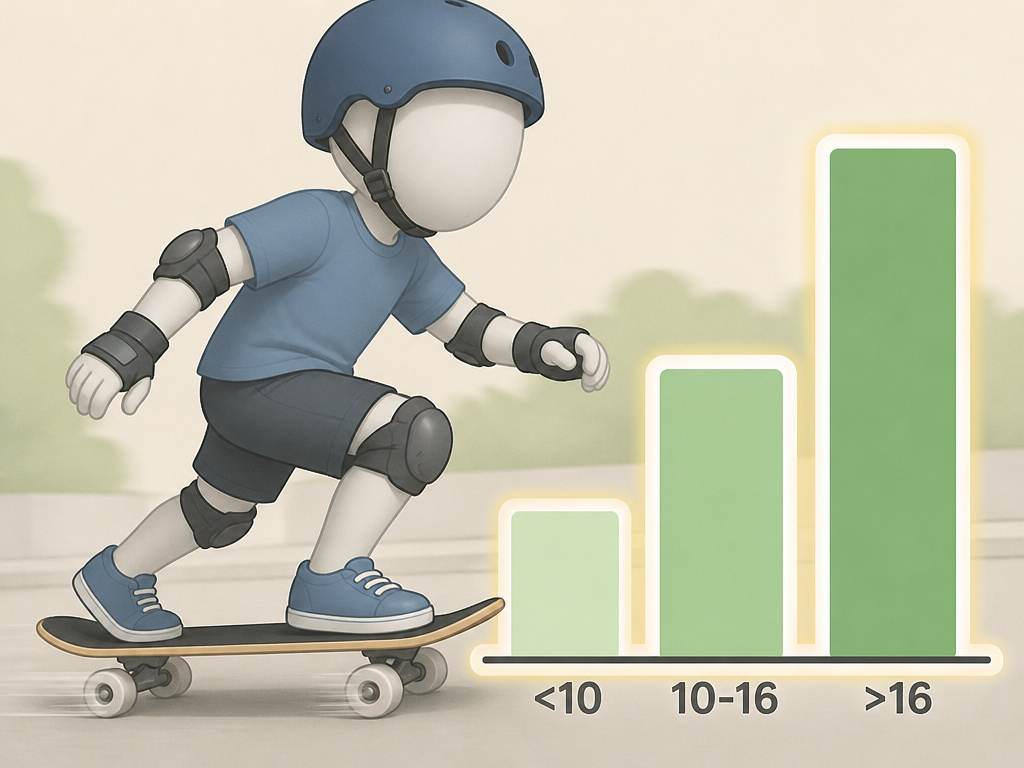
A 10-year-old on a skateboard and a 20-year-old are not doing the same activity, medically speaking. Age is the single biggest predictor of what will get hurt and how badly.
The National Trauma Databank analysis breaks it down cleanly. The incidence of severe trauma (an Injury Severity Score ≥16) isn’t a flat risk:
- <10 years old: 5.4%
- Ages 10–16: 13.5%
- >16 years old: 23.7%
The chance of a traumatic brain injury increases with age: 24.1% for those under 10, and 32.6% for ages 10-16 among trauma admissions.
Younger kids break different bones. Children under 10 are significantly more likely to suffer femur fractures and less likely to break their tibia than older skaters. Their bones behave differently on impact. This is a key reason organizations like the American Academy of Pediatrics suggest close supervision for kids between 6 and 10, and recommend those under 5 shouldn’t ride at all.
For parents, this means the skateboarding safety for kids conversation isn’t just about helmets. It’s about matching the environment to the child’s age and skill. A quiet cul-de-sac for a young beginner is a world apart from a street spot with traffic and curbs. The statistics on child injuries show that supervision and environment selection matter as much as padding.
Head Injuries: Concussions, Helmets, and Hard Facts This is the scary part, so let’s stick to the numbers. How likely is a serious head injury? Sources disagree on the percentage of all injuries that are head injuries. A broad literature review estimates head trauma accounts for 3.5–13.1% of all skateboarding injuries. Meanwhile, data from Gold Coast Health hospitals found that, when a head injury occurs, traumatic brain injuries and concussions made up 62% of those head injuries.
The protective factors are clear. The National Trauma Databank analysis identified helmets and use of a skatepark as significant factors protecting against head injury. Another study quantified it: not wearing a helmet resulted in 70% greater odds of sustaining a head injury.
| Factor | Effect on Head Injury Odds | Source |
|---|---|---|
| Not Wearing a Helmet | 70% higher odds (OR = 1.7) | Helmet Use Factors Study |
| Skateboarding (vs. Snowboarding) | 96% higher odds (OR = 1.96) | Helmet Use Factors Study |
| Male Sex | 44% higher odds (OR = 1.44) | Helmet Use Factors Study |
Helmet use isn’t equal across the board. The same study found skateboarders had 72% lower odds of using a helmet compared to snowboarders (OR = 0.28). Kids 12 and under were more likely to wear them, and racial/ethnic minorities had lower odds of helmet use.
The takeaway is mechanical, not moral. A certified helmet (look for CPSC or N-94 standards) manages the energy of an impact. It can’t make you invincible, but it dramatically alters the equation, especially for the beginner injury risk period when slams are frequent and unpredictable. Your brain is a soft organ in a hard case. The helmet adds a crumple zone.
Where and Why: Skateparks, Streets, and Collisions
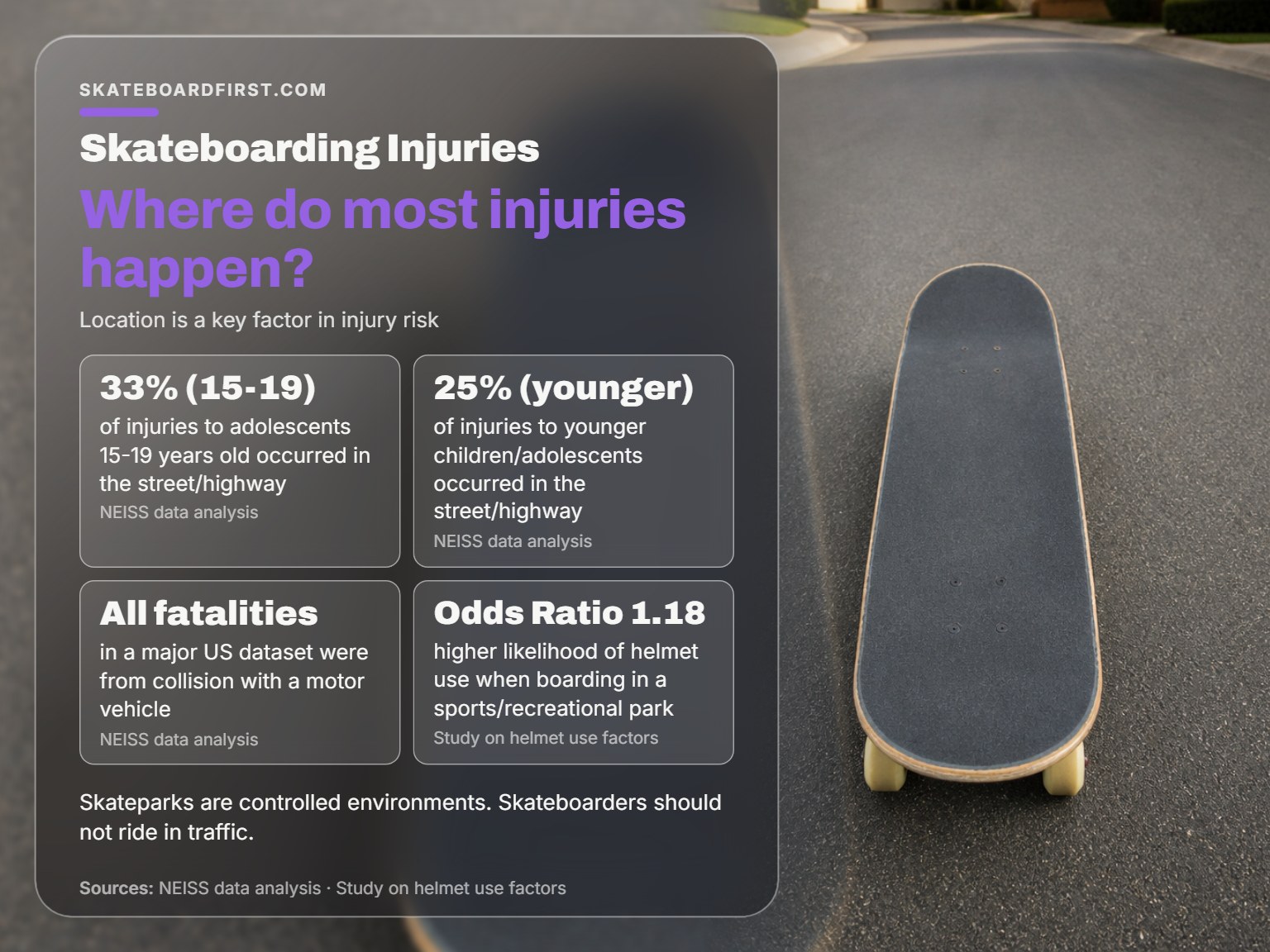
Location decides the danger. One-third of injuries to adolescents 15-19 years old, and one-quarter of injuries to younger kids, happened in the street or on a highway.
Every fatality in a major US dataset was related to a collision with a motor vehicle. The recommendation is non-negotiable: skateboarders should not ride in traffic.
The street introduces variables a skatepark eliminates: cars, curbs, unpredictable pavement, and traffic laws not designed for boards. A skatepark, even with its concrete bowls and ramps, is a controlled environment. The same study that praised skateparks as protective also found that boarding in a sports/recreational park (vs. “other” locations) increased the odds of helmet use by 18%. Safety measures cluster together.
What Does Recovery Actually Look Like?
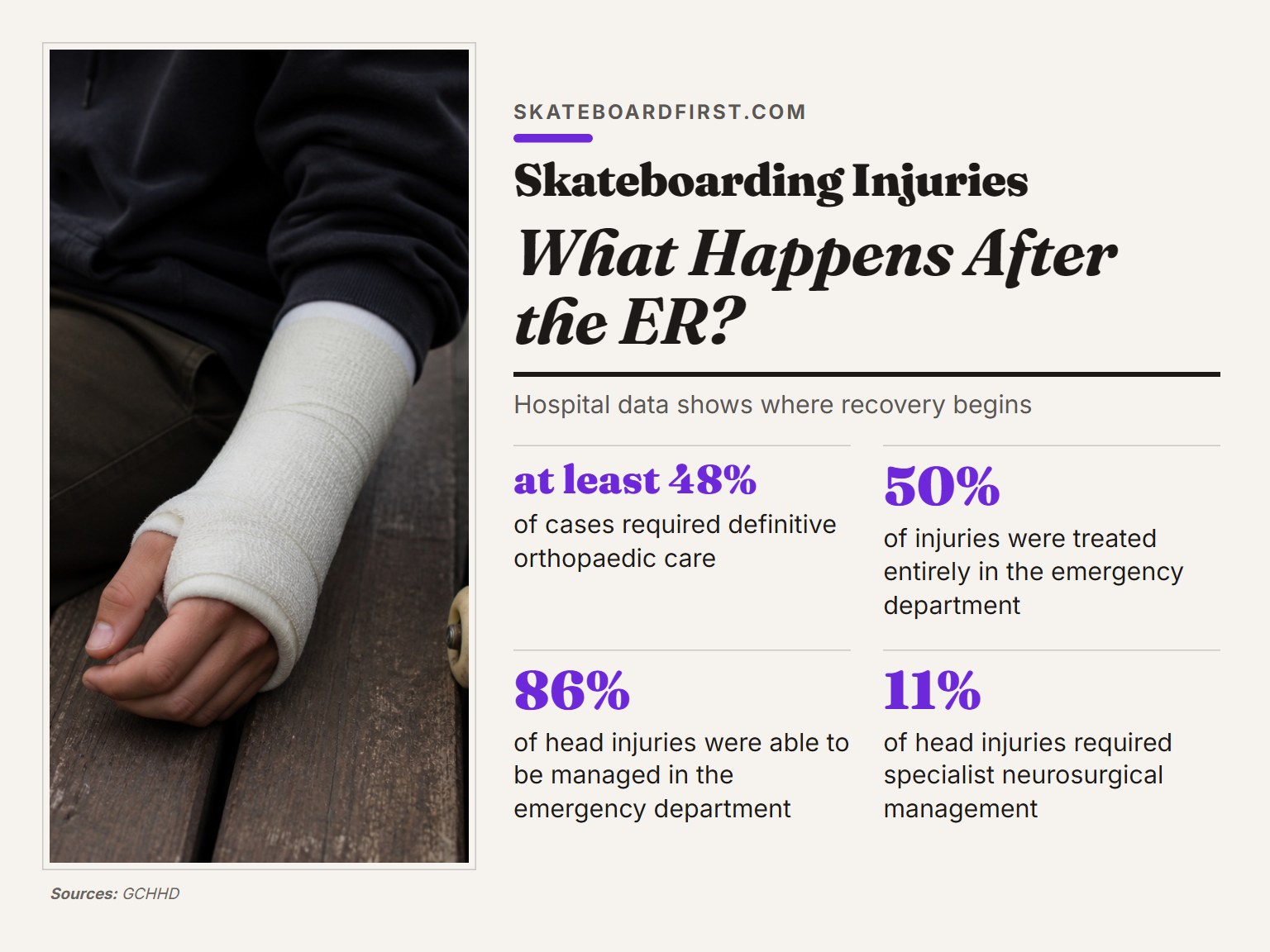
You’ve seen the cast or the knee brace at the park. What happens after the ER?
The Australian data gives a clear picture. Definitive orthopedic care, meaning follow-up appointments, casting, surgery, or physical therapy, was required in at least 48% of cases. That’s nearly half of all injured skaters needing ongoing bone and joint treatment. Conversely, 50% of injuries were able to be treated entirely in the emergency department with stitches, a splint, or advice.
Head injuries had a different path. 86% were managed in the ER, but 11% required specialist neurosurgical management. That’s a small percentage, but it represents severe cases with potential for lasting impact.
For the individual, this translates to timelines. A wrist fracture recovery can take 6-8 weeks for the bone to heal, and months more to regain strength and flexibility. An ankle sprain recovery might have you off the board for a few weeks, but without proper rehab, it becomes a weak point that re-sprains easily. This is where the value of injury prevention exercises becomes obvious, stronger supporting muscles can turn a potential fracture into a bruise.
Who Gets Hurt Skateboarding?
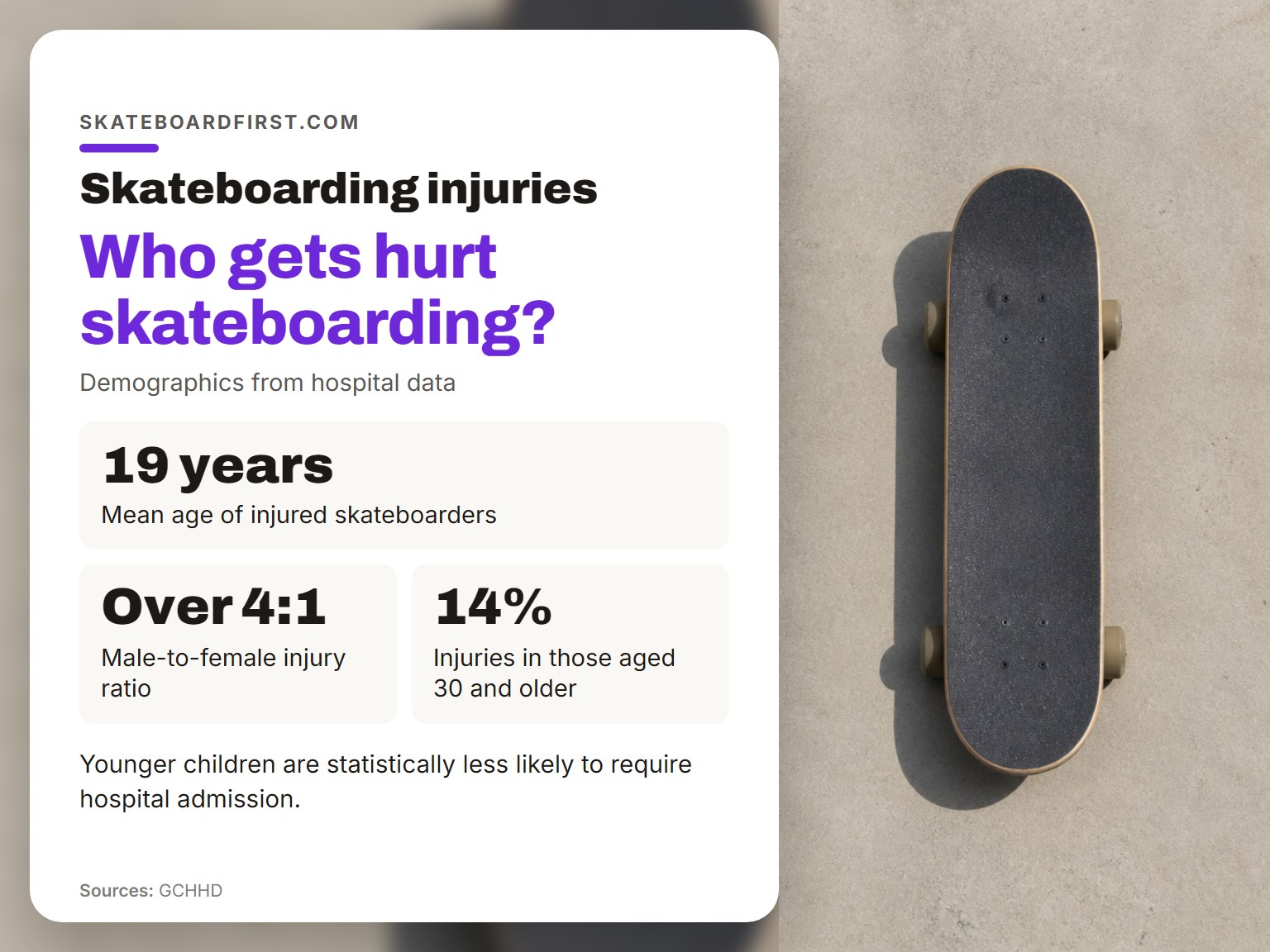
Skateboarding injuries predominantly affect young males. Data from a decade of hospital admissions shows the mean age of injured skateboarders is 19 years, with only 14% of injuries occurring in those aged 30 and older. The male-to-female ratio of those injured is over four to one. While younger children are statistically less likely to require hospital admission, supervision is critical; experts recommend children under 5 should not ride skateboards at all, and those between 6 and 10 years old should be closely supervised while skating.
General Skateboarding Safety Tips
Skate in designated areas like skate parks whenever possible, as this has been shown to be a protective factor against injury, particularly head injury. Never skate in traffic; one analysis found that all recorded fatalities were due to collisions with motor vehicles. For younger skaters, active supervision is essential. Learning to fall safely can help reduce the severity of injuries, especially to the wrists and ankles, which are commonly fractured or sprained. Always inspect your skateboard and the riding surface for defects or hazards before starting.
Frequently Asked Questions
What is the most common injury in skateboarding?
Fractures, particularly of the wrist and hand. A 10-year hospital review found 44% of skateboarding injuries were fractures, and 57% of upper limb injuries involved the wrist and hand. Ankle sprains are also extremely frequent.
How many people get injured from skateboarding?
In the US, an average of 64,572 children and adolescents were treated in emergency departments each year from 1990-2008. A single Australian hospital system saw 5,026 injuries over a decade. It’s a common sport for ER visits.
How risky is skateboarding compared to other sports?
It’s difficult to compare directly due to different participation rates, but skateboarding has a high risk for specific injuries like wrist fractures and concussions. One study found skateboarders had 96% higher odds of a head injury than snowboarders. The risk shifts dramatically with age and environment, street skating carries the added danger of car collisions.
Do helmets prevent concussions in skateboarding?
Yes, but they don’t eliminate the risk. Studies show not wearing a helmet increases the odds of a head injury by 70%. Helmets that meet CPSC or N-94 standards are designed to manage impact energy and reduce the severity of head trauma, including concussions.
What age group gets hurt the most skateboarding?
Teenagers and young adults face the highest risk of severe injury. The chance of severe trauma jumps from 5.4% for skaters under 10 to 23.7% for those over 16. However, the largest number of injuries overall occurs in the 10-16 year age group, making up a significant portion of trauma admissions.
Before You Go
The numbers tell a specific story. Skateboarding injury isn’t a single monster; it’s a set of predictable patterns tied to age, location, and gear. For a parent, the threshold is clear: if your skater is under 10, the focus is on supervision and safe environments, their bones break differently. If they’re a teen pushing limits, the conversation has to include helmet culture and skatepark use, their risk of severe trauma is four times higher.
