
Ceramic Skateboard Bearings Pros and Cons: How to Choose
This post contains affiliate links. As an Amazon Associate, we earn from qualifying purchases.
Ceramic skateboard bearings use silicon nitride balls in steel races for less friction and no ball rust, but they have a 58% lower predicted fatigue life than steel under load, and sources disagree on their tolerance for high-impact landings from jumps and gaps. The choice hinges on your skating style: low-impact cruising and speed benefit most; street and park skating see fewer advantages for the high cost.
That 58% number comes from a NASA technical report. It is a calculation, not a guess, a specific trade-off hidden behind marketing claims of “long-lasting performance.” The entire debate about ceramic skateboard bearings pros and cons collapses into one question: what loads are you actually putting on the board?
What follows: a breakdown of the ceramic skateboard bearings pros and cons, where the pros are real (speed, rust resistance for the balls), where the cons are physical (brittleness, fatigue life), and the one skating style where the math might actually work in your favor.
Key Takeaways
- Ceramic balls do not rust, but the steel races in hybrid bearings still can, you must avoid water and maintain them like any other bearing.
- For a given load, a NASA report calculates hybrid ceramics have a 58% lower predicted fatigue life than all-steel bearings due to higher contact stress.
- Sources disagree on their suitability for high-impact skating: SMB Bearings and Tactics.com advise they are best for low-impact use, while Koyo Bearings positions its hybrid ceramics for enabling ‘more spectacular acrobatic acts.’
- A set like SKF Ceramic needs a 2–3 week break-in period to overcome factory grease and reach maximum roll.
- Ignore ABEC ratings for skateboarding; the standard does not measure impact handling, lateral stress, or materials.
The Speed and Friction Advantage (It’s Real, But Narrow)
Ever push off and feel your board glide a few extra feet without effort? That is the ceramic promise. Silicon nitride balls are harder and smoother than steel. This creates less rolling resistance and friction at the contact points inside the bearing.
A hybrid ceramic bearing uses silicon nitride balls rolling between hardened steel races. The ceramic’s lower coefficient of friction and natural lubricity can reduce drag, which is most noticeable during sustained, high-speed rolling.
The sensation involves holding speed with less push, not achieving a higher raw top speed. On long, smooth pavement or a gentle downhill, you will coast farther. That is the physical reality behind the “faster” claim. For a cruiser or a longboarder covering distance, this is a tangible, measurable benefit. For a street skater stopping and starting every ten seconds, it is barely perceptible.
Where this goes sideways: Chasing this feeling by removing bearing shields to reduce friction. The SKF Ceramic Skate Bearings come packed with a “significant amount” of low-friction grease from the factory. A wear test found they took roughly 2-3 weeks to achieve maximum rolling capacity after that grease worked in. If you pull the shields off for a louder, faster sound right away, you also let in grit that grinds away at both the ceramic balls and the steel races. The test advice is clear: if you remove shields, de-grease the bearings first to prevent them from collecting dirt.
Rust Resistance: The Half-Truth Every Skater Should Know
You can skate them in the rain, right? Not exactly. The ceramic balls themselves are inert. Water will not corrode a silicon nitride sphere. This is the kernel of truth in the “rust-proof” claim.
However, a hybrid ceramic bearing is not all ceramic. The outer and inner races are steel. The cage holding the balls is often steel or sometimes nylon. Both of those components can and will rust if exposed to moisture. SMB Bearings and Tactics.com are explicit on this point: despite ceramic balls not rusting, the steel races and cages in hybrid bearings can still corrode.
So the practical advice flips: you must maintain a hybrid ceramic bearing almost exactly like a steel one. Avoid puddles. Dry the board off after a damp session. The only difference is that if you do get water inside, the balls won’t pit, but the races still can. That is a marginal safety net, not a license to treat them carelessly.
The 58% Fatigue Life Drop (and Why It Matters)
This most important con comes from a NASA report on silicon nitride bearings, not a bearing brand. The 2005 technical memorandum calculated that, for a given load, hybrid ceramic bearings have a lower predicted fatigue life than all-steel bearings (58% lower for deep-groove ball bearings) due to higher Hertz contact stresses.
The ceramic ball is stiffer and deforms less under load than a steel ball. This concentrates the force into a smaller contact patch on the steel race, increasing the stress. Over thousands of rotations, this higher stress can lead to premature spalling (pitting) on the raceway. Marketing materials from companies like Koyo and Rollerblade tout “long-lasting performance” and “improved durability,” but these are not quantified claims against a known load.
| Claim Source | Fatigue Life Assertion | Key Detail |
|---|---|---|
| NASA Technical Report (2005) | 58% lower predicted life than steel. | Based on calculated Hertz contact stresses for a given load. |
| Koyo Hybrid Ceramic (2022) | “Long-lasting performance.” | Marketing claim; no load or life quantification provided. |
| Rollerblade Hydrogen Ceramic | “Long-lasting performance.” | Marketing claim; no load or life quantification provided. |
The main idea is that ceramics do not always last longer. Under the high, shock loads of skateboarding, landing a trick off a ledge, the physics are not in their favor. If you are a heavier skater or punish your board with big gaps, this calculation matters more.
Impact Tolerance: Where Manufacturers and Skaters Disagree

Can they handle street skating? The sources directly conflict. SMB Bearings, an industrial bearing specialist, states plainly: “Hybrid ceramic bearings are less likely to withstand repeated impact loads, such as constant jumps.” Tactics.com aligns with this, advising ceramics are “better suited for low-impact skating and commuting rather than big gaps or stair sets.”
Conversely, a 2022 product announcement for Koyo Hybrid Ceramic Skate Bearings positions them for enabling “more spectacular acrobatic acts.” This implies the bearing is designed to tolerate the impacts of advanced trick skating.
Who is right? The OSTI technical report on ceramic fatigue offers a clue: it notes a “lack of standardized testing for ceramic bearing rolling contact fatigue (RCF), and some concern for the reliability remains.” Without a standard test for skateboarding’s unique side and shock loads, both claims are somewhat speculative. The conservative, physics-based advice from SMB is the safer bet for a street skater.
Hybrid vs Full Ceramic: The Only Type You Should Buy

You might see “full ceramic” bearings advertised. Ignore them. SMB Bearings is definitive: “Full ceramic bearings are the least forgiving of impact loads which is why they are not generally used as skate bearings.” Both the balls and the races are ceramic, making them extremely brittle. A hard landing can shatter them. For skateboarding, hybrid ceramic, ceramic balls in steel races, is the only viable design.
The steel races provide the ductility needed to absorb impact without catastrophic failure. Modern hybrids, like the Koyo Hybrid Ceramic Skate Bearing, also incorporate design tweaks like an optimized raceway and special heat treatments to the rings to better handle skating dynamics.
Bearing Construction: Shields, Cages, and Why They Matter

The benefits of ceramic can be undone by poor surrounding design. Two components are critical:
- Cage Material: Many quality hybrids, like the Rollerblade Hydrogen Ceramic (which uses a nylon cage) and SMB’s own offerings, use nylon cages. Why? “Nylon cages are more forgiving if dirt or other particles enter the bearing, or if there is insufficient lubrication.” The nylon can flex slightly, whereas a steel cage might grind a trapped particle into the race.
- Seal Type: SMB Bearings argues non-contact seals are arguably best suited for skate bearings. They keep out more dust than open metal shields without adding the frictional drag of rubber contact seals. They are also serviceable: “Seals can be removed using a Stanley knife or other thin blade, carefully inserted under the tip of the seal and gently prised open.”
This is where you should spend your attention, not on the ABEC rating. As Tactics.com notes, “ABEC ratings do not include factors like impact handling, lateral stress handling, materials, lubricant, noise, and vibration.” The world record skateboard speed is too low for an ABEC 9 bearing to roll faster than an ABEC 3.
Maintenance and Lifespan: The Ceramic Care Paradox
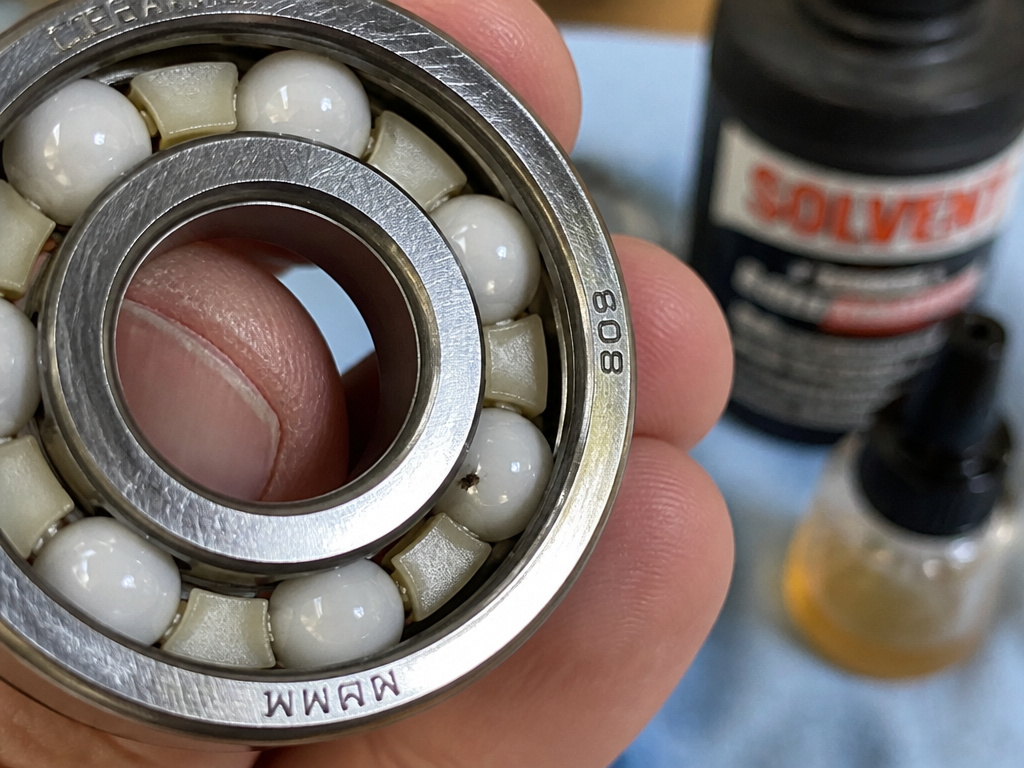
Ceramics promise longer life, but they demand the same maintenance as steel to achieve it. The idea that they are “maintenance-free” is a myth. In fact, their tighter tolerances and harder balls can make them less forgiving of grit. If you get dirt inside, the hard ceramic ball will press it against the steel race, potentially causing faster wear than a softer steel ball might. This makes a non-contact seal, and a disciplined routine of cleaning your bearings, more important, not less. The process is identical: remove shields, soak in solvent, dry thoroughly, and lubricate the bearings with a light oil or dedicated skate lubricant.
Your bearings’ lifespan depends more on this maintenance and your skating style than the material. A well-kept set of quality steel bearings can outlast a neglected ceramic set.
Are Ceramic Skateboard Bearings Worth It? A Style-Based Decision

So, are they worth the premium, often triple the cost of a good steel set? The answer depends entirely on the individual skater.
Consider ceramics if: You are primarily a cruiser, longboarder, or distance skater. You value maintaining speed with minimal push and are disciplined about keeping your board dry and clean. The cost is not a major factor.
Stick with high-quality steel bearings if: You skate street, park, or do a lot of high-impact tricks. You are a beginner (put the money into better wheels or trucks first). You skate in all conditions or are less meticulous about maintenance. Brands like Bones Reds or Bronson G3s are the default choice here for a reason.
For most skaters, especially those reading a ceramic skateboard bearings pros and cons comparison, the smarter performance-per-dollar upgrade is almost always better wheels or perfectly dialed trucks. Once your entire setup is refined and you can genuinely feel the limitations of a broken-in set of best bearings like Bones Swiss, then the ceramic conversation might be relevant.
Frequently Asked Questions
Are ceramic bearings worth it for a skateboard?
For most skaters, no. The high cost delivers benefits only noticeable in specific, low-impact skating styles like cruising and long-distance pushing. Street and park skaters will see minimal improvement for a large price jump, making quality steel bearings a much better value.
Do ceramic bearings wear out faster?
Sources disagree on fatigue life: a NASA report calculates a 58% lower predicted fatigue life for hybrid ceramics under load, while marketing from Koyo and Rollerblade claims ‘long-lasting performance’ without quantification.
What bearings do most skaters use?
The vast majority of skaters, from beginners to pros, use high-quality steel bearings. Bones Reds are the ubiquitous industry standard because they offer reliable performance, are easy to service, and are affordable enough to replace regularly. The pros and cons of sealed bearings versus serviceable ones often matter more than the ball material.
Do ceramic bearings need to be oiled?
Yes, absolutely. While the ceramic balls themselves do not need lubrication to prevent rust, the steel races and the cage do. Friction and wear still occur at all the contact points. They require the same lubrication as steel bearings to run smoothly and prevent premature failure.
The Bottom Line
Ceramic skateboard bearings are a specialized tool, not a universal upgrade. The pros, reduced friction, rust-resistant balls, are real but narrowly applicable. The cons, higher cost, questionable impact tolerance, and a calculated fatigue life penalty, are significant.
Before you consider them, ensure your understanding ABEC ratings for bearings is solid so you are not paying for a meaningless number. Then, honestly assess your skating: do you spend most of your session pushing for distance on smooth ground, or popping tricks onto concrete? For the former, they might be a fun luxury. For the latter, your money and attention are better spent elsewhere on your setup.
