
What Size Skateboard Bolts Do You Need? Tools and How-To
This post contains affiliate links. As an Amazon Associate, we earn from qualifying purchases.
You need eight 10-32 thread bolts. The length depends on your deck thickness and whether you use riser pads: 7/8-inch to 1-inch for a standard 7-ply deck with no risers, 1-inch to 1 1/8-inch for the same deck with 1/8-inch risers. Always pair them with locking nyloc nuts.
That 10-32 thread is the essential part. The “10” is an ANSI size code, and the “32” means 32 threads per inch. Get that wrong, and the bolt simply will not thread into the truck’s baseplate. The length is variable, but messing it up has consequences, too short and the nut cannot grip, too long and exposed threads catch on everything. To avoid this, you must know what size skateboard bolts do you need.
What follows is the breakdown of those three specs, thread, length, and head type, plus the materials and tools that keep everything tight. By the end, you will be able to look at any deck and truck setup and answer what size skateboard bolts do you need.
Key Takeaways
- Every skateboard bolt uses a 10-32 thread; the nuts for your baseplates match this, while wheel and kingpin nuts are different sizes.
- For skateboarding without shock or riser pads, you need 7/8” – 1” bolts. Add 1/8-inch to the bolt length for every 1/8-inch of riser pad thickness.
- Sources disagree on the default: Concrete Waves recommends countersunk bolts for ollies/fliptricks, while skatedeluxe advises always using countersunk bolts for skateboarding and notes raised heads are suited for drop-through longboards.
- Zinc-plated steel hardware works for 90% of skaters; save stainless steel for wet climates or if you frequently ride in the rain.
- Check and tighten your hardware weekly if you ride regularly; loose bolts let trucks shift and are a common, fixable cause of instability.
The Standard Skateboard Bolt Specs (And Why They Matter)
A skateboard has three different nut sizes, but only one bolt thread. The baseplate nuts, the ones that secure your trucks to the deck, are 10-32, matching the bolts. The nuts holding your wheels onto the axles are 5/16″-24. The kingpin nut, which adjusts your truck tightness, is 3/8″-24. This matters because grabbing the wrong nut from your toolbox when you are in a hurry leads to a stripped axle or a stuck kingpin.
The baseplate nuts are the tiniest and mount the trucks to the deck. The wheel nuts are the mid-sized nuts that secure the wheels onto the truck axles. The kingpin nuts are the largest ones that screw onto the kingpin, securing the bushings.
All baseplate nuts should be the nyloc type. That little nylon collar inside the nut bites into the bolt threads and resists vibration. Without it, your hardware will loosen every few sessions. I learned this after a month of re-tightening bolts before every skate. Switching to a pack of Independent Genuine Parts hardware with locking nuts solved it, the difference in stability was immediate.
The thread specification, 10-32, is an industry standard. The “10” is a size designation from the ANSI B1 standard, not a measurement. The “32” means there are 32 threads per inch. This standardization, once you know what size skateboard bolts do you need, is why hardware from brands like Thunder, Independent, and Mini Logo all fit the same trucks. If you are ever looking at a bolt pack and the description does not mention 10-32, it is not for standard skateboard trucks.
Bolt Length: The Math You Actually Need
Bolt length is not about your deck width. It is about the total stack height the bolt must pass through: the deck, the truck baseplate, and any riser pad in between. Get it right, and the nut sits flush on the bolt with no exposed threads. Get it wrong, and you have either a safety issue or an annoyance.
A common formula, such as the one from Concrete Waves, is to start with 1 inch (which accounts for a standard 7-ply deck and the truck baseplate), then add the thickness of your riser pad. A 1/8-inch riser means you need a 1 1/8-inch bolt. The Tactics sizing guide for Dooks 1/8″ riser pads confirms this exact length. If you run no riser, you drop back to 1 inch, or even 7/8-inch for a perfectly flush fit.
| Your Setup | Deck Ply | Riser Pad | Bolt Length Needed |
|---|---|---|---|
| Street, no riser | 7-ply | None | 7/8″ – 1″ |
| Street, thin riser | 7-ply | 1/8″ | 1″ – 1 1/8″ |
| Cruiser/Longboard | 8-ply or 9-ply | None | Longer than standard 7-ply hardware* |
| Cruiser with riser | 8-ply or 9-ply | 1/4″ | 1 1/4″ – 1 1/2″* |
These are common ranges; always measure your specific stack.
Here is where a minor source disagreement pops up. The safe play is to go with the longer recommendation if you are between sizes. A bolt that is slightly too long is a cosmetic issue; a bolt that is too short is a structural failure.
Common mistake: Guessing bolt length based on deck width. An 8.0″ deck and an 8.5″ deck of the same ply count need the same bolt length. Width does not affect hardware size.
Why does a too-long bolt matter? First, those exposed threads are sharp. They will tear up your hands when you carry the board. Second, and less known, is that the threaded portion does not always run the full length of the bolt. If you have an excessively long bolt, you might run out of threads before the nut can tighten down securely. The nut will spin freely, leaving the truck loose.
Head Types and Drive Styles: Countersunk vs. Raised, Phillips vs. Allen
You have two choices to make here: the shape of the bolt head and the tool pattern on top.
Head Shape: Countersunk vs. Raised (Button)
For street skating, you always want countersunk bolts. The head tapers to sit flush with the deck’s surface. This is critical if you plan to do ollies or flip tricks. A raised head will catch the sole of your shoe every time you drag your foot. Raised heads are reserved for drop-through longboard mounting, where the bolt head sits on top of the deck.
Drive Style: Phillips vs. Allen (Socket)
This is a matter of tool preference and stripping risk. Phillips heads are ubiquitous, any hardware store screwdriver fits them. Allen heads require a hex key. The trade-off is strength: Phillips heads are more prone to stripping if you over-tighten them or if the tool is worn. Allen heads transfer torque more evenly and are harder to strip.
I have a box of stripped Phillips bolts from my first year of skating. I was using an old, slightly rounded screwdriver and cranked them too hard. Switching to Allen head bolts can reduce the risk of stripping. The included hex key fits perfectly, and I have not stripped one since.
Materials and Maintenance: Zinc, Stainless, and Weekly Checks
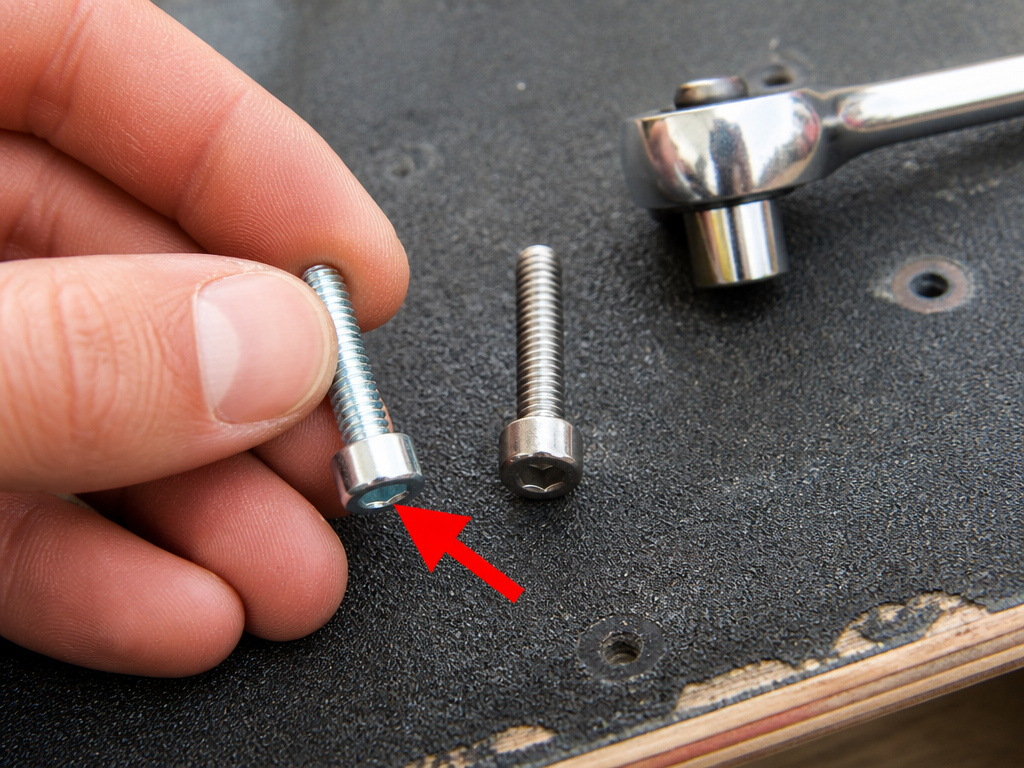
Skateboard hardware is a consumable part. It takes physical stress and weathers over time. Your material choice affects how long it lasts and how it fails.
- Zinc-Plated Steel: This is the default and the recommendation for 90% of skaters. It is cheap, strong, and sufficiently corrosion-resistant for dry conditions. Most shop-bought hardware packs are zinc-plated.
- Stainless Steel: Choose this if you frequently skate in wet conditions or live in a humid coastal area. It resists rust far better but is more expensive. The downside is that stainless can gall or seize if tightened against a dissimilar metal, like a zinc-plated nut.
Where this goes sideways: Using regular bolts from a hardware store. They are often a weaker alloy not rated for the lateral shear forces skating applies. They can snap, and the thread pitch might be wrong.
Maintenance is simple but critical. Tighten your bolts until they are flush with the top of the deck. Do not sink them below the surface, as this can crack the deck’s top ply. Do not leave them proud, or they will shred your grip tape and shoes.
Hardware loosens on its own from vibration. A loose bolt allows the truck to shift side-to-side, which feels unpredictable and can throw off your balance. It takes about a minute, and it has caught a loose nut more than once. The guide at Skateboards.com recommends a formal inspection once per week for regular riders.
If hardware is stripped or damaged, replace it. Skating with only two bolts per truck is risky. All eight bolts share the load; missing one increases the stress on the remaining seven.
Tools You Need and How to Install
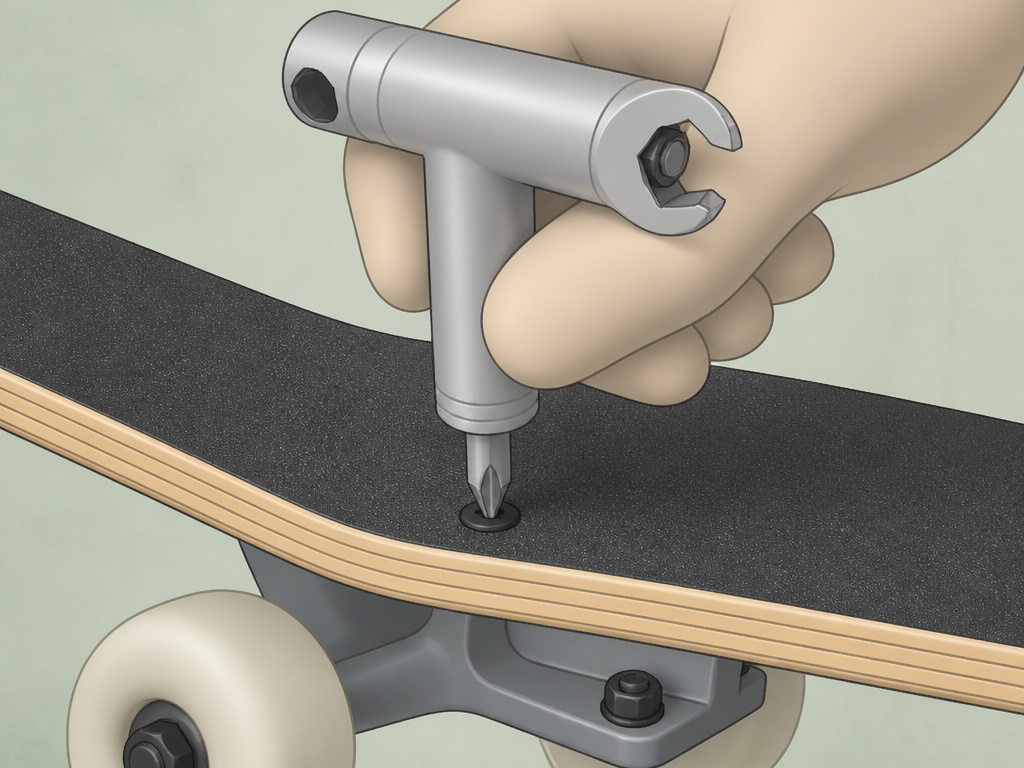
Installing hardware is the easiest part of building a board, but you need the right tools.
- A Phillips screwdriver or an Allen key, depending on your bolt head.
- A 3/8-inch wrench or a skate tool to hold the nut underneath.
A skate tool combines both and is the most efficient choice. The process is straightforward:
- Insert the bolts through the deck from the top.
- Slide your riser pad (if using) and truck baseplate onto the bolts from below.
- Thread a nyloc nut onto each bolt by hand.
- Place the wrench on the nut and the driver on the bolt head.
- Apply opposing pressure and tighten until the bolt head is flush with the grip tape.
Avoid over-tightening. You should not see the wood of the deck compressing around the bolt head. The goal is snug, not crushing.
What size nuts are on a skateboard?
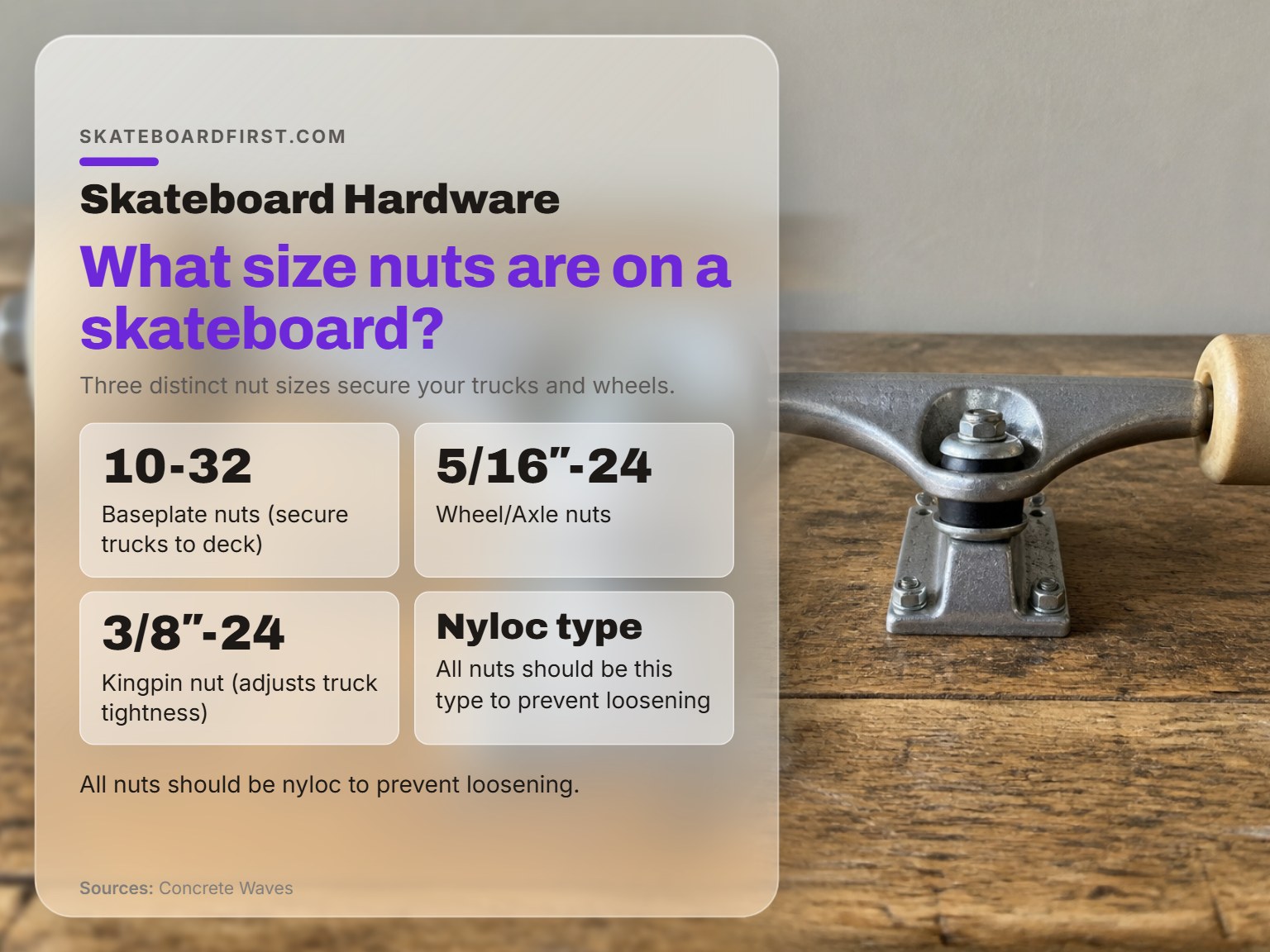
A skateboard uses three distinct nut sizes, but all the bolts that hold the trucks to the deck share the same thread. The baseplate nuts, which secure the trucks to the deck, are size 10-32. The nuts that hold your wheels onto the axles are a different size, 5/16″-24. Finally, the kingpin nut, which you adjust to change your truck tightness, is size 3/8″-24. Using the correct nut is crucial; a wheel nut won’t fit a kingpin, and using the wrong one can damage your trucks. For safety, all these nuts should be the nyloc type to prevent them from loosening due to vibration.
Frequently Asked Questions
What size bolts for an 8.25 deck?
Deck width does not determine bolt size. For an 8.25-inch deck that is 7-ply, use the same bolt length as any other 7-ply deck: 7/8-inch to 1-inch with no risers, 1-inch to 1 1/8-inch with 1/8-inch risers.
Can I use hardware store bolts?
It is not recommended. Standard hardware store bolts are often a different grade of steel and may not have the correct 10-32 thread pitch for skateboard trucks. They are not designed for the lateral shear forces of skating and can fail.
How tight should skateboard bolts be?
Tighten them until the bolt head is flush with the top of the grip tape. You should not be able to see the top of the bolt protruding, nor should it be sunk below the deck surface. Use a wrench and screwdriver in opposition to prevent spinning.
What if my bolts keep coming loose?
First, ensure you are using nyloc locking nuts.
The Bottom Line
Do not overcomplicate hardware. Buy a pack of eight 10-32 thread, zinc-plated, countersunk bolts from a skate brand. Match the length to your deck and riser combo using the 1-inch + riser height formula. Pair them with nyloc nuts, tighten flush, and check them weekly. This is one of the cheapest parts of your setup, but getting it wrong undermines everything else. Start with the basics, get a pack of eight 10-32 thread, zinc-plated, countersunk bolts, install them correctly, and then forget about them. Your board will be safer and more consistent for it.
