
Skateboard Bearing ABEC Rating Explained: The Real Story
This post contains affiliate links. As an Amazon Associate, we earn from qualifying purchases.
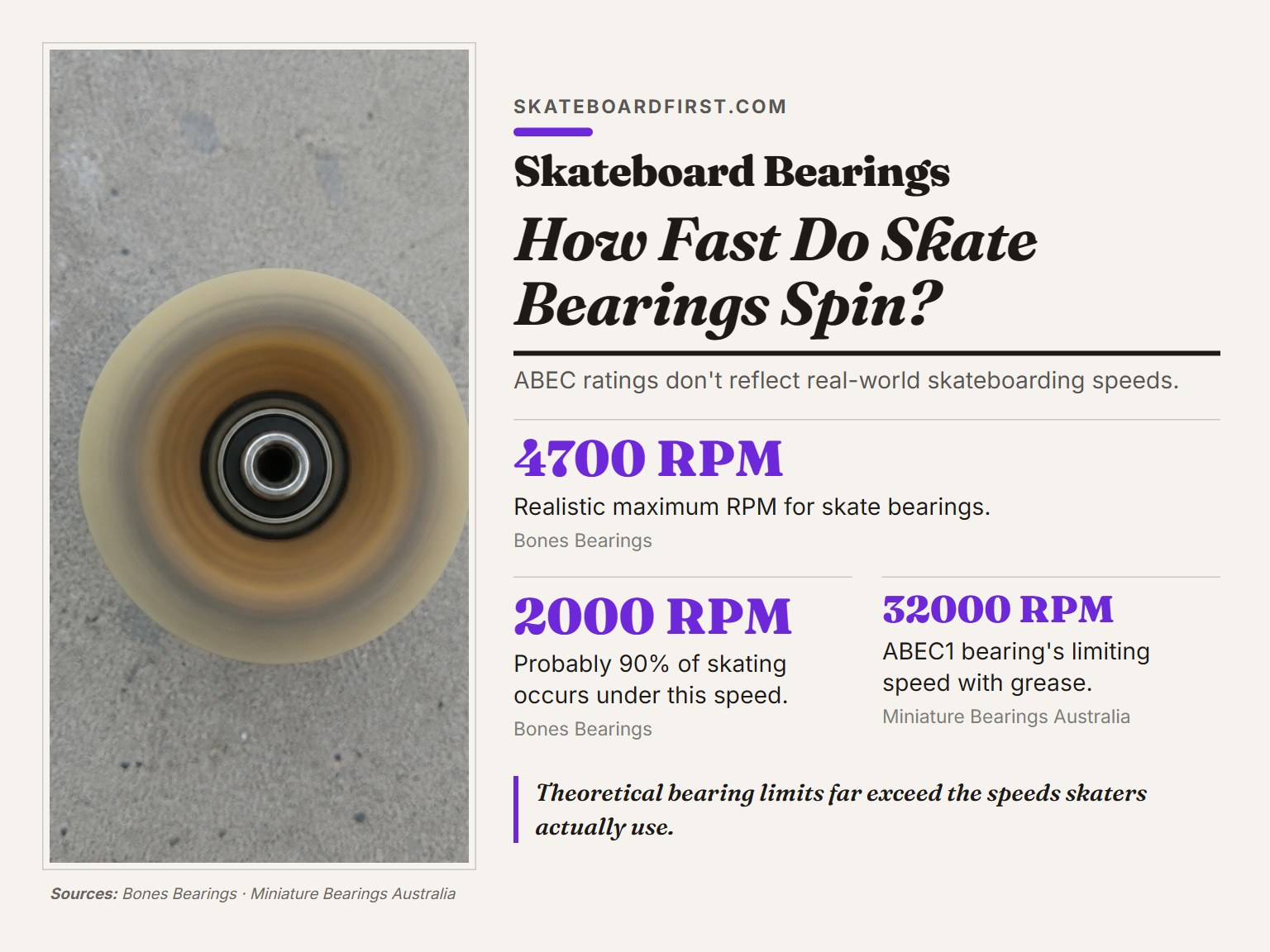
Skateboard bearing ABEC ratings measure dimensional tolerances, bore diameter, width, and raceway runout, using an odd-number scale from 1 to 9. Higher numbers mean tighter tolerances, but these specs are irrelevant for skateboarding because they ignore side loads, impact resistance, materials, and the low speeds (under 4,700 RPM) a skateboard actually sees. Some sources, like Alliance Bearing Industries, state an ABEC 1 or 3 bearing is all you need, while others market ABEC 5 or higher as standard.
The tolerance numbers get incredibly small. An ABEC 1 bearing allows a maximum eccentricity, out-of-roundness in the inner race, of 0.0075 mm. An ABEC 9 bearing cuts that to 0.0012 mm. That difference matters in a machine spinning at 30,000 RPM. On a skateboard, your wheels aren’t hitting those speeds, and the first hard landing or powerslide introduces more imperfection than the entire ABEC scale. This is the essence of a skateboard bearing ABEC rating explained.
What follows is a breakdown of where the ABEC myth came from, the two or three specs that actually affect how your board rolls, and a direct comparison of what popular bearing brands are really selling. By the end, you’ll know how to spend your bearing money.
Key Takeaways
- ABEC measures tolerances for high-RPM machinery, not skate performance. Higher numbers don’t mean faster.
- Real skate speeds are under 4,700 RPM, with 90% of skating under 2,000 RPM, far below where ABEC precision matters.
- Focus on bearing materials, lubrication, and shields, the ABEC rating ignores all three.
- For most skating, an ABEC 1 or 3 bearing is sufficient; spending more on ABEC 7 or 9 buys precision you can’t use.
- Proper installation with spacers does more for smooth rolling than any ABEC rating.
What Does ABEC Actually Measure?
ABEC stands for the Annular Bearing Engineering Committee, a part of the Anti-Friction Bearing Manufacturers Association (AFBMA). Its job is to set standards for bearing dimensions and geometry, how round the hole is, how parallel the sides are, how smooth the groove for the balls is. Manufacturers send bearings to be rated, and the committee assigns a grade: 1, 3, 5, 7, or 9. The higher the number, the tighter the allowed tolerances.
For an ABEC 1 bearing, the maximum eccentricity (out of roundness) allowable is 0.0075 mm (0.000295″). For an ABEC 9 bearing, it’s 0.0012 mm (0.000047″). This precision matters in a CNC spindle. On a skateboard, a single hard landing introduces more variation than that.
The system was designed for industrial applications where bearings spin in one direction at constant, extreme speeds, think electric motors or router bits. At 20,000 RPM, a tiny imperfection causes vibration, heat, and failure. The ABEC rating gives engineers a way to match bearing precision to machine needs, a key point in any skateboard bearing ABEC rating explained.
Skateboards don’t live in that world. According to Bones Bearings, a board with 54mm wheels would need to be going about 127 mph to hit 20,000 RPM. The realistic maximum for skate bearings is about 4,700 RPM, and 90% of skating happens under 2,000 RPM. At those speeds, the difference between an ABEC 1 and an ABEC 9 is literally undetectable by the bearing itself.
Why ABEC Ratings Are Irrelevant for Skateboarding
The ABEC committee does not test for axial or side loads. When you land a trick, slide sideways, or carve a tight turn, your weight pushes against the bearing’s side. That’s an axial load. Skateboarding exerts tremendous axial forces, which can deform or damage components. A bearing manufactured to a high tolerance (ABEC 7 or 9) can be more susceptible to this deformation than a more forgiving ABEC 3.
The rating also ignores almost everything else that determines how a bearing feels under your board:
- Materials: The grade of steel, the quality of the balls, and the retainer type (nylon vs. Steel) aren’t covered.
- Lubrication: Whether it’s grease or oil, and how much is inside, is not part of the standard.
- Clearance: The internal space between the balls and races, critical for thermal expansion and load handling, is ignored.
- Impact resistance: How well the bearing survives concrete kisses isn’t on the test sheet.
Two bearings with the same ABEC rating can perform wildly differently, a nuance often missed in a basic skateboard bearing ABEC rating explained. Bones Bearings states that reliance on ABEC alone “can lead skaters and dealers to choose a bad bearing for skating over a good bearing.” They don’t use ABEC ratings at all, instead using their own Skate Rated™ system.
Common mistake: Chasing a high ABEC number because it’s “more precision.” In skating, that precision is a liability, it makes the bearing more brittle under impact, and you’ll never spin fast enough to use it.
Steve Heplar of Alliance Bearing Industries, a major supplier to the skate industry, puts it bluntly: “An ABEC 1 or 3 is all you really need on a skateboard. In skateboarding, you’re not using the precision of the bearing.”
The ABEC Scale and What the Numbers Mean
The ABEC scale uses odd numbers: 1, 3, 5, 7, and 9. There is no ABEC 2, 4, 6, 8, or 11 in the official standard. Higher numbers indicate progressively tighter tolerances. The International Organization for Standardization (ISO) has an equivalent scale, so you might see bearings labeled with both.
| ABEC Rating | Approximate ISO Grade | Max Inner Race Eccentricity | Best For |
|---|---|---|---|
| ABEC 1 | ISO P0 | 0.0075 mm | Any skateboarding |
| ABEC 3 | ISO P6 | 0.005 mm | Any skateboarding |
| ABEC 5 | ISO P5 | 0.0035 mm | Marketing claims |
| ABEC 7 | ISO P4 | 0.0025 mm | Industrial machinery |
| ABEC 9 | ISO P2 | 0.0012 mm | High-speed spindles |
The jump from ABEC 1 to ABEC 9 is a reduction in allowable eccentricity from 0.0075 mm to 0.0012 mm. We’re talking about a variation over ten times smaller than a hair’s breadth. After a few sessions, grit, impact, and normal wear will make any bearing’s internal tracks more irregular than that.
What Matters More Than ABEC When Choosing Bearings
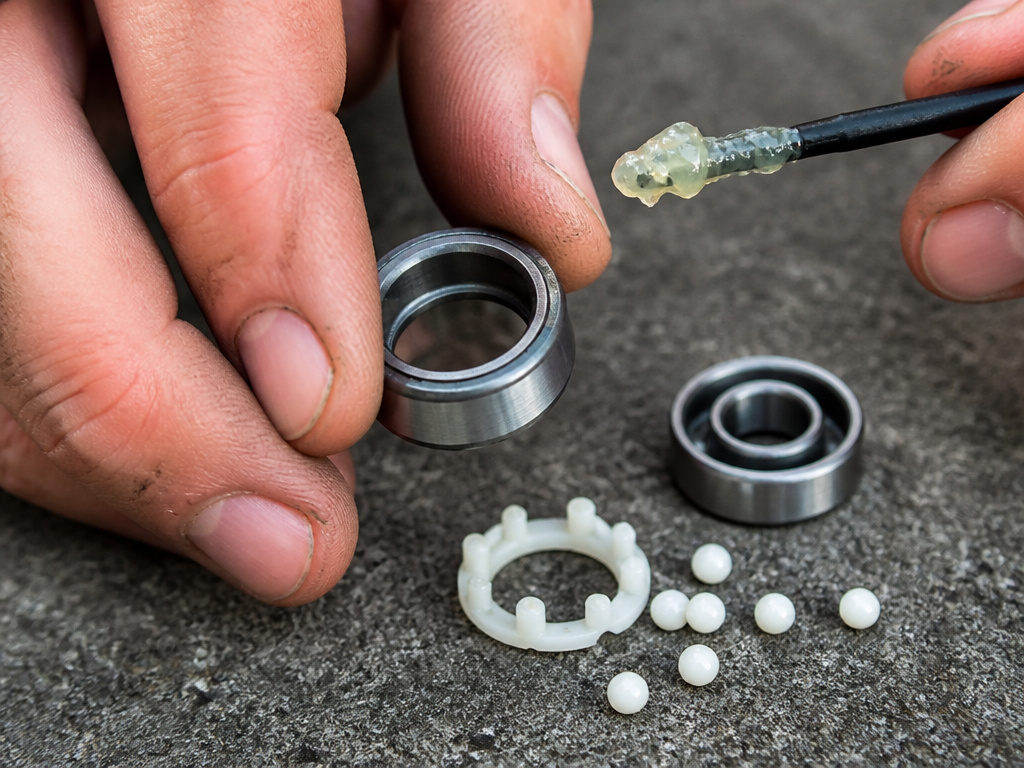
If ABEC isn’t the decider, what should you look for? Your checklist should have three items: materials, lubrication, and protection.
Materials and Build Quality
Stick with known skate brands like Bones Reds, Bronson G3, or Spitfire Cheapshots. These companies use bearing-grade steel (often labeled SUJ2) and quality control that generic “ABEC 9” bearings from a no-name brand lack. The retainer, the cage that holds the balls, is usually better in name-brand bearings. Nylon retainers are quieter and lighter; steel retainers are more durable but can corrode.
Lubrication Type and Amount
This is where you’ll feel a difference. Grease is thicker, stays in place longer, and seals out dirt better. Oil is thinner, offers less drag, but needs frequent reapplication. SMB Bearings states grease is a better option for skate bearings, while Miniature Bearings Australia suggests oil lubricant can be beneficial for speed. Most quality skate bearings come packed with a high-speed, low-torque grease. If a bearing feels slow out of the box, it’s often the grease, it needs a short break-in period to warm up and distribute.
Shields or Seals
Shields (usually metal) keep out larger debris but aren’t watertight. Seals (rubber or Teflon) provide better protection. Removable shields let you clean and relubricate, but sources disagree on this practice: Miniature Bearings Australia warns: “Removing the shields and relubricating the bearings is not recommended. If the bearing is running well, don’t open it,” while SMB Bearings provides guidance for relubrication. For most skaters, sealed bearings that you ride until they die are the simpler choice.
Internal Clearance (MC Rating)
This is a spec that actually matters but rarely appears on packaging. It’s the intentional gap between the balls and races. For normal skating, you want MC3 to MC4 clearance. If pure speed is the goal, like for downhill. MC5 clearance with an oil lubricant can reduce drag, but the bearings will wear out faster. You won’t find this on a blister pack; you have to trust the brand’s design.
The 0.095″ Tolerance That Doesn’t Matter
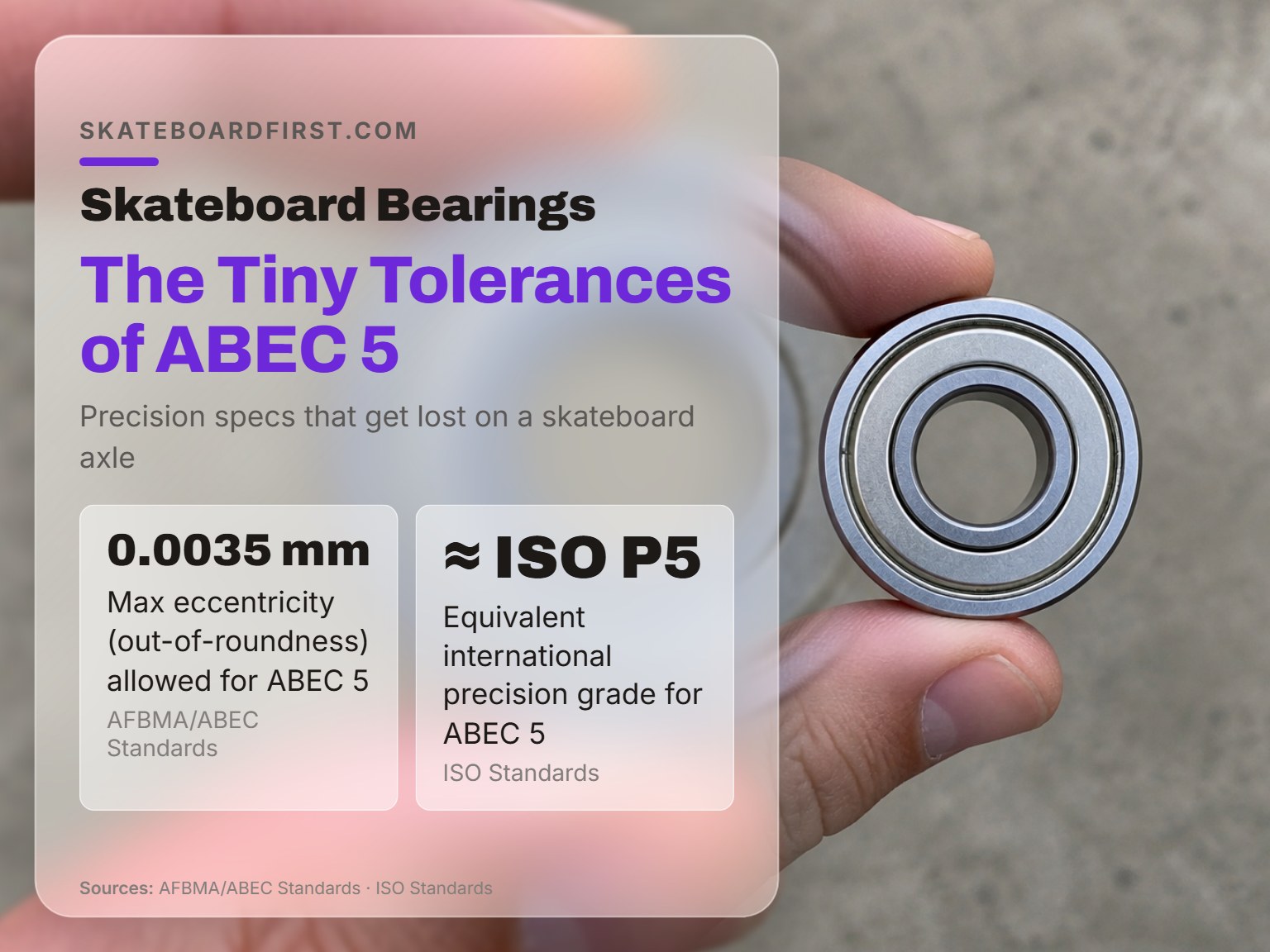
To be precise. For a standard 8mm inner diameter bearing, an ABEC 5 rating specifies the bore must measure between 7.995 mm and 8.0 mm. That’s a tolerance of 0.005 mm. Your skateboard axle is 8mm. The fit is already loose by design, the axle isn’t a press-fit shaft; it floats between two bearings with speed rings and a spacer.
Where this goes sideways: Using a high-precision ABEC 9 bearing with lower-precision skateboard components. The axle, wheel core, and truck hanger are not machined to ABEC 9 tolerances. The minute you tighten the axle nut, you’re bending that perfect inner race to match the imperfect axle. You just nullified the entire reason you paid extra.
The universal measurements for skateboard bearings are 8mm (inner diameter), 22mm (outer diameter), and 7mm (width). This is the 608 standard. Every bearing you buy should match these dimensions. The precision of how those 8mm are measured is what ABEC grades. Since your axle is also 8mm, and the fit isn’t perfect, the grading is academic.
ABEC 7 vs. ABEC 9 vs. “ABEC 11” – Cutting Through the Hype
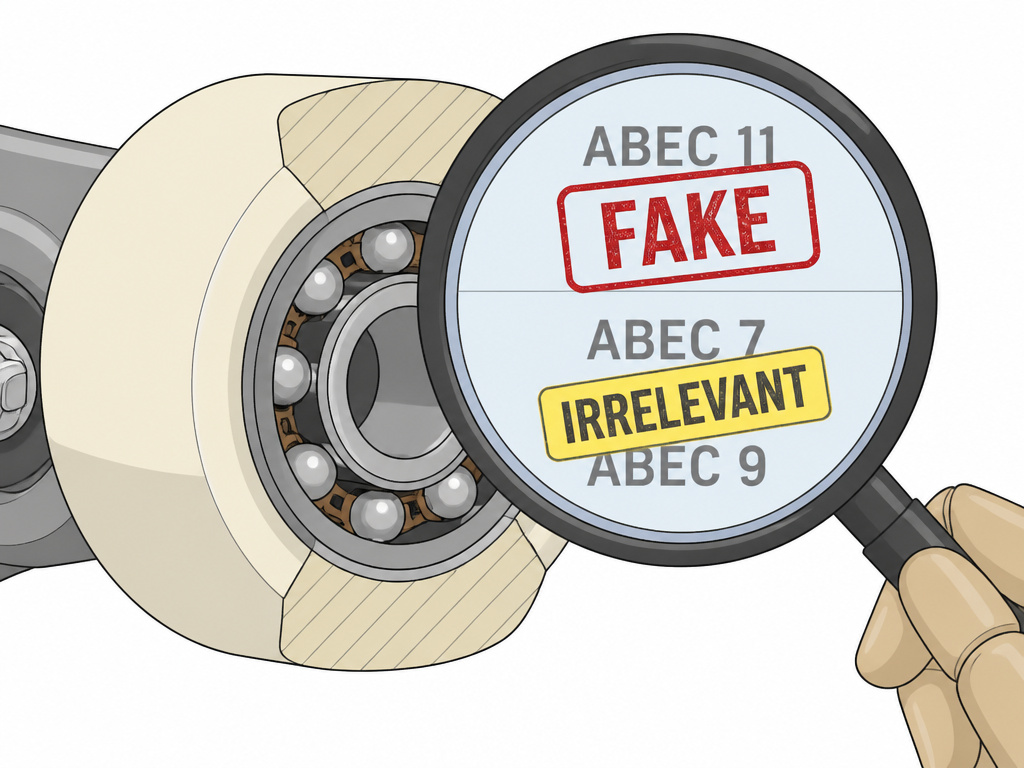
You’ll see bearings advertised as ABEC 7, ABEC 9, and sometimes even ABEC 11 or 13. Here’s what that means in practice.
ABEC 7 and ABEC 9: These are legitimate grades on the scale, representing high precision for industrial use. In a skateboard, they offer zero performance benefit over an ABEC 3. They often come with a price premium and, paradoxically, can be more fragile because the tighter tolerances leave less room for impact deformation. Brands that sell them are banking on the “higher number is better” myth.
“ABEC 11” or “ABEC 13”: These are not real ABEC ratings. The scale stops at 9. Any claim beyond that is pure marketing fabrication, a red flag that the brand is trying to dazzle you with a fake number. Treat these claims with extreme skepticism, if they’re lying about the rating, they’re likely cutting corners on materials and lubrication too.
| Claim on Package | Reality | What It Signals |
|---|---|---|
| ABEC 7 / ABEC 9 | Real rating, but irrelevant for skating. | Marketing to beginners; higher price. |
| ABEC 11 / ABEC 13 | Fake rating. ABEC scale ends at 9. | Aggressive marketing; likely low-quality generic bearing. |
| “Skate Rated” or no ABEC rating | Brand acknowledges ABEC is not useful for skating. | Focus is on skate-specific performance (e.g., Bones Bearings). |
When you see a high ABEC number, ask yourself: is this bearing from a reputable skate brand, or is it a generic bearing in flashy packaging? The brand’s reputation for quality control matters far more than the number stamped on the shield.
How to Choose Skate Bearings (A Practical Checklist)
Forget ABEC. Use this list instead.
- Pick a reputable skate brand. Go with Bones Reds, Bronson G3, Spitfire Cheapshots, or SKF Skateboard Bearings. These are proven in the real world.
- Decide on serviceability. Do you want to clean and relubricate? If yes, choose bearings with removable shields (often labeled “RS”). If no, get sealed bearings and plan to replace them when they get gritty.
- Install them correctly. This step matters more than anything you buy. Use speed rings on both sides of the wheel and a spacer between the bearings. Tighten the axle nut until it’s snug, then back it off a quarter-turn. This prevents the bearings from being preloaded, which creates drag and wears them out fast.
- Break them in. New bearings, especially greased ones, feel slow for the first few sessions. The grease needs to warm up and thin out. Don’t judge them until you’ve skated them for an hour or two.
- Maintain the rest of your setup. Dirty, worn wheels and loose hardware will ruin your roll long before your bearings will. Keep your skateboard bearing size in mind, and make sure you’re using the right tools for installation to avoid damaging them from the start.
Following these steps will get you a smoother, longer-lasting ride than chasing an ABEC number ever will. Your money is better spent on quality wheels or upgrading your trucks.
What do the numbers and letters on a bearing mean?
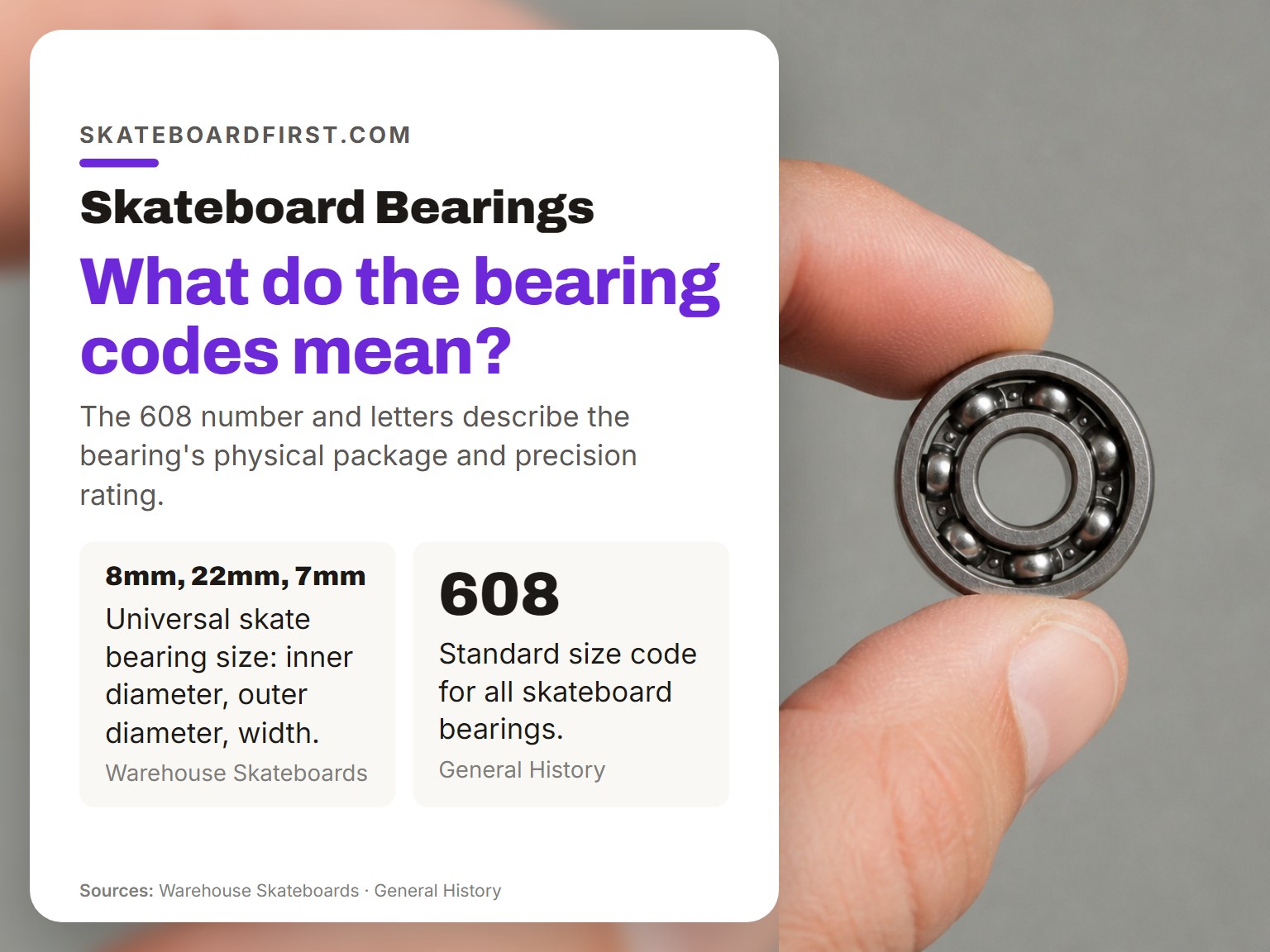
Every skateboard bearing you see is built to a standard size, and that’s what the ‘608’ code tells you. It means the bearing has an 8mm inner diameter, a 22mm outer diameter, and is 7mm wide. The letters that follow, like ‘ZZ’ or ‘RS’, describe the bearing’s shields. ‘ZZ’ indicates two metal shields, which offer good protection but are harder to open for cleaning. ‘RS’ typically means a single rubber seal on one side, which can be easier to remove. These codes are about the bearing’s basic construction, not its precision rating. They tell you the physical package you’re dealing with, while the ABEC rating speaks to the tightness of the manufacturing tolerances inside that package.
Frequently Asked Questions
What is better, ABEC 7 or 9?
Neither is better for skateboarding. Both are precision ratings for high-speed industrial machinery. An ABEC 7 bearing allows a maximum inner race eccentricity of 0.0025 mm; an ABEC 9 allows 0.0012 mm. That difference is meaningless on a skateboard, where impacts and side loads introduce far more variation. Choosing between them is like choosing between two racing tires for your bicycle, the difference exists, but your bike can’t go fast enough to use it.
Is ABEC 9 better than ABEC 5?
Only if you’re using the bearing in a device that spins above 20,000 RPM. For skateboarding, no. The tighter tolerances of an ABEC 9 offer no speed or longevity advantage over an ABEC 5, or even an ABEC 3. In fact, the tighter construction can make an ABEC 9 bearing more prone to damage from the axial loads of landing tricks.
What is better, ABEC 1 or 3?
Both are perfectly sufficient. An ABEC 1 bearing meets all the precision requirements a skateboard will ever demand. An ABEC 3 is slightly tighter but still well within the range of usefulness for skating. Industry suppliers like Alliance Bearing Industries state that an ABEC 1 or 3 is all you really need. Don’t pay extra for an ABEC 3 if a good ABEC 1 bearing from a reputable brand is cheaper.
What does “ABEC 11” mean?
It means the manufacturer is making up a rating. The official ABEC scale ends at 9. Claims of ABEC 11, 13, or higher are marketing fiction designed to make a generic bearing seem superior. Consider it a bright red warning flag about the brand’s honesty.
Do ceramic bearings need an ABEC rating?
No, and most quality ceramic bearings don’t carry one. Brands like Bones Swiss Ceramics use their own performance standards. The ABEC system measures dimensional tolerance in steel bearings. While ceramics can be made to ABEC tolerances, their performance advantage comes from material hardness, reduced friction, and corrosion resistance, factors ABEC doesn’t measure.
The Bottom Line
The ABEC rating is a solution to a problem skateboards don’t have. It’s a precise ruler in a world of hammers and concrete. Your bearing choice should hinge on brand reputation, proper installation, and realistic maintenance, not a number designed for factory machines.
Spend your money on bearings from a company that understands skateboarding, such as Bones Bearings, which states reliance on ABEC ratings alone can lead skaters to choose a bad bearing for skating over a good one. Then, put the time into installing them right with spacers and speed rings. That combination, a trusted brand and correct setup, is what gives you a fast, reliable roll. Everything else is just noise on the packaging.
