
Skateboard Bearing Size Guide: Specs and Compatibility
This post contains affiliate links. As an Amazon Associate, we earn from qualifying purchases.
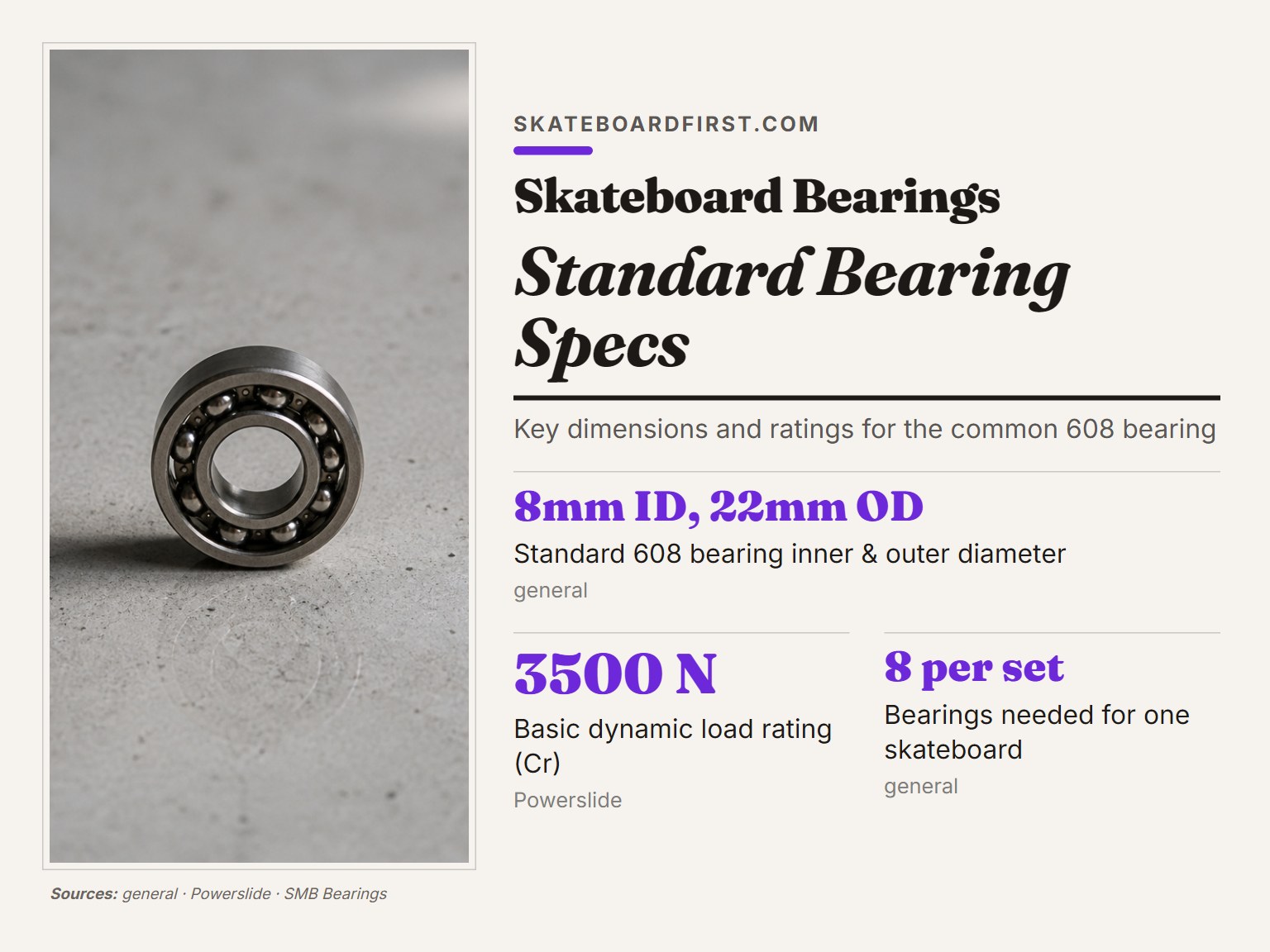
Skateboard bearings use a universal size known as 608, with dimensions of 8mm inner diameter, 22mm outer diameter, and 7mm width. This standard fits all modern skateboard wheels and trucks with 8mm axles. Sets are sold in eight because each wheel needs two bearings.
That 8x22x7mm spec is the one you will find printed on almost every bearing package. It is the definitive rule, not merely a suggestion or common size. The only time you need to look for a different number is if you are setting up quad skates, a specialty longboard, or using micro-hub wheels that demand a different standard. For clarity, consult a skateboard bearing size guide.
What follows: a breakdown of the 608’s why, the other bearing codes you might see, what ABEC ratings actually measure, and how to match bearings to your riding without overspending. We will also cover the tools you need to confirm your own bearing size and the one mistake that grinds new bearings to a halt in a week.
Key Takeaways
- The 608 bearing (8x22x7mm) is the universal skateboard size, any other number requires a specific, non-standard hub or axle.
- You need eight bearings for a skateboard, two per wheel, which is how all retail sets are packaged.
- ABEC ratings measure manufacturing tolerance, not speed; for street and park skating, an ABEC 5 bearing is the practical standard.
- Steel bearings from brands like Bones Reds or Bronson G3 are reliable for 99% of skaters; save ceramic bearings for wet, salted conditions where corrosion kills steel.
- Always use bearing spacers and speed rings, they prevent side-loads that destroy bearings and make wheels spin smoother under your weight.
The Universal 608: Dimensions and Compatibility
Look at the axle of your skateboard truck. That metal rod is 8mm thick. The hole in the center of your wheel’s hub is designed to accept a bearing with an 8mm inner diameter. This design is the 60-year-old legacy of an industrial bearing standard that became the default for skateboards, inline skates, and even office chairs.
The 608 bearing has an 8mm inner diameter (ID), a 22mm outer diameter (OD), and a 7mm width. These dimensions are defined by international standards, not by skate companies.
If you pull a bearing from a typical skateboard wheel, those are the numbers you will get every time. The Warehouse Skateboards buying guide and the Powerslide bearing specification PDF agree on this, as does any complete skateboard bearing size guide. The consistency is why you can buy a set of bearings from any brand and know they will fit.
Compatibility is absolute. A 608 bearing fits any skateboard wheel sold today and any truck with an 8mm axle. This includes longboard wheels up to 70mm in diameter, the hub core is still sized for a 22mm OD bearing.
How do you know what size bearings you need? If you are holding a standard skateboard truck and a typical street or cruiser wheel, the answer is 608. You do not need to measure. If you are holding a wheel from an old pair of quad roller skates or a specialty inline skate, then you might need to check. The process is simple: use a caliper or a ruler to measure the inner hole of the wheel hub. If it is exactly 8mm, you need a 608. If it is 7mm, you need a 607 or 627. If it is smaller, like 16mm across, you may be looking at a micro-bearing like a 688.
The math for how many is easier. Each wheel seats two bearings. A skateboard has four wheels. That is eight bearings total. Every retail pack reflects this. Buying a single bearing is an industrial supply move; buying an eight-pack is the skateboard way.
Bearings Beyond 608: When Size Actually Differs
The 608 is the default, but other numbers exist. These are adaptations for different equipment, not upgrades, and using the wrong one means the bearing will not seat in the wheel or fit on the axle.
The most common alternate you might encounter is the 607 (or the similar 627). This bearing has a 7mm inner diameter, a 22mm outer diameter, and a 7mm width. According to the SkateFAQ, some quad roller skates use this size for indoor use. The Powerslide guide notes there are no technical advantages between a 607 and a 608, the smaller bore is just a fitment requirement for a specific axle.
Then there are the smaller, lighter bearings designed for speed sports: the 688 and the 698.
| Bearing Code | Inner Diameter | Outer Diameter | Width | Primary Use | Note |
|---|---|---|---|---|---|
| 608 | 8mm | 22mm | 7mm | Skateboards, inline skates | Universal standard. |
| 607 / 627 | 7mm | 22mm | 7mm | Some quad skates | No performance difference vs 608. |
| 688 | 8mm | 16mm | 5mm | Micro-hub inline speed skates | Requires special wheel hubs/adapters. |
| 698 | 8mm | 19mm | 6mm | Custom lightweight setups | Less common; niche application. |
The 688 is a “mini” bearing. Its outer diameter is only 16mm, so it cannot fit into a standard skateboard wheel hub, as confirmed by any skateboard bearing size guide. As the Powerslide guide states, you need special hubs or adapters to use them. They are used in inline speed skates where saving weight matters. For a skateboarder, seeing a 688 means you are likely holding a bearing for inline skates, not a skateboard.
The 698 is another lightweight variant with a 19mm OD. It is less common for skateboarding. These alternate sizes highlight a key point: the first number (6) indicates a deep-groove ball bearing series, and the last two numbers specify the bore size in millimeters.
Where this goes sideways: Pressing a 688 bearing into a standard skateboard wheel because it “looks smaller and faster.” The bearing will not seat against the hub walls. The wheel will wobble on the axle, and the bearings will blow out on the first hard carve. Stick with 608 unless your equipment explicitly calls for something else.
ABEC Ratings Demystified: Precision vs. Performance
Here is the thing about ABEC ratings: they measure tolerance, not speed. The Annular Bearing Engineering Committee (ABEC) scale. ABEC 1, 3, 5, 7, 9, specifies how precisely the bearing’s inner race, outer race, and balls are manufactured. A higher number means tighter tolerances. For high-speed industrial applications, that precision reduces vibration and heat. For a skateboard bearing under the skater’s weight, the difference is theoretical.
The SMB Bearings guide puts it plainly. For an ABEC 5 bearing with an 8mm bore, the inner diameter tolerance band is between 7.995mm and 8.0mm. That is a variation of five-thousandths of a millimeter. An ABEC 9 bearing tightens that band to between 7.9975mm and 8.0mm. One solid ollie can distort the bearing races more than such tiny tolerances.
So why do ABEC 9 bearings often feel faster? Lubrication is one explanation. The AHR International page states that ABEC 9 bearings are usually filled with oil, not grease. Oil has lower viscosity, so it creates less drag at startup. The feeling of a “free spin” where the wheel spins for minutes when flicked is mostly about the lubricant, not the ABEC rating. Under load, your weight on the board, the difference evaporates.
| ABEC Rating | Tolerance (Bore Example) | Common Use in Skateboarding | Feels Faster Because… |
|---|---|---|---|
| ABEC 1 | 7.9920mm – 8.0mm | Budget completes, basic replacement | Often cheaper, less consistent. |
| ABEC 5 | 7.995mm – 8.0mm | The standard for most skating. | Good balance of precision and cost. |
| ABEC 7/9 | 7.9975mm – 8.0mm | Downhill, high-speed applications. | Often packed with low-viscosity oil. |
The Vandem Longboardshop guide goes further: “A bearing’s ABEC rating means almost nothing for skateboarding.” They argue that shocks and side loads make any precision advantage irrelevant. This contrasts with sources like Warehouse Skateboards, which states ABEC 5 bearings are standard for most skateboarding and ABEC 9+ bearings are great for downhill. For the rest of us, an ABEC 5 bearing is a common sweet spot.
What’s better, ABEC 7 or 9? For typical street, park, or cruiser skating, neither. The money is better spent on better wheels or a proper bearing installation. If you must choose, ABEC 7 is often the same price as ABEC 5 and comes with better seals. ABEC 9 is for chasing a feeling, not a proven performance gain.
Steel, Ceramic, and Hybrid: The Material Truth
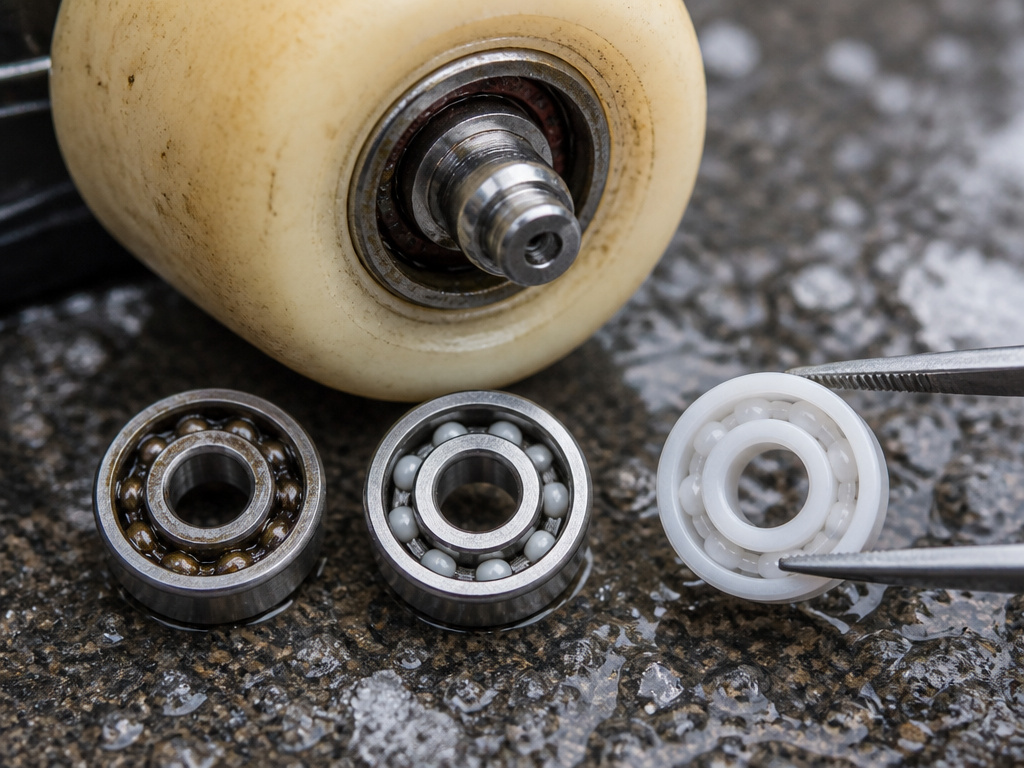
Most skateboard bearings are made from chrome steel (SAE 52100). They are affordable, durable, and when maintained, they last for years. Brands like Bones Reds and Bronson Speed Co. have built their reputation on reliable steel bearings. Then there are ceramic bearings, often priced from $70 to $100 for a set, compared to $15 for a basic steel set.
Ceramic bearings use silicon nitride balls. The material is harder, smoother, and does not corrode. The Warehouse Skateboards guide says they produce very little friction and won’t expand with heat. That is all true in a lab. On the pavement, the real advantage is corrosion resistance. As noted in a Reddit discussion among experienced skaters, ceramic bearings are absolutely necessary if you skate in a wet environment and especially through winter where roads are salted. Steel bearings will seize with rust; ceramics will not.
Common mistake: Buying ceramic bearings because a YouTube review showed a wheel free-spinning for two minutes. Free spin means almost nothing. Under load, the differences shrink. For dry, everyday skating, a quality steel bearing like Bones Reds will perform identically for the vast majority of skaters.
Hybrid bearings use ceramic balls in steel races. They offer some of the corrosion resistance at a lower price than full ceramic. Are they worth it? If you skate in damp conditions but cannot justify full ceramics, a hybrid set is a reasonable compromise. For everyone else, they are a solution in search of a problem.
Your bearing material choice should follow your environment, not your budget. Start with steel. If you notice rust after a few wet sessions, then consider corrosion-resistant options. Spending your entire bearing budget on ceramics while riding rock-hard, cheap wheels is a classic misallocation.
The Support Cast: Shields, Spacers, and Lubrication
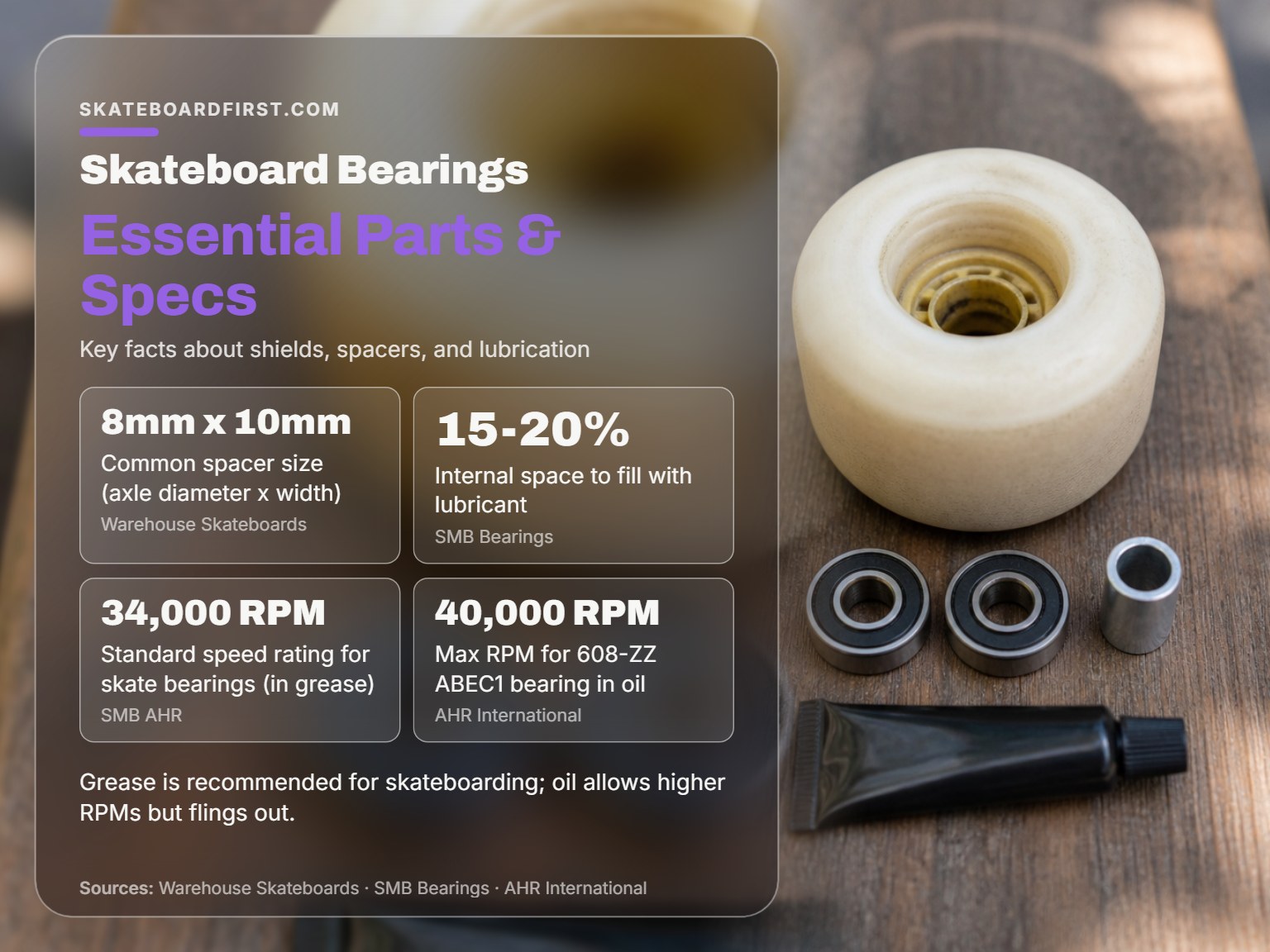
A bearing is more than its races and balls. The shields (or seals) keep dirt out. The cage holds the balls in place. Spacers and speed rings are not part of the bearing, but they are essential to how it lives on your axle.
Shields come as metal (ZZ) or rubber-contact (RS). Metal shields are basic protection. Rubber seals are better at blocking water and fine dust. Removable shields (RS) let you clean and relubricate the bearing. Sealed bearings are often packed with heavy grease and are considered “maintenance-free” but roll slower.
Spacers are the little tubes that sit between the two bearings inside the wheel. They ensure the bearings are pressed against the inner hub walls, not against each other. This prevents the inner races from being pinched, which creates drag and kills bearings fast. The common spacer size is 8mm (axle diameter) by 10mm (width). According to Warehouse Skateboards, large longboard wheels will take 10mm spacers, and skateboard wheels will take 8mm spacers.
Speed rings (also called washers) go between the bearing and the axle nut. They provide a smooth contact surface and prevent the nut from digging into the bearing shield. Always use them. Skipping spacers and speed rings is the fastest way to turn a new set of bearings into a gritty, slow mess within a week.
Lubrication is the final piece. The SMB Bearings guide states grease is a better option for skate bearings than oil. Grease stays in place, seals out contaminants, and lasts longer. However, AHR International notes oil can allow higher maximum RPMs (40,000 RPM vs 34,000 RPM for grease) but it flings out quickly. For skateboarding, where speeds are low but contamination is high, many sources recommend grease.
When applying grease, fill 15-20% of the internal space of the bearing. Overpacking it creates drag; under-packing it invites wear. A small tube of skate-specific grease can last for many maintenance sessions.
How to Choose Bearings for Your Riding Style
Your skating dictates your bearing needs more than any ABEC number. Here is a blunt breakdown.
Beginner / Street / Park Skater: You are learning, falling, and skating rough surfaces. You need durable, affordable bearings that are easy to replace. Buy an ABEC 5 or 7 steel bearing set with removable shields. Bones Reds, Bronson G3, or Spitfire Cheapshots are all proven. Do not overthink it. Your skill, not your bearings, is the limiting factor.
Cruiser / Commuter: You cover distance on less-than-perfect pavement. Reliability and corrosion resistance start to matter. A steel bearing with good rubber seals (like Bones Reds) works fine. If you ride in all weather, consider a hybrid bearing. Always use spacers and speed rings to extend lifespan.
Downhill / Speed Longboarder: You push higher speeds and need consistent roll. Bearing smoothness under load matters more than free spin. A precision steel bearing (ABEC 7 or 9) packed with a light grease or quality oil can offer marginal gains. Ceramic bearings may help with heat dissipation on long runs, but the truck and wheel quality are far more important. This is the only discipline where the bearing ABEC discussion has a slight practical footing.
Vert / Bowl Skater: You face high impacts and sweat. Durability is key. A robust steel bearing with good seals will handle the impacts.
The one upgrade that always pays off is proper installation with spacers. An inexpensive set of bearings correctly installed with spacers will often outroll a more expensive set installed without them. If you want to feel a real difference, learn how to install bearings correctly before you spend more money.
Troubleshooting Common Bearing Problems
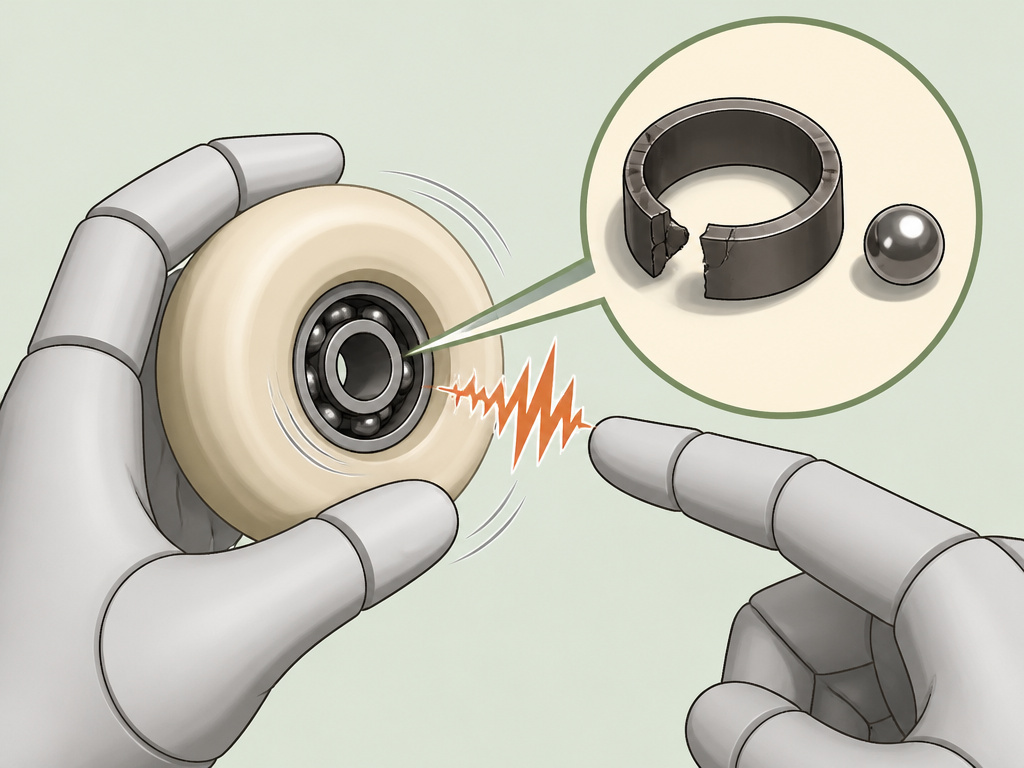
Bearings fail in predictable ways. Here is how to diagnose the sound and feel.
Grinding or gritty feel when spinning the wheel by hand: Dirt inside the bearing race. Time to clean and relubricate. If it persists after cleaning, the balls or races are pitted. Replace the bearing.
Loud clicking or popping sound: A broken ball or cracked cage. The bearing is failing catastrophically. Stop skating and replace it immediately to avoid wheel lock-up.
Wheel wobbles side-to-side on the axle: The bearings are not seated against the spacer inside the wheel hub. The inner races are floating. Disassemble the wheel, ensure the spacer is centered, and press the bearings in squarely.
One wheel spins significantly slower than the others: This is almost never the bearing itself. Check that the axle nut is not over-tightened. It should be snug against the speed ring, not cranked down. Over-tightening pinches the inner races and creates drag.
Rust on the outer shield: You skated in wet conditions and did not dry your gear. Surface rust can be cleaned off with a light abrasive. Rust inside the bearing means it is compromised. For future setups, consider a corrosion-resistant lubricant or sealed bearings for wet climates.
Most “dead” bearings are just dirty. Learning to lubricate bearings properly can significantly extend their lifespan. If a bearing is truly seized, however, you will need to remove bearings and replace them.
What do brand-specific bearing ratings mean?
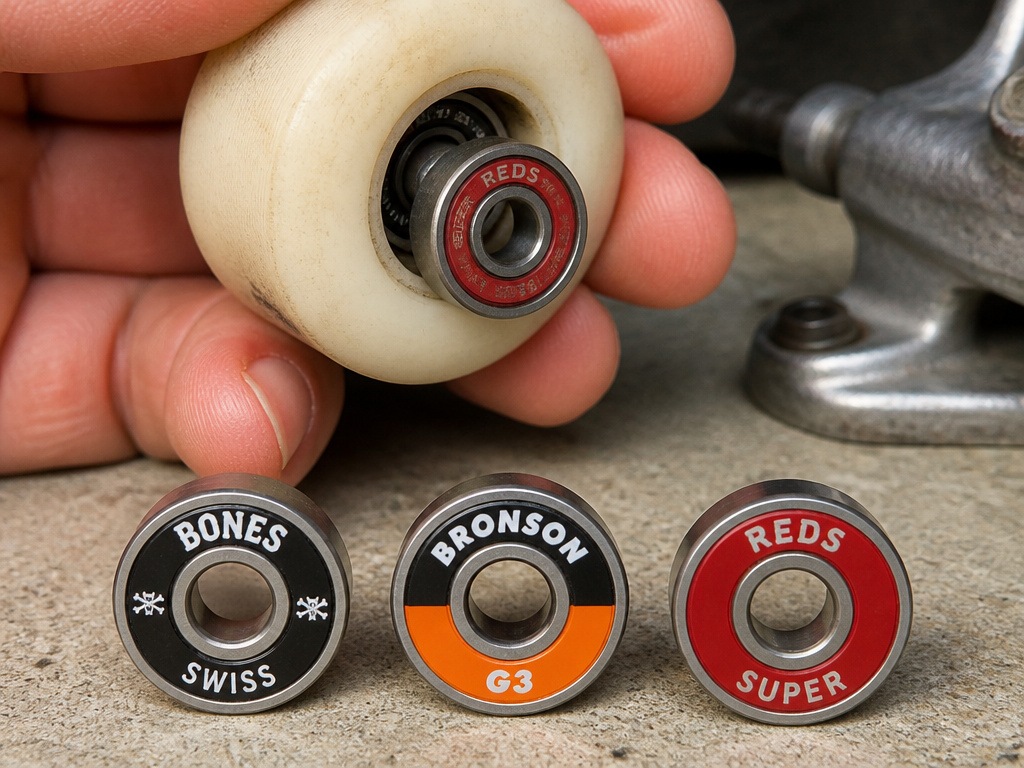
Manufacturers often create their own rating systems to describe a bearing’s performance for skateboarding. These ratings are designed to be more relevant than the industrial ABEC scale, focusing on factors like durability, smoothness under the unique side-loads of skating, and maintenance needs. While an ABEC rating only measures precision tolerances, a skate-specific rating aims to tell you how the bearing will actually feel and hold up under your board. When choosing bearings, look for these brand-specific labels as a guide to the product’s intended use, whether it’s for street skating, downhill speed, or all-around cruising.
Frequently Asked Questions
Are all skateboard bearings 8mm?
Yes, the inner diameter (bore) of a standard skateboard bearing is 8mm. This matches the 8mm axle on skateboard trucks. The full designation is 608, which specifies an 8mm bore, 22mm outer diameter, and 7mm width.
How do I know what size bearings I need for my skateboard?
If you have a standard skateboard with 8mm truck axles, you need 608 bearings. Measure the inner hole of your wheel hub, if it is roughly 22mm across, it accepts a 608. If you have a specialty setup like quad skates or micro-hub wheels, you may need a 607, 627, or 688. Always confirm with your equipment specs.
Is ABEC 7 or 9 better for street skating?
Neither offers a meaningful advantage for street skating. The precision difference is microscopic and is erased by the impacts and side loads of tricks. An ABEC 5 bearing is the practical standard. Spend the price difference on better wheels or a quality bearing press tool for proper installation.
Why do my new bearings feel slow?
The most common cause is over-tightening the axle nut. The nut should be snug against the speed ring, not cranked down with force. Another cause is thick factory grease. Some bearings are packed with heavy grease for shipping. Cleaning and relubricating with a light skate grease can wake them up.
How often should I replace my skateboard bearings?
Replace them when cleaning and relubrication no longer restore a smooth spin, or when you feel grinding or hear clicking. With regular maintenance, a set of eight standard 608 steel bearings can last a long time. Without maintenance, their lifespan is significantly reduced. Watch for the signs of wear rather than following a calendar.
The Bottom Line
Skateboard bearing sizing is simple: 608 is the rule, and everything else is the exception. Match the bearing to your axle and hub, not to a marketing claim. ABEC ratings measure tolerance, not performance, and for street skating, the difference between a 5 and a 9 is a rounding error after your first session.
Your money is better spent on proven steel bearings from a reputable skate brand, proper installation with spacers, and learning basic maintenance. The fastest bearing in the world will not help if it is pressed in crooked or drowning in dirt.
One rule to walk away with: if your setup is standard, buy 608. If your setup is not, you will already know. Keep it that simple, and you will never buy the wrong size again.
