
Kickflip vs Heelflip: Key Differences Explained
This post contains affiliate links. As an Amazon Associate, we earn from qualifying purchases.
A kickflip spins the board toward your feet with a toe flick; a heelflip spins it away with a heel flick. Your best starting point depends on your body mechanics, try both and stick with the one that feels less foreign.
That “try both” clause is the part most guides skip. They’ll tell you to start with kickflips, period. But the data from actual skaters shows a real split on the kickflip vs heelflip question, and your ankle might vote differently than the consensus.
This guide walks through the mechanics of each trick, the documented disagreement on which is easier, and a concrete method for deciding which one to tackle first. You’ll get foot placements, common failure modes, and the measurable standard for calling a trick “yours.”
Key Takeaways
- The core difference is spin direction: a kickflip spins toward you (counterclockwise), a heelflip spins away (clockwise).
- Sources disagree on which trick to learn first after the ollie: Skateboard Session and nollie.zone recommend the kickflip, Trick Dojo suggests trying both based on your body, and Skateboard.my Wall advises starting with a Shuvit.
- A trick is mastered when you can land it seven clean times out of ten, rolling, on unpicked ground, over two separate days.
- Heelflips often send the board forward, a common cause of backward falls; keep your weight slightly forward.
- If your flick feels awkward, switch tricks, the heelflip motion uses different ankle muscles and might feel more natural.
The Core Difference: Spin Direction & Flick
A kickflip spins the board toward your feet (counterclockwise) using a toe flick off the toe-side corner of the nose. A heelflip spins the board away from your feet (clockwise) using a heel flick off the heel-side corner. This mirror-image relationship changes everything from foot placement to where the board travels.
Think of them as left and right turns. A kickflip is a toe-side spin; the board rotates into your body. A heelflip is a heel-side spin; the board rotates away from you. That single change dictates where your front foot points, which part of your shoe contacts the board, and where you need to place your weight to stay over it.
The flick itself is the other half. A kickflip uses the side of your foot, near the pinky toe, to drag off the corner. A heelflip uses your actual heel to kick forward and out. One isn’t inherently harder than the other, they use different muscle groups in your ankle. Some people have a stronger, more coordinated toe flick. Others have a more natural heel kick.
Which Trick Is Actually Easier to Learn?
Here’s where the experts don’t agree on the kickflip vs heelflip. You’ll find authoritative sources on both sides of the fence, which is useful information in itself.
| Source | Position on Ease | Key Reasoning |
|---|---|---|
| Skateboard Session | Kickflip is easier. | “Kickflips are generally easier to learn and offer better board control.” |
| nollie.zone | Kickflip is learned first. | “Most skaters learn the kickflip first because the toe flick feels more natural.” |
| Trick Dojo | It depends on your body. | “The honest answer is that it depends on your body. Try both. Keep working on the one that feels less foreign.” |
| Skateboard.my Wall | Heelflip flick is easier to understand. | “Heelflip uses the heel instead of the toe… The flick motion is easier to understand.” |
The Reddit discussions mirror this split. One skater noted, “I feel like with kickflips, you legit have to develop a muscle in your ankle you only use for kickflips.” Another said, “Heelflip requires less from your ankle than kickflip in my opinion and heel comes more naturally to me.”
Where this goes sideways: Picking one trick because a guide said so, without trying the other. You might waste weeks on a motion your body fights, when the opposite flick could click in a single session.
So the real answer isn’t in a table. It’s in your first ten minutes on flat ground. Set up for a stationary heelflip and a stationary kickflip. Which flick feels more intentional? Which one makes the board spin more reliably? That’s your starting signal.
The Prerequisites: What You Need First
You cannot have this debate if you’re missing the foundation. Both tricks rely on the same essential skill.
A reliable, rolling ollie. Not a sketchy, one-in-five ollie. According to Trick Dojo, you need an ollie you can land “rolling, at a steady speed, landing over the bolts.” If your board isn’t staying under you consistently during a simple ollie, a flip will just magnify the problem. The pop for a kickflip or heelflip is identical to your ollie pop, don’t soften it because you’re thinking about the flick.
Comfort with board movement. This is why many progression lists, like the one from nollie.zone, suggest learning pop shuvits and 180s before flip tricks. A pop shuvit teaches you to let the board spin underneath you and find it again with your feet. That “find it again” skill is 90% of landing a flip trick.
My own documented experience lines up here. I tried kickflips long before I could roll comfortably. I spent roughly three weeks frustrated and landed nothing. When I went back to pushing, turning, and stopping, everything else started to click. The fundamentals aren’t a box to check; they’re the language you need to speak before you can form a sentence.
Breaking Down the Mechanics
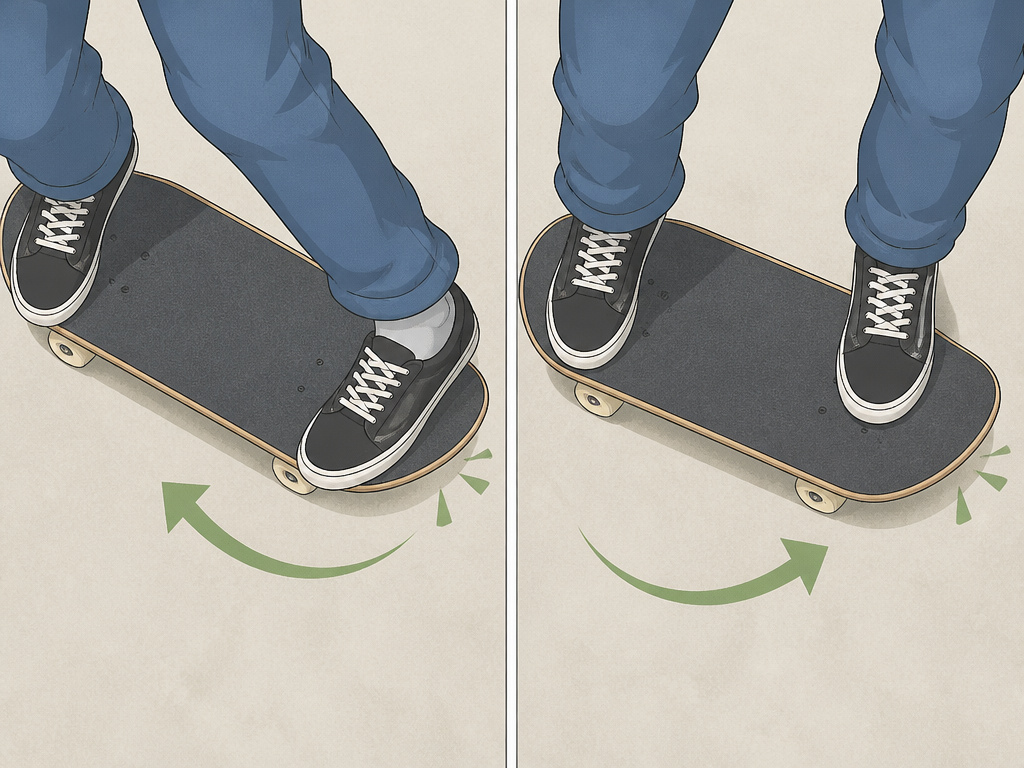
Kickflip: The Toe Flick
Your front foot angles across the board, ball of your foot near the toe-side edge. As you pop, you drag that front foot up and off the toe-side corner of the nose. The flick is a sideways, karate-kick motion. The board should spin levelly along its long axis.
Common mistake: Flicking down into the ground instead of out along the nose. This kills your pop and sends the board into your shins.
The fix: Focus on dragging your foot up the board first, then flicking out off the corner. The board needs height to complete its rotation.
Heelflip: The Heel Kick
Your front foot points more forward, toes hanging slightly off the toe-side edge, heel over the middle of the board. As you pop, you kick your heel forward and out, off the heel-side corner of the nose. Think of pushing a door open with your heel.
Common mistake: Leaning back. The heel kick pulls your weight toward your heels. “Heelflips often send the board out in front of you,” warns Trick Dojo, “and a board shooting out from under your feet is how people fall backward.”
The fix: Consciously keep your shoulders over the board and your weight slightly forward through the whole motion.
Foot Placement: The Subtle Stance Shift
This is the most overlooked detail. The foot placement isn’t just about where your foot is, but its angle.
| Trick | Front Foot Placement | Flick Point |
|---|---|---|
| Kickflip | Angled diagonally, ball of foot near toe-side edge. | Toe-side corner of the nose. |
| Heelflip | Pointed mostly forward, toes off toe-side edge, heel centered. | Heel-side corner of the nose. |
If you try a heelflip with a kickflip foot angle, your heel has no room to travel. The board won’t spin cleanly. That one change, angled vs. Forward, makes all the difference.
How to Decide Which One to Practice First
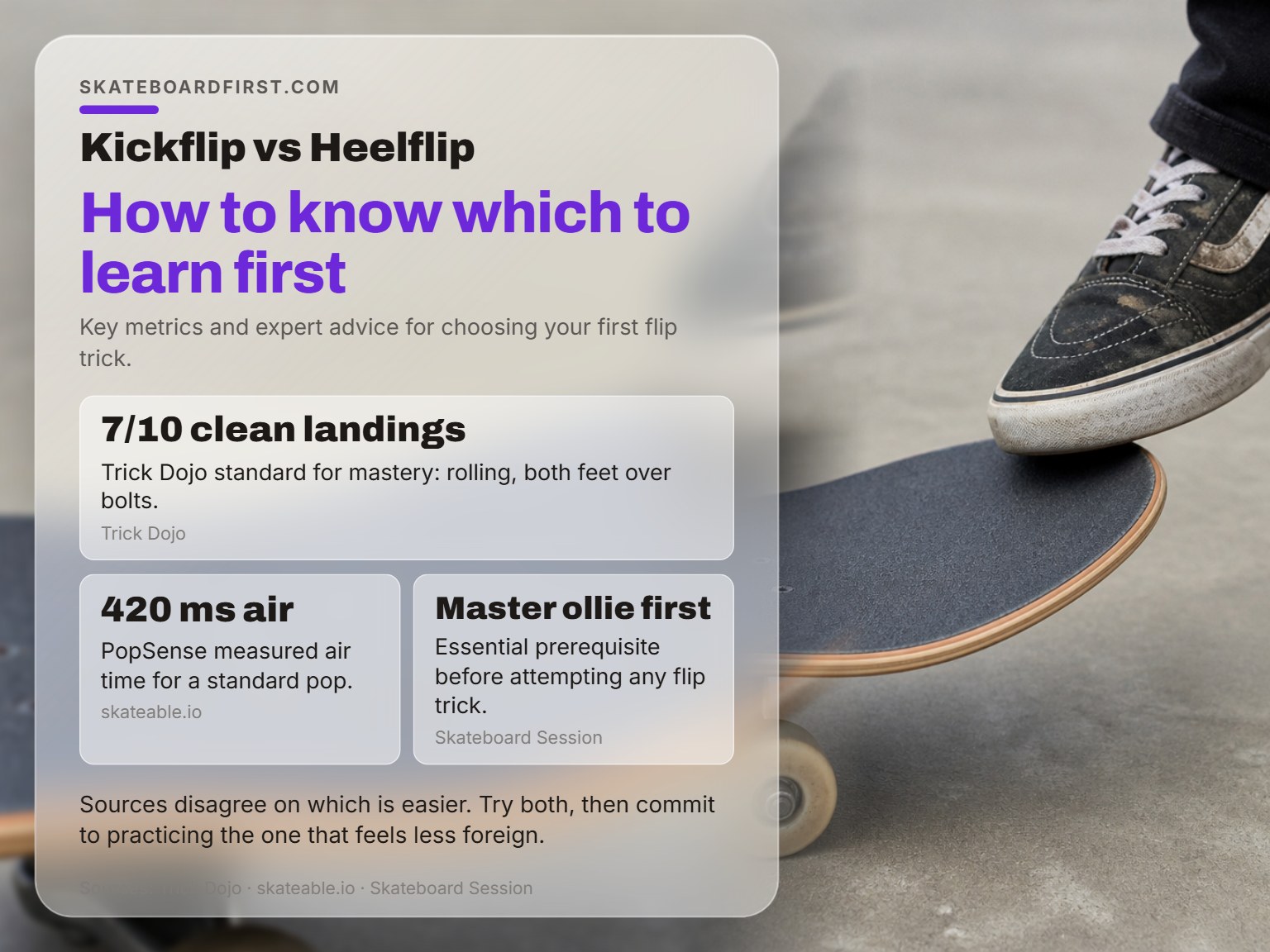
- Run a self-test. On smooth, flat ground (or even carpet), attempt ten stationary “flicks” of each trick. Don’t worry about landing. Which one consistently makes the board spin a full, level rotation? Which flick feels more deliberate and less forced? Note the answer.
- Check your gear. Is your grip tape fresh and razor-sharp? Fresh grip can lock your toe in place, making a kickflip flick harder to slide out of. Worn-in tape might make the heelflip heel slide easier. Also, look at your shoes. A worn, slick sole will sabotage both tricks. A fresh, grippy vulcanized sole gives you the friction you need without sticking too much.
- Listen to your ankles. The Reddit observation about developing “a muscle in your ankle you only use for kickflips” is real. The heelflip uses a different pushing motion. If one causes immediate strain or feels unstable, the other might be your body’s preferred path.
- Commit to a two-week block. Pick the trick that won the self-test. Dedicate your practice to it for two weeks, following a structured drill progression: stationary flicks, then stationary attempts, then slow rolling attempts.
The part nobody mentions: You can, and should, cycle back to the other trick after a focused block. Working on heelflips can teach your body things about board control that make your kickflips better, and vice versa. Ignoring one entirely is a common long-term plateau.
What “Mastery” Actually Looks Like
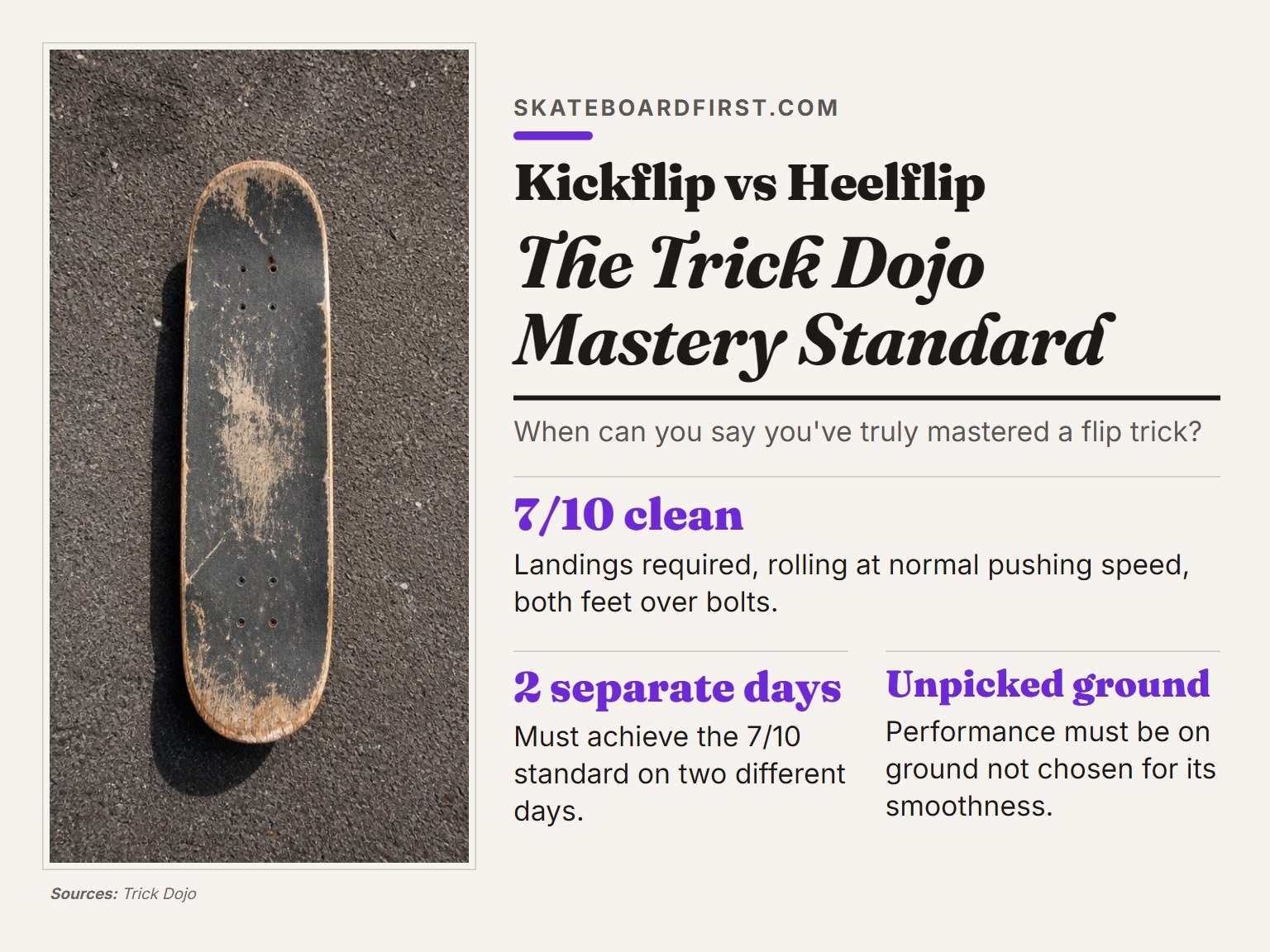
A single landed trick is a milestone, not mastery. Trick Dojo provides a concrete, measurable standard: a trick is yours when you can land it seven clean times out of ten.
But there are conditions:
- You must be rolling at normal pushing speed.
- The landings must be clean: both feet over the bolts, the board rolling straight afterward, no foot dragging or board slapping sideways.
- You must do this on ground you did not pick for its smoothness.
- You must repeat this performance on two separate days.
Why this strict definition? Consistency. Anyone can get lucky once on perfect asphalt. Being able to land it consistently, on imperfect ground, on different days, means the muscle memory is baked in. That’s when you truly own the trick and can build on it.
Frequently Asked Questions
Should I learn kickflips or heelflips first?
Most progression guides and skaters recommend learning the kickflip first because the toe flick offers more board control and feels more natural to many. However, credible sources like Trick Dojo and numerous skaters on Reddit argue it’s personal, your heel flick might be stronger. The best approach is to try both in a stationary setting and see which spin you can produce more reliably, then focus on that one.
Is a heelflip the opposite of a kickflip?
Yes, they are mirror images. A kickflip spins the board toward your feet (counterclockwise for regular stance) using a toe flick. A heelflip spins it away from your feet (clockwise) using a heel flick. They require opposite foot placements and send the board in different directions.
Why do my heelflips always shoot out in front of me?
This is the most common heelflip failure. It happens because the heel kick naturally pushes the board forward, and if your weight is centered or leaning back, the board escapes. The fix is to consciously keep your shoulders over the board and your weight slightly forward throughout the pop, flick, and catch.
How long does it take to learn a kickflip or heelflip?
There’s no universal timeline. It depends entirely on the strength of your foundational ollie and your body’s aptitude for the flick motion. Using the Trick Dojo standard, “mastery” (7/10 clean, rolling landings over two days) could take weeks or months of consistent practice. The key is to measure progress by the cleanliness of your spin and your landing consistency, not just the occasional make.
The Bottom Line
Start with the trick your first ten stationary flicks recommend, not the one a list tells you to. The data shows a real split, some bodies are built for toe flicks, others for heel kicks. Ignoring that signal is how people stall.
Spend your first two-week block on that trick. Drill the foot placement, master the flick without the pop, then add the pop. Aim for the concrete standard of seven clean, rolling landings out of ten.
And then, crucially, circle back to the other flip. Learning both isn’t just for style; it teaches your feet two distinct ways to control the board, which is the real foundation for everything that comes after. Your first varial kickflip or inward heelflip will thank you.
