
Foot Placement on a Skateboard Guide: Stance and Balance
This post contains affiliate links. As an Amazon Associate, we earn from qualifying purchases.
Foot placement on a skateboard is not one fixed position. It’s a dynamic set of positions you move through for standing, pushing, riding, and stopping, all centered around the truck bolts for maximum stability and control.
The first step is finding which foot naturally goes forward, your stance. From there, you learn to step on and off over the bolts, push with your back foot, and pivot your front foot to ride. The core principle from Skateboard GB is “Bolts for Balance,” meaning your feet should always be over the top of the bolts when you’re trying to stay stable. This foundation makes everything else, from cruising to tricks, feel more natural.
This guide walks through each stage, from figuring out if you’re regular or goofy to where your feet go for a manual. It also tackles where the official sources disagree, so you can see the full picture and find what works for your board and your goals.
Key Takeaways
- Your front foot is the one you’d step forward with to catch your balance if pushed from behind. Left foot forward is regular stance, right foot forward is goofy.
- For basic stability when stepping on, jumping on, or just standing, keep both feet over the truck bolts. This is the “Bolts for Balance” rule.
- When pushing, place your front foot angled over the front bolts, push with your back foot, then return that back foot to the board over the rear bolts.
- Sources disagree on cruising foot placement: some say keep the back foot on the tail for readiness, others say over the bolts is fine for comfort. Try both.
- For tricks like manuals, the community consensus is both feet should be mostly on the bolts, with the back foot slightly back to apply pressure.
Regular vs. Goofy: Finding Your Natural Stance
Don’t overthink this. Your natural stance is the one that feels stable when you stand on the board. Forcing a stance because a friend uses it is a common beginner mistake that makes every other step harder.
The official sources, including each foot placement on a skateboard guide, offer two main methods, and they don’t fully agree. Sources disagree on how to determine stance: Skateboard GB, Arbor Collective, and Hammer Skateboard recommend a “push from behind” test, while Skateboarding.com suggests simply standing on the board to see which foot feels right forward. Stand on the ground, have a friend give you a gentle shove from behind, and see which foot you step forward with to catch your balance. That foot is your front foot. If it’s your left, you’re regular. If it’s your right, you’re goofy.
The Skateboarding.com guide suggests simply standing on the board and seeing which foot feels right forward. Right foot forward is goofy, left foot forward is regular.
Which method is right? Try both. The push test mimics a loss of balance, which can reveal your instinctual lead foot. The stand-on-the-board test checks immediate comfort. They usually point to the same result. If they conflict, go with what feels more solid after a few tries. The goal is a natural skateboarding stance, not a label.
I copied a pro’s stance from a video for weeks. My pushes were weak, my balance was off, and I couldn’t figure out why. When I finally did the push test, I realized I was forcing a goofy stance when I was regular. Switching felt awkward for a day, then everything clicked. My board control improved because I was working with my body’s instincts, not against them.
| Stance | Front Foot | Back Foot (Pushes) | Common Test |
|---|---|---|---|
| Regular | Left Foot | Right Foot | Push-from-behind: left foot steps forward. |
| Goofy | Right Foot | Left Foot | Push-from-behind: right foot steps forward. |
Once you know your stance, you can understand all other instructions. A regular rider pushes with their right foot; a goofy rider pushes with their left. This is the baseline for your entire beginner skateboarding guide.
The “Bolts for Balance” Foundation
Before you roll, you need to be able to stand on a stationary board. Every major guide agrees on the starting point: your feet belong over the bolts.
The Skateboard GB “Learn to Skate” PDF is direct: “Remember the phrase ‘Bolts for Balance’ – Meaning that your feet should always be over the top of the bolts to have the right stance for balancing.” Their stepping-on and jumping-on drills both end with “Land with your feet covering the bolts.”
This isn’t just theory. The bolts are where the trucks attach the wheels to the deck. Placing your weight directly over these pivot points gives you the most direct control and the widest, most stable base. Step too far forward onto the nose, and the board tips forward. Place your foot too far back on the tail, and the board wants to pop up.
Hammer Skateboard’s beginner guide adds a practical warning: “At first, it is best to avoid stepping on the kicked up parts of the board (nose or tail).” They instruct you to place your front foot “in the area where you can see the 4 truck bolts” and your back foot “somewhere in the area where you can see the 4 back truck bolts.”
Skateboard GB’s “Bolts for Balance” principle: For basic stability when stepping on, jumping on, or just standing, keep both feet over the truck bolts. This is the foundational stance for all beginner maneuvers.
Practice this on grass or carpet so the board doesn’t roll. Step on with one foot over the front bolts, then bring the other foot over the rear bolts. Step off. Jump on with both feet landing over the bolts. Get comfortable shifting your weight and bending your knees while maintaining that position. This muscle memory is your first real skill, and it directly supports your balancing on a skateboard.
Pushing and Riding Stance: The Transition
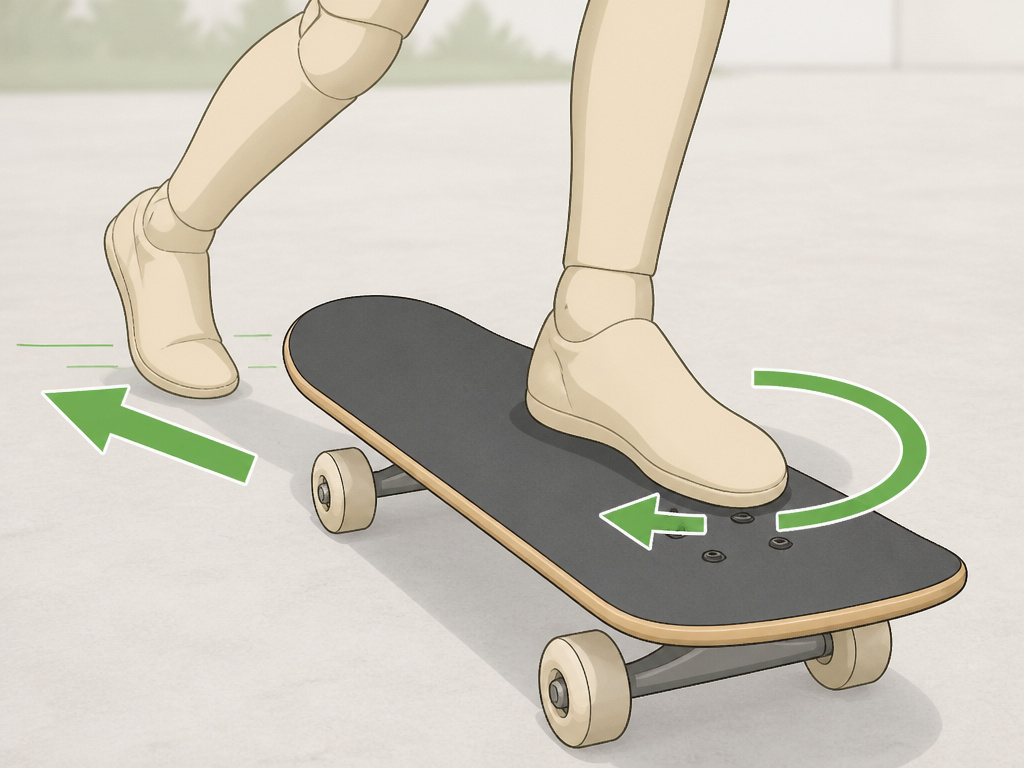
Now you’re ready to move. Pushing is the process of generating forward momentum, and your feet have a specific job sequence.
Here’s the step-by-step, compiled from Skateboard GB, Skateboarding.com, and Arbor Collective:
- Start Position: Place your front foot on the deck, angled over the front bolts.
- Push: With your front foot firmly planted, use your back foot to push off the ground. Keep your pushing leg relatively straight and use a solid, smooth stroke.
- Return & Pivot: After the push, return your back foot to the board. Skateboard GB says to place it “over the truck bolts towards the tail.” As you roll, pivot your front foot on the ball of your foot so it turns from a 45-degree angle to be more sideways, aligned with the direction of travel.
This is where a key source disagreement pops up. When should you pivot your front foot?
- Skateboard GB: Pivot after pushing, once you are moving.
- Arbor Collective: Pivot your front foot before you take your back foot off to push.
- Skateboarding.com: Keep your front foot at a 45-degree angle during the push.
The part nobody mentions: Trying to pivot your foot while it’s bearing all your weight during a push is a fast way to wobble. Most beginners find it easier to follow Skateboard GB: push first, get a little momentum, then pivot the front foot as you settle into your riding stance. This splits the balance challenge into two simpler steps.
| Source | Front Foot Placement | Back Foot Placement (After Push) |
|---|---|---|
| Skateboard GB | Pivoted to align with direction of travel. | Over the truck bolts towards the tail. |
| Skateboarding.com | Angled at 45 degrees, toes toward nose. | On the tail, slightly outside of the board. |
| Arbor Collective | On top of or just behind the front truck. | Wherever feels comfortable, roughly shoulder-width. |
| Reddit Community | Varies, but for cruising, comfort is key. | Can be nestled in the tail pocket or closer to bolts. |
The Reddit thread from r/NewSkaters captures the real-world middle ground. One rider asked if they must keep the ball of their back foot on the tail for cruising, noting it felt unnatural. The community response was pragmatic: “It isn’t necessary… Do what feels most comfortable.” Another user added that having your foot on the tail makes you more prepared for quick maneuvers, but you can always shift your foot when needed.
So, what should you do? Start with the “Bolts for Balance” riding stance, both feet over or near the bolts, front foot pivoted sideways, knees bent. This is the most stable, beginner-friendly position. As you get comfortable, experiment. Try sliding your back foot further back onto the tail pocket. Feel how it prepares you for a quick kick-turn or tic-tac. Then bring it back to the bolts. This ability to adjust your stance width and foot position while rolling is the real skill.
Foot Placement for Stopping and Basic Maneuvers
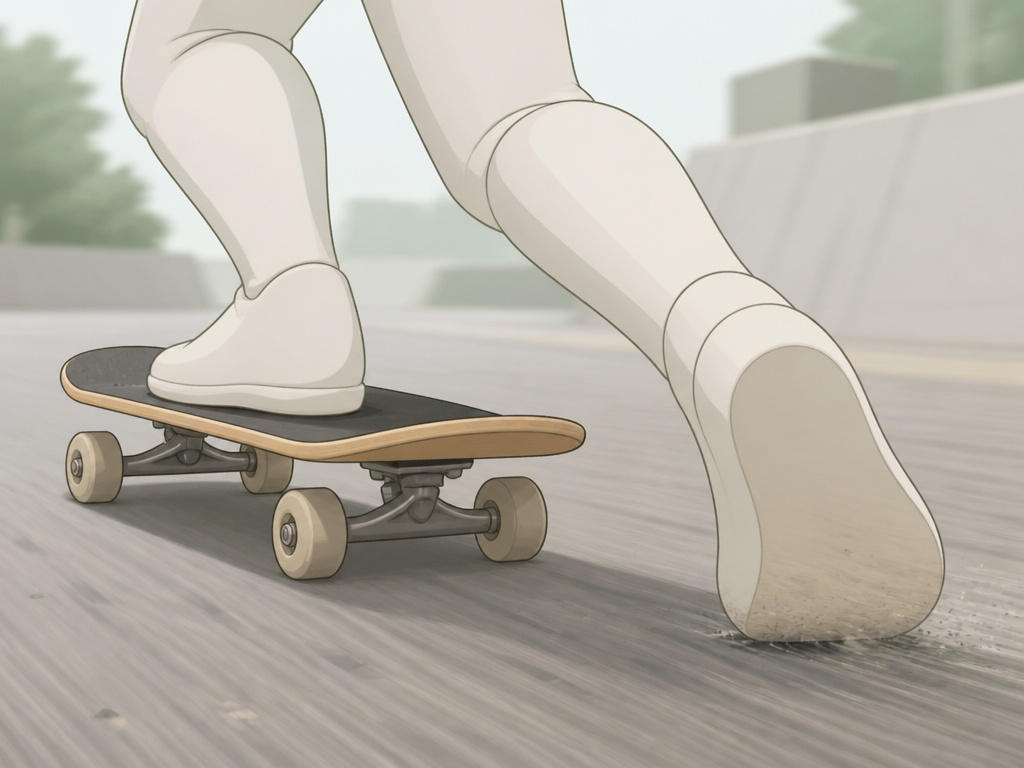
Knowing how to stop is essential. The most common and beginner-friendly method is foot braking.
Skateboard GB instructs: “Simply take the foot with which you’ve been pushing with, off the skateboard and gradually apply pressure to the ground until you come to a stop.” Arbor Collective adds nuance: “Pivot your front foot before taking your back foot off the board. Instead of pushing with your back foot, gently place it next to your board flat on the ground, and let the friction slow you down.”
The technique is straightforward, but the feel is specific. You’ll hear a soft, gritty scraping sound as your shoe sole drags. Start on slight, gentle slopes. The key is gradual pressure, stomping down will jerk you forward.
For turning, you have two beginner options. A tic-tac is a great way to turn sharply or generate speed without pushing. Skateboard GB’s guide details it: “Put your back foot on the tail of the board, and put your front foot covering the nearest two bolts. Apply pressure to the tail…” This lifts the front wheels, letting you pivot the board side-to-side.
Carving is the other method. As you ride, gently lean on your toes to turn backside, or on your heels to turn frontside. This is where your pushing technique and relaxed posture pay off. The board responds to subtle weight shifts.
Common mistake: Stomping your foot down to brake. This locks your foot and often pitches your upper body forward. You’ll likely run off the board. Instead, think of it as gradually increasing the weight on a dragging foot. It’s a smooth gradient, not an on/off switch.
Foot Placement for Tricks: Manuals and Ollies
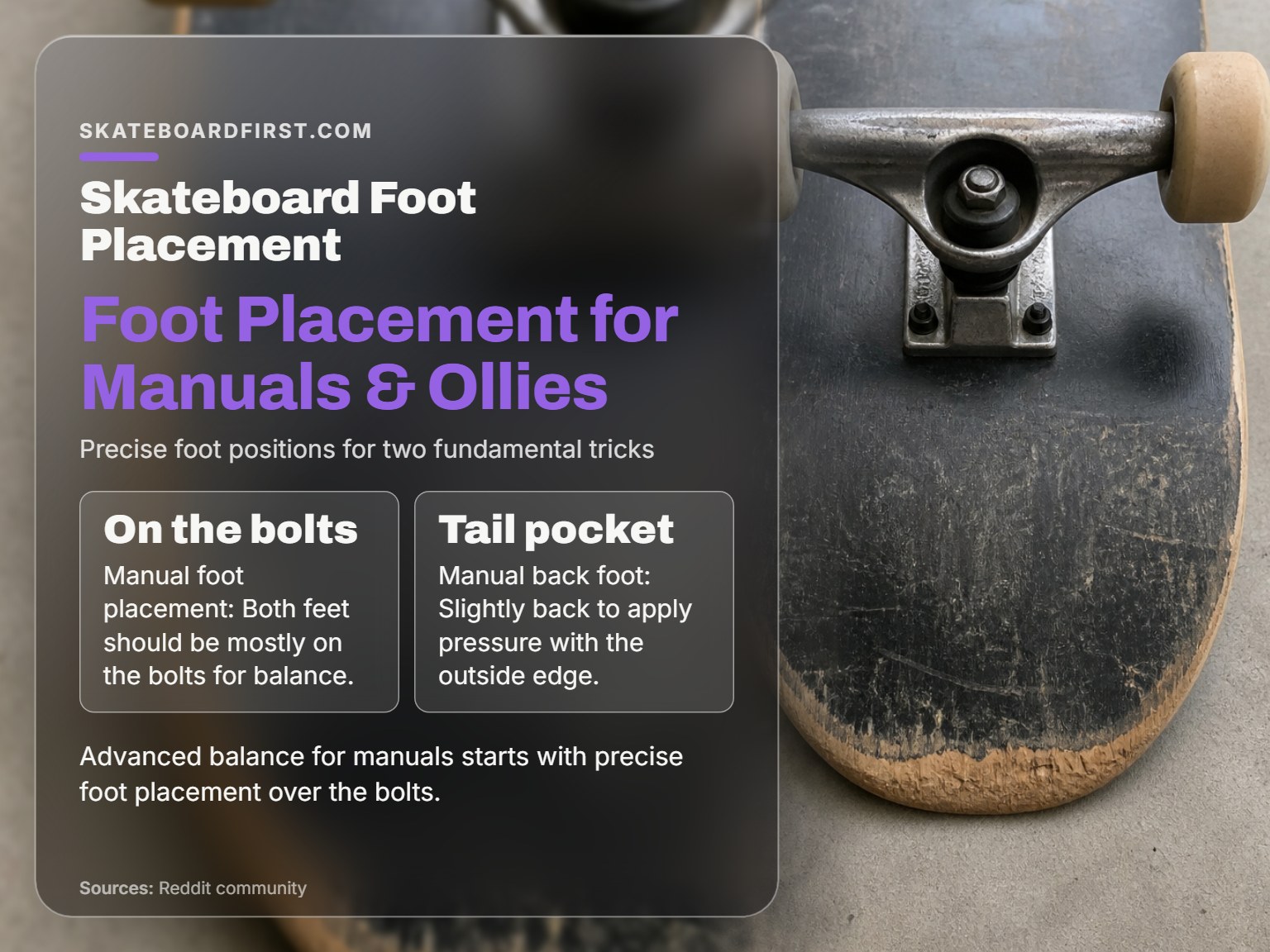
Once you’re comfortable riding, foot placement becomes more precise for tricks. We will examine two fundamental ones: the manual and the ollie.
For a manual, riding on the back wheels, the Reddit community discussion is incredibly valuable. A user posted their foot positioning, asking if it was too narrow. The feedback was unanimous: “Both feet should be mostly on the bolts.” Comments specified the back foot should be slightly back to apply pressure with the outside edge, and the front foot needs to be over the front screws for control.
This aligns with the “Bolts for Balance” principle but refines it. Your weight is mostly over the bolts, but the back foot creeps back just enough to find the point in the ‘pocket’ just before the end of the tail for pressure. You’re not standing on the very end of the tail; you’re in the “pocket” just before it. The front foot stays active, often making tiny adjustments to keep the board level. This is a perfect example of advanced balance and foot placement in action.
The ollie introduces a new variable: the pop. While a full ollie guide is its own topic, foot placement is the first step. The back foot goes on the tail, ball of the foot centered. The front foot is positioned in the middle of the board, just behind the front bolts. During the pop, the back foot snaps down on the tail while the front foot slides up toward the nose to level the board.
The stance you’ve built, comfort over the bolts, ability to shift your back foot to the tail, and control from your front foot, makes learning these tricks possible. Trying an ollie before you can comfortably shift your weight and adjust your feet while rolling is putting the cart before the horse.
Electric Skateboards and Longboards: Special Considerations
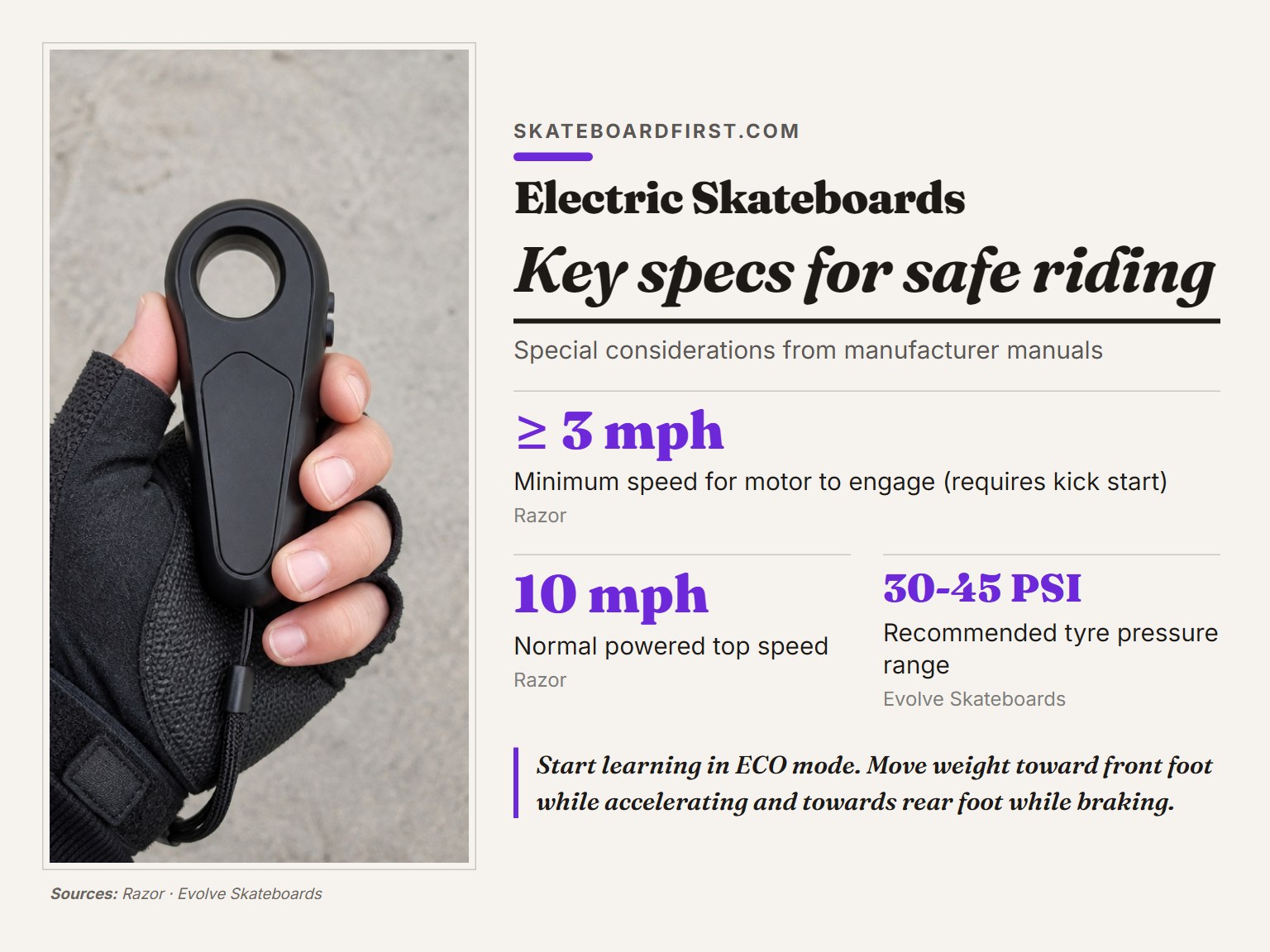
Electric skateboards and longer cruiser boards follow the same basic principles, but their manuals add critical specifics.
They also advise shifting your weight toward your front foot while accelerating and toward your rear foot while braking. For learning, Evolve Skateboards advises starting in a low-power mode for learning.
The Razor manual specifies a unique “kick start” procedure because its motor won’t engage until the board is moving at least 3 mph. It instructs: “To kick start, place forward foot on front of deck and push start using rear foot.” This blends traditional pushing with e-skate operation.
Safety First: The U.S. CPSC skateboarding safety fact sheet is essential reading. It emphasizes that a helmet “can mean the difference between life and death” and that children under 8 years old should be supervised closely. For riding a skateboard, these aren’t suggestions, they’re the rules that let you keep skating.
Longboards and cruisers, with their wider wheelbases, are inherently more stable, a point often made in a foot placement on a skateboard guide for these boards. This allows for a wider, more relaxed stance width. You might place your feet just inside the bolts, or even wider, for a surf-like carving stance. The “Bolts for Balance” rule still applies, but you have more real estate to work with comfortably.
How to find a safe place to practice skateboarding
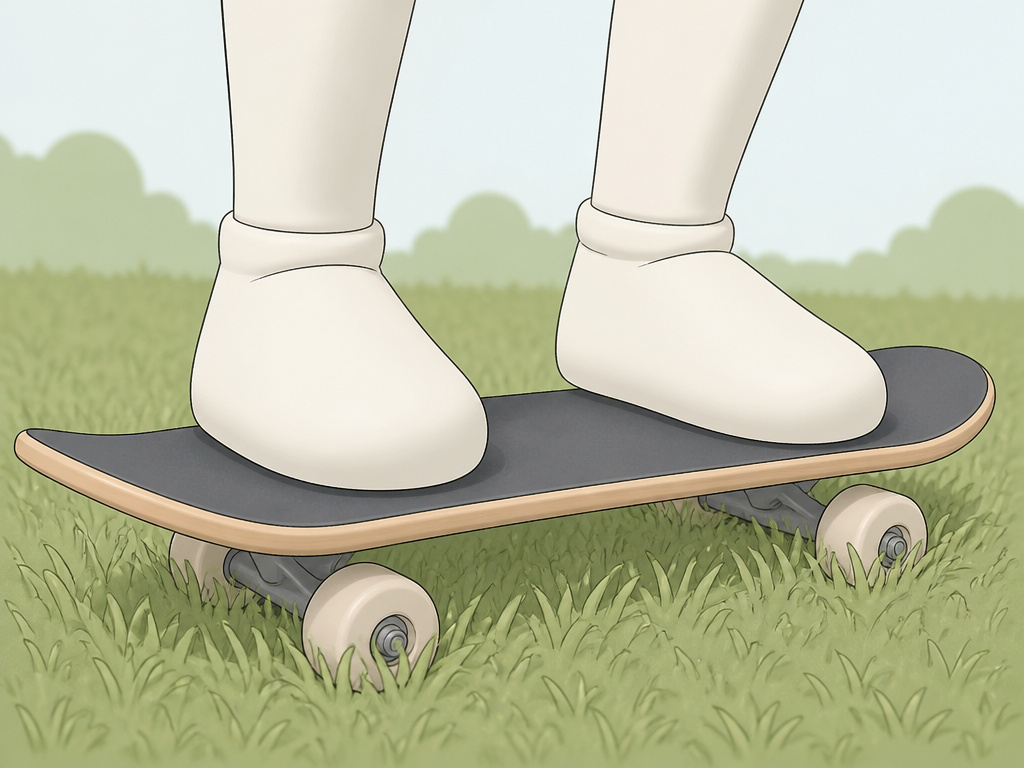
Before you even step on the board, find a flat, smooth surface where the board won’t roll away from you. A patch of grass, a carpeted area indoors, or a flat section of pavement blocked by a curb are all good options. The goal is to get comfortable with the feeling of standing on the board without it moving. This lets you practice placing your feet over the bolts and finding your balance safely. Once you can step on and off confidently in this stable environment, you can move to a gentle, open slope or flat ground to try pushing.
How to use your arms for balance on a skateboard
Your arms are a key tool for staying upright. Keep them relaxed and out to your sides, not pinned to your body. As you push and ride, let them move naturally to counterbalance your weight shifts. If you feel yourself starting to wobble, a slight adjustment with your arms can help you regain stability. Think of them as your body’s own stabilizers, working with your feet to keep you centered over the board. This becomes especially useful when learning to pivot your front foot after a push or when preparing for maneuvers.
Frequently Asked Questions
Where should your feet go on a skateboard?
For basic stability, your feet should be over the truck bolts. This is the “Bolts for Balance” rule from Skateboard GB. When pushing, your front foot angles over the front bolts, you push with your back foot, then return it to the board over the rear bolts. Your exact riding stance can vary for comfort and control.
Is there a wrong way to place your feet?
Yes. Placing your feet on the very tip of the nose or tail when you’re just learning to stand or ride makes the board unstable. Also, “mongo” pushing, pushing with your front foot while your back foot stays on the board, is harder to balance and less efficient, though not technically “wrong.” The biggest error is forcing a stance that doesn’t feel natural.
Which foot first on a skateboard?
Your front foot goes on the board first. This is the foot you lead with based on your stance (regular or goofy). You place it over the front bolts, then use your back foot to push off the ground.
How do I position my feet when skating downhill or at speed?
The U.S. CPSC advice for avoiding speed wobble is crucial: “Ride forward and crouch on your board.” This lowers your center of gravity. Keep your feet over or near the bolts, bend your knees deeply, and keep your weight slightly forward. A wider, more stable board also helps, as does ensuring your trucks are properly tightened.
Before You Go
Foot placement isn’t a single mark you tape onto your grip tape. It’s a living skill. You start with the absolute rule, bolts for balance, and then learn the exceptions and adjustments. Your back foot slides back for a tail-dependent trick, your front foot angles and pivots for pushing, and your whole stance widens or narrows for comfort.
The official sources don’t always agree, and that’s fine. It means there’s room for your own style to develop. The Skateboard GB guide gives you the certified fundamentals, while the Reddit community shows you how those fundamentals bend in real street practice.
One concrete step you can take right now: Go stand on your board on a carpet. Find your natural stance using the push test. Then, without rolling, practice the foot motions of pushing and pivoting your front foot. That muscle memory, built off the board, will make your first real pushes on pavement feel familiar. Trust the process, one session at a time.
