
Dogtown and Z Boys History: The Documentary vs. The Movie
This post contains affiliate links. As an Amazon Associate, we earn from qualifying purchases.
The Z-Boys were a group of teenage skateboarders from the Dogtown area of Santa Monica and Venice, California, who fundamentally changed skateboarding in 1975 with an aggressive, surf-inspired style developed in empty swimming pools and asphalt playgrounds. Their story was later documented in the award-winning 2001 documentary Dogtown and Z-Boys, narrated by Sean Penn and directed by original member Stacy Peralta.
That specific year—1975—is the pivot. Before it, skateboarding was one thing; after their explosive debut at the Del Mar Nationals that year, it was something else entirely. The change wasn’t just about new tricks. It was a shift in attitude, territory, and what a skateboard could even do, a transformation chronicled in the Dogtown and Z Boys history.
What follows is the how and why: the rundown neighborhood that shaped them, the surfing style they stole, the empty pools they commandeered, and the exact moment they broke the sport open, all essential to the Dogtown and Z Boys history. We’ll also untangle the documentary from the Hollywood movie it inspired, and trace where that 1975 energy still shows up on boards today.
Key Takeaways
- The Z-Boys’ aggressive, low-to-the-ground style was influenced by the surfing style of Hawaiian superstar Larry Bertelman, applied to concrete.
- Their 1975 debut at the Del Mar Nationals was their first major public competition.
- The documentary Dogtown and Z-Boys is directed by original member Stacy Peralta, while Lords of Dogtown is a dramatized Hollywood version.
- The group’s legacy includes the enduring brands founded by its members, like Powell Peralta.
- Key figures like Stacy Peralta became the first skateboarder ever to get paid to endorse shoes by Vans.
The Concrete Wave: Dogtown’s Origins
Forget the polished skateparks of today. Dogtown was a section of Santa Monica and Venice that was, by the early 1970s, practically in ruins. It was a “rundown urban beach neighborhood with a legacy of outlaw surfing,” as the film’s synopsis puts it. This wasn’t a postcard. It was a tough, territorial place where your neighborhood defined you.
The heart of it all was the Jeff Ho & Zephyr Production Surf Shop. Jeff Ho, Skip Engblom, and Craig Stecyk assembled the Zephyr Skateboard Team there. The shop wasn’t just a store; it was a clubhouse for a group of local kids. The team was ethnically diverse, and for many, it was a refuge. They were trained by Engblom and Ho, and their every move was documented in photos and articles by Stecyk.
This environment bred a specific mentality. You defended your spot. You innovated with what you had. And what they had, besides the ocean, were two unconventional training grounds: the asphalt-banked school playgrounds and, crucially, the empty backyard swimming pools left by a California drought in the 1970s. These pools became their laboratories. For a deeper look at the culture of this formative era, explore our article on skateboarding in the 1970s.
The Z-Boys practiced on asphalt-banked school playgrounds and empty swimming pools. A 1970s drought left pools dry, turning backyards into accidental half-pipes where they could test vertical, surfing-inspired maneuvers for the first time.
The Z-Boys’ Surf-Inspired Style Explained
If you watch old footage of 60s skateboarding, you’ll see handstands, wheelies, and a stiff, upright posture. The Z-Boys looked nothing like that. Their style was low, crouched, and fluid. They didn’t just ride the board; they carved through space as if it were a wave.
This wasn’t an accident. They were directly influenced by the surfing style of Hawaiian superstar Larry Bertelman. Bertelman’s approach was aggressive and close to the face of the wave. The Z-Boys translated that to concrete. In a pool or on a bank, they would drop in low, pump their knees, and use their whole bodies to generate speed and change direction. It was visceral, not performative.
The mechanical reason this worked is simple: surfers use their legs and torsos to redirect energy from a moving wall of water. On a skateboard, especially in a pool, you’re redirecting the energy of your own momentum off a curved concrete wall. The Z-Boys figured out that the same body mechanics applied. Their “carving” was just surfing on land. This foundational shift is a key part of the broader history of skateboarding.
The 1975 Del Mar Nationals: The Big Bang
Every revolution needs a catalyst. For the Z-Boys, it was the Bahne-Cadillac Skateboard Championship, known as the Del Mar Nationals, in 1975. This was their first major public competition.
The existing skate world was not ready. The old-guard skaters were still doing tricks from a previous era. Then the Z-Boys showed up. According to the film synopsis, “these wild kids with their riffing, low-slung style seemed to explode out of nowhere.” They weren’t following the contest’s expected script. They were treating the concrete course like a series of waves and pools, applying their Dogtown style with a pugnacious attitude.
They didn’t just compete; they announced a new era. Almost immediately, Tony Alva, Jay Adams, and Stacy Peralta became international teenage superstars. The Dogtown style came to dominate the sport within a year. This moment is arguably the single most important event in the rise of skateboarding as a mainstream cultural force.
| The Z-Boys’ Key Innovations | What It Replaced | Why It Mattered |
|---|---|---|
| Low, surf-inspired “carving” | Upright, gymnastic-style tricks | Created flow and speed, the foundation of modern vert riding. |
| Using empty swimming pools as terrain | Flatground and manufactured ramps | Unlocked vertical skating and complex aerial maneuvers. |
| Aggressive, territorial attitude | Polite, sport-focused competition | Injected punk and DIY ethos into skate culture. |
The Documentary vs. The Hollywood Movie
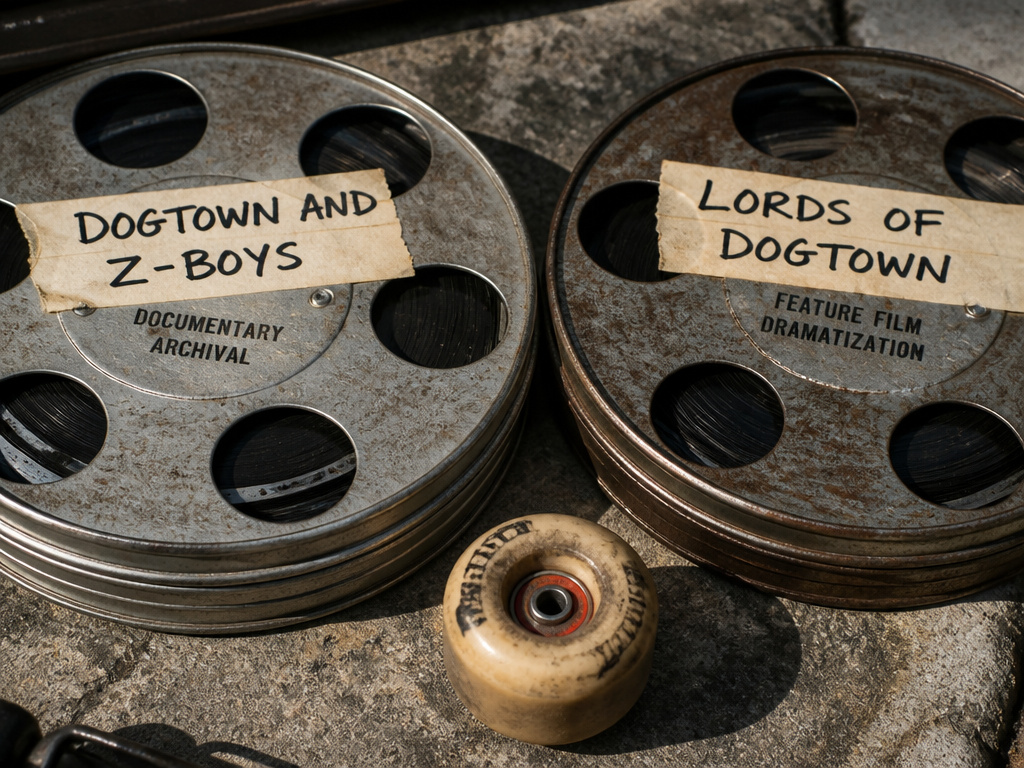
The story has been told twice, and they are not the same thing. The 2001 documentary Dogtown and Z-Boys is the primary source. Directed by Stacy Peralta and screenwritten by Peralta and Craig Stecyk, it was produced by Agi Orsi and executive produced by Jay Wilson of Vans, which financed the film. It runs 90 minutes, is narrated by Sean Penn, and premiered at the Sundance Film Festival in 2001, where it won the Audience Award and Director’s Award.
Where this goes sideways: Confusing the documentary with the Hollywood film. The documentary is built from archival footage and interviews with the actual Z-Boys. The Hollywood version adds fictionalized drama and composite characters.
The documentary was inspired by a March 1999 Spin magazine article titled “The Lords of Dogtown” by G. Beato. That article also inspired the 2005 Hollywood feature film Lords of Dogtown. The film is a dramatization. It takes the real people and events and compresses them, adds conflict, and creates scenes for cinematic effect. For a curated list of other authentic films on the subject, check out our guide to skateboarding documentaries.
The documentary’s purpose was preservation of the Dogtown and Z Boys history. Peralta has said he wanted to capture the “very real moment” before Hollywood fictionalized it. Understanding this difference helps you value each film for its own purpose.
From Zephyr Team to Skateboard Empires

The Z-Boys era as a unified team was surprisingly short. As the synopsis notes, “the Z-Boys era ended soon after as its members took off on independent skating careers.”
But their influence didn’t fade; it fragmented and multiplied. A major legacy was the creation of iconic skate brands by its members.
Stacy Peralta, along with George Powell, co-founded Powell Peralta, one of the most influential skate companies of the 1980s.
On the commercial side, the Z-Boys proved skateboarding had market power. Stacy Peralta was the first skateboarder ever to get paid to endorse shoes, by Vans. Vans was also the first shoe company to ever pay attention to skateboards.
Where Are the Z-Boys Now?
The “People also ask” questions are telling. People don’t just want the history; they want to know what happened after the spotlight faded.
The stories are as varied as the individuals. Stacy Peralta transitioned from pro skater to successful entrepreneur (Powell Peralta) and then to an acclaimed filmmaker, directing not only Dogtown and Z-Boys but also other sports documentaries.
Other stories are marked by tragedy and struggle.
The original territorial bonds also shifted.
Frequently Asked Questions
What is the documentary Dogtown and Z-Boys about?
The documentary tells the story of the Zephyr Skateboard Team (Z-Boys) from Dogtown, California. Directed by original member Stacy Peralta, it uses archival footage and interviews to show how their surf-inspired style fundamentally changed skateboarding in the mid-1970s, leading up to their iconic debut at the 1975 Del Mar Nationals.
Was Jay Adams sober when he died?
Yes, according to multiple reports from friends and family at the time, Jay Adams had achieved sobriety and was sober when he passed away in 2014.
What’s the difference between Dogtown and Z-Boys and Lords of Dogtown?
Dogtown and Z-Boys is a documentary featuring the real Z-Boys telling their own story. Lords of Dogtown is a 2005 Hollywood drama film inspired by the same events but with fictionalized scenes, composite characters, and added dramatic conflict for entertainment.
Who were the key members of the Z-Boys?
The core team included Jay Adams, Tony Alva, Bob Biniak, Paul Constantineau, Shogo Kubo, Jim Muir, Peggy Oki, Stacy Peralta, Nathan Pratt, Wentzle Ruml, and Allen Sarlo. They were assembled and guided by Jeff Ho, Skip Engblom, and Craig Stecyk from the Zephyr surf shop.
How did empty pools help create modern skateboarding?
Drought in 1970s California left many backyard swimming pools empty. The Z-Boys used these pools as the first vertical concrete terrain, allowing them to practice and perfect the aerial, carving moves that became the foundation of vert (vertical) skateboarding.
The Bottom Line
The Z-Boys’ story is often told as a simple underdog tale, but the real lesson is about resourcefulness. They didn’t have parks, so they used pools and playgrounds. They didn’t have a rulebook, so they wrote their own with a surfboard as a pen. That 1975 moment at Del Mar wasn’t just a win; it was a proof of concept that a DIY attitude could redefine a global sport.
Their legacy isn’t locked in the past. You can see it in the deep carves of a skater in a bowl today, in the Vans shoes on their feet, and in the DNA of brands like Powell Peralta. It’s a reminder that innovation doesn’t always come from a lab or a corporate boardroom. Sometimes, it comes from a bunch of kids in a broken-down neighborhood, seeing a drained pool not as an empty hole, but as a canvas.
