
Electric Skateboard Laws Explained: Where You Can Ride
This post contains affiliate links. As an Amazon Associate, we earn from qualifying purchases.
Electric skateboard laws are defined state by state, with key differences in maximum speed (20–25 mph), power (1,000–2,500 watts), and where you can ride. Michigan allows 25 mph and 2,500 watts, while Virginia caps speed at 20 mph and requires sealed batteries. Local city ordinances can override state rules, often banning riding in business districts or on specific sidewalks.
That variance is the whole game. A board that’s street-legal in Detroit could get confiscated in Delaware, and a cop in Huntington Beach might not know the state law changed last year.
What follows: a state-by-state breakdown with exact numbers, a method to check your local rules, and the practical steps to take if you’re ever stopped, which is the core of the electric skateboard laws explained. By the end, you’ll know how to read your board’s specs against the legal code and where the line between a warning and a fine actually is.
Key Takeaways
- State laws set the baseline, but local city ordinances can be stricter, always check your municipal code before riding downtown or in a park.
- Maximum legal speeds vary: Virginia is 20 mph, Michigan is 25 mph.
- Helmet and age rules are common but not universal; Virginia requires riders under 14 to be supervised, while Michigan has no statewide helmet mandate.
- Your board’s motor wattage matters legally. California’s 1,000-watt limit is half of Michigan’s 2,500-watt allowance.
- Sidewalk riding is often permitted with strict yield-to-pedestrian rules, but it’s flat-out illegal in places like Delaware and special charter cities in Michigan.
The State-by-State Breakdown Table
We begin with the hard numbers. The law isn’t vague about dimensions, power, and speed. It prints them in the state vehicle code.
I learned this the hard way trying to explain a 2,500-watt motor to an officer who only knew California’s 1,000-watt rule before the electric skateboard laws explained were clarified. The specs on your board’s website aren’t just marketing, they’re your first legal checkpoint.
Technical Snippet: Under Michigan Compiled Laws §257.13f, an electric skateboard is defined as a wheeled device no more than 60 inches long and 18 inches wide, with an electrical propulsion system of no more than 2,500 watts and a maximum speed on a paved level surface of not more than 25 miles per hour. The device may have handlebars and may also be powered by human propulsion.
Here’s how three major states compare on the critical specs. Notice where they disagree, that’s where riders get tripped up.
| State | Max Speed | Max Power | Key Local Authority | Common Rider Mistake |
|---|---|---|---|---|
| California | 20 mph | 1,000 watts | Cities can prohibit operation on specific streets/sidewalks. | Assuming state law is the final word, not checking city ordinances. |
| Michigan | 25 mph | 2,500 watts | Local governments can ban riding in business districts, waterfronts, or historic districts. | Riding a handlebar-less board on a road with a speed limit over 25 mph. |
| Virginia | 20 mph | Not specified | Operation is prohibited on any Interstate Highway System component. | Using a board without spill-proof, sealed, or gelled electrolyte batteries. |
The wattage difference isn’t academic. A 2,500-watt board has more than enough torque to climb hills and accelerate quickly, which is why Michigan allows it. California’s 1,000-watt limit reflects a focus on lower-speed, neighborhood-friendly devices. If your board’s motor exceeds your state’s limit, you’re not just speeding, you’re riding an unclassified vehicle. That usually means a fine and the board gets impounded.
Where You Can (and Can’t) Ride
This is where most interactions with police happen, a key section in any electric skateboard laws explained. The rules for sidewalks, bike lanes, and roads aren’t intuitive.
Common mistake: Assuming “sidewalk” means “slow lane.” In Michigan, you must yield the right-of-way to every pedestrian and give an audible signal before passing. Miss that, and you’re the problem, regardless of your speed.
States break into different camps on sidewalk use. Michigan and others permit it with strict yield rules. Delaware’s code §4198N represents another approach: it generally prohibits operation on public highways, streets, or sidewalks outright. Meanwhile, the FHWA report recommends PTD users should be permitted to ride on both streets and sidewalks, subject to safety rules.
Road riding has its own layer of logic. Michigan law adds a twist based on your board’s design:
- An electric skateboard without handlebars cannot be operated on a highway or street with a speed limit greater than 25 mph, except to cross.
- An electric skateboard equipped with handlebars cannot be operated on a highway or street with a speed limit greater than 45 mph, except to cross.
The law assumes handlebars give you more control at higher speeds alongside traffic. It’s a rare instance where a physical feature changes your legal riding zone.
Bike lanes are generally the safest legal bet, but they’re not always a right. Michigan law says where a usable and designated bike path exists, a local ordinance may require you to use it instead of the road. It’s worth learning your local laws for bike lanes because that’s often the space you’re meant to occupy.
Special Zones and Automatic Bans
Some areas are no-go by default. Under Michigan law, operation is prohibited in a special charter city and in any state park under the jurisdiction of the Mackinac Island State Park commission. Local governments can also ban riding in waterfront areas, downtown business districts, or on streets with streetcar tracks.
The FHWA model state regulations call this “local flexibility.” For you, it means a sign at the park entrance can override the state’s permission.
Helmet, Age, and Equipment Laws
These rules are less about your board and more about you. They’re also the most visible to police.
Virginia law is specific: no person less than 14 years old shall drive a motorized skateboard unless under the immediate supervision of someone at least 18. Michigan’s state law, however, doesn’t set a minimum age. The control is local.
Helmet laws are a patchwork. No state-wide mandate exists in Michigan, but many cities impose one. You should wear one anyway, it’s the single best injury reducer, but know that a city ordinance can make it a ticketable offense if you don’t. Our helmet guide walks through the choices that actually protect at 20 mph.
Equipment requirements are few but critical. The Virginia motorized skateboard law mandates “spill-proof, sealed, or gelled electrolyte batteries.” It’s a safety rule meant to prevent corrosive leaks in a crash. Many quality boards already meet this requirement, but some models might not. Check your specs.
But riding at night without them is a great way to get stopped for “impeding traffic” or “failure to be visible.” A simple USB-rechargeable bike light strapped to your backpack solves that.
How to Check Your Local Ordinances

State law is just the foundation. The real rules are written by your city or county. Missing them is the number one reason riders get fines.
Here is a direct, step-by-step method. It takes twenty minutes and saves you a $200 citation.
- Search your city’s name + “municipal code.” Almost every city hosts its laws online. The site is usually
[CityName].govor[CityName].org. - Use the site’s search function. Search for “skateboard,” “electric skateboard,” “personal transportation device,” or “EPAMD.” Don’t just browse, the relevant law might be buried under “traffic” or “parks and recreation.”
- Look for the words “prohibit” or “regulate.” Local laws often say things like “The operation of electric skateboards is prohibited in the downtown business district” or “No person shall operate a motorized skateboard on any sidewalk designated for pedestrian use only.”
- Check for park-specific rules. Your city’s parks department website might have separate rules banning skateboards (electric or not) on paved paths or in certain parks. These are classic no-skate zones.
- When in doubt, call. A quick call to the non-emergency line of your local police department can clarify. Phrase it as, “I want to make sure I’m riding my electric skateboard legally in the [specific area]. Can you tell me if there are any local ordinances I should know?”
This process works because local laws are public record. A Reddit user in Huntington Beach learned this after an officer incorrectly told them e-skates were “illegal everywhere.” The state law (AB-604) had changed, but the officer wasn’t trained on the update. The rider later carried a printed copy of the law.
DUI, Insurance, and Legal Risks
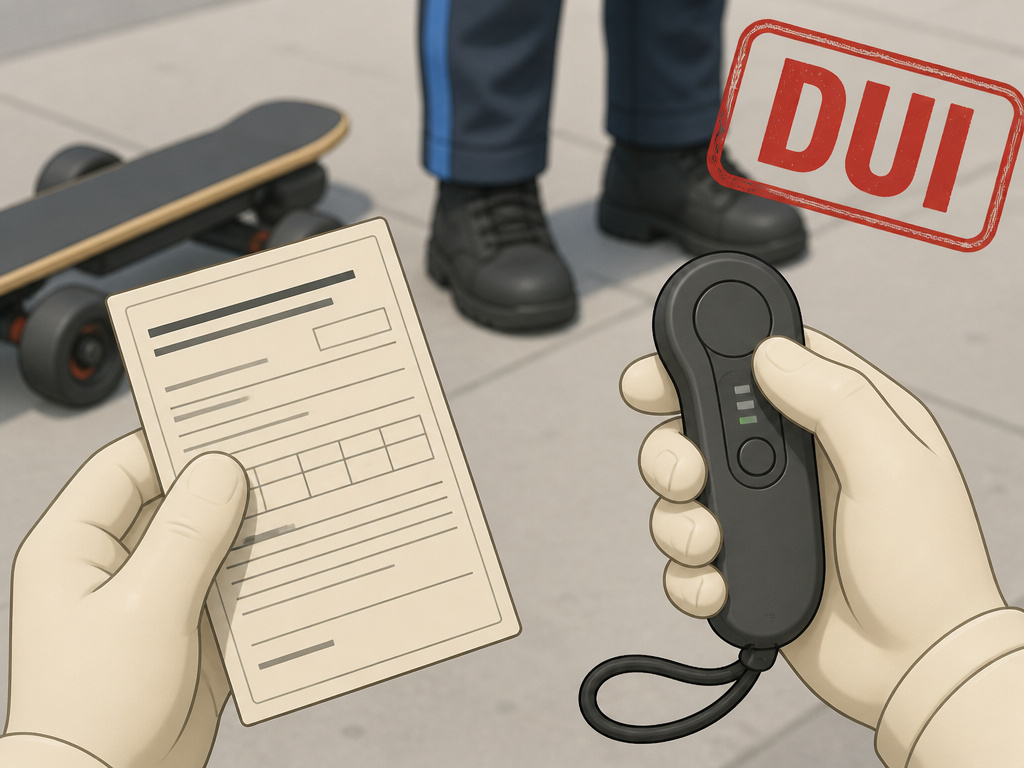
This is the section nobody wants to read. But a mistake here doesn’t end with a fine. It can end with a criminal record.
You can get a DUI on an electric skateboard. Every state that has addressed the issue applies its Driving Under the Influence laws to electric skateboards. The logic is simple: you’re operating a motorized vehicle on a public roadway. A 0.08 BAC on a board is the same as in a car. The penalties, license suspension, fines, jail time, are also the same.
Insurance is not required by law, but it’s your financial shield. If you crash into a pedestrian or damage property, you are personally liable. Your homeowner’s or renter’s insurance might cover it, but policies often exclude motorized vehicles. Specialty micro-mobility insurance policies exist and are worth the monthly fee if you ride daily in populated areas. They cover your board if it’s stolen, too.
Where this goes sideways: Arguing with an officer about the law on the street. You won’t win. The time to contest a ticket is in court, with printed copies of the relevant state and local codes.
What to do if you’re stopped: Be polite, keep your hands visible, and answer questions directly. “I’m riding an electric skateboard, officer. I believe I’m following the state law.” If you’re given a citation, accept it calmly. Note the exact location, time, and the officer’s badge number. Fighting an unjust ticket is for later, with research and maybe a lawyer.
International Standards and Safety Certifications
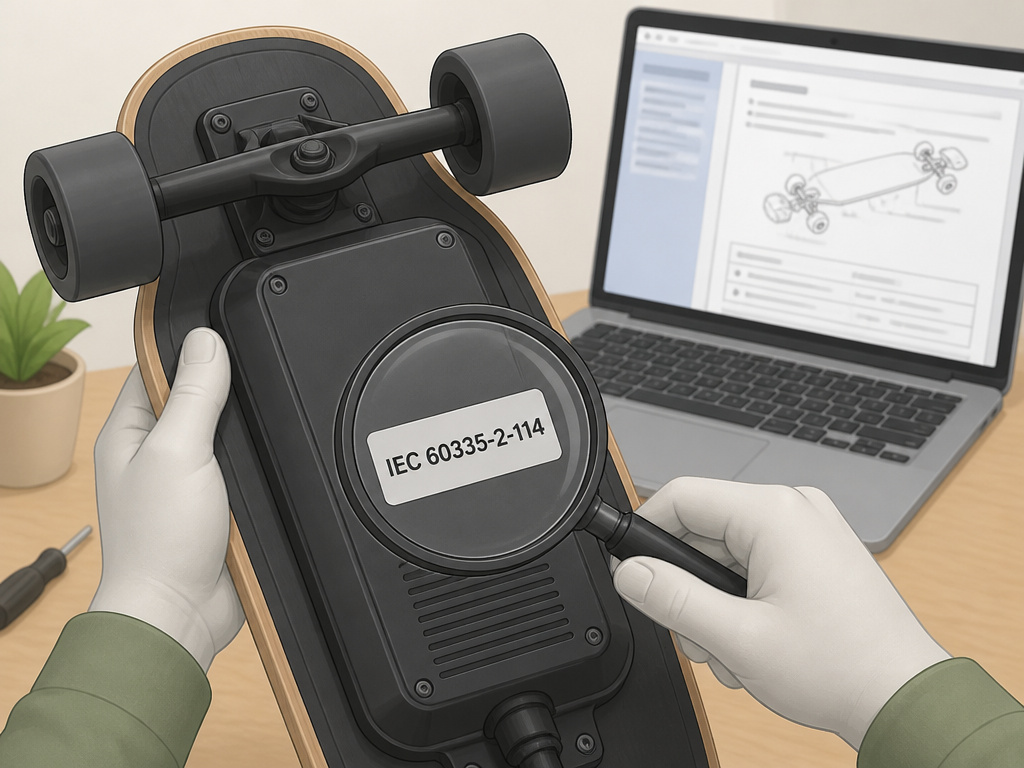
Beyond government law, there’s a layer of product safety law. It matters if you’re buying a board or if yours is involved in an accident.
The IEC 60335-2-114 safety standard is the international benchmark. It deals with the electrical safety of Personal e-Transporters used in private or public areas. Boards certified to this standard have been tested for electrical shock, fire hazard, and mechanical safety under the IEC standard for personal transporters.
Look for this certification on the manufacturer’s website. It’s not a legal requirement to ride in the U.S., but it’s strong evidence the board was built to a recognized safety standard. In a liability lawsuit, not having it looks bad.
The Consumer Product Safety Commission (CPSC) has general authority but hasn’t issued specific regulations. This means the market is self-policing. Some brands advertise compliance with IEC or UL standards precisely because it shows due diligence.
International laws overview
There is no single global law for electric skateboards. Rules vary dramatically by country and even within regions. An international safety standard exists for Personal e-Transporters, which classifies devices like electric scooters by features such as having a seat, but this standard informs product safety, not traffic law. Your board might be legal in one country and prohibited in another based on its power, speed, or design. Before traveling with your board, research the specific national and local regulations of your destination. Assume nothing carries over, and check both import rules for the device itself and operating rules for public spaces.
Frequently Asked Questions
Are electric skateboards legal everywhere?
No. Legality is determined by state and local law. Some states, like Michigan and California, have legalized them with restrictions. Others, like Delaware, largely prohibit their use on public roads and sidewalks. Even within a permissive state, cities can enact stricter bans.
Can you get a DUI on a non-motorized skateboard?
Typically, no. DUI laws generally apply to “motor vehicles.” A traditional, foot-pushed skateboard lacks a motor, so it wouldn’t qualify. However, the line blurs with very low-speed electric boards, and an officer could potentially charge you with public intoxication or reckless endangerment. The safe rule: don’t ride any skateboard under the influence.
Is it illegal to ride an electric skateboard without a helmet?
It depends on your location. No U.S. State has a universal helmet law for electric skateboard riders. However, many cities and counties do. For example, while Michigan state law doesn’t require one, the city of Ann Arbor might. Always check your local helmet regulations for skateboarders.
Do I need a license for an electric skateboard?
No state currently requires a driver’s license to operate an electric skateboard. They are not classified as motor vehicles for licensing purposes. However, age restrictions (like Virginia’s 14-year-old rule) and the ever-present risk of a DUI charge mean responsible riding is still tied to mature judgment.
Before You Go
The one threshold that changes everything is local ordinance. State law gives you a green light, but your city council can paint a red line on the map. Your first ride in a new area should be a slow reconnaissance, not of the pavement, but of the municipal code.
If your daily commute takes you across a city line, you might be crossing from a legal zone into a prohibited one. Know where those borders are. Map your common routes against the city’s posted rules for sidewalks and parks.
The law isn’t trying to stop you. It’s trying to place a fast, quiet vehicle into a system built for cars, bikes, and pedestrians. Your job is to fit in without friction. That means knowing the numbers on your board’s label, the numbers in the legal code, and the unspoken rule that yielding right-of-way always wins. Keep those straight, and you’ll roll without looking over your shoulder.
