
Where Is Skateboarding Illegal? 6 Places and Restrictions
This post contains affiliate links. As an Amazon Associate, we earn from qualifying purchases.
Skateboarding is illegal or restricted in specific locations, not entire countries. In the US, state laws like Delaware Code § 4198N prohibit motorized skateboards on public highways, streets, sidewalks, or rights-of-way, while city ordinances in places like West Liberty, Kentucky, ban all skateboards from streets and sidewalks, and Reno, Nevada, bans skateboards on roadways (except at crosswalks) and on specific downtown sidewalks. Campus policies at universities like Kansas also enforce local bans. The rule is local, granular, and full of surprising exceptions, with jurisdictions disagreeing on scope; for example, Delaware prohibits only motorized skateboards, while West Liberty, Kentucky, bans all skateboards.
That local, granular nature is the whole game. A state law might address motorized boards, a city code might target sidewalks in a business district, and a university might cite a town ordinance to ban boards on campus walkways. You can be legal in one block and banned in the next.
What follows is a breakdown of six specific places with current bans, the exact language they use, and the often-confusing exceptions they carve out. You’ll also learn how to check the rules where you skate, what “illegal” really means for enforcement, and the one question that matters more than any law.
Key Takeaways
- Skateboarding bans are almost always local, governed by city ordinances or university policies, not federal law.
- Delaware prohibits motorized skateboards on public highways, streets, sidewalks, or rights-of-way per state law, but allows pushing them across streets and exempts low-speed scooters.
- Enforcement is often complaint-driven; police are more likely to issue a warning or move you along than write a ticket, unless local policy is strict.
- To find your local rules, search for “[Your City] municipal code skateboard” or check your city clerk’s online ordinance database.
The Short Answer: It’s Almost Always Local
Skateboarding legality is determined by a patchwork of municipal codes, county ordinances, and institutional policies. There is no single US federal law prohibiting skateboarding. Common restrictions include prohibitions on roadways, sidewalks in business districts, and all skateboarding on certain types of public or private property, with significant variation between jurisdictions.
You won’t find a “Skateboarding is banned in America” law. Instead, you’ll find a city council in West Liberty, Kentucky, passing Ordinance No. 112805-01 to ban boards on public streets, which is a perfect example of where is skateboarding illegal.
This means the answer to “where is skateboarding illegal?” is almost always “it depends on the city, and sometimes the specific street.” A state might set the stage, but the city writes the script. And sometimes, a university like the University of Kansas uses a town ordinance to create its own skateboarding policy for student safety.
6 Specific Places Skateboarding Is Currently Restricted or Banned
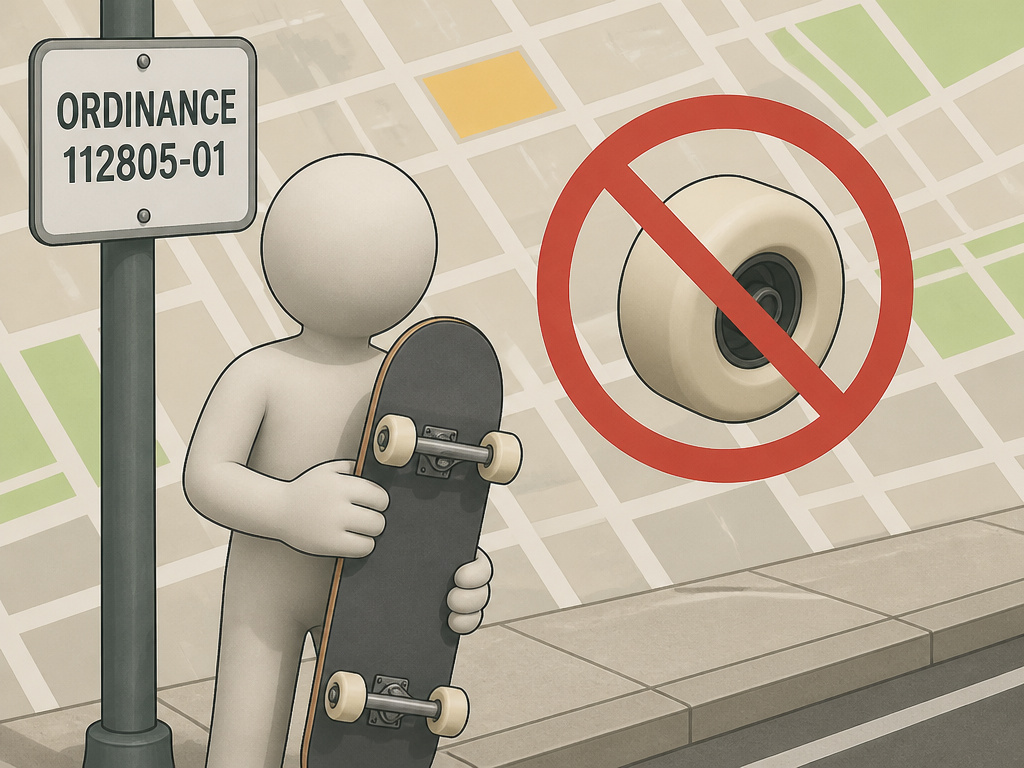
While a global ban like Norway’s 1978 law is historical trivia, current restrictions are alive and well in American towns and cities. Here are six places with active, codified rules.
1. Delaware (State Law – Motorized Boards Only)
Delaware takes a specific approach. Its state law, Delaware Code § 4198N, doesn’t touch your standard push-powered skateboard. Its prohibition is for motorized skateboards and scooters. You cannot operate them on public highways, streets, sidewalks, or rights-of-way.
The law has two key wrinkles. First, you can push a motorized board across a public street if the drivetrain is disengaged. Second, it explicitly exempts “low-speed motorized scooter[s]” from the ban.
2. West Liberty, Kentucky (City Ordinance – All Boards)
Contrast Delaware’s focused law with the blanket ban in West Liberty. Their Ordinance No. 112805-01 is far broader.
There’s no exception for pushing across. There’s no distinction between motorized and non-motorized. If you’re on a board with wheels in a public space, you’re in violation. The ordinance also restricts use on private property without written consent in your possession, which directly addresses the common issue of skating in parking lots.
It’s not a state guideline; it’s a local rule with local penalties.
3. Reno, Nevada (Downtown Sidewalk Ban)
Reno’s Municipal Code Sec. 6.06.030 shows how geographic precision works. It’s illegal to skateboard on roadways, except at crosswalks. The exception is that you may cross a street on a crosswalk, where you’re temporarily granted the rights and duties of a pedestrian.
The more notable ban is on sidewalks within the downtown business district. The code defines this district as the area bounded by 6th Street, 2nd Street, Lake Street, and Sierra Streets. Skateboarding on sidewalks there is illegal. It also bans skateboarding on any public property that is posted with prohibitive signs. This turns a general rule into a very specific map: legal on a sidewalk six blocks east, illegal on this block.
4. Lawrence / University of Kansas Campus (Institutional Policy)
Sometimes the enforcer isn’t the city police, but campus security. The University of Kansas policy cites Lawrence Ordinance 6794 to prohibit skateboarding, rollerblading, and similar activities on sidewalks along Jayhawk Boulevard from West Campus Road to 13th Street.
This is a classic case of an institution adopting and enforcing a local law. It creates a university skateboarding policy that students must follow, with violations potentially leading to campus disciplinary action, not just a city fine.
5. Grand Rapids, Michigan (Age-Based District Rules)
Grand Rapids adds another layer: age. Chapter 165 of its Code of Ordinances prohibits skateboarding, longboarding, and roller/inline skating within the Downtown Improvement District, specifically the portion south of I-196.
This creates a strange inversion where the law pushes older, presumably more experienced skaters into the road with cars, while confining younger skaters to the sidewalk. It’s a clear example of an age-based exception that assigns different legal surfaces to different age groups.
6. California (State Authorization for Local Rules)
California itself doesn’t ban skateboarding statewide. Instead, California Vehicle Code § 21967 authorizes local authorities—cities and counties—to adopt ordinances prohibiting or restricting the use of skateboards and electrically motorized boards on highways, sidewalks, or roadways.
It means the state has delegated the power to regulate skateboarding to its cities. So while California is not “illegal,” your city or town very well might be, thanks to this state law authorizing local restrictions.
| Jurisdiction | What’s Banned | Key Exception / Twist |
|---|---|---|
| Delaware (State) | Operation of motorized skateboards/scooters on public ways. | Allows pushing across with disengaged drivetrain; exempts “low-speed motorized scooters.” |
| West Liberty, KY (City) | All skateboards on public streets, roads, sidewalks, parking facilities. | No exception for pushing across; also restricts use on private property without written consent. |
| Reno, NV (City) | Skateboards on roadways; on sidewalks in defined downtown business district. | Legal to cross streets at crosswalks; ban is geographically precise (bounded by 6th, 2nd, Lake, Sierra). |
| Univ. Of Kansas (Campus) | Skateboarding on sidewalks along Jayhawk Blvd corridor (+1000 ft each side). | Enforcement is through university policy citing city ordinance. |
| Grand Rapids, MI (City) | Skateboarding in Downtown Improvement District (south of I-196). | Age-based: Under 15 may use sidewalks; 15+ may use streets/alleys. District north of I-196 is exempt. |
| California (State) | No state ban. | Authorizes local authorities (cities/counties) to create their own prohibitions. |
Illegal vs. Prohibited: What’s the Difference?
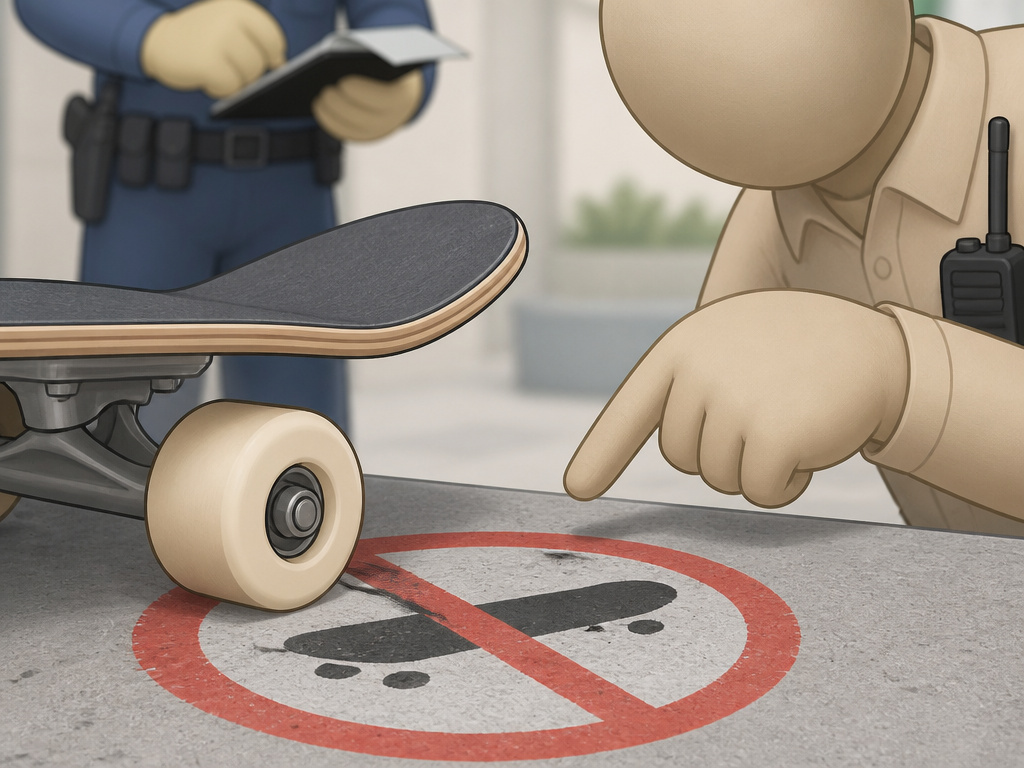
This is where online forum confusion runs deep. The terms are often used interchangeably, but they point to different consequences.
Illegal means a violation of a law or ordinance passed by a government body (city council, state legislature). The penalty is typically a fine, and enforcement is by police or code enforcement. The West Liberty skateboard ordinance creates an illegal activity.
Prohibited means forbidden by a property owner or managing entity under their rules. This includes shopping malls, office plazas, university campuses (beyond adopted ordinances), and skateparks with specific rules. The penalty is being told to leave (trespassing). If you refuse, then police may be called for trespassing, which is illegal.
Common mistake: Assuming a “No Skateboarding” sign on private property means skateboarding is “illegal” in your town. It usually means it’s prohibited on that property, and you can be asked to leave. The next plaza over might be fine.
This distinction matters for how to skate street spots. Getting kicked out is a property issue. Getting a ticket is a legal one.
How to Actually Find Your Local Skateboarding Laws
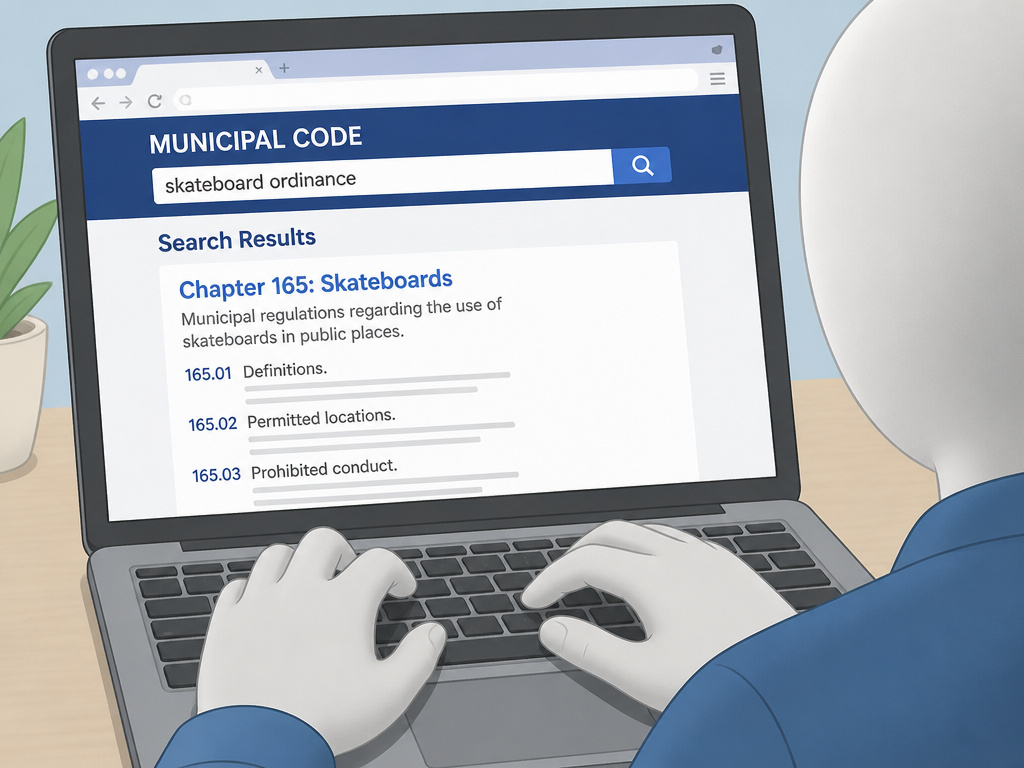
You don’t need a law degree. You need a search engine and some patience.
- Search Your City’s Municipal Code. Go to “[Your City] municipal code online.” Most cities host their codes on sites like Municode or eCode360. Once there, use the search function for “skateboard,” “rollerblade,” or “coaster.”
- Check for “Traffic” or “Vehicle” Chapters. Laws about moving on roadways often live in chapters titled “Traffic,” “Vehicles and Traffic,” or “Public Ways.”
- Look for Specific Ordinances. Some cities have a standalone “Skateboard” ordinance, like Grand Rapids’ Chapter 165. Search for that.
- Review University Student Handbooks. If you skate on campus, the student code of conduct or a specific policy page (like KU’s) will outline the rules, which often mirror city skateboarding regulations.
If you’re considering skateboarding in a bike lane, this is where you’d check. Many bike lane laws classify users, and skateboards are rarely included as legal vehicles, putting you in a gray zone.
Can Police Confiscate Your Skateboard?
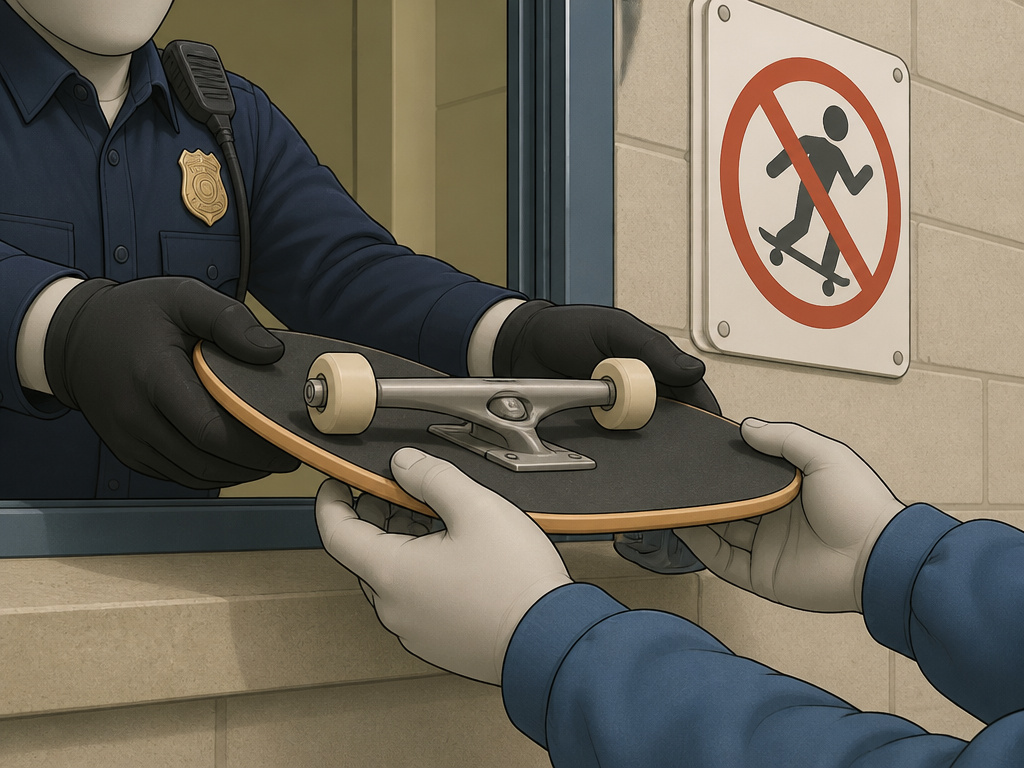
The “People also ask” question gets right to the fear. Can they take it?
Generally, no, not permanently for a simple violation. Police can’t just seize your property for a municipal infraction like illegal skateboarding. However, they can impound it as evidence if you are being cited or arrested. More commonly, if you are a minor, they might hold your board until a parent comes to retrieve it.
The real risk isn’t confiscation; it’s the escalation. If you’re given a lawful order to stop skating and you refuse, you could be cited for disobedience or, in some cases, arrested. In those situations, your board becomes evidence and is taken. This is why the Reddit advice holds up: be courteous, move on if asked, and don’t give an officer a reason to escalate. Your goal is to keep your session going elsewhere, not to win a legal argument on the spot.
What About Electric Skateboards and Longboards?
The laws get even more fragmented. Delaware’s state law specifically targets motorized devices. Many cities haven’t updated older “skateboard” ordinances to address modern e-skates, leaving their status unclear.
Where this goes sideways: Assuming your electric skateboard is treated the same as a regular skateboard. Many electric skateboard laws classify them as motorized vehicles, which can bring in a whole other set of rules regarding registration, helmet requirements, and where they can operate.
If you ride an e-board, you need to check both the standard skateboarding laws and any vehicle or motorized device codes to fully understand where is skateboarding illegal. The laws for electric skateboards are evolving faster than the ordinances can keep up.
Frequently Asked Questions
Is skateboarding illegal in the USA?
No, there is no federal law banning skateboarding in the USA. It is regulated at the state, county, and city level. Many cities have restrictions or bans on skateboarding in specific areas like roadways, downtown sidewalks, or business districts.
What country banned skateboarding?
Historically, Norway instituted a national ban on skateboarding in 1978 due to safety concerns. The ban was lifted in 1989. There is no major country with a current, nationwide ban on skateboarding today.
Is skateboarding banned in Japan?
No, skateboarding is not banned nationwide in Japan. However, like in the US, local restrictions are common. It is generally prohibited on roads and sidewalks in busy urban areas, and many public parks and plazas have signs forbidding it. Dedicated skate parks are widely available.
Can police take your skateboard?
Police typically cannot permanently confiscate your skateboard for a simple ordinance violation. They can impound it as evidence if you are being cited or arrested. The most common outcome of an encounter is a warning or a ticket, after which you leave with your board.
Do I need a helmet by law?
Helmet laws for skateboarding are highly local. Some cities or states have laws requiring helmets for minors (under 18), especially in public skate parks. There is no universal US law. You should check your local helmet requirements and always wear one for safety, regardless of the law.
Can I skateboard on the sidewalk?
It depends entirely on your city’s ordinance. Many cities allow it, many prohibit it in business districts, and some ban it outright. You must check your local sidewalk laws. Even where legal, you must yield to pedestrians.
Before You Go
The most important rule isn’t written in any city code. It’s this: don’t be a nuisance. Most enforcement is complaint-driven. Skating empty parking lots early on a Sunday morning rarely draws police. Doing kickflips on a crowded downtown sidewalk at lunch hour almost certainly will.
If you want to skate street spots without trouble, scout quietly, skate quickly, and leave before complaints stack up. Have a backup spot in mind. And if you’re ever unsure about the need for a skateboarding permit for an event or filming, call your city clerk’s office—they’d rather answer a question than write a citation.
One final, practical step: bookmark your city’s municipal code page. Knowing your local skateboarding regulations is the best way to skate with confidence and avoid the headache of a fine. It takes ten minutes and saves a lot of future trouble.
