
How to Build Confidence Skateboarding: Step-by-Step
This post contains affiliate links. As an Amazon Associate, we earn from qualifying purchases.
Building confidence skateboarding starts with the right protective gear and a focus on mastering board control through simple, repetitive drills before attempting any tricks.
That first-week statistic isn’t just a warning, it’s a map. It tells you exactly where and when most beginners get scared off, usually because they skipped the fundamentals. The confidence you want comes from knowing your board won’t surprise you, and that happens when you control the variables: your gear, your terrain, and your expectations. Learning how to build confidence skateboarding starts with this foundation.
What follows is a breakdown of the three things that actually build confidence, answering the core question of how to build confidence skateboarding: gear that works, drills that build board feel, and a mindset that turns fear into feedback. By the end, you’ll have a clear, week-by-week plan that prioritizes safety and measurable progress over vague motivational advice.
Key Takeaways
- One-third of skateboard injuries occur in the first week of learning, making a cautious, gear-first start critical for long-term confidence.
- Pre-assembled boards are best for beginners according to the CDC, as they eliminate setup variables that can make a board feel unpredictable.
- Master cruising, turning, and stopping on flat ground for at least a month before attempting an ollie; board control is the foundation of every trick.
- Wrist guards are especially important, per the CPSC, as wrist fractures are a common early injury that can destroy confidence for months.
- Analyze every fall. Ask “why did my feet leave the board?” instead of “did I get hurt?”, turning spills into data is the fastest way to reduce fear.
The First Week Is Everything: Gear and Grounding
The American Academy of Pediatrics notes that one-third of skateboard injuries happen in the first week of learning the sport. That’s not a coincidence. It’s the period where excitement outruns skill, and a single bad fall can plant a seed of fear that takes months to overcome.
I learned this the hard way trying to teach a teenager who’d never stood on a board. He was eager to ollie within minutes. An hour later, after a few gentle pushes and turns on flat asphalt, he wasn’t doing tricks, but he was smiling, rolling, and in control. That hour of fundamentals did more for his understanding of how to build confidence skateboarding than any trick tutorial could have. It proved the board was predictable if he treated it with respect.
For absolute beginners, the CDC states pre-assembled boards are best. They come with trucks tightened to a standard setting and wheels that roll predictably, removing the variable of a poorly built board from the confidence equation.
Your first line of confidence is your gear. This isn’t about looking pro; it’s about creating a safety net so your brain can focus on learning, not on protecting itself. The CPSC skateboarding safety fact sheet is blunt: wear protective gear, especially a helmet. But the specifics matter. The CDC names the Snell B-95 standard as best for skateboarding helmets, while the CPSC advises wearing a helmet designed for skateboarding (hard shell with foam interior). This is a higher-performance benchmark than basic bike helmets, designed for the multiple-impact nature of skate falls.
What most people get wrong: They buy a helmet that fits “okay” and never adjust it. The CPSC says a helmet must fit snugly with the chin strap fastened and sit level on your head, not tilted back. A loose helmet will shift on impact, and in that first week, impacts are likely. Wrist guards are also essential. The CPSC calls them “especially important.” A broken wrist from an instinctive hand-out fall can sideline you and make you hesitant to step back on the board.
Drills That Build Board Feel (Before You Ever Push Off)
Confidence is the feeling of knowing what your board will do before it does it. That only comes from hours of mundane, non-gloryous contact. The goal for your first few sessions isn’t to move, but to feel.
Start with the board on grass or carpet. Stand on it, find your balance, and rock from your toes to your heels. Feel the trucks flex. Then, practice stepping on and off the board smoothly from the side, not the tail or nose. This kills the fear of mounting. Next, practice a stationary “kickturn.” Shift your weight to the back foot, lift the front wheels a few inches, and pivot the board 90 degrees. Put it down. Repeat. This single drill teaches you how to manipulate the board with your weight, which is the secret to every turn and trick later.
Common mistake: Jumping straight to pushing. If you can’t balance comfortably on the stationary board, pushing will feel frantic and unstable, reinforcing fear instead of curing it.
After you’re bored with stationary drills, move to a smooth, flat, and empty parking lot or tennis court. The CDC advises beginners to skate on a smooth, flat surface to practice control. Now practice pushing. Put your front foot just behind the front trucks, pointed forward. Push with your back foot and place it gently on the tail. Don’t try to go fast. Go slow enough that you can step off safely if you feel wobbly. The sound you’re listening for is the steady, quiet roll of four wheels on smooth pavement, not the clack-clack-clack of a wobbly, unstable push.
This is where most strategies to progress faster fall apart. Rushing creates instability. Instability causes falls. Falls without understanding cause fear. Stick with these basic drills, pushing, gentle carving turns by leaning, and a simple foot-brake stop, until they are utterly boring. That boredom is your confidence manifesting.
Managing the Mental Game: Fear, Frustration, and Plateaus
Fear of falling is rational. The trick isn’t to eliminate it, but to make it useful. Every time you feel that hesitation, it’s a signal pointing at a skill gap. Are you scared to roll down a gentle slope? Your balance on the board isn’t automatic yet. Nervous to try a kickturn on pavement? You need more practice on grass.
When you do fall, and you will, the immediate question shouldn’t be “am I hurt?” It should be “why did my feet leave the board?” Did your weight drift too far back? Did you lean forward without committing? Did you look at the ground instead of where you were going? This turns a scary event into a data point. This analytical approach is the core of learning to lose fear of falling skateboarding. It transforms fear from a monster under the bed into a diagnostic tool.
Frustration is the other confidence killer. It usually hits during a plateau, when you feel you’re not improving. Here’s where structured practice separates lifelong skaters from quitters. Don’t just “go skate.” Have a 15-minute plan for each session: “Today I will practice kickturns around that crack in the pavement 20 times.” Filming yourself on a phone, even at low speed, is underrated. You’ll see your foot position errors clearly, errors you can’t feel while riding.
| Confidence Killer | Physical Cause | Confidence-Building Fix |
|---|---|---|
| Speed Wobbles | Loose trucks, uneven weight distribution, high speed | Tighten trucks slightly; practice crouching low while rolling; use longer board for stability. |
| Fear of Falling | Poor balance, stiff posture, unfamiliar motion | Practice stepping off board safely at low speed; wear all pads to reduce injury fear. |
| Frustration with Tricks | Attempting tricks before mastering board control | Revert to a previous, mastered skill (like cruising) for 10 minutes to regain “feel.” |
| Anxiety at the Skatepark | Social pressure, perceived skill gap | Go during off-hours; focus on your own session, not others; remember everyone started here. |
Social dynamics matter. Skating with others can boost confidence through shared encouragement, but it can also crush it through comparison. If you’re feeling anxious, go alone or with one supportive friend at first. The CDC skateboarding physical activity page advises skating out of the way of traffic and other people, noting skate parks are great places, but only if you’re ready for that environment.
How to Structure Your First Month for Maximum Confidence

A clear plan beats vague ambition. This four-week framework uses the sources’ safety advice to build confidence in a logical, low-risk sequence.
Week 1: Foundation on Grass. Goal: Complete comfort standing on and stepping off the stationary board. Wear your full kit, helmet, wrist guards, knee and elbow pads, even on grass. This gets you used to the feeling. Practice 15-minute sessions, every other day. Week 2: The Empty Lot. Goal: Consistent pushing, rolling, and foot-braking to a stop on perfect asphalt. Find a dead-end parking lot. Practice until you can roll 50 feet in a straight line without putting a foot down. This is where you build the mental techniques for commitment to simple motion. Week 3: Introduction of Variables. Goal: Controlled carving turns and managing gentle slopes. Find a very slight incline. Practice rolling down, crouching low for stability. Learn to turn by leaning, not just kicking. Start practicing kickturns on pavement. Week 4: Integration and Play. Goal: Linking skills together. Carve a figure-eight pattern. Try rolling off a small curb. Practice pushing switch (with your other foot). By now, the board should feel like an extension of your feet, not a separate entity.
Throughout this month, the AAOS skateboarding safety PDF principle of learning safe techniques is your guide. Never lie down on a moving board, never skitch behind a vehicle, and always ride during daylight, as the CPSC warns to avoid riding at dusk and dawn or in other low-light conditions. If you feel wobbly at speed, remember the CPSC’s advice: crouch lower on your board. It lowers your center of gravity.
What Not to Do: Confidence Killers to Avoid
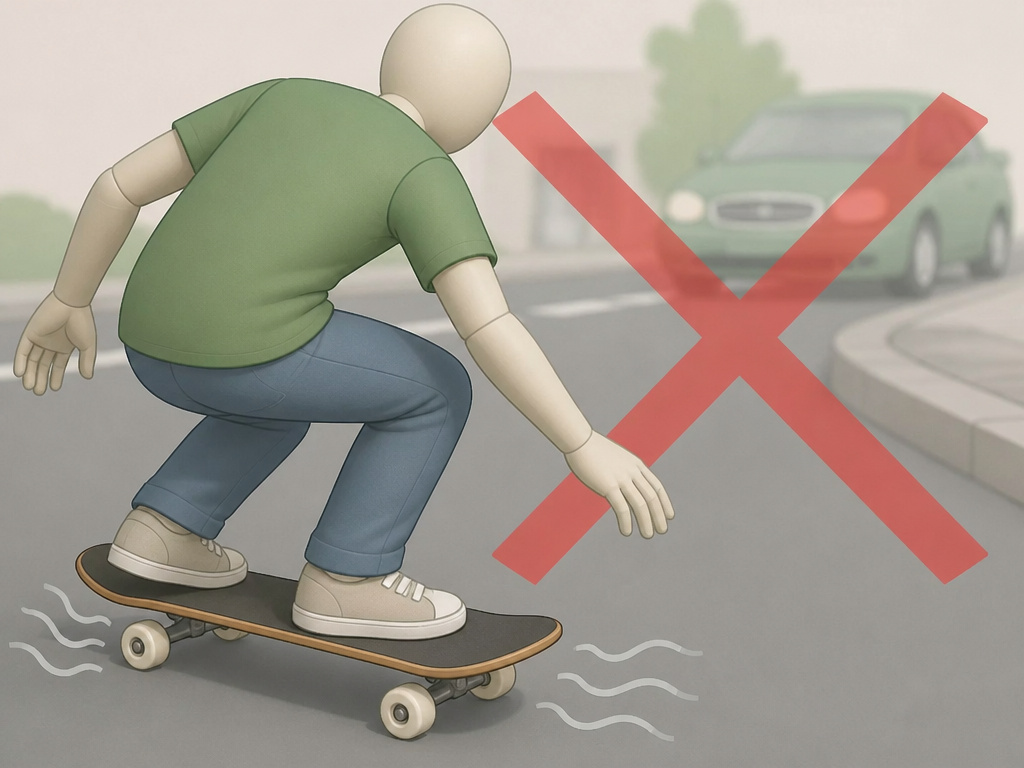
Confidence is fragile in the beginning. A few common mistakes can undermine weeks of good work.
First, avoid street skating until you have absolute control. The CDC is explicit: “Street skating is best left to the pros, it’s very dangerous.” Cars, curbs, and pedestrians add too many unpredictable variables. Second, don’t ride alone, especially as a beginner. The CPSC advises never riding alone and says children under 8 need close supervision. Having a friend there provides company and a safety net, which helps you try a bit more. Third, never adjust to speed wobbles by standing up straight. It makes them worse. Crouch, relax your legs, and let the board slow down naturally.
Where this goes sideways: Practicing while tired or frustrated. Your focus drifts, your reactions slow, and you start making uncharacteristic mistakes. That’s when a minor slip can lead to a hard fall and a real setback in confidence. End your session while you’re still having fun.
Finally, ignore the pressure to “learn ollies in a week.” The Reddit community for new skaters consistently advises mastering cruising, balance, and kickturns first. A rushed ollie attempt often leads to a painful, confusing fall that teaches you nothing except that ollies are scary. The skateboarding and mental health connection is positive, but only if you’re not constantly beating yourself up for not meeting artificial timelines.
How to get in the right headspace before skating

Your mindset is your first piece of safety gear. To build a resilient mindset, focus on turning fear into feedback. Instead of seeing a wobbly ride as a failure, treat it as data on your balance. Before you step on the board, take a moment to visualize a simple success, like a smooth push and roll. Remember that learning safe techniques, including how to fall properly, is a core part of the sport. This practical focus on skill over outcome keeps your mind engaged on progress, not on fear.
Frequently Asked Questions
How do I get rid of fear in skateboarding?
You don’t get rid of it; you outgrow it with competence. Fear is a signal you’re attempting something beyond your current skill level. Dial back to the last thing you felt comfortable doing, maybe that’s just pushing in a straight line, and master it completely. Each small win shrinks the fear.
Is 27 too late to start skateboarding?
No. While the AAP says children under 5 should not ride and kids 6-10 need close supervision, there’s no upper age limit. Adult beginners have the advantage of better risk assessment and patience. The key is embracing a beginner’s mindset, wearing all protective gear, and progressing slowly to avoid the high injury-risk first week.
What is the best protective gear for a beginner?
Snell B-95 certified skate helmet, wrist guards, knee pads, and elbow pads. The CPSC emphasizes wrist guards are especially important. Don’t buy the cheapest set; cheap pads have hard plastic that doesn’t absorb impact and slides out of place. Gear that stays put and actually cushions falls is a direct investment in your confidence.
How long should I practice each day when starting?
Short, frequent sessions beat long, exhausting ones. Aim for short, frequent practice sessions. This gives your muscles and brain time to recover and absorb the new skills. Marathon weekend sessions often lead to fatigue, sloppy form, and injury.
Why do I keep losing my balance when I push?
Your front foot is likely pointed sideways, not forward. Place your front foot just behind the front trucks, pointing in the direction you’re going. This aligns your hips and shoulders, creating a stable platform. Also, you might be looking at your feet. Look ahead at where you want to go, your body will follow.
Before You Go
Confidence isn’t something you find; it’s something you build, layer by layer, with the right materials. Those materials are verified safety advice, specific repetitive drills, and a mindset that treats every stumble as useful information. The one-third first-week injury statistic isn’t a prophecy, it’s a preventable outcome. You prevent it by choosing control over speed, fundamentals over flash, and consistent, short practice over sporadic bursts.
Your next step isn’t to go watch more trick videos. It’s to put on your wrist guards and helmet, go to an empty patch of flat ground, and stand on your board. Rock side to side for five minutes. Do that tomorrow, and the next day. The confidence will come from the monotony, not the magic.
