
How to Practice Skateboarding Effectively: Step-by-Step
This post contains affiliate links. As an Amazon Associate, we earn from qualifying purchases.
To practice skateboarding effectively, you need a structured session plan, a focus on one skill at a time, and a commitment to logging your attempts. A 2022 peer-reviewed study of 91 skaters found an average session duration of 78 minutes, with riders using cognitive tools like imagery and peer observation. Most beginners burn out trying to learn three tricks at once; sticking to one skill per session and aiming for ten clean reps is what builds consistency.
That 78-minute average is the sweet spot between muscle fatigue and mental focus observed in a coach-free environment. It means progress isn’t about marathoning until you’re sore, but about focused, intentional repetition, which is the core of how to practice skateboarding effectively.
What follows is a breakdown of that effective practice structure: the essential gear check, the foundational movement drills most people skip, a sample 78-minute session blueprint, and how to troubleshoot when you hit a wall, which is the core of how to practice skateboarding effectively. This plan works whether you’re in a skatepark or a driveway.
Key Takeaways
- Gear up every time. A helmet should be approved by groups who test helmets; the CDC notes the Snell B-95 standard is best for skateboarding helmets. The CPSC states wrist guards are especially important.
- Master the push and carve before the ollie. Board control beats trick count for long-term progression, and Board control beats trick count for long-term progression.
- Structure your session. Structure your session with a warm-up, focused work on one skill, and a cool-down. This 78-minute framework prevents burnout.
- Track your reps. Aim for clean attempts of your focus skill before you call the session done. Logging your hits and misses in a phone note reveals patterns mere feeling can’t.
- Practice falling on purpose. Learning to roll out of a bail on grass or carpet transfers the impact away from your wrists and tailbone, which are the most common fracture points.
The Gear Check That Prevents Falls
Before you even think about drills, your board needs to be safe. The U.S. Consumer Product Safety Commission is blunt: inspecting your board before you ride is not optional. A loose truck or a cracked wheel hub isn’t a minor detail; it’s the difference between a controlled slide and a sudden, hard stop that launches you over the front.
Give your board the five-point check. First, grip the board and try to wiggle each truck laterally. Sources offer different guidance on truck adjustment: the CDC advises making sure your trucks are tightened, while the CPSC says to check for excessive play (looseness). Second, spin each wheel. They should spin freely for several seconds without a gritty sound or wobble. Third, check that the kingpin nut on each truck is tight and the mounting bolts securing the trucks to the deck haven’t loosened. Fourth, look for cracks in the deck, especially around the truck mounts. Fifth, make sure your grip tape isn’t peeling at the edges. This whole process is quick but essential. Skip it, and you’re trusting luck.
Before you start: A loose truck can cause speed wobble at any velocity, throwing you off-balance before you can react. A cracked wheel seizes on its bearing mid-roll, stopping the board dead while your body keeps moving forward. Both will put you on the ground faster than any trick mistake.
Your protective gear is part of your equipment. The CDC specifically calls out the Snell B-95 standard as best for skateboarding helmets. It’s a harder shell standard designed for multiple impacts. Your helmet should sit level on your head, not tilted back, with the chin strap snug. Wrist guards are not optional for beginners—the CPSC notes they are “especially important.” Knee and elbow pads round out the kit. Breaking in this gear feels awkward at first. After that, putting it on becomes as automatic as tying your shoes.
Foundational Drills Everyone Rushes
You want to ollie. I get it. Trying to ollie before you can comfortably steer and stop is like trying to write a novel before you know the alphabet. You’ll produce something, but it will be messy, frustrating, and ultimately slow you down. The foundation is board control.
Start with the CDC’s basic starting steps: front foot on the board near the front bolts, push with your back foot, then place that foot on the tail to glide. Do this repeatedly in an empty parking lot. Not for five minutes until you’re bored. Twenty. The goal is to stop thinking about where your feet go. Your push should become a single, smooth motion, not a three-part mental checklist. This is the first sensory shift: the hollow clack of the tail hitting the ground as you push off replaces the silent, hesitant shuffle.
Next, practice turning. The CDC method is to shift your weight to your back foot to lift the front truck and pivot your shoulders. But there’s a more fluid way: carving. Find a gentle slope or use momentum from a push, and practice making wide, smooth “S” shapes across the pavement. You’re not lifting the truck; you’re leaning your weight onto your toes or heels to make the board arc. You’ll hear the wheels change pitch as they scrub across the pavement. That sound is your cue. Carving teaches you how your body weight steers the board, which is the secret to controlling every trick later.
Now, stopping. Sources disagree here, and that’s a critical gap most guides miss. The CDC says, “If you start going too fast, step off the board with your back foot.” The Kmart Skateboard Manual says to push down the tail until it drags. Which is right? Sources disagree on the primary braking technique for beginners: the CDC advises stepping off with your back foot, while the Kmart Skateboard Manual recommends pushing down the tail until it drags. Learn the foot-brake (dragging your pushing foot on the ground) as your first real stopping technique once you’re comfortable rolling. Commit to one method before trying another.
| Foundational Skill | What It Builds | Common Rush Mistake |
|---|---|---|
| Smooth Pushing | Balance, foot placement instinct | Moving to tricks after 5 minutes |
| Carving Turns | Weight distribution, board feel | Only using kick-turns |
| Foot-Brake Stop | Speed control, confidence | Skipping to power slides |
| Riding Switch | Ambidexterity for trick recovery | Never practicing opposite stance |
The 78-Minute Session Blueprint
Random practice yields random results. The skaters in the 2022 study weren’t just hanging out; they averaged 3.1 park visits per week with sessions lasting a precise 78 minutes. They used that time intentionally. Your session should have three phases: warm-up, focused work, and cool-down.
Warm-Up (10 minutes): This is about getting your board feel back. Push around slowly. Do some lazy carves. Practice a few simple kick-turns and tail taps. The goal is to get blood flowing and remind your muscles about balance. This is where you shake off the day and enter “skate mode.”
Focused Work (40 minutes): This block is for one thing only. Not a category like “flip tricks,” but one specific skill: stationary ollies, frontside 180s, rolling shuvits. The 2022 research found skaters use tools like “demonstration, drills, and error usage” cognitively. So watch a clip of the trick, then try it. Break it into parts if you need to. The key is the “ten clean reps” rule from my own documented experience. I used to bounce between tricks and got good at none. Now I keep a tally in my phone notes. I don’t finish the focused work block until I’ve landed my focus trick cleanly multiple times. It forces quality over quantity.
Cool-Down (20 minutes): This is the most underrated part. You’re tired, mentally drained. Now, just cruise. Skate around without an agenda. Try a few manuals or ride off a low curb. The cool-down does two things: it reinforces board comfort through unstructured play, and it ends the session on a positive note, not on the frustration of a missed trick. It’s what makes you want to come back tomorrow.
I won’t recommend fast-paced tutorial videos that promise a trick in ten minutes. The visual feedback is useful, but new skaters overcorrect on every shot and chase ghosts. Real progress is measured in sessions, not minutes.
This blueprint works anywhere. If you’re practicing at home in a garage or driveway, your focused work might be stationary balance drills or ollies over a stick, a key part of how to practice skateboarding effectively. The structure remains your anchor.
How Skaters Actually Learn (Without Coaches)
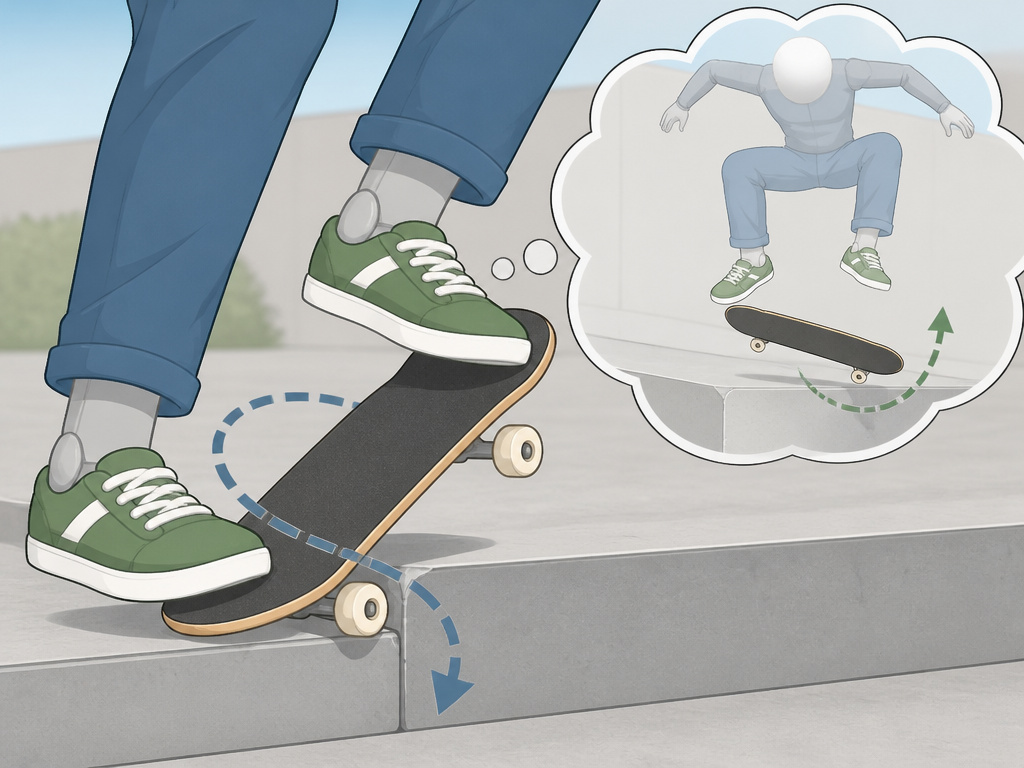
Formal coaching is rare in skateboarding. The 2022 study in the PMC article bluntly states the sport “presently remains largely coach-free.” Training practices exist because they are “shared amongst, and learnt from, peers.” This is your superpower. It means effective practice is social and observational.
When you’re at the park, watch. Don’t just wait for your turn. Watch how someone sets up for a boardslide. Where is their weight before they pop? What’s their shoulder doing? The study calls this “peer observation” a primary learning tool. Then, talk. Ask, “How do you keep your front foot from sliding off on that?” Most skaters will break it down. This informal knowledge transfer is the engine of progression.
Self-analysis is your other tool. The study notes skaters use “imagery, analogy, and understanding” to store a movement. After you try a trick, close your eyes for a second and replay your attempt. Did your back foot flick? Did you lean too far forward? This mental rehearsal solidifies the motor pattern faster than mindless repetition. This is also why analyzing your skate footage is so powerful—it gives you an objective view your mental replay can miss.
| Learning Method | How It Works | Formal Coaching Equivalent |
|---|---|---|
| Peer Observation | Watching & decomposing a trick in real-time | Coach demonstration |
| Verbal Breakdown | Asking for & receiving tip from a peer | Technical instruction |
| Mental Imagery | Replaying the attempt cognitively | Guided visualization |
| Error Usage | Analyzing why a attempt failed | Coach feedback |
This environment also creates informal leaders. You’ll notice a few skaters everyone seems to watch or ask for tips. They aren’t appointed coaches; they’re just the most consistent or analytical riders. Find them. Their advice, grounded in the peer-reviewed research on informal coaching, is often more directly applicable than a generic tutorial.
Breaking Plateaus and Managing Fear
You will stall. A plateau isn’t a sign you’re bad; it’s a sign you’ve mastered the current version of the skill and need to change the variable. The frustration of trying a kickflip 200 times with the same foot placement is a signal, not a failure.
First, diagnose the block. Are you not committing (leaning back, not leveling out)? Is it a technical flaw (foot placement, timing)? Film yourself. What you feel is happening and what is actually happening are often different. A front foot that feels like it’s flicking might actually be sliding straight off the side. This objective feedback is how you break a plateau.
Second, change one variable. If your ollies are consistent but low, try them rolling faster. If your shuvits aren’t landing under you, focus on jumping straight up rather than spinning the board. The brain learns by solving new problems. Giving it a slight variation on the old problem forces a new neural pathway.
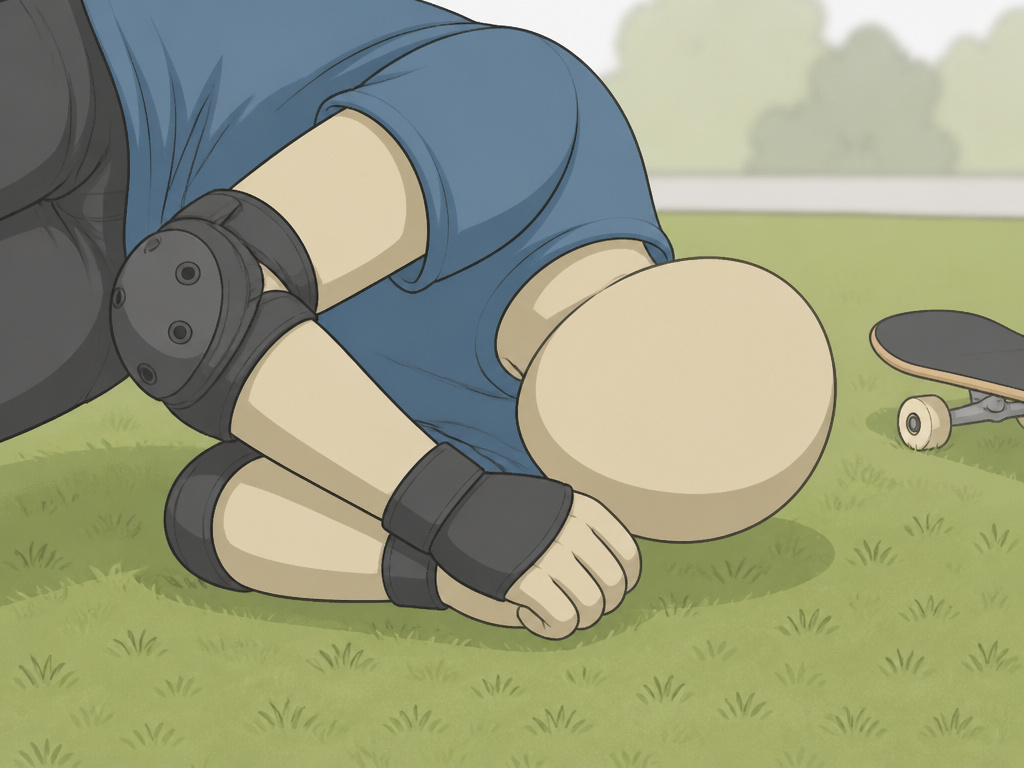
Fear is the other plateau. The CPSC warns you can “lose control at any speed,” and that awareness breeds hesitation. The solution is controlled exposure, not reckless action. Wear all your pads—this reduces the real cost of a fall. Practice the actual fall on a softer surface. The Kmart manual’s advice to “learn to fall (by rolling if possible) without the skateboard first” has merit, even if it’s not how most skaters formally learn. Spend five minutes on grass practicing tucking your chin and rolling from a crouch onto your shoulder. Making the bail a practiced skill removes the panic.
For adult beginners, this is doubly important. Your brain is better at risk assessment, and your body heals slower. Your practice must include deliberate recovery. A post-session stretch focusing on ankles, knees, and wrists can reduce next-day soreness. It’s not glamorous, but it’s what lets you stay consistent over months, not weeks.
Frequently Asked Questions
How do you practice skateboarding?
You practice by combining structure with self-directed learning. Follow a session blueprint (like the 78-minute plan above), focus on one specific skill per session, use peer observation and mental imagery, and track your attempts. Practice isn’t just repeating a trick; it’s the intentional cycle of attempt, analysis, and adjustment.
Is 27 too late to start skateboarding?
No, it’s not too late. The learning curve is steeper regarding fear and recovery, not ability. Adult beginners often progress faster in board control because they’re more analytical. The key is managing expectations, prioritizing protective gear, and focusing on consistency over explosive progress. Your goal is long-term enjoyment, not becoming a prodigy.
Can skateboarding be self-taught?
Absolutely, and historically it mostly has been. The 2022 study confirms skateboarding remains a largely coach-free environment where skills are learned from peers and personal practice. Self-teaching requires you to become your own coach: you must seek out demonstrations (in-person or video), analyze your errors, and structure your own practice routine. It’s less guided but often leads to a deeper, more personalized understanding of the mechanics.
How long does it usually take to learn to skateboard?
There’s no single answer. To comfortably cruise, turn, and stop requires consistent practice. To land a basic ollie consistently takes dedicated practice. The 2022 study sample had an average of 4.2 years of training, illustrating that “learning” is a continuous process. Comparing it to riding a bike is misleading; skateboarding demands constant micro-adjustments of balance that a bicycle’s geometry provides for you.
Before You Go
Effective practice comes down to a simple, unsexy formula: a pre-ride gear check, a timed session focused on one skill, and a habit of reviewing what went wrong. The fancy tricks are just applications of that formula.
If you take one thing from this, let it be the “one trick per session” rule. My own documented failure was bouncing between kickflips, shuvits, and ollies and mastering none of them. The day I switched to drilling just the ollie for a full hour, aiming for ten clean landings, was the day my progress actually started to stick. That single shift in approach did more for my progress faster journey than any new board or bearing ever could.
Your next session is already planned. Tighten your trucks, strap on your wrist guards, and go roll for ten minutes to warm up. Then pick your one thing. Everything else is just noise.
