
Skateboard Helmet vs Bike Helmet: Which Should You Choose?
This post contains affiliate links. As an Amazon Associate, we earn from qualifying purchases.
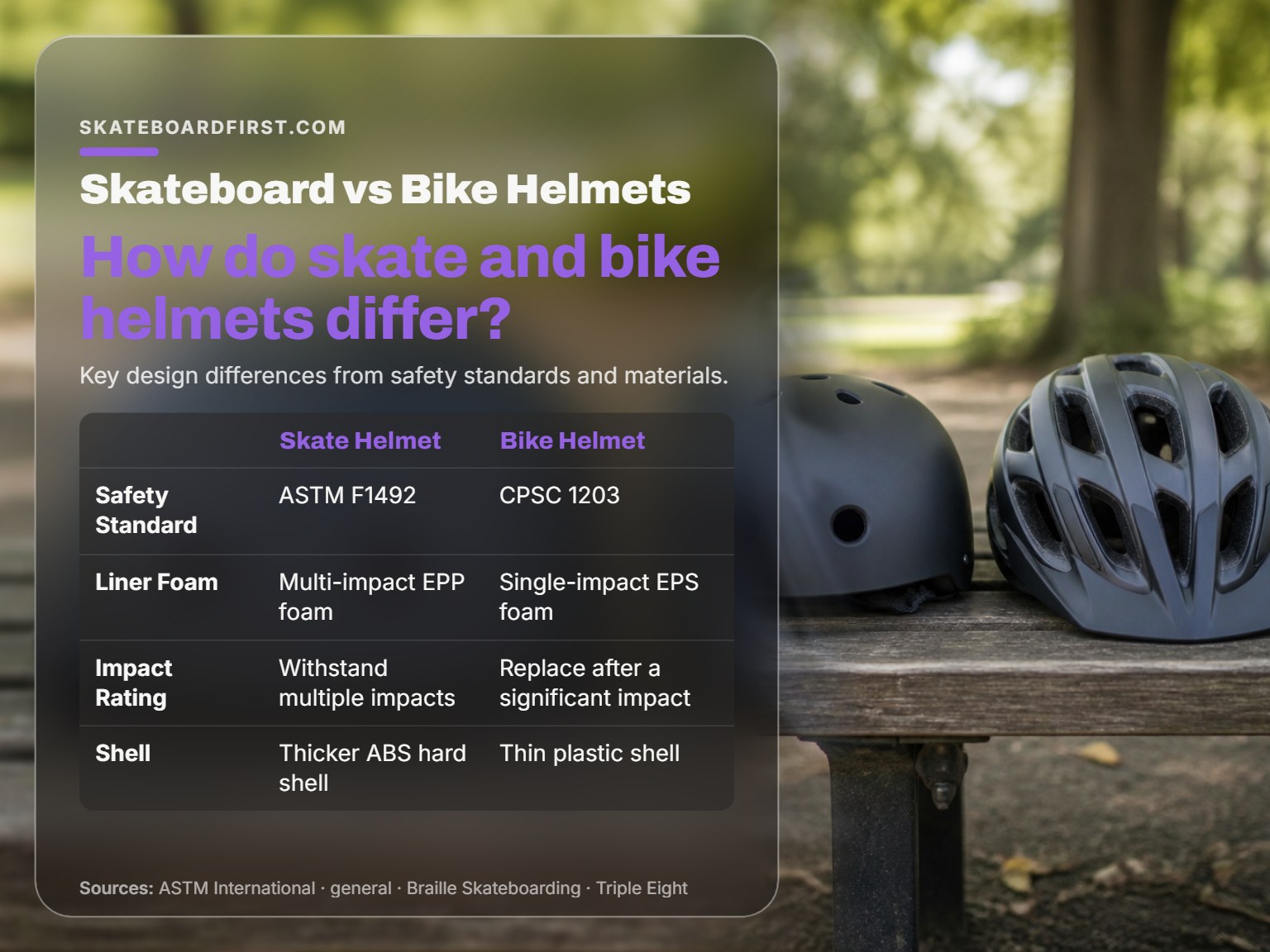
Skateboard helmets are certified for multiple lower-impact falls, while bike helmets are certified for a single high-impact crash. The difference comes down to three things: the safety standard (ASTM F1492 vs. CPSC 1203), the foam liner (EPP vs. EPS), and the shape and coverage. For casual street skating on a board, a skate helmet is the right call. For road cycling or downhill mountain biking, you need a bike helmet.
That distinction is the practical line between a helmet that stays protective after a few tumbles and one that becomes a safety risk after one hard hit. The wrong choice doesn’t just feel awkward, it can leave parts of your head exposed to the exact impacts your activity delivers, a key difference in the skateboard helmet vs bike helmet debate.
What follows: a breakdown of the three specs that matter, a look at the hybrid “dual-certified” option, and the one simple rule for knowing when your helmet is done protecting you.
Key Takeaways
- Look for an ASTM F1492 sticker inside a skate helmet, this certifies it for the repeated, multi-directional impacts common in skateboarding.
- Bike helmets certified to CPSC 1203 are designed to absorb one massive linear impact, like hitting pavement at speed. Sources disagree on replacement: Braille Skateboarding advises replacement after each fall, while SkateboardersHQ and Skateboard Session advise replacement after a significant or major impact.
- Dual-certified helmets exist and are a practical choice if you split time between biking and casual skating; check for both CPSC and ASTM labels.
- Fit matters more than brand. A $30 helmet that sits level on your forehead and doesn’t wobble protects better than a $150 one worn too far back.
The 3 Things That Decide Which Helmet You Need
The helmet on your head is a tuned safety device. Its job is to manage a specific kind of energy in a predictable way. Get the tuning wrong, and the protection drops fast.
ASTM F1492 is the performance specification for skateboard helmets. It requires the helmet to pass impact tests at multiple sites on the same sample, proving its multi-impact capability. CPSC 16 CFR Part 1203 is the mandatory U.S. Standard for bicycle helmets, focused on single high-energy impacts.
1. The Safety Standard: ASTM vs. CPSC
This is the essential starting point. A sticker inside the helmet tells you what it’s legally rated to handle.
ASTM F1492 is the benchmark for skateboarding. The standard simulates the kinds of hits skaters take: falling from your own height, hitting curbs, bailing on flat ground. The key is that a single helmet sample gets whacked in several places during testing. Passing means it can likely take a few real-world knocks before the foam is compromised.
CPSC 1203 is the law for any bike helmet sold in the U.S. The test is brutal but singular: a headform is dropped onto an anvil at a set speed, and the force transmitted must stay below a specified threshold. It’s engineered for the worst-case cycling scenario, a high-speed linear impact. The foam is designed to crush, beautifully and completely, exactly once.
Which one wins? They’re for different jobs. For skateboarding, ASTM F1492 is your baseline. For biking, CPSC 1203 is mandatory. A helmet missing the correct sticker for your activity is a gamble.
2. The Foam Liner: EPP vs. EPS
Under the shell, the foam does the actual work of stopping your skull. The type of foam dictates how many times it can do that job.
EPP (Expanded Polypropylene) is the rubbery, multi-impact foam common in skate helmets. When you compress it, it wants to bounce back to its original shape. Its elasticity allows it to absorb several moderate hits. Think of it like a car’s suspension soaking up small bumps on a dirt road, it recovers.
EPS (Expanded Polystyrene) is the crisp, single-impact foam in almost every bike helmet. It’s a network of tiny rigid beads. On impact, those beads crush and fracture, absorbing a huge amount of energy. They don’t uncrush. It’s a one-time sacrificial layer.
The physical feel is different. Press your thumb into the liner of a skate helmet, it might give a little and feel slightly spongy. Press into a bike helmet liner, and it feels firm, almost brittle.
The consequence of getting it wrong: Using an EPS-lined bike helmet for a skate session means that first decent fall could permanently compact the foam. You might not see any damage, but the helmet is now a hat. It won’t properly absorb the next hit.
3. The Shape and Coverage: Bucket vs. Missile
Look at the silhouette. A skate helmet is round, smooth, and covers more of the back of your head and the temples. It’s shaped like a bucket. A road bike helmet is elongated, often with a pointed tail, and prioritizes the top and front of the head. It’s shaped like a missile.
This design is a map of likely impact zones.
| Design Feature | Skateboard Helmet | Bike Helmet (Road) |
|---|---|---|
| Primary Coverage | Back, sides, temples | Top, forehead |
| Shell | Thicker ABS plastic | Thin polycarbonate |
| Vents | Fewer, smaller holes | Many, large openings |
| Weight | Heavier (more material) | Lighter (for aerodynamics) |
Skateboarders fall in all directions, often backwards. The round, full-coverage shell is there to slide and protect. Cyclists usually pitch forward; the elongated shape and massive vents are for aerodynamics and cooling during long, strenuous efforts.
Where this goes sideways: Wearing a road bike helmet for skateboarding. That elongated back leaves the base of your skull exposed, which is exactly where you’ll impact if you slip out backwards on a board. It’s a mismatch of risk and gear.
Can You Use a Bike Helmet for Skateboarding? (And Vice Versa)
The short answer is “sometimes, but you really shouldn’t.” The long answer lives in the certification label and what you’re actually doing.
The Case for a Bike Helmet on a Board
It’s only a viable option under two strict conditions. First, the helmet must be dual-certified (carrying both CPSC 1203 and ASTM F1492 stickers). Second, you must be doing casual, low-speed rolling, think cruising a bike path on a longboard, not attempting kickflips or dropping into a bowl.
Even then, you’re making a compromise. Ventilation will be better, but the shape likely won’t protect the back of your head as well as a true skate helmet. I tried using my old Giro Register MIPS bike helmet for cruising around the neighborhood on a cruiser board. It worked, but every time I stepped off a curb, I was acutely aware that the back of my head felt naked.
The Case for a Skate Helmet on a Bike
This is more common, especially with the rise of casual urban cycling and mountain biking. A dual-certified skate helmet is perfectly legal and safe for biking. The trade-off is comfort and cooling.
Skate helmets are heavier and hotter. On a long summer ride, you’ll feel the weight and miss the airflow. For short commutes or a trip to the store, it’s fine. For a 20-mile road ride or a climb on a hot day, you’ll be miserable.
The verdict: Get a dedicated helmet for your primary activity. If you split time 50/50, invest in a well-ventilated dual-certified helmet and accept it as a jack-of-all-trades, master-of-none.
Dual-Certified Helmets: The Hybrid Solution
These helmets bridge the gap. They pass both the CPSC’s single high-impact test and the ASTM’s multi-impact test. They’re the answer for the person who bikes to the skatepark, or whose kid does a bit of everything.
Brands like Triple Eight (with their Gotham MIPS model) and Bern (like the Watts model) make popular dual-certified options. They typically look more like a skate helmet, round, full-coverage, but may have slightly improved ventilation over a pure skate design.
Easy to miss: Not all helmets from skate brands are dual-certified. A Triple Eight “Sweatsaver” might only have the ASTM sticker. You must look inside the helmet for both the CPSC and ASTM F1492 labels. No stickers, no guarantee.
Here’s a quick comparison of two approaches:
| Scenario | Best Helmet Type | Key Reason |
|---|---|---|
| Street Skateboarding | ASTM F1492 Certified Skate Helmet | Multi-impact EPP foam, full rear-head coverage for frequent falls. |
| Road Cycling | CPSC 1203 Certified Bike Helmet | Lightweight, aerodynamic, excellent ventilation for sustained effort. |
| Casual Commuting (Bike & Board) | Dual-Certified Helmet (CPSC + ASTM) | Legal for both, simplifies gear, good for low-speed, mixed use. |
| Downhill Mountain Biking | Full-Face Bike Helmet (CPSC) | Maximum facial and chin protection for high-speed, high-risk crashes. |
When you’re picking a skateboard helmet, start by checking these certifications to resolve the skateboard helmet vs bike helmet choice. It’s the most fundamental step in your helmet guide.
The ‘2 2 2 Rule’ and When to Replace Any Helmet

Helmets don’t last forever. Sunlight, sweat, and impacts degrade materials. The industry’s old “replace every five years” advice is vague. The ‘2 2 2 rule’ is more actionable.
- 2 Years of Regular Use: If you’re out several times a week, the foam and straps degrade. Mark your calendar.
- 2 Significant Impacts: Any hit that makes you go “oof” or leaves a visible mark on the shell. The foam could be compromised even if you can’t see it.
- 2 Fingers Under the Strap: If you can fit two fingers between the chin strap and your jaw, the fit is too loose. A helmet that moves on impact transfers force poorly. Tighten it or fit a new helmet.
This rule applies whether you’re wearing a full face helmet for the park or a ventilated road helmet. After a crash, inspect it. Look for deep scratches, cracks, or any deformation. When in doubt, replace it. Your brain’s safety isn’t worth the $80 you’ll save.
MIPS, Rotational Force, and the Tech Debate
You’ll see MIPS (Multi-directional Impact Protection System) in many higher-end helmets, both bike and skate. It’s a thin, low-friction liner inside the helmet that allows the outer shell to slide slightly on impact, theoretically reducing rotational forces on the brain.
Virginia Tech Helmet Ratings, a respected independent tester, factors MIPS into its star ratings and states it reduces rotational motion. Many of their top-rated helmets with MIPS carry the technology.
However, the Bicycle Helmet Safety Institute notes that MIPS is not required by any safety standard (CPSC or ASTM), and the real-world benefit in actual crashes is still debated. They call it a beneficial feature but not a primary selection criterion over basic fit and certification.
My take? If you’re choosing between two otherwise equal helmets and one has MIPS, take it. It’s a plausible extra layer of protection. But don’t buy a poorly fitting MIPS helmet over a perfectly fitting non-MIPS one. Fit is critical.
Before You Go
Check the helmet on your head right now. Is it certified for what you’re actually doing? Does it sit level, just two fingers above your eyebrows? If you’ve taken a spill recently, have you inspected it closely?
Start there. That’s more important than any brand name or technology buzzword. For most skaters, that means an ASTM F1492-certified helmet from a brand like Triple Eight or Pro-Tec. For most cyclists, it’s a CPSC-certified model from Giro or Bell. And if you see someone at the park with a bike helmet on, maybe don’t judge, just check that they’ve got the dual-certified stickers inside. We all start somewhere.
Frequently Asked Questions
Is a bike helmet the same as a skateboard helmet?
No. They are designed and certified for different types of impacts. Bike helmets (CPSC 1203) are for single, high-energy crashes. Skateboard helmets (ASTM F1492) are for multiple, lower-impact falls. The foam, shape, and coverage reflect this difference.
Can you wear a bike helmet when skateboarding?
You can, but only if the bike helmet is dual-certified to both CPSC 1203 and ASTM F1492. Check for both stickers inside. Even then, it’s only recommended for casual, low-speed skating, not for trick progression or park skating where multi-impact protection is key.
What is the 2 2 2 rule for helmets?
It’s a simple checklist for knowing when to replace a helmet: after 2 years of regular use, after 2 significant impacts, or if you can fit 2 fingers between the chin strap and your jaw. It’s a more practical guide than a generic expiration date and applies to all helmet types.
Can you use a cycling helmet for skating?
It’s not advised for serious skating. A standard cycling helmet lacks the rear-head coverage and multi-impact foam needed for the frequent, multi-directional falls in skateboarding. Using one increases your risk of injury during the kinds of falls skaters actually experience.
