
Skateboard Truck Size Chart: The 3-Step Fit Check
This post contains affiliate links. As an Amazon Associate, we earn from qualifying purchases.
The right skateboard truck size matches your deck’s width, measured at the axle nuts. Aim for the axle ends to sit within a quarter-inch of the deck’s edge. Brands use different numbering systems. Independent’s 149 fits an 8.375–8.6″ deck, Thunder’s 147 fits a deck range according to brand charts, and Venture’s 5.6 fits a deck range according to brand charts, so you must check each brand’s specific chart.
That quarter-inch rule is where most setups live or die. Get it right, and your board feels stable and predictable. Get it wrong, and you’re fighting wheel bite or a wobbly feel on every push. The catch is that every major brand measures its trucks a little differently, and their sizing charts don’t always agree. Always consult a skateboard truck size chart for accurate comparisons.
What follows is a decoder ring for those charts. We’ll break down how to measure your own trucks, translate the brand-specific numbers into real axle widths, and spot the overlaps where one deck can work with two different truck sizes. You’ll also get the specs that matter for racing and downhill, where the street rules don’t apply.
Key Takeaways
- Match your truck’s axle width to your deck width, not the brand’s model number. An Independent 149 has an axle width that corresponds to its model number, while a Thunder 147’s axle width must be checked via the brand’s chart.
- Brand charts disagree on compatible deck ranges. For an 8.5″ deck, Rollersnakes says an Independent 149 fits 8.375–8.6″, while CCS says 8.25–8.5″.
- High trucks (52mm+) fit larger wheels and are more stable; low trucks (under 50mm) turn quicker and are lighter. Mid trucks are the default for 50–54mm wheels.
- Never mix truck brands on one setup. Element Brand warns that differing geometries can make the board pull to one side.
- If your board feels loose and wobbly at speed, check the kingpin bushings before buying new trucks. A worn bushing flattens and loses rebound.
Why Truck Width Isn’t Just a Number
You measure your deck in inches. Truck boxes show numbers like 149, 147, or 5.6. There is no industry standard that converts one to the other. Some brands measure the full axle width from nut to nut. Others list the hanger width, which is the part between the wheels where you grind. This is why a truck width guide is essential, as it translates the marketing number into the physical axle width that must align with your deck.
A truck that’s too narrow feels twitchy and unstable, especially at speed. One that’s too wide increases the chance of wheel bite, where the wheel touches the deck during a turn and stops you dead, and can lead to your shoe scraping the wheel while you push.
The first sensory check is sound and feel. A too-narrow truck makes a hollow, chattery rumble over rough asphalt because the deck isn’t supported at the edges. Wheel bite announces itself with a loud thunk and a sudden, jarring stop mid-carve.
The 3-Step Fit Check (and Where Charts Disagree)
Forget memorizing numbers. Follow this sequence every time you pair a deck with trucks.
1. Measure Your Deck Accurately
Use a ruler or tape measure across the widest point, perpendicular to the length. Most decks are measured to the nearest quarter-inch (8.0, 8.25, 8.5). Write this number down.
2. Find the Real Axle Width
This is the critical translation step. Brands publish a skateboard truck size chart that converts their model number to an axle width. For example, the Slappy ST1 truck for an 8.5″ deck has a listed axle width of 149mm. Don’t assume a number means what you think.
3. Consult Multiple Sizing Charts
Retailers and brands publish slightly different compatibility ranges. You must check more than one source. For a common size like an Independent 149, the Rollersnakes chart says it fits decks from 8.375 to 8.6 inches. The CCS chart for the equivalent Ace Classic Low 03 says 8.25 to 8.50 inches. These sources disagree on the exact compatible range.
Where this goes sideways: Assuming all “149” trucks are the same. An Independent 149 fits decks from 8.375 to 8.6″ per Rollersnakes, while a Krux 149 fits decks from 8.38 to 8.62″. The numbers match, but the recommended deck ranges differ by an eighth of an inch on either side.
If you’re between sizes, go wider for more stability, narrower for quicker turns. A quarter-inch mismatch is noticeable but skateable. A half-inch mismatch will cause problems.
Decoding the Major Brand Numbering Systems
This table translates the cryptic model numbers into the axle width you can measure and the deck width range you should target. All data is pulled directly from retailer Rollersnakes and manufacturer Slappy specs.
| Brand | Model Number | Axle Width (in) | Compatible Deck Width Range (in) |
|---|---|---|---|
| Independent | 149 | 8.5 | 8.375 – 8.6 |
| Krux | 149 | 8.5 | 8.38 – 8.62 |
| Ace | 8.5 | 8.5 | 8.25 – 9.0 |
| Slappy | 8.5 | 5.87 (149mm) | 8.5 (named for deck width) |
Notice the inconsistency? An Ace 8.5 truck is recommended for decks up to 9 inches wide, while an Independent 149 (also 8.5″ axle) tops out at 8.6 inches. This is why you need the skateboard truck size chart, the number alone doesn’t tell the whole story.
Independent Trucks: The Standard
Independent’s numbering is straightforward: the number is the axle width in millimeters divided by 10. A 149 is approximately 149mm, or about 5.87 inches. Their truck geometry is known for a deep, stable turn. The classic Independent 149 is the benchmark for an 8.5″ street deck.
Thunder & Venture: The Lighter Options
Thunder and Venture use different systems. Thunder’s numbers correspond to axle widths as listed in their sizing charts. Venture uses a fractional inch system (5.0, 5.6, 6.0) that refers to hanger width. A Venture 5.6’s axle width can be found in the brand’s sizing chart. Both brands offer lower profiles and lighter weights, which is why they’re popular for technical street skating.
When Your Truck Size is Between Decks
What if you have 8.25″ trucks and an 8.5″ deck? It’s a common mismatch. The board will be slightly less stable, but it will turn quicker. For a beginner, that instability is a drawback. For a technical skater who wants a more responsive feel, that might be the goal. The inverse, 8.5″ trucks on an 8.25″ deck, makes the board heavier and increases the risk of wheel bite unless you run smaller wheels.
I ran 8.25″ Thunders on an 8.38″ deck for a season because I wanted a quicker, more pocket-sized feel for street ledges. It worked, but I had to be more precise with my foot placement on landings.
Truck Height: Low vs. High vs. Mid
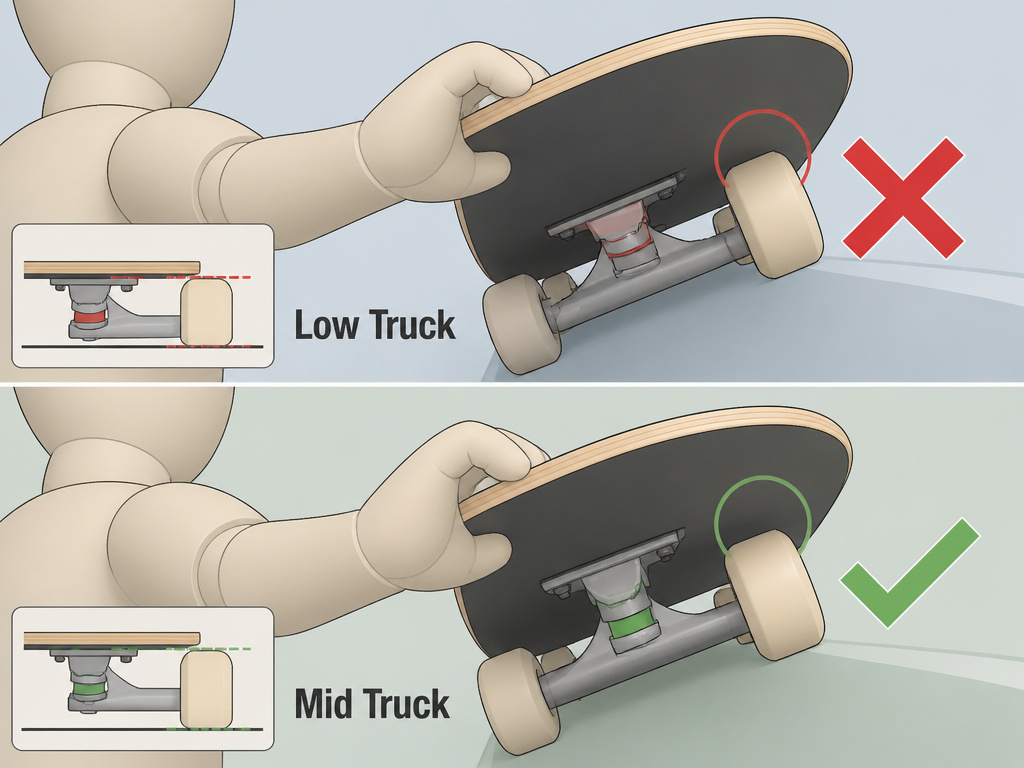
Width is the first decision. Height is the second. Height determines how big your wheels can be before they bite the deck.
| Truck Height | Typical Range | Best Wheel Size | Feel & Use Case |
|---|---|---|---|
| High | 53mm and above | 52mm+ | Stable, slower turning. Good for transition, cruising, rough ground. |
| Mid | 50–53mm | 50–54mm | Balanced. The default for most street and park skating. |
| Low | Under 50mm | Under 52mm | Quick, responsive turns. Lighter. Preferred for technical street. |
The CCS buyers guide states high trucks are “more compatible with larger wheels (52mm and above)” and mid trucks work with “most small to mid-sized wheels (50-54mm).” This isn’t just preference, it’s clearance physics. Consulting a truck height guide helps you avoid the trial and error of wheel bite.
My daily wheels are 54mm. I run mid-height trucks. When I tried a set of low trucks with the same wheels, I got wheel bite on my first hard carve. The board stopped, and I didn’t.
The Hidden Specs: Bushings, Weight, and Geometry
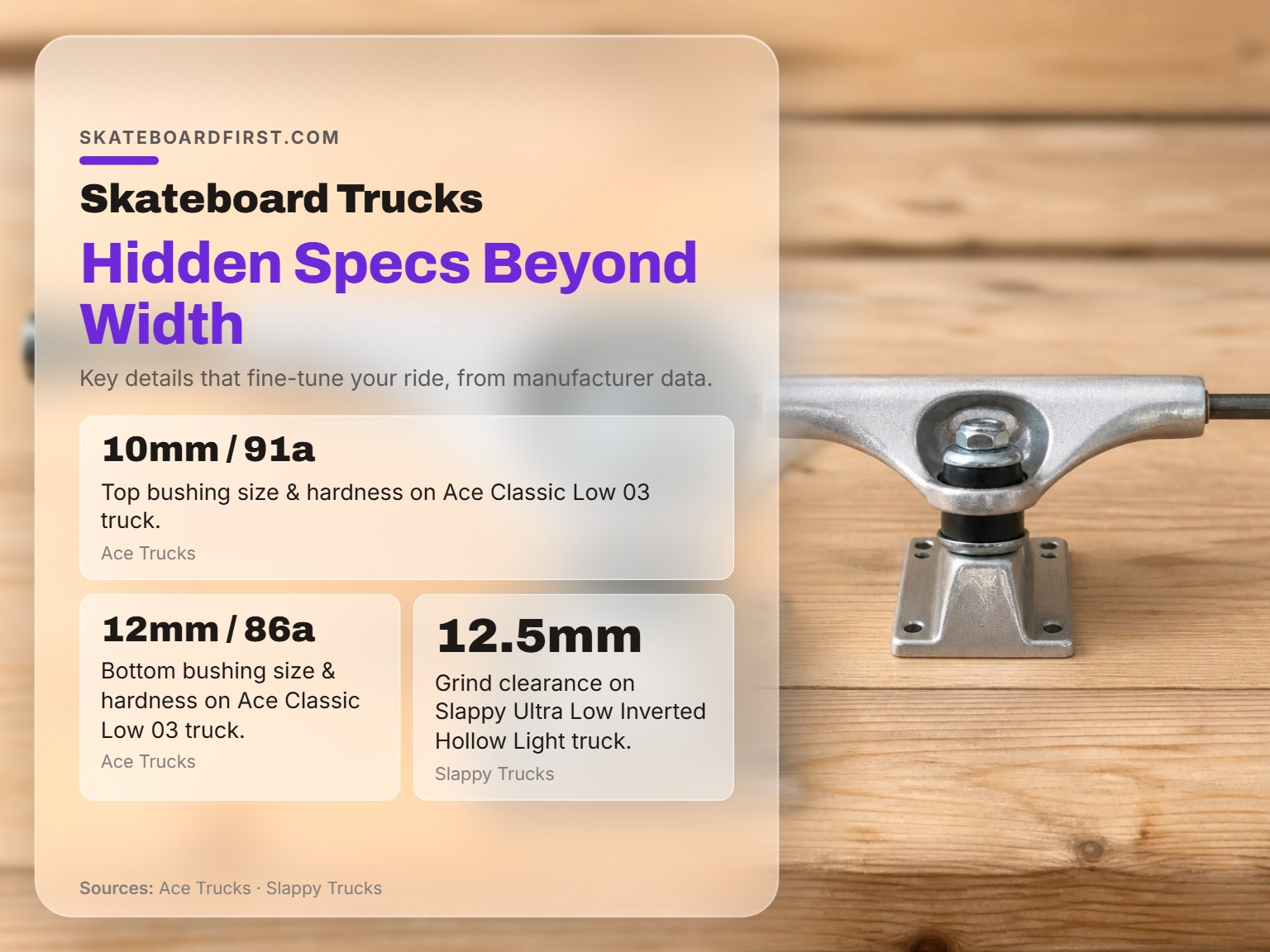
Once width and height are set, these finer details fine-tune the feel.
Bushings
These urethane cylinders control your turn. The Ace Classic Low 03 comes with a 10mm/91a top bushing and a 12mm/86a bottom bushing. Harder bushings (higher durometer, like 94a) create a stiffer, more stable turn. Softer bushings (like 85a) turn easier and are more forgiving. If your trucks feel loose and vague, swap the stock bushings before you blame the truck. I spent an afternoon chasing a wobbly feel before realizing the kingpin bushings had gone flat.
Weight
Manufacturers list per-truck weights. The Slappy ST1 Classic for an 8.5″ deck weighs 388g. Their Hollows version weighs 368g, and their Ultra Low Inverted Hollow Lights weigh 351g. Saving 37 grams per truck might not sound like much, but over a two-hour session, your legs will notice the difference. Lighter trucks make flip tricks less taxing.
Grind Clearance and Angle
For grind-heavy skaters, the kingpin’s position matters. The Slappy Ultra Low Inverted Hollow Light truck has a 12.5mm grind clearance and a 25-degree Slappy angle. Higher clearance means the kingpin is less likely to catch on smiths, feebles, or hurricane grinds. This is a spec you only find on manufacturer catalogs, not retailer charts.
When Standard Sizing Doesn’t Apply: Racing and Downhill
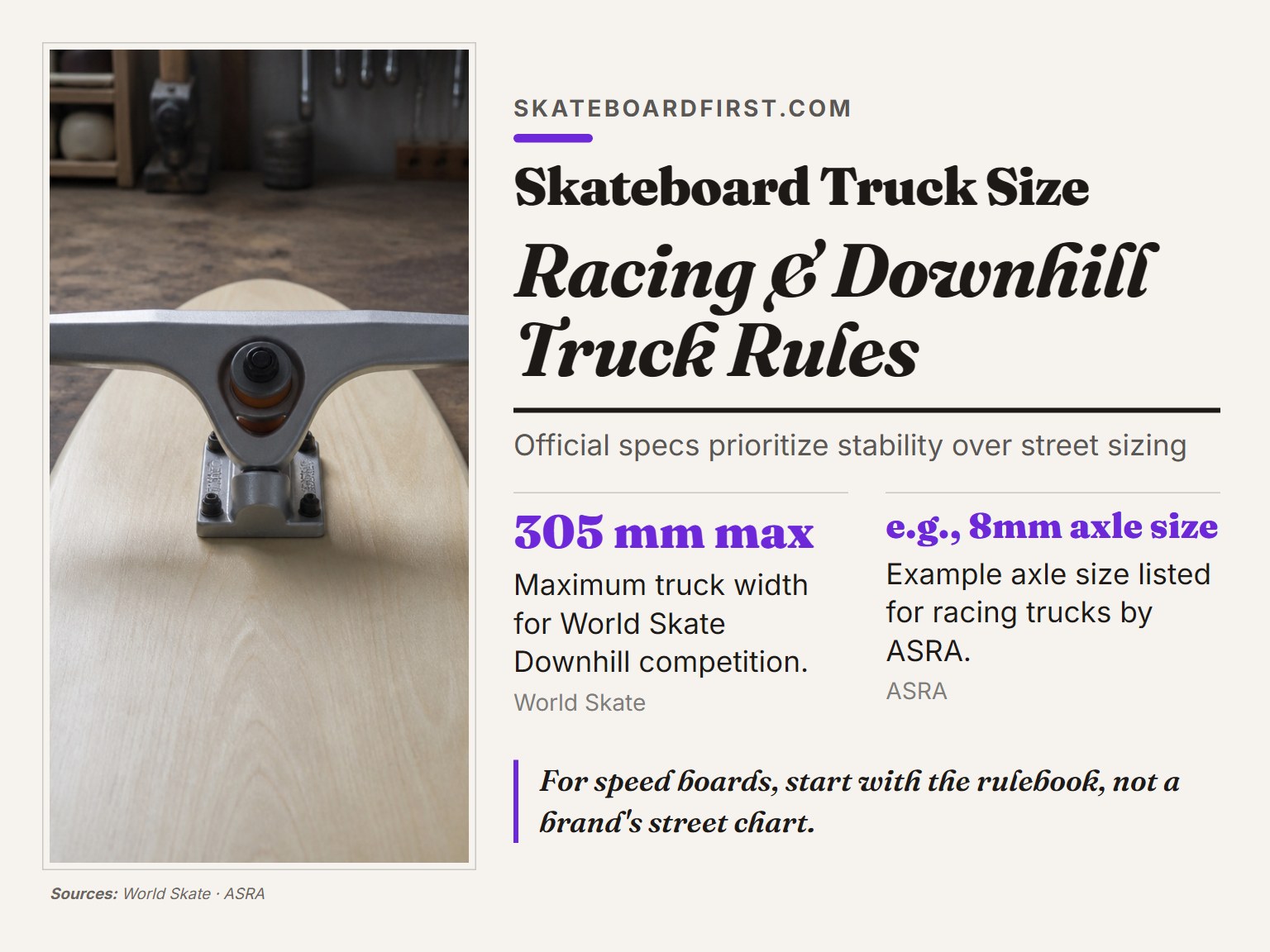
Street skate sizing goes out the window here. The World Skate downhill rulebook sets a maximum truck width of 305 mm (12 inches) for official competition. The Australian Skateboard Racing Association (ASRA) lists technical specs for racing trucks, including axle widths like 200mm and axle sizes of 8mm.
If you’re building a speed board, you start with the rulebook, not a brand’s street chart. The priorities shift from quick turns and low weight to maximum stability and precise steering at high speed.
Frequently Asked Questions
How do I know what size skateboard truck to get?
Measure your deck width in inches. Then, consult the specific brand’s size chart to find the model number that corresponds to that width. Aim for the axle ends to be within a quarter-inch of your deck’s edge. If you’re between sizes, wider trucks add stability, narrower trucks increase turn speed.
Will 8.25 trucks fit an 8.5 deck?
Yes, but they will be slightly narrow. The deck will overhang the axle nuts by about an eighth of an inch on each side. This setup can feel less stable at high speed but will turn more quickly. It’s a common choice for skaters who prefer a more responsive, technical feel. Just be aware that your deck width and truck width are mismatched.
What size truck goes on an 8.25 skate deck?
For an 8.25″ deck, common truck sizes are Independent 144/146, Venture 5.6, and Ace 8.25. Always double-check the brand’s chart, as recommendations vary. For example, the Independent 144 is listed for 8.2–8.375″ decks, while the 146 fits 8.125–8.625″.
Will 5.5 trucks fit an 8.25 deck?
It depends on the brand. A generic “5.5” truck likely refers to a 5.5-inch hanger width. Using the SkateHut guideline, a 5.5″ (140mm) truck is recommended for 8.25–8.5″ decks. So, a 5.5″ truck could fit an 8.25″ deck, but you must verify the axle width with the specific brand’s chart to be sure.
The Bottom Line
Start with your deck width. Translate that into the real axle width for your chosen brand using their official chart, not a generic rule. If you’re building your first board and want one answer: for an 8.5″ deck, get Independent 149 trucks. That covers the vast majority of street and park skating.
Then, leave the stock bushings alone for your first ten sessions. Get used to how the truck is supposed to feel from the factory. When it starts to feel dead or leans without springing back, that’s when you open the tool kit. Changing one thing at a time, like just the bushings, tells you exactly what was wrong.
Finally, your wheel size and truck height are a package deal. If you want to run 56mm wheels for rough ground, you’ll need high or mid trucks and possibly riser pads. Trying to force big wheels onto low trucks is a direct path to wheel bite. Match the system, and the board will work with you, not against you.
