
How to Stay Consistent With Skateboarding: Step-by-Step
This post contains affiliate links. As an Amazon Associate, we earn from qualifying purchases.
Staying consistent with skateboarding means building a simple weekly routine around fundamentals you can actually do, not chasing tricks you see online. Ride for short, frequent sessions, focus only on pushing and turning, and keep your board’s trucks tightened to a stable-but-turnable setting. That routine beats two-hour weekend marathons that leave you sore and frustrated.
The “stable-but-turnable” truck setting is where most new skaters quit. Too loose, and the board wobbles uncontrollably the first time you pick up speed. Too tight, and you can’t steer without kicking the tail, which feels awkward and unnatural. The initial phase isn’t about ollies. It’s about finding that middle ground where the board feels like an extension of your feet, not a separate piece of equipment you’re fighting. Learning how to stay consistent with skateboarding begins with mastering this fundamental setup.
What follows is a five-rule system built from safety agency guidelines, shop mechanics’ advice, and the one thing every consistent skater does: they make it easy to say yes. We’ll cover the essential gear checks, the progressive skill ladder that actually builds confidence, and how to structure a 30-minute session so you walk away wanting more, not less.
Key Takeaways
- Ride three times a week for 30 minutes. Short, frequent sessions build muscle memory faster than occasional long ones.
- Set your trucks for stability first using the CPSC’s advice to keep mounting screws tight, then loosen a quarter-turn at a time until you can carve comfortably.
- Spend your first two weeks mastering push, turn, and stop before attempting any trick; comfort precedes control.
- Use a 7-ply maple deck and urethane wheels (hardness 76a-101a) to ensure your board responds predictably to your weight and movement.
- Log one small win per session, like rolling over a crack you previously avoided, to build a record of progress that motivation can’t erase.
The 5 Rules for Staying Consistent (and Why They Work)
Consistency dies to complexity. If getting ready to skate takes 15 minutes of gear fussing and a 20-minute drive, you’ll find an excuse. The rules below strip that away. They are not about willpower. They are about designing an environment where skating is the easiest, most obvious next thing to do.
Before you start: A loose kingpin nut can work its way off while you ride, according to Skate Labs. Always keep the nut fully threaded. Work in good light with a proper skate tool, and wear gloves when cleaning bearings with isopropyl alcohol, which is flammable.
Rule 1: Start With the Right Setup (Not a Toy Board)
Your board must work with you, not against you. The Portland Parks & Recreation guide is blunt: toy boards have “weak components that will not stand up to repetition.” They don’t turn properly, the wheels barely roll, and they kill motivation within a week. A proper setup is about predictable, responsive parts that do what you ask. It’s about predictable, responsive parts that do what you ask.
The industry standard is a 7-ply maple deck. It shouldn’t flex much when you stand on it. Trucks should be metal, not plastic. For a beginner, truck width matching your deck is fine. The real secret is in the bushings and wheels. Bushings “should be made of urethane, not hard plastic,” and if they’re too hard, “the board will be nearly impossible to turn,” per the Portland guide. Start with the stock medium bushings that come with quality trucks—they’re a safe middle ground.
Wheels need to be urethane, with a durometer (hardness) between 76a (softest) and 101a (hardest). Softer wheels around 78a-86a absorb vibration on rough streets. Harder wheels above 90a are for smooth skateparks. For a beginner skating sidewalks and parking lots, a wheel in the mid-range of hardness is a good starting point. It grips enough to feel stable but won’t stick on every pebble.
Where sources disagree: If you’re an adult or taller teen, a slightly longer board might feel more stable. For a smaller rider, a shorter deck could be easier to maneuver. There’s no single right answer—try standing on a few at a shop.
Rule 2: Lock In a Micro-Schedule
A “micro-schedule” means skating for a short, fixed time on specific days. Not “whenever you feel like it.” Skaters who burn out are often going out alone for long sessions with no goal, then getting discouraged when progress stalls. That’s a recipe for frustration.
Schedule short, frequent sessions. Put them in your calendar. Tuesday, Thursday, Saturday after work. The time constraint works in your favor. You’re not out there to conquer the skatepark. You’re out there to complete the session. This builds the habit without relying on motivation, which is famously unreliable. When you know it’s only 30 minutes, it’s easier to lace up your shoes and go, even when you’re tired.
What most people get wrong: They schedule two-hour weekend sessions. Your ankles and muscles aren’t ready for that, and mental fatigue sets in. You end the session sore and demoralized. Thirty minutes is enough to practice, but not enough to break yourself.
Rule 3: Follow the Progressive Skill Ladder (No Skipping)
This is the core of structured, effective practice. You cannot land an ollie if you can’t comfortably ride toward a target and stop safely. Follow a progressive skill ladder, and only move up when the current skill feels comfortable.
- Push and Coast: Push once, put both feet on the board, and coast until you stop. Do this until you can look ahead, not at your feet.
- Turn: Practice gentle leans to turn left and right. Then practice kick-turns (lifting the front wheels to pivot).
- Stop: Master the foot-brake (dragging your back foot) and the simple step-off.
- Ride Over Small Obstacles: Aim for a crack, then a stick. This teaches balance and commitment.
- Ollie Stationary: Only after rungs 1-4 are automatic.
Skipping a rung is the most common mistake. Someone sees a kickflip online and spends two days trying it, never learning to stop. They fall hard, get scared, and the board collects dust. The ladder prevents this by guaranteeing small wins every session. Your goal isn’t to learn a trick. It’s to climb one rung.
Rule 4: Tune Your Trucks for Your Current Skill Level
Truck tightness is not a “set it and forget it” spec. It’s a dynamic setting that should evolve as your balance improves. The Skate Labs guide explains the mechanism: “Tighten the kingpin nut and the board gets more stable and harder to turn. Loosen it and carving gets easier, but the board can wobble at speed.”
| Tightness Setting | Best For | Risk If Too Loose/Tight |
|---|---|---|
| Firm | First week, absolute beginners | Too tight: cannot turn, must kick-turn everything. Too loose: speed wobble at low speed. |
| Medium | Weeks 2-4, learning to carve | Too loose: board becomes twitchy when pushing. Too tight: restricts fluid, lean-based turns. |
| Loose | Confident riders, park carving | Too loose: kingpin nut may back off (safety issue). Too tight: limits deep carves and quick direction changes. |
Start with both trucks set for stability. Skate and adjust the kingpin nut a quarter-turn at a time, riding between changes, until you find a setting that balances stability and turning. This is your “goldilocks” setting. Write it down (e.g., “1/2 turn from tight”). Consistency requires a known, repeatable setup.
Rule 5: Log One Win Per Session
Motivation fades. A written record doesn’t. Your win doesn’t need to be a landed trick. It can be physical, mental, or equipment-based.
- Physical: “Rode over the driveway crack without stopping.”
- Mental: “Skated for 30 minutes even though I was tired.”
- Equipment: “Cleaned my bearings and the wheels spin freely.”
Log it in your phone’s notes app or a notebook. Date it. This creates a tangible history of progress. On days when you feel like you’re getting nowhere, scroll back through your logs. You’ll see the pattern: you are getting better. This is a powerful tool for tracking your progress and smashing through the inevitable plateaus.
How to Structure Your 30-Minute Session
A session with no structure is a session where you default to trying the same trick 50 times and failing. Here’s a template that ensures you work on fundamentals while leaving room for play.
Start with a warm-up and gear check.
Push around slowly. Check your board: Are any nuts loose? Do the wheels spin freely? The CPSC says to always check for “excessive play (looseness) and any broken or cracked parts.” This isn’t busywork. A loose truck hanger feels fundamentally different than a tight one, and that inconsistency will undermine your muscle memory.
Spend time on focused skill work.
Pick the current skill ladder rung you’re on. Spend 15 minutes on only that skill. If you’re on “Turn,” practice left and right carves around a parking lot line. Don’t suddenly decide to try an ollie. This focused repetition builds the neural pathways for that specific movement. It’s how you build a sustainable practice habit.
End with free skating and a cool down.
The last 10 minutes are for play. Just ride. Practice nothing. Explore your neighborhood. Try a gentle slope. This part of the session associates skateboarding with fun, not just work. It’s the reward that makes you want to come back next time. Then, spend the last minute consciously cooling down: slow pushes, deep breaths. This signals to your body that the session is over, reducing next-day soreness.
The Mental Hurdles (And How to Clear Them)
The board isn’t the problem. Your brain is. Many skaters battle isolation, comparison, and the gloom of slow progress. The solutions are tactical.
Skating Alone: If you have no skate friends, bring headphones. Create a “skate playlist” of high-energy music you only listen to while riding. It transforms a solo session into a private event. Also, even if you’re not talking to anyone, go to a skatepark. The ambient energy of other people skating is a surprisingly effective motivator.
Comparing Yourself to Others: You will see someone land a trick with smooth, easy-looking control. Remember the AAOS skateboarding safety PDF focuses on injury prevention for beginners, not progression rates. That skater has probably put in thousands of hours. Your journey is your own. Your only benchmark is your log from last week. This mindset is crucial to building confidence.
The “No Progress” Feeling: Progress in skateboarding is not linear. You will have weeks where nothing clicks. This is the time to descend the ladder. Go back and practice a rung you’ve already mastered. Cruise around focusing only on smooth pushes. This resets your frustration and often, paradoxically, leads to the next step when you return to the hard thing. It’s a proven method to breaking a plateau.
Safety and Consistency Are Partners
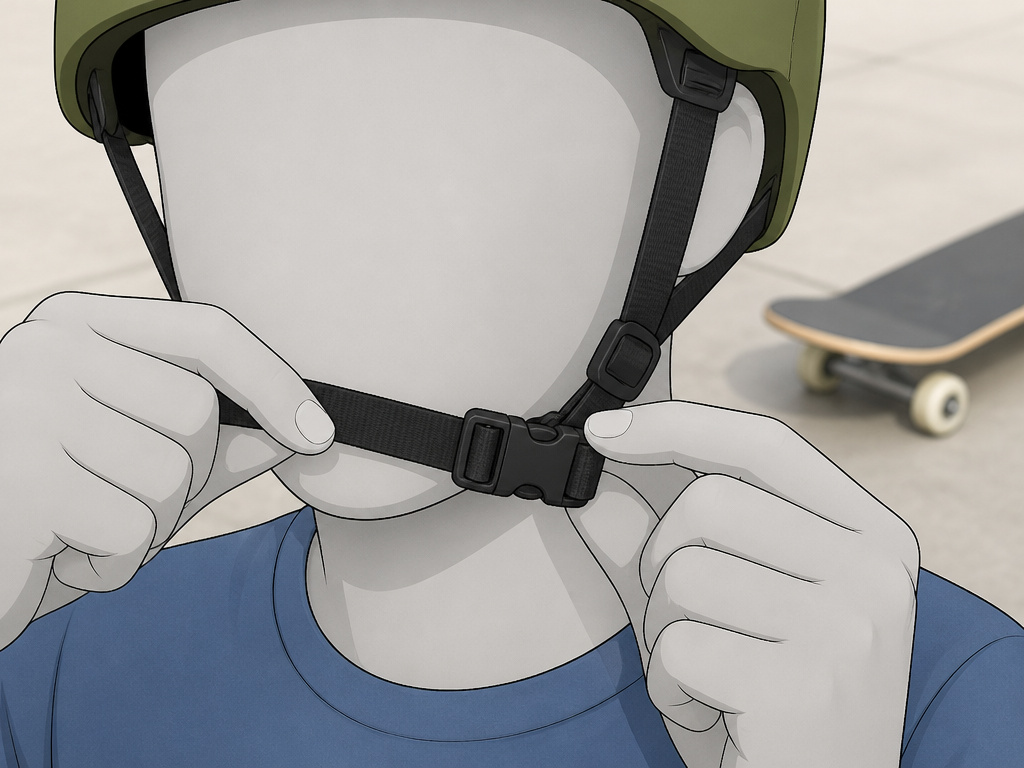
Ignoring safety leads to injury. Injury breaks consistency. The CPSC skateboarding safety fact sheet isn’t just a list of rules; it’s the foundation of a long-term skating habit.
- Helmet: It must fit snugly with the chin strap fastened and sit level on your head, not tilted back. A concussion will sideline you for months.
- Wrist Guards: The CPSC calls these “especially important.” A sprained wrist means no pushing for at least two weeks.
- Session Timing: Ride during the day. The CPSC warns against dusk and dawn when visibility is low. A fall you don’t see coming is a hard stop to all progress.
- Terrain Inspection: Always scan your riding area for holes, rocks, and debris. Hitting an unseen crack can buck you off and destroy your board’s momentum—literally and figuratively.
Making safety routine makes skating routine. Gear up the same way every time. It becomes a ritual that signals to your brain: it’s time to skate.
Frequently Asked Questions
How often should a beginner skateboard?
Aim for three short sessions a week. This practice frequency recommendation balances skill acquisition with recovery. Daily skating can lead to overuse injuries for unconditioned muscles, while once-a-week skating is too infrequent to build lasting muscle memory. Thirty minutes, three times a week, is the sustainable sweet spot.
What if I don’t have a skatepark nearby?
You don’t need one. Empty parking lots, smooth sidewalks, basketball courts, and even quiet cul-de-sacs are perfect for the fundamental skill ladder. The focus for your first month is flat-ground control, which you can practice anywhere with a smooth, flat surface. Use the environment you have.
My board feels wobbly. What should I check first?
Check your truck tightness. Then, while holding the board, try to wiggle each wheel side-to-side. If there’s lateral play, your axle nuts might be too loose. The CPSC specifically advises keeping “trucks, wheels, nuts, and mounting screws tightened properly to improve stability at higher speeds.” A wobbly board destroys confidence. A stable board builds it.
How do I stay motivated when I’m not learning tricks?
Shift your definition of progress. A “win” is not just a landed trick. It’s riding farther without stepping off, turning more smoothly, or stopping more controllably. Use your session log to track these micro-wins. Motivation follows action, not the other way around. Start the session, and the motivation to finish it will often meet you halfway. For more, see our guide on staying motivated to skateboard.
Is it okay to take a break?
Absolutely. A planned break of a few days can prevent burnout and let minor aches heal. The key is to schedule your return. Don’t just “take a break” indefinitely. Mark on your calendar the day you’ll do a short, easy session to get back into the rhythm. Consistency is about the long-term pattern, not never missing a day.
The Bottom Line
Staying consistent with skateboarding isn’t about gritting your teeth and trying harder. It’s about making the process so simple that showing up is the default. Set your board up correctly, schedule three short sessions, follow the skill ladder, and log one small win. That’s the system. The rest is just showing up.
The one field test that reframes everything: try two weeks where you only practice pushing, turning, and stopping. Don’t even think about an ollie. You’ll build more foundational control in those 14 days than in two months of frantic trick attempts. And control, more than any single trick, is what makes skateboarding feel good. When it feels good, you’ll keep doing it. That’s the only consistency that matters.
