
How to Set up a Skateboard for Park Skating: Step-by-Step
This post contains affiliate links. As an Amazon Associate, we earn from qualifying purchases.
To set up a skateboard for park skating, prioritize a stable deck, hard wheels (99a+ durometer), and loose, responsive trucks. The industry-standard deck is 7 plies of Canadian Maple. Hard wheels slide predictably on smooth park surfaces, while loose trucks enable quick turns and carves in bowls and on ramps. Tighten axle nuts fully, then back off slightly for free wheel spin.
That last part about wheel spin is where most first builds go wrong. An overtightened axle nut binds the bearings against the wheel hub, killing roll speed before you even push off. It feels like skating through mud. A key part of how to set up a skateboard for park skating is ensuring the wheels spin freely.
What follows is the assembly order that works, the parts that matter for park terrain, and how to tune the feel so your board carves instead of wobbles, which is the core of how to set up a skateboard for park skating. By the end, you’ll know which specs to check and how to adjust them one quarter-turn at a time.
Key Takeaways
- Start with a 7-ply Canadian Maple deck for strength; graphics don’t affect performance.
- Choose hard urethane wheels (99a+ durometer) for predictable slides and speed on smooth park concrete.
- Tune trucks loose for turnability, but keep the kingpin nut fully threaded, sources disagree on how loose is safe.
- Tighten axle nuts fully, then back off a touch so wheels spin freely with minimal side-to-side play.
- Use riser pads if your wheels are large or if you ride your trucks very loose to prevent wheel bite during sharp turns.
Choosing Your Parts for Park Terrain
You can’t trick a park setup into being something it’s not. The concrete is smooth, the transitions are banked, and the obstacles are designed for pop and slide. Your parts need to match that.
The deck is your foundation. Portland Parks & Recreation states the industry standard is 7 plies of Canadian Maple. This isn’t about brand loyalty; it’s about a wood laminate that won’t flex or snap under the impact of landing. A wider deck offers more stability for landing in a bowl, a common preference noted in park-focused Reddit discussions. The shape is less critical than the wood. A blank “shop deck” performs just as well as a pro model.
Wheels are where park skating diverges from cruising. Urethane wheels are rated on a durometer scale from around 76a (softest) to 101a (hardest), according to the same Portland guide. For park skating, you want the harder end of that spectrum.
Harder wheels are usually preferred at smooth skate parks and for performing tricks or sliding. Softer wheels are easier to skate on rougher streets by absorbing vibrations and rolling over cracks easier. Portland Parks & Recreation, “What Makes a Good Skateboard?”
A wheel in the 99a to 101a range will slide predictably on coping, hold speed on smooth concrete, and offer less grip for pivots and reverts. This is a key difference from a street skating setup, where you might compromise for rougher ground, when you compare a how to set up a skateboard for park skating.
| Component | Park Priority | Typical Spec | Why It Matters for Park |
|---|---|---|---|
| Deck | Stability & Pop | 7-ply Maple, 8.25″–8.5″ width | Withstands impact, provides consistent ollie pop. |
| Wheels | Hardness & Slide | 99a–101a Durometer, 52mm–56mm | Slides predictably on coping, maintains speed on smooth concrete. |
| Trucks | Responsiveness | Loose kingpin, urethane bushings | Enables quick carves in bowls and tight turns on ramps. |
| Bearings | Free Spin | Sealed or serviceable | Maximizes roll speed for maintaining momentum through transitions. |
Trucks are the steering system. The bushings inside them, the urethane cushions, are critical. Portland Parks notes that bushings should be made of urethane, not hard plastic, and that softer bushings are often recommended for lighter riders. For park skating, you want a bushing soft enough to allow deep carves but firm enough to avoid speed wobbles.
Bearings just need to spin. The Portland guide insists it’s important to keep bearings clean and out of the rain. For park skating, where you’re not dealing with street grime, a sealed bearing is fine. Just know that if they get wet and gritty, they will slow down.
The Step-by-Step Assembly
Gather your parts: deck, grip tape, two trucks, four wheels, eight bearings, hardware (eight bolts and nuts), a skate tool, a razor blade, and a screwdriver. The Skate Labs guide advises working on a table, in good light, and taking your time when using the blade.
- Apply the Grip Tape. Peel the backing, center it on the deck, and press from the middle outward to avoid bubbles. Use the razor blade to trim the excess around the edge. Then, use the screwdriver to firmly scrape the blade along the edge for a clean finish. This creates a visible line to cut against.
- Punch the Hardware Holes. Find the eight mounting holes under the new grip. Use the tip of a screwdriver to poke through the grip tape at each hole. Press firmly and twist to cleanly puncture the tape. This step prevents the tape from bunching when you mount the trucks.
- Mount the Trucks. Place the truck’s baseplate over the holes. Insert the four bolts from the top of the deck down through the holes and baseplate. Add the nuts underneath and tighten them with the skate tool. Use a cross pattern (like tightening a car tire) to ensure even pressure, top-left, bottom-right, top-right, bottom-left. Overtightening can strip the wood; snug is enough.
- Install Bearings into Wheels. This is the step where feel matters. Take the nut and outer washer off one truck axle. Slide a bearing onto the axle. Set a wheel over it and push straight down until the bearing seats flush inside the wheel. Flip the wheel, drop in a spacer if you have one, and press the second bearing into the other side. The axle is the best tool for this.
- Mount the Wheels. Slide a washer onto the axle, then the wheel with its two bearings, then another washer. Thread the axle nut back on. Here’s the crucial instruction from Skate Labs: Tighten the axle nut all the way, then back it off a touch so the wheel spins freely with almost no side-to-side play. A wheel that doesn’t spin freely kills your speed. One with too much play will feel clunky and unstable.
Your board is now mechanically assembled. The next step is where a park board comes to life.
Tuning Your Trucks for Park Performance
Truck tightness is the single biggest adjustment for park feel. The mechanics are simple: Tighten the kingpin nut and the board gets more stable and harder to turn. Loosen it and carving gets easier, but the board can wobble at speed.
The Skate Labs guide says to go a quarter turn at a time and ride between changes, and to set both trucks the same to start. This is the only sane method. A quarter-turn is the difference between a board that feels dead and one that feels alive.
Where sources disagree: How loose is too loose? Where sources disagree: The Kmart manual warns you should not need to loosen the nut more than a few turns for a loose setting. The Skate Labs guide says never loosen it so far that it barely hangs on, keep the nut fully threaded. Reddit community discussions note that in park skating, many riders run trucks very loose for maximum turnability. Start with the nut flush, then loosen in quarter-turn increments until you find your comfort zone.
Your weight and style factor in, as noted in the Clas Ohlson manual. A lighter rider or someone focusing on tight carves in a bowl will likely prefer a looser setting. The bushings are key here. They are the urethane rings around the kingpin that compress and rebound as you turn.
The Skate Labs guide gives a clear failure signal: Replace bushings if they crack, squash flat, or won’t hold a setting. A cracked bushing loses all rebound. A flattened one creates a dead spot in your turn. If you’ve cranked your trucks down to stop speed wobbles instead of swapping for harder bushings, you’ve probably flattened them.
For park skating, you’re looking for a bushing that allows a deep, lean-and-return turn. Start with a medium-soft durometer. The tuning process never really ends; as your bushings break in or you progress to steeper transitions, you’ll re-adjust.
Wheels, Risers, and Clearance
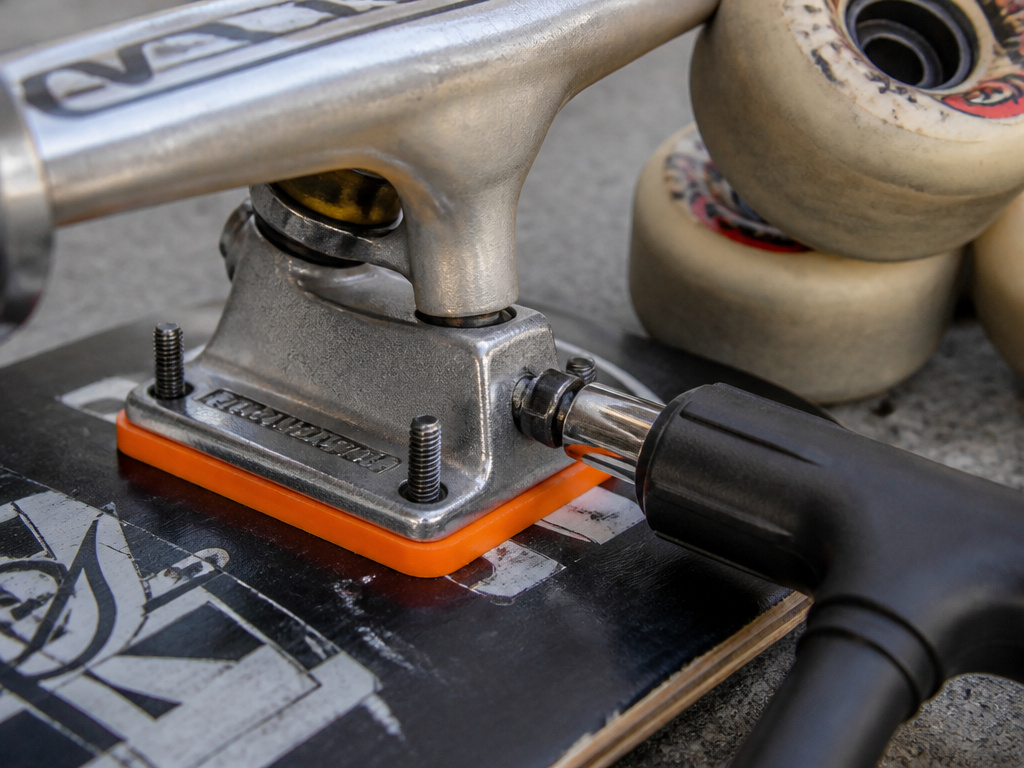
Your wheel choice dictates another component: riser pads. The Skate Labs guide notes that if riser pads are used, you need longer bolts. This isn’t optional. If you’re running larger wheels for more speed (say, 56mm and up), you need the extra clearance.
Wheel bite, when the wheel touches the deck during a sharp turn, stops you dead and can send you flying. A 1/4-inch riser pad is cheap insurance. It’s especially useful for park skating where deep carves in bowls are common. The trade-off is a slightly higher ride height, which can feel less stable for very low, technical tricks. For most park skating focused on flow and transitions, it’s a worthy trade.
Consider your wheel differences carefully. A park skater might have dedicated sets of hard wheels for different park obstacles and bowl skating. Swapping them takes five minutes with a skate tool.
Ongoing Care and Adjustment
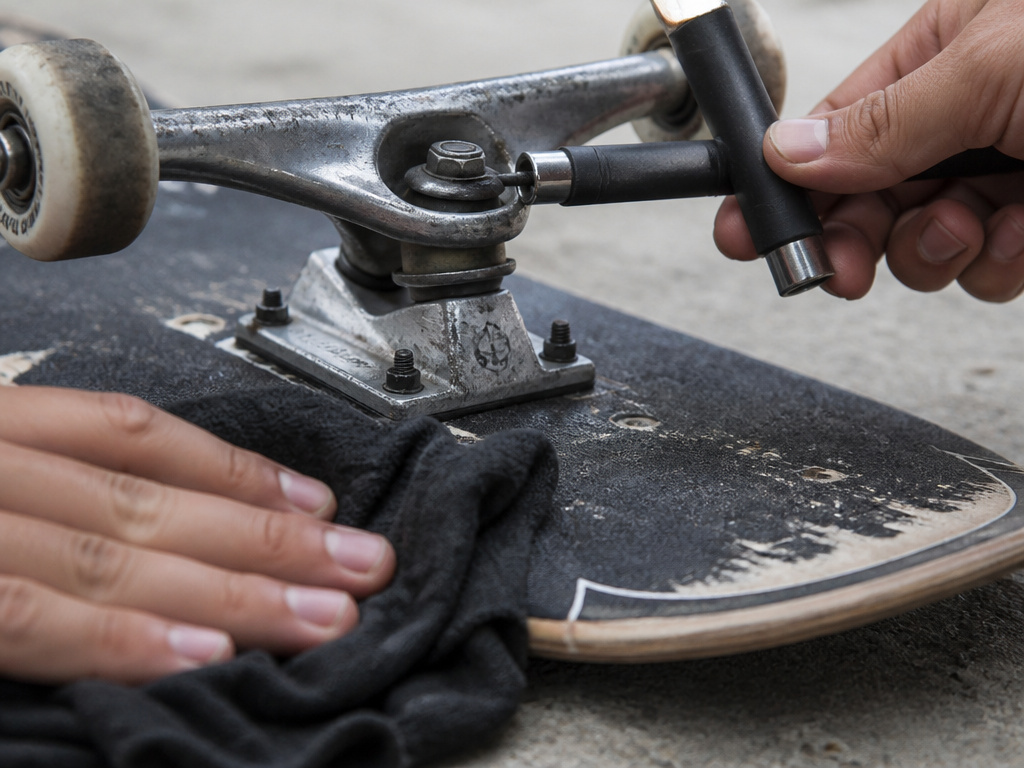
A park board lives a hard life. Concrete impacts, high-speed slides, and repeated adjustments take their toll. The care routine is straightforward.
Keep it dry. Portland Parks & Recreation advises to keep your skateboard dry and out of direct sunlight or moist conditions to prevent warping or delamination. A warped deck ruins your pop and landing stability. Wipe down your board after a session on damp concrete.
Check your hardware before each session. Vibrations from rolling on concrete can loosen nuts. A quick check with the skate tool takes 30 seconds. Pay special attention to the kingpin nut if you’re running trucks loose; ensure it hasn’t vibrated even looser.
Listen to your bearings. A gritty, grinding sound means dirt or moisture has gotten in. While some are sealed, the Portland guide’s advice to keep them clean stands. If they’re slow, consider cleaning or replacing them. Speed is currency in a park.
Finally, know when parts are done. A deck with visible cracks or a pronounced soggy spot is a hazard. Wheels that are coned or uneven from sliding will make your ride feel unstable. Bushings that are cracked or permanently deformed won’t return your turns. Replacing worn parts isn’t a failure; it’s standard maintenance for performance.
Frequently Asked Questions
What size skateboard is best for park skating?
Deck width is a matter of personal preference, balancing stability for landing and flick for tricks. The length and wheelbase are less critical than the deck’s material and construction. Wider decks are often preferred for bowl skating, as noted in community discussions.
How loose should my trucks be for the park?
Start with the kingpin nut tightened so the washer is flush with the top of the kingpin, then loosen it a quarter to a half-turn. Skate and adjust. Many park skaters, especially in bowls, run trucks looser than street skaters for deeper carves. The key rule from multiple guides: never loosen the nut so much that it’s barely threaded on.
Can I use the same board for street and park?
You can, but it’s a compromise. A true park setup uses harder wheels (99a+) and often looser trucks. Skating that setup on rough street terrain will be slow and jarring. Many skaters own two sets of wheels, swapping them for different terrains, or have two complete boards. It’s easier than constantly re-tuning your trucks.
Do I need riser pads for park skating?
It depends on your wheel size and truck tightness. If you’re using wheels 56mm or larger, or if you ride your trucks very loose for deep carves, 1/4-inch riser pads are a smart addition to prevent wheel bite. For smaller wheels (52mm-54mm) and medium truck tightness, you can often skip them.
How often should I replace my skateboard deck?
There’s no set timeline, only signs of failure. Look for razor tail (the tail wearing thin to the layers), cracking around the truck mounts, or a soggy, dead feel when you pop. A deck used frequently for park skating, with its high-impact landings, will need replacement when it shows signs of failure like cracking or a soggy pop.
Before You Go
One rule most guides skip: if you’re setting up your first park board, build it, tune it, then spend your first session just riding. Push around the flat bottom of a bowl. Practice pumping for speed on a mellow ramp before you ever think about dropping in. Get a feel for how the loose trucks carve and how the hard wheels roll. The specs matter, but the feel is what you’re actually buying. Adjust from there.
Everything above assumes a standard park with concrete transitions. If you’re heading to a new skatepark with unique skatepark features, the same setup principles apply, hard wheels for slide, responsive trucks for turnability. The board is your tool. Now go break it in.
