
How to Choose a Deck for Street Skating: Step-by-Step
This post contains affiliate links. As an Amazon Associate, we earn from qualifying purchases.
To choose a deck for street skating, pick a width between 7.5 and 8.25 inches to match your shoe size, a medium or steep concave for flick control, and a standard 7-ply maple popsicle shape. An 8.25-inch width is a popular starting point because it balances stability for landing and lightness for flip tricks.
That width range isn’t a random guess. It comes from a pile of broken decks and the specs shops actually sell. Street skating punishes a board, impact cracks from missed ollies, razor-tails from constant drags, pressure snaps from hard landings. Your deck choice decides how long you get before that happens, which is why knowing how to choose a deck for street skating is key.
What follows: the three numbers that matter (width, wheelbase, concave), the one shape that still dominates the streets, and how to pair your deck with trucks and wheels so the whole setup works instead of fighting itself.
Key Takeaways
- If you’re new to street skating, begin with an 8.25 inch deck. It’s a popular middle ground that helps you find your preference without wasting money.
- Match your truck axle width to your deck width within a quarter-inch; a mismatch makes flip tricks inconsistent and can speed up wheel wear.
- A medium or steep concave locks your foot in for kickflips and heelsides; a mellow concave will feel vague when you need precise flick.
- 7-ply Canadian maple is cited by Portland Parks & Recreation and TGM Skateboards as the industry standard, hitting a sweet spot of pop, weight, and cost for many skaters, while an IOP Conference Series study found a titanium-wood hybrid to be the optimum material in lab tests.
- Check for razor tail and pressure cracks before every session; a worn-out deck loses pop and can snap unexpectedly on a impact.
The Width Sweet Spot for Street Skating
Your shoe size gives you the first clue. This isn’t about precise measurements, but about where your feet actually sit on the board. A size 8 foot on a 10-inch deck looks and feels silly; the skater is constantly overreaching to catch the edge. A size 12 foot on a 7.5-inch deck hangs off so much that board control suffers.
Most sources point to a common range. The Portland Parks guide and major retailers like Skate Warehouse note that for street skating, widths between 7.5 and 8.25 inches are common, with 8.25 inches as the most popular choice. That’s the baseline. If you have smaller feet, you might prefer a narrower deck. If you have larger feet, you might prefer a wider deck. The goal is to have the ball of your back foot and the arch of your front foot comfortably covering the bolts without excessive overhang.
Common mistake: Choosing a deck based only on a pro skater’s sponsor. They often skate wider or narrower boards for very specific reasons that don’t apply to a beginner’s need for an all-rounder.
I rode an 8.5 for a year because a skater I admired rode that size. Flip tricks felt like throwing a brick. Moving down to an 8.25 was the difference between forcing a trick and letting it happen. The board just went where I told it to.
Here’s how the deck width choices break down for street:
| Width Range | Best For | Feels Like | Trick Trade-off |
|---|---|---|---|
| 7.5″ – 7.75″ | Small feet (under size 8), technical flip tricks | Light, quick, twitchy | Less stable for landing, easier to over-rotate |
| 8.0″ – 8.25″ | Most street skaters (size 8-11), all-around use | Balanced pop and control | The sweet spot for learning and progressing |
| 8.5″+ | Larger feet (size 11.5+), big gaps, stability focus | Solid, planted, slower to flip | Heavier, requires more effort for technical tricks |
TL;DR: Match width to your shoe size first, then adjust based on whether you want faster flips (go narrower) or more landing stability (go wider).
Popsicle vs. Shaped: Which Street Deck Shape Wins?
The popsicle is the default for a reason. Its symmetrical shape with a rounded nose and tail is almost perfectly balanced for street skating, where you’re constantly switching stance and popping off either end. As Source Skate Co. Puts it, popsicle decks are ideal for street and park skating and are the most common deck type. Every flip trick, every shove-it, every grind is designed around this shape.
Shaped decks, those based on old-school pool styles, have made a comeback. They’re now popular for all types of skating, including street. These often have a wider nose, a shorter or squared-off tail, and a more pronounced outline. For pure street tech, the popsicle still wins. But if your street skating includes carving banks, hitting transition, or you just prefer the feel of a wider platform under your front foot, a shaped deck can work as a hybrid.
Think of it as the difference between a chef’s knife and a cleaver. The chef’s knife (popsicle) is the versatile tool for 90% of kitchen tasks. The cleaver (shaped deck) is brilliant for its specific job, but you wouldn’t use it to julienne a carrot.
A shaped deck with a width from 8.25” to 10.5” can be a fun change, but it changes how the board flips and feels underfoot. Try one after you’re comfortable on a standard popsicle.
When you’re dialing in your street setup, starting with a popsicle removes one variable from how to choose a deck for street skating. You know the board will behave predictably as you learn. The differences between a true street board and a hybrid deck become obvious once you’ve got a few months of wear on your tail.
Concave, Wheelbase, and the Feel You Can’t See
Concave is the curve across the width of the deck. You can’t see it in a product photo, but you feel it every time you set up for an ollie. There are three general types, and your choice here is more important than any graphic.
- Mellow Concave: A gentle curve. It’s comfortable for cruising and less aggressive skating. For street, it can make foot placement feel vague when you’re trying to catch a kickflip.
- Medium Concave: The versatile choice. It offers a clear pocket for your feet without being extreme. This is what most street skaters use because it provides lock-in without sacrificing comfort.
- Steep Concave: A deep, aggressive curve. It offers maximum responsiveness and precise foot placement, great for technical street skating where every millimeter of foot movement matters. It can feel unforgiving if you’re not used to it.
For a first deck, medium is the safe bet. It’s the standard for a reason. As one retailer notes, medium concave is suitable for a variety of riding styles, making it a popular choice for street, park, and transition.
Wheelbase, the distance between the inner truck mounting holes, affects how the board turns. A shorter wheelbase (around 13 inches) makes the board feel twitchy and quick to rotate. A longer wheelbase (closer to 15 inches) feels stable at speed but slower to turn. Most street decks have a wheelbase within the common 13 to 15 inch range. The TGM Skateboards guide confirms that smaller wheelbases are more responsive, and wider wheelbases are more stable at higher speeds.
If you’re building your first board, don’t overthink wheelbase when you compare a how to choose a deck for street skating. Pick a deck you like and use its default mounting holes. The deck wheelbase is something you tweak on your second or third deck, once you know if you want a quicker or more stable turn.
The 7-Ply Standard and When to Break It
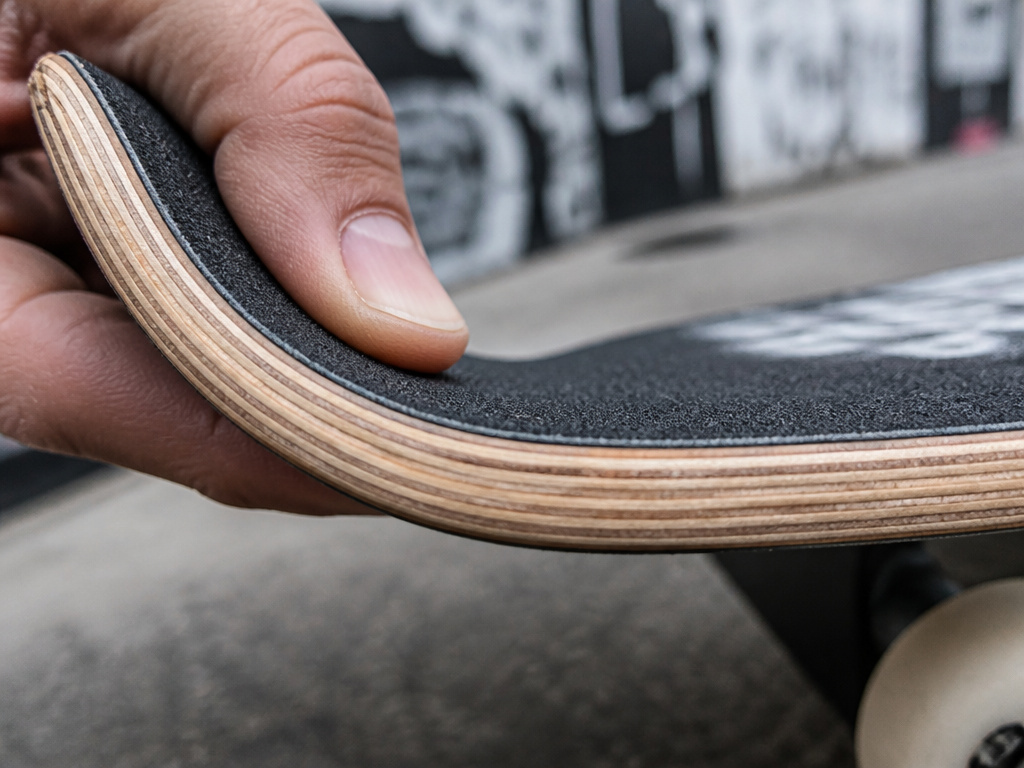
The industry standard for a skateboard deck is 7 plies, or layers, of Canadian Maple. That’s not marketing. That’s the result of decades of breaking boards and finding what works. The Portland Parks municipal guide and most manufacturer specs repeat this number because it delivers the right combination of strength, pop, and weight.
Some brands, like Powell Peralta with its Flight Deck series, incorporate a composite layer for added strength and durability without a major weight penalty. These are great for skaters who break decks quickly or want maximum strength for big gaps. For most street skaters, especially beginners, the extra cost isn’t justified. A standard 7-ply maple deck from a reputable brand, or even a shop blank, will last through the learning phase.
Where this goes sideways: Storing a wet board in a hot car. The wood warps or delaminates, and the deck is dead before you’ve even broken it in properly. Keep it dry and out of direct sunlight.
There’s an interesting counterpoint in the research. A peer-reviewed engineering study in the IOP Conference Series found that a sandwich panel hybrid of 50% titanium alloy and 50% wood performed better than standard plywood in lab tests for fracture toughness and lifetime. That’s a fascinating engineering skateboard deck paper, but you won’t find it on the shelf at your local shop. It highlights the innovation happening, but for now, 7-ply maple is the real-world answer.
Knowing how to tell deck quality means looking past the graphic. Press on the nose and tail, they should have a crisp, springy feel, not a dead thud. Check the plies along the side; they should be even and tight, with no gaps. A deck that feels alive in your hands has a crisp, springy feel when you press the nose and tail, with even, tight plies and no gaps.
Pairing Your Deck with Trucks and Wheels
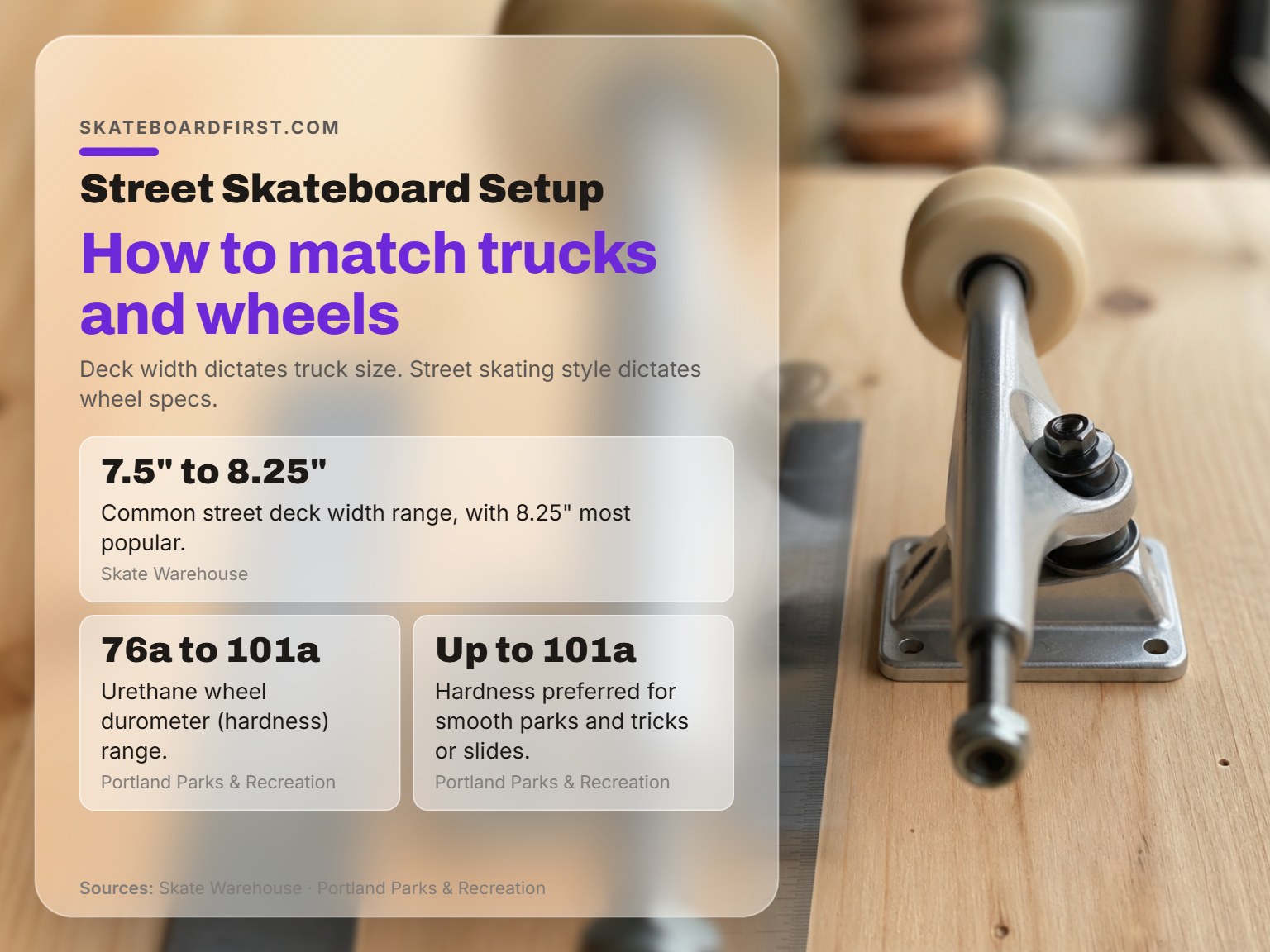
Your deck doesn’t skate alone. Its width dictates your truck size, and your skating style dictates your wheel choice. Get this wrong, and a perfect deck feels awful.
Trucks should match your deck width. The axle should be roughly flush with the edge of the deck. If the axle sticks out, you’ll get wheel bite easier and catch on grinds. If it’s too narrow, the board will feel tippy. Major truck manufacturers make trucks in specific sizes to match common deck widths.
Wheels for street are harder and smaller. You want a durometer (hardness) up to 101a for slides and less grip on smooth concrete. Smaller wheels keep your board closer to the ground for stability, and harder wheels slide predictably. As the municipal skateboard specifications document notes, harder wheels (up to 101a) are usually preferred at smooth skate parks and for tricks or slides.
Softer, larger wheels (like 56mm 78a) are for cruising rough ground. They’ll stick on every landing and make flip tricks feel sluggish. Your street skating wheels are a component, not an afterthought. Pairing a 101a 53mm wheel with your 8.25″ deck is what makes the setup feel cohesive.
Street Deck Wear: When to Retire Your Board
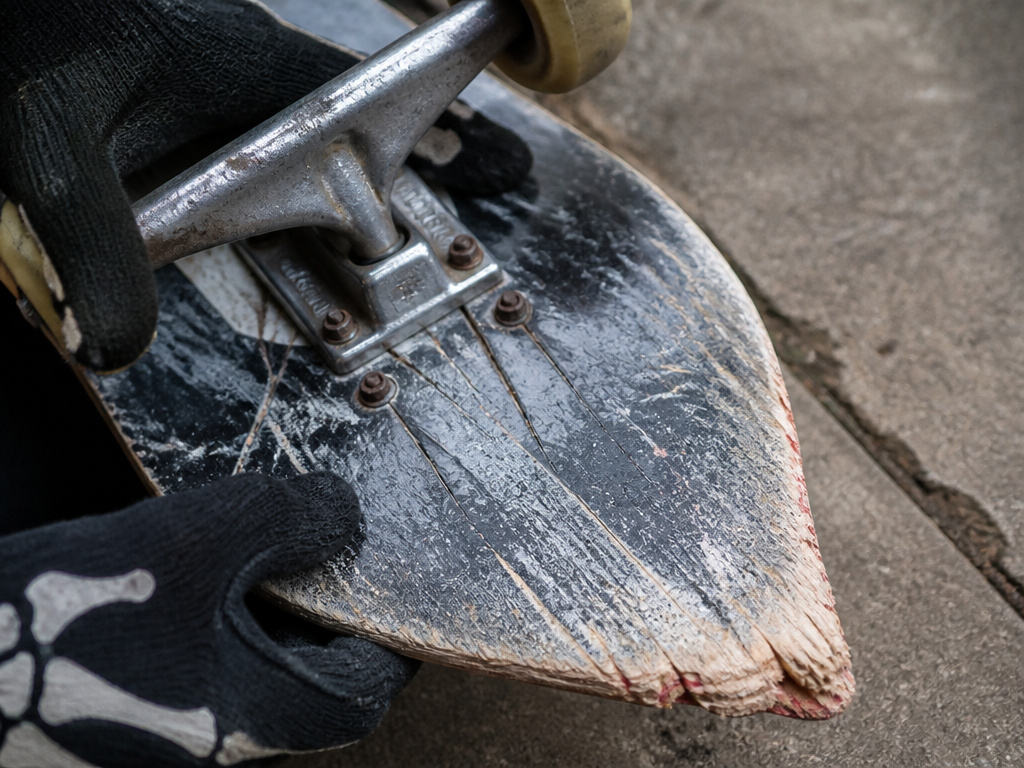
A street deck doesn’t fail quietly. It gives you clear, physical warnings. The Skate Labs maintenance guide lists the signs: cracks, a soft or dead feel when you pop, deep chips, or a tail worn thin.
For street, the two biggest killers are razor tail and pressure cracks. Razor tail happens from constant tail drags on rough concrete. The tail wears down to a sharp, thin edge that lacks pop. Pressure cracks appear as small, horizontal lines in the concave around the front truck bolts, caused by the repeated impact of landing. Both are normal. Both mean the deck’s lifespan is ending.
You can keep skating a deck with a razor tail, but your pop will suffer. Pressure cracks are more serious, they can lead to a full snap if you land a big trick wrong. Check your deck before every session. Run your hand along the tail. Look at the bolt areas. A deck that’s lost its pop makes learning new tricks harder, and a cracked deck is a safety risk.
Before you start: Always check that bolts are tight, wheels spin freely, and the deck has no new cracks. A loose truck or a suddenly wobbly wheel is your board telling you something’s wrong.
Knowing when to replace a deck is part of the street vs transition calculation. Transition decks might last longer because they face less direct impact, but they have their own wear patterns. That’s the cost of doing business on concrete.
How rider height influences deck choice
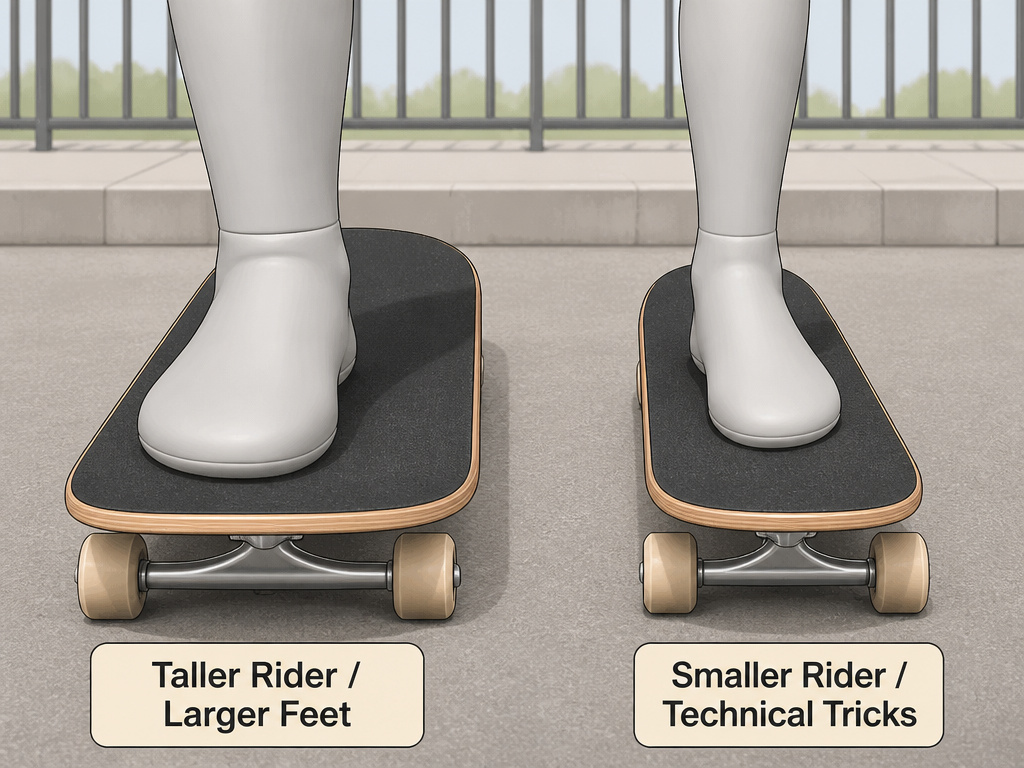
Your height is a practical guide for finding a deck that feels stable and responsive. Taller riders or those with larger feet generally benefit from a wider deck. Wider decks provide more stability and a better platform for your feet to stand on. Conversely, a narrower deck is typically lighter and easier to lift, which can offer more control for technical tricks. This makes narrower widths a common choice for smaller or younger skaters. The goal is to match the deck’s width to your frame so your feet sit comfortably on the board without excessive overhang or too much unused space.
Comparing street vs. Transition/park deck needs
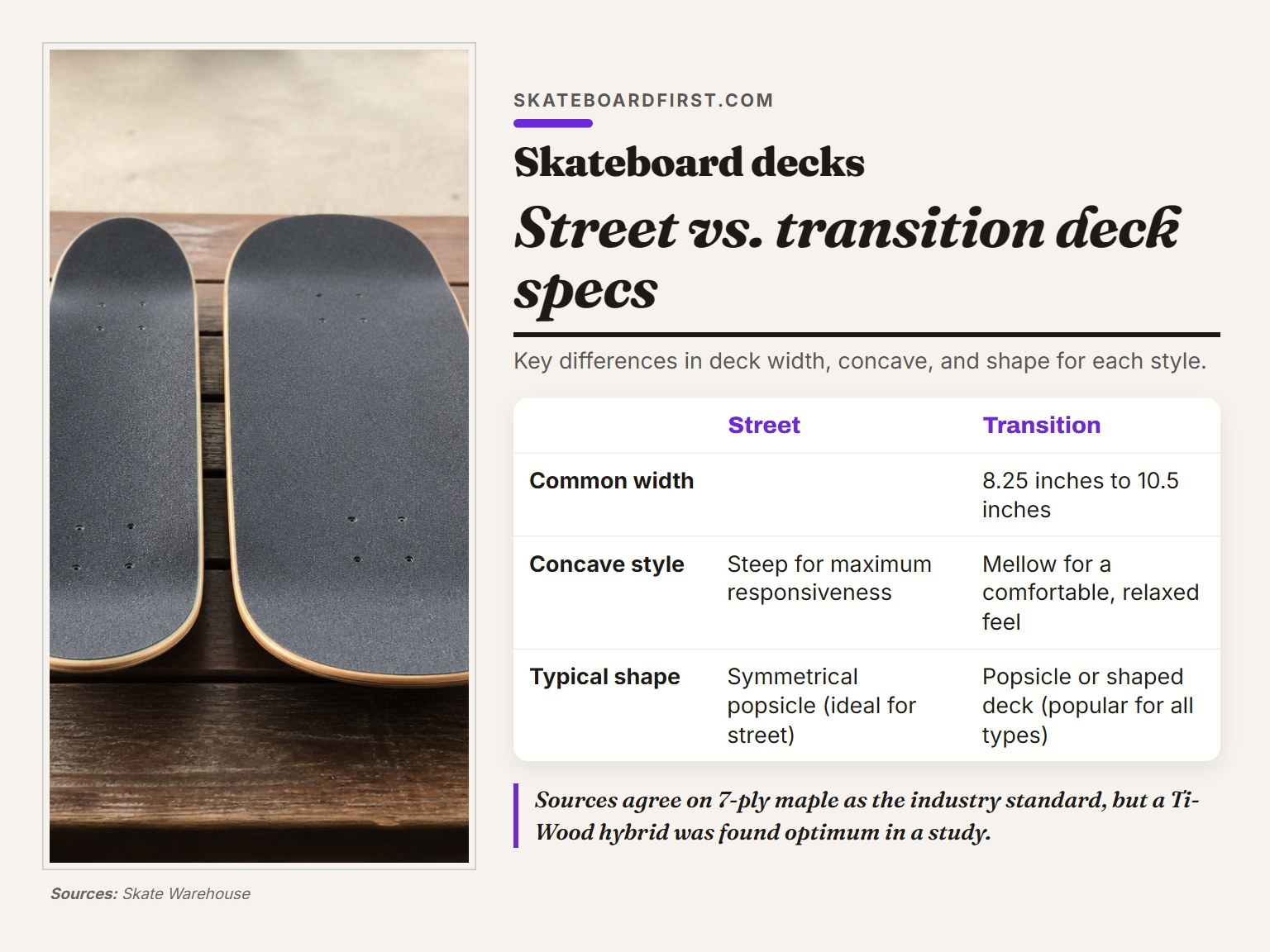
Street skating and transition skating place different demands on your deck. For street, where technical flip tricks and quick maneuvers are key, a standard popsicle shape is the most common choice. These decks are almost symmetrical, ideal for street, park, and transition skating. A steep concave offers maximum responsiveness for precise foot placement during street tricks. For transition skating in bowls and ramps, a mellow concave provides a more comfortable, relaxed feel suitable for carving. While popsicle shapes dominate, shaped decks based on older pool styles have also become popular for all types of skating, including a hybrid street approach.
Frequently Asked Questions
What’s a good size deck for street skating?
An 8.0 to 8.25 inch width is the most common and recommended starting point for street skating. It provides a balance of stability for landing and lightness for flip tricks, fitting most shoe sizes (US men’s 8-11).
Is an 8.25 deck good for street?
Yes, an 8.25-inch deck is excellent for street skating. Retail sales data shows it’s the most popular width because it’s versatile enough for technical tricks while remaining stable enough for learning and for skaters with larger feet.
How do I pick a skate deck if I’m a total beginner?
Go to a local skate shop if possible and stand on a few decks. If that’s not an option, choose a complete skateboard from a reputable brand with an 8.0 or 8.25-inch deck, medium concave, and hard wheels (99a-101a). This removes the guesswork and gives you a proper setup to learn on.
Should I get an 8.25 or 8.5 deck?
Choose 8.25 if your primary focus is flip tricks, technical street skating, or you have average-sized feet (up to size 11). Choose 8.5 if you prioritize stability for big gaps, have larger feet (size 11.5+), or your street skating includes more cruising and carving. The 8.25 is the safer first choice.
Do deck graphics or brands matter for performance?
No. The graphic is purely aesthetic. The brand matters only insofar as it guarantees a certain construction standard (like 7-ply Canadian maple). A blank “shop deck” from your local store will perform identically to a branded deck from the same manufacturer, often for less money.
Before You Go
Skip the analysis paralysis. If you’ve read this far and still don’t know, just buy an 8.25-inch popsicle deck with medium concave. That single decision covers probably 80 percent of what a new street skater needs. The other 20 percent, whether you prefer a steeper concave, a slightly shorter wheelbase, or a specific brand’s feel, is what you figure out on deck number two or three.
One concrete step: before you buy anything online, go to a physical shop. Ask to stand on a couple of decks. You’ll know in ten seconds if an 8.0 feels too narrow or an 8.5 feels like a boat. That tactile test beats any buying guide.
And when your first proper deck finally gets that beautiful, worn-in razor tail and a network of pressure cracks, you’ll know it’s time. Not because a guide told you, but because the board itself will have lost the springy response that made learning fun. That’s the real sign you chose right, you wore it out doing the thing it was built for.
