
How to Choose a Deck for Transition Skating: Step-by-Step
This post contains affiliate links. As an Amazon Associate, we earn from qualifying purchases.
To choose a deck for transition skating, prioritize width (sources recommend various ranges from 8.0″ to 10″+), a longer wheelbase for control, and mellow-to-medium concave for comfort. Your exact setup depends on whether you skate technical lines, flowy parks, or dedicated vert, wider and longer suits higher speeds and bigger transitions.
That width range is the overlap zone where most transition skaters land after trying a few sizes. The 8.25” to 8.5”+ spread exists because transition skating itself splits into sub-styles, a fact most buying guides gloss over. A key part of how to choose a deck for transition skating is understanding this split.
What follows is a breakdown of the three specs that matter most in how to choose a deck for transition skating, how they change for different types of transition, and the one common mistake that makes a perfect deck feel wrong. We’ll also look at a real deck’s numbers and what a materials science study says about what you’re actually standing on.
Key Takeaways
- Start with a deck width appropriate for your style; SkateboardersHQ suggests 8.25″ as a sweet spot and a range of 8.0″ to 8.5″, while CCS and Skate Warehouse recommend 8.5″ and above for vert/transition.
- Pair your deck with trucks of the exact same axle width; a mismatch of even a quarter-inch throws off stability and grind balance.
- Opt for a mellow or medium concave for a comfortable, locked-in feel during carves; steep concave is for street precision, not ramp flow.
- A longer wheelbase increases stability for big transitions but slightly reduces turning agility for “surfing” in bowls.
- Choose a popsicle or symmetrical shape for all-around transition skating; save radical shaped decks for when your style is fully defined.
The 8.25 vs. 8.5 vs. 8.5+ Width Debate
The first number you see on a deck is its width. For transition, this is about managing inertia as much as foot space. A wider deck resists unwanted rotation when you’re carving at speed, giving you a more stable platform. The question is how wide you need to go.
Most sources point to a range, but they don’t all point to the same one. CCS categorizes 8.50” and above as good for vert/transition, while labeling 8.25” to 8.50” as ideal for all-around skating. Skate Warehouse notes deck widths of 8.5 inches to 10 inches or more are common for transition skating. Meanwhile, SkateboardersHQ calls 8.25” the sweet spot and suggests a general guideline of 8.0” to 8.5”.
So who’s right? They all are, for different riders. Your width should follow your primary style of transition skating, which is the central principle of how to choose a deck for transition skating.
| Skating Style | Typical Deck Width | Best For | Risk If Too Narrow |
|---|---|---|---|
| Technical (Street + Transition) | 8.0” – 8.25” | Skaters who mix flip tricks with park lines. | Feeling unstable at speed; feet slipping off during carves. |
| Flowy (Park & Mini-Ramp) | 8.25” – 8.5” | Carving, pumping, and maintaining momentum. | Losing the “surf” feel; board feels sluggish for quick carves. |
| Vert / Deep Bowl | 8.5”+ | High-speed stability and control on large transitions. | Speed wobbles; lack of platform for big airs and landings. |
If you’re coming from street skating and want to hit ramps, an 8.25” deck is a safe, versatile step up. If you live for the deep end of a pool or a vert ramp, start at 8.5”. The extra quarter-inch makes a tangible difference when you’re riding vertical.
Where this goes sideways: Choosing a deck based solely on the graphic. You might end up with an 8.0” deck when you needed an 8.5”, and that missing half-inch of platform will have you fighting for balance on every carve. Pick the size first, then find the graphic.
This is also where your knowledge of skateboard deck width becomes practical. It is the foundation of your park setup.
Wheelbase and Length: The Stability Engine
After width, look at the wheelbase, the distance between the inner truck mounting holes. This measurement dictates how your board turns and how stable it feels at speed. A longer wheelbase increases stability, which is why transition decks often have one.
The Opera Transition Symmetrical EX7 deck, marketed for this very purpose, has a wheelbase of 14.25 inches. That’s on the longer side for a popsicle shape, and it’s a deliberate choice. Skateboards.com notes a longer wheelbase gives your ride more balance and helps you stay grounded during fast transitions. SkatePro points out that a larger wheelbase results in a larger turning radius, which “may not be desirable if you enjoy ‘surfing’ in pools and bowls.” If your style is tight, snappy carves close to the coping, a very long wheelbase can feel like it’s fighting you.
Think of it this way:
- Long Wheelbase (14”+): Stable, predictable, great for generating speed through pumping. Ideal for big, open bowls and vert.
- Standard Wheelbase (~14”): A balanced choice for most park and mini-ramp skating.
- Short Wheelbase (<14”): Twitchy and quick-turning, better suited for technical street skating than flowing transition lines.
Your deck’s overall length is related. The same Opera deck is 31.50 inches long. Longer decks generally accompany longer wheelbases and can feel more comfortable for wider stances. You can explore more on how this interacts with your ride in our skateboard deck length guide.
Concave and Shape: Where Your Feet Live
Concave is the curve across the width of the deck. It’s not a visual feature; it’s a tactile one that locks your feet in place. For transition, you generally don’t want the aggressive, steep concave favored by street skaters for flicking tricks.
Skate Warehouse breaks it down clearly: Mellow concave provides a comfortable and relaxed feel, making it suitable for cruising and transition skating. They add that medium concave is suitable for a variety of riding styles, including transition skating. Steep concave is for maximum foot-lock on flat ground, not for the shifting weight and fluid foot movements of carving a bowl.
Mellow or medium concave gives your feet a gentle pocket to sit in without catching on quick direction changes. It’s the difference between wearing stiff new boots and broken-in sneakers for a long walk.
Deck shape follows a similar logic. The standard popsicle shape is ideal for street, park, and transition skating, as noted by Skate Warehouse. Its symmetrical nose and tail let you ride and perform tricks with equal ease in either direction, which is crucial when you’re constantly switching stance in a bowl.
Fun shaped decks, while popular for their unique look and feel, are a more advanced choice. Skate Warehouse says they cater to skaters looking for a distinct experience skating street and transition. If you know exactly how you want your board to respond and where you want your feet, a shape can enhance that. If you’re still dialing in your transition style, a symmetrical popsicle is the wiser starting point. The debate between shaped decks vs popsicle deck is worth reading once you have a baseline.
Matching Trucks, Wheels, and Bearings

A perfect deck can feel awful if the rest of your setup fights it. This is the most common mistake I see, a great deck paired with street-geometry trucks or tiny wheels.
Trucks: Your truck axle width should match your deck width. Independent, Venture, and Ace all make models in these sizes. Skateboards.com recommends medium to high trucks for transition skating to prevent wheel bite with larger wheels. SkateboardersHQ adds a critical warning: Avoid low and stiff trucks. They don’t turn as easily, which kills your ability to pump and carve smoothly.
Wheels: Larger wheels maintain speed better. Skateboards.com states larger wheels (usually in the 55mm to 58mm range) are preferred for transition skating. SkateboardersHQ refines this, recommending wheels between 54mm and 56mm for general transition, and 56mm to 58mm wheels for dedicated bowl/pool/vert and mini ramp riders. Hardness is key, harder wheels slide predictably on ramp surfaces. SkateboardersHQ says anything between 99A and 84B is fine.
Bearings: Don’t overthink this. A reliable, mid-priced bearing cleaned occasionally will outperform a neglected expensive one. SkateboardersHQ recommends standard Bones Reds or Bronson G2’s. They’re the industry standard for a reason.
Truck tightness is debated: SkateboardersHQ advises against tight trucks for transition, while some vert skaters prefer tighter trucks for stability at high speed.
What the Lab Says: Deck Materials and Durability

Most decks are 7-ply maple. Some brands use epoxy, carbon fiber, or plastic layers (like Powell Peralta’s Flight Deck) to increase strength and pop. But what does “strong” actually mean in engineering terms?
A 2018 study published in the IOP Conference Series set a benchmark. It stated a skateboard deck must have a fracture toughness of 5 MPa/m² and a minimum lifetime of 10,000 cycles without experiencing brittle fracture. The IOP Conference Series study, which aimed to find an ideal material under $200, concluded a sandwich panel hybrid of 50% titanium alloy and 50% wood (Ti-Wood) was the optimum material.
You won’t find a titanium-wood composite deck at your local shop. The point is the performance standard: 10,000 cycles. Every time you ollie or land a trick, that’s a cycle. A quality maple deck from a reputable brand is built to meet this kind of durability demand through its laminated construction. When evaluating a deck, you’re looking for that good quality deck construction that can take the repeated impact of transition skating.
How to Choose Based on Your Level

Your experience should steer your choice more than any pro’s setup.
Beginners: Stability is everything. Choose a deck on the wider side of the spectrum with a mellow concave. This gives you a confident platform to learn pumping, carving, and kick-turns without feeling twitchy. Don’t copy a pro’s narrow, steep deck.
Intermediate: You have a feel for what you like. This is the time to experiment. Try an 8.25” deck if you came from street. Try a shaped deck if you’re drawn to a specific style. This is where reading an article on how to choose a deck for street can help you understand the differences in your own hands.
Advanced: Your deck choice is highly specific to the terrain. You might have a very wide shaped deck for deep bowls and a narrower popsicle for technical park lines. You know how wheelbase affects your carve and you choose concave based on the session ahead.
The academic skateboard deck materials study underscores that the ideal material minimizes weight while hitting strength targets. In the real world, that means a maple deck from a known woodshop is rarely a bad choice.
How shoe size relates to deck width

Your shoe size can be a starting point for finding a comfortable deck width, but it’s not a strict rule. The goal is to have your feet feel secure and in control while carving. A deck that’s too narrow for your stance can feel twitchy and unstable at high speeds in a bowl. Conversely, a very wide deck might feel cumbersome if your feet are small. Many skaters find that a width where the ball of your back foot and the heel of your front foot are near the deck’s edges offers a balance of control and flick response for transition tricks.
How height relates to deck size
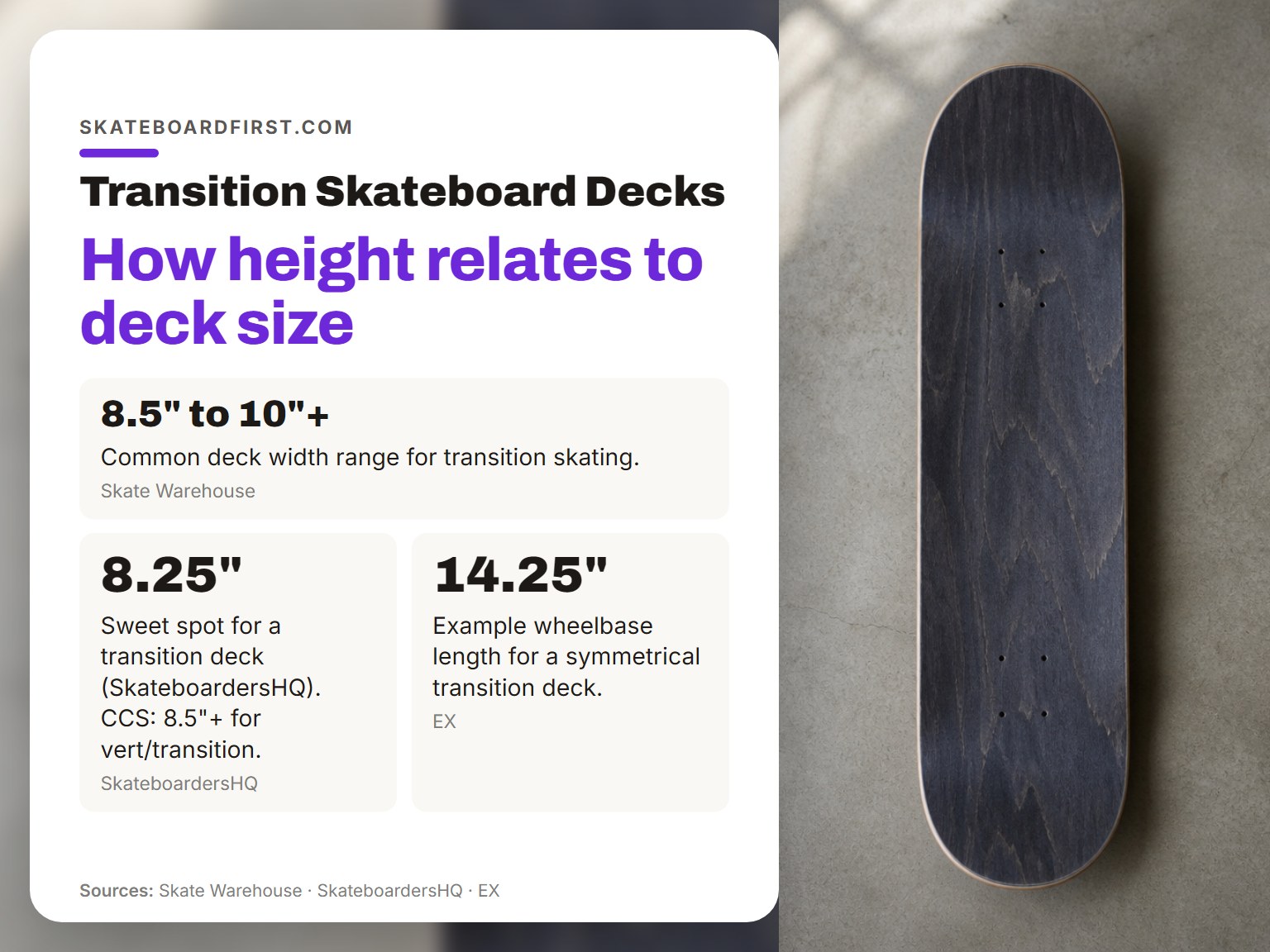
Your height influences the deck size that will feel balanced under you. A taller skater with a longer stance will generally benefit from a deck with a longer wheelbase, which provides more stability and a grounded feel during fast transitions. This often pairs with a wider deck width. A shorter skater might find a very long wheelbase makes the board feel less responsive when turning. The key is to match the deck’s overall footprint to your natural stance so you feel centered and in command of your carves and pumps.
Frequently Asked Questions
Is a 7.5 deck too small for transition skating?
Yes, for almost everyone. SkateboardersHQ explicitly advises to avoid a deck below 8.0″ for transition skating. A 7.5” deck offers minimal foot space, making it difficult to stay balanced during carves and high-speed maneuvers. It’s built for flip tricks, not flow.
How do I pick a skate deck?
Focus on width first (match it to your transition style: 8.25” for mixed, 8.5”+ for pure transition), then wheelbase (longer for stability), then concave (mellow/medium for comfort). Finally, ensure it’s from a brand known for consistent deck quality. Your shoe size and height can guide you, but comfort on the board is the final test.
Should I get an 8.25 or 8.5 deck for transition?
If you also skate street and do technical tricks, get the 8.25”. It’s the versatile sweet spot. If you primarily skate transition, bowls, and ramps, or have larger feet, get the 8.5”. The extra width provides noticeable stability. Many skaters find their perfect size lies between these two, like 8.38”.
How to choose skate deck size?
For transition, let your skating style dictate the size. Use the table in the Width Debate section as a guide. Then, the best method is to stand on different sizes at a skate shop. How the width feels under your feet is more important than any formula. Our guide on what size skateboard should I get walks through this process.
Do I need a special “transition” deck?
Not necessarily. Many standard popsicle decks have the right specs (width, wheelbase, concave) for transition skating. Brands sometimes label decks “transition” to indicate a longer wheelbase and mellow concave, like the Opera Transition Symmetrical EX7. You can build a great transition board from any deck that has those key features.
The Bottom Line
Forget the graphic. Your deck is a tool, and for transition skating, the tool needs a wider blade, a longer handle, and a comfortable grip. Start at 8.25” if you’re testing the waters, or 8.5” if you’re diving in. Pair it with matching trucks and wheels in the 55mm+ range.
The real choice isn’t between two sizes; it’s between prioritizing stability for learning or agility for advanced lines. Beginners always need more stability than they think. Once you can pump a bowl without thinking about your feet, that’s when you’ll feel what a deck is really doing, and that’s when you’ll know what to try next.
If you’re coming from street, the jump to transition is less about a new deck and more about a new mindset. It’s flow over force. Your setup should reflect that. Now go stand on a few decks at a shop. Your feet will tell you the rest.
