
Skateboard Wheel Size Chart: The 3 Rules That Matter
This post contains affiliate links. As an Amazon Associate, we earn from qualifying purchases.
Skateboard wheel size is measured by diameter in millimeters (mm), and the general range spans from 49mm to 75mm. The right size for you depends on three things: the terrain you skate, your truck height, and your style, smaller wheels (50-53mm) accelerate faster for street tricks, while larger wheels (56mm+) roll smoother for cruising and transition skating.
That 26-millimeter range from 49mm to 75mm isn’t just a number. It’s the difference between a board that feels glued to your feet and one that feels like it’s fighting you on every push. A couple of millimeters changes how a trick locks in, how a crack in the pavement feels, and how far you roll before needing another push.
What follows is the skateboard wheel size chart that cuts through the noise, plus the practical rules for matching wheel size to your deck, your trucks, and the ground you actually ride on. You’ll learn how to measure what you have, when wheel bite becomes a real problem, and why the most common size might be your best starting point.
Key Takeaways
- The most common wheel size range is about 52-56mm.
- Match your wheel size to your truck height to prevent wheel bite; low trucks work with wheels up to ~51mm, while high trucks can handle up to 58mm without riser pads.
- Larger wheels (56mm+) roll faster and smoother over rough ground but make the board feel heavier and sit higher off the ground.
- Always check the durometer (hardness) alongside size; a soft 78A wheel at 59mm is for cruising, while a hard 101A wheel at the same size is for park speed.
The Standard Skateboard Wheel Size Chart
Forget memorizing numbers. A wheel’s job is simple: it needs to roll over your terrain and let you do your tricks. Diameter, the distance across the wheel, decides both. The general skateboard wheel size range is 49mm to 75mm, but most everyday skating happens between 50mm and 60mm.
Here’s the breakdown of what each size range is typically good for, compiled from major retailer guides.
| Wheel Size Range | Best For | Key Trade-Off |
|---|---|---|
| 49 – 53 mm | Street skating, technical tricks, ledges/rails | Faster acceleration, lighter feel. Less smooth over cracks, can get hung up on rough pavement. |
| 53 – 56 mm | All-around skating, small ramps/mini-ramps, beginners | Balanced speed and control. The versatile middle ground that handles most situations well. |
| 56 – 60 mm | Cruising, vert skating, rougher pavement | Smoother roll, maintains speed. Board sits higher, can feel less nimble for flip tricks. |
| 60 mm+ | Longboarding, dedicated cruising, downhill | Maximum speed and comfort over cracks. Not suitable for standard skateboard tricks; high risk of wheel bite. |
The Skatedeluxe Wiki notes that wheels larger than 59mm “are not suitable for your skateboard and is intended for cruisers or longboards.” This is a practical limit for a typical street/park setup before wheel bite and a high ride height become major issues.
The skateboard wheel size chart gives you the landscape, but your truck height is the map. A 56mm wheel on a low truck might bite constantly, while the same wheel on a high truck could be fine. We’ll get to that next.
Wheel Size Compatibility: Deck Width and Truck Height
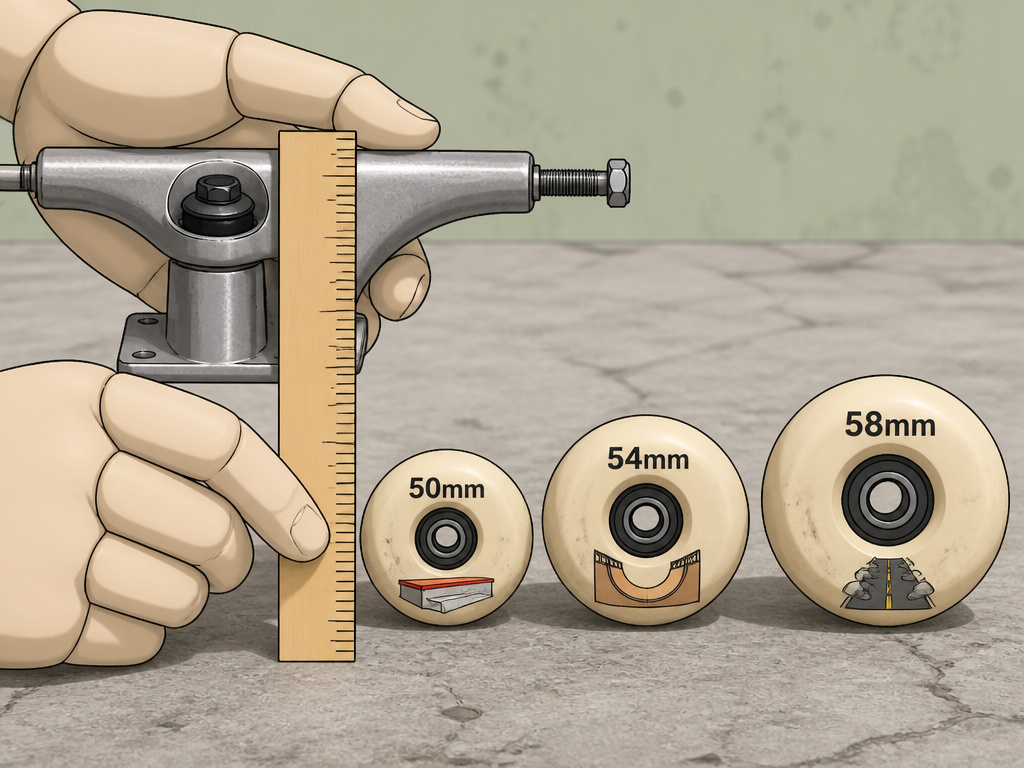
Your wheels don’t live in a vacuum. They have to fit under your deck without touching it during turns or hard landings, a problem called wheel bite. Two things decide this fit: your deck width and, more critically, your truck height.
Deck width suggests a wheel size range, but it’s a loose guideline. An 8.25″ deck often pairs with wheels in a common size range, but truck height is a more critical factor for fit. Go much larger, and the wheels might stick out past the deck’s edge, affecting grinds. Go much smaller, and the board can look and feel a bit off. It’s an aesthetic and functional check, not a hard rule.
Truck height is the hard rule. Truck geometry, the distance from the axle to the baseplate, sets your clearance.
- Low Trucks: Fit wheels up to about 51mm. Perfect for a low, stable feel for street skating.
- Mid/Standard Trucks: Without riser pads, these match best with wheels from 52mm to 56mm. This is the default for most completes.
- High Trucks: Can accommodate wheels up to 58mm without risers, ideal for vert skaters or those using bigger wheels on rough ground.
Where this goes sideways: Slapping 56mm wheels on low trucks because you like the graphic. The wheel will contact the deck on hard carves, sending you flying. The fix is either smaller wheels or adding thin riser pads, which changes the board’s pop feel.
If you’re venturing into larger wheel territory, understanding wheel bite and when to use riser pads becomes non-negotiable. Getting your truck size right for your deck is the first step in this equation.
How Wheel Size Changes Your Ride
You feel wheel size in your legs and your timing. The mechanical reason involves leverage and rotational mass. A larger wheel has more urethane mass farther from the axle, so it takes more effort to get spinning but holds speed longer once it’s moving. A smaller wheel has less mass closer to the axle, so it accelerates quicker but also slows down faster.
Small Wheels (50-53mm): The Flick
They feel light and fast off the mark. This is why they dominate street skating, you get quick pop for ollies, less friction for slides and grinds, and they’re less likely to catch on coping. The trade-off is a buzzy, harsh ride over anything but perfect concrete. Every pebble telegraphs right up your legs.
Mid-Size Wheels (53-56mm): The Compromise
This range offers the best balance for most people. You get decent speed retention for pumping in a bowl or rolling through a park, but they’re still small enough for responsive trick control. They smooth out rough pavement just enough without feeling like boat anchors. For a beginner or an all-terrain skater, this is the sweet spot.
Large Wheels (56mm+): The Glide
The ride transforms. Speed builds easily and carries, and cracks that would stall a 52mm wheel barely register. This is the zone for cruising, vert skating where you need momentum in deep bowls, and skating crusty urban landscapes. The board feels higher off the ground, which changes the point where you apply force for your pop, and flip tricks require more effort. They can also make a board feel slightly top-heavy.
Your weight and height play a role here, too. A heavier rider will compress a soft wheel more, effectively making it slightly smaller. A taller rider on a larger wheel might not notice the increased ride height as much as a shorter rider would. It’s a secondary factor, but it’s real.
Matching Wheel Size to Your Skating Style
Now, we can get specific. What size should you actually buy? It comes down to the primary surface your wheels will touch.
For Street & Technical Skateboarding
You want smaller, harder wheels. The CCS guide recommends 49-53mm for street, while the Skatedeluxe Wiki specifies 50-53mm. The goal is quick acceleration, easy slides, and minimal wheel weight for flick. A hard durometer (99A-101A) is standard here. Hard wheels in this size range are commonly used for street skating. If your local “street” is broken asphalt, lean toward the higher end of this range (53mm).
For Park & Transition Skating
This is where recommendations split. Some sources, like Skatepro, suggest small-to-medium wheels (50-56mm) with high hardness (99A-101A) for park skating. In practice, many transition skaters go a bit larger, 54mm to 56mm, for the extra speed needed to get up and down ramps without constant pushing. The hardness stays high for slide control. It’s a blend of street responsiveness and cruising momentum.
For Cruising & Rough Ground
Go bigger and softer. The CCS guide lists 56-60mm for cruising/vert and 60mm+ for longboarding. Hardness drops dramatically into the 78A-90A range for shock absorption. Softer wheels in the 56mm-59mm range are common choices here. Remember the CPSC wheel recall notice for 75mm Orangatang wheels? That incident highlights the extreme end of this category, where very large, soft wheels were used for downhill and cruising before a manufacturing flaw caused failures.
For Beginners & All-Around Use
If you’re new or skate a bit of everything, the consensus points to the middle. Both CCS and the Skatedeluxe Wiki recommend an all-around size of 53-56mm. Pair it with a mid-level durometer like 99A, and you have a setup that handles rough ground well but still allows you to learn ollies and ride at the park. It’s the default for a reason.
The choice between street wheels and cruiser wheels often boils down to this size and hardness decision. Understanding the street vs park wheel nuances helps if you frequent both terrains.
How to Measure Your Existing Skateboard Wheels
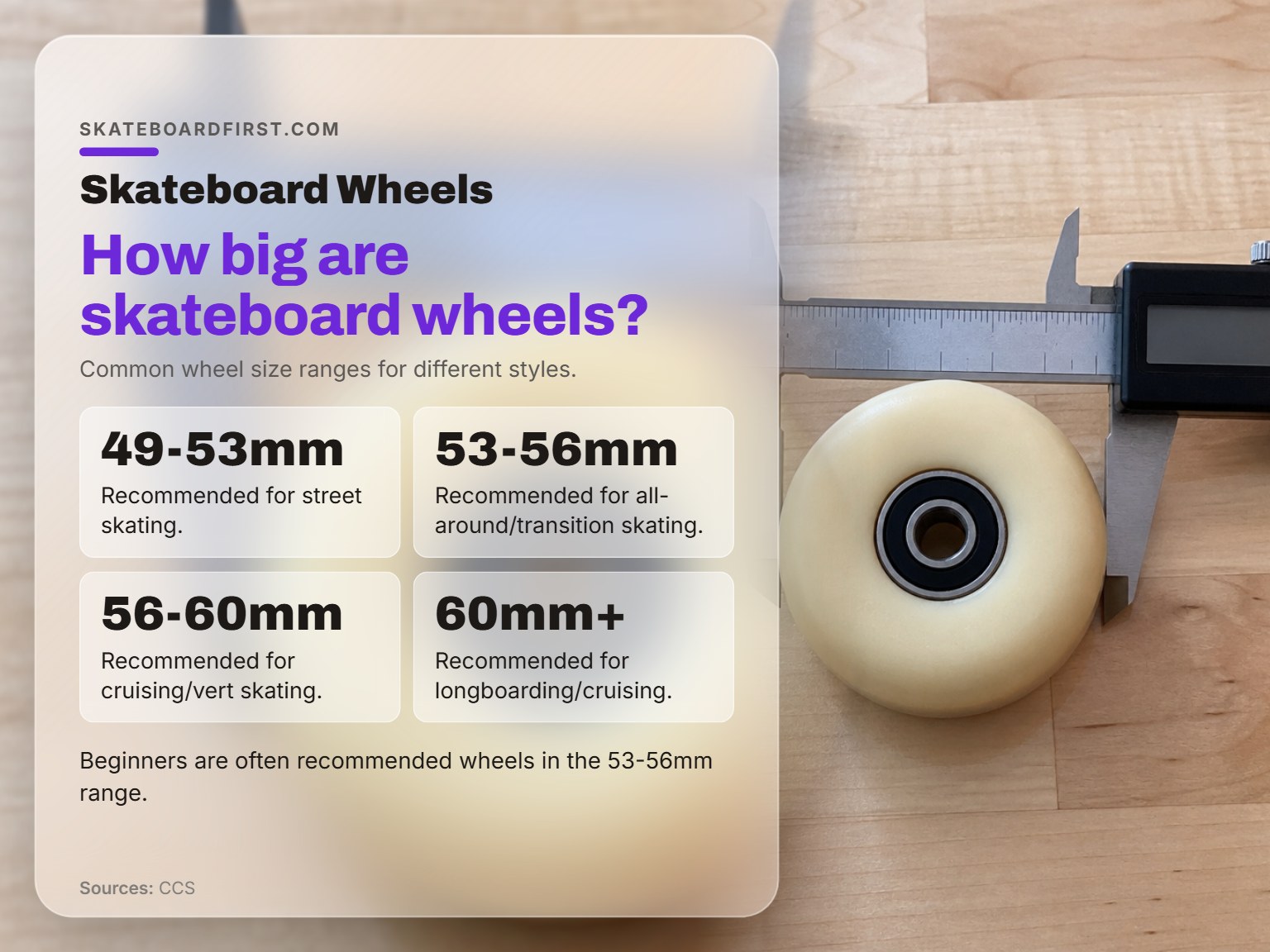
Don’t guess. If you’re replacing wheels or buying a used complete, measure what’s on there. A cheap digital caliper from a hardware store is the best tool, it’s accurate and easy. No caliper? A ruler works in a pinch.
- Remove the wheel from the truck. Take off the axle nut and pull the wheel off.
- Measure the diameter. Place the caliper jaws across the widest part of the wheel, from one outer edge to the opposite outer edge. The reading in millimeters is your wheel size.
- Check the sidewall. Most wheels have the size and durometer stamped or printed on the side. It might say “54mm 99A” or “52 101B”. The “B” scale, used by brands like Bones, reads 20 points lower than the “A” scale (an 80B is like a 100A).
Common mistake: Measuring with the wheel still on the truck, using the edge of the caliper on the bearing. This gives you the bore size, not the wheel diameter. Always measure the urethane body itself.
Why does this matter? If you like how your current board rides but want new wheels, matching the diameter keeps the feel consistent. If you hate it, you know what size to move away from.
The Durometer Factor: Hardness Works With Size
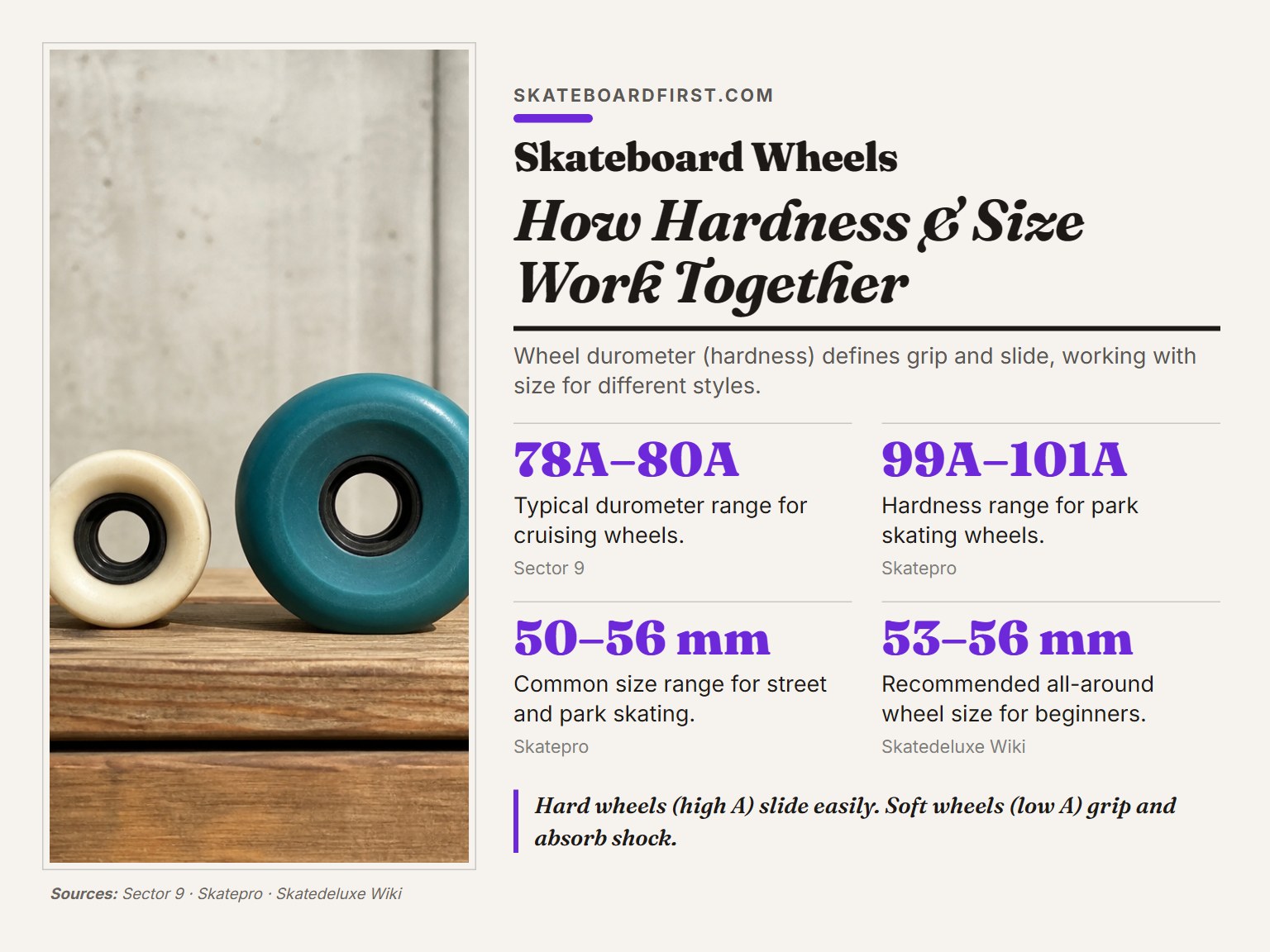
Wheel size tells only half the story. Durometer, the hardness rating, is the other half. It’s measured on the A scale (e.g., 101A) or sometimes the B scale (e.g., 84B). A higher number means a harder wheel.
Hard Wheels (99A-101A+)
They slide predictably, feel responsive, and don’t absorb much vibration. Almost all street and transition wheels are harder than 98A. They’re fast on smooth concrete but feel brutal on rough pavement.
Soft Wheels (78A-90A)
They grip, absorb shock, and quiet your ride. Cruising wheels are usually around 78A. They roll over anything but can feel sluggish and grippy when you try to slide or pivot quickly.
The two specs work together. A 54mm 101A wheel is a park weapon. A 54mm 78A wheel is a smooth cruiser. A 59mm 83A wheel is Penny Skateboards’ standard wheel setup (though they note it’s not recommended for their 32″ deck).
When you’re looking at a wheel hardness chart, remember it’s a package deal with size. Your wheel’s contact patch (the part that touches the ground) and shape also influence grip and slide, but hardness is the primary lever.
Frequently Asked Questions
How do I know what size skateboard wheels to get?
Start with the terrain you skate most and your truck height. If you’re on streets and at the park, begin with a mid-size wheel (53-56mm) and a hard durometer (99A-101A). If you’re just cruising, go larger (56mm+) and softer (78A-87A). Check your truck height to avoid wheel bite, low trucks need smaller wheels.
Are 52mm wheels small?
Yes, 52mm wheels are on the smaller side of the standard spectrum. They’re excellent for street skating, technical tricks, and smooth park surfaces. They offer quick acceleration and a light feel but will be less comfortable on rough or cracked pavement.
What size wheels for an 8.25 deck?
An 8.25″ deck pairs well with wheels in the 52mm to 54mm range. This keeps the board’s proportions balanced and minimizes wheel overhang. Your truck height is more important than deck width for final fit, so ensure your chosen wheel size is compatible with your trucks (or be prepared to add riser pads).
What are 55mm skate wheels good for?
55mm wheels are versatile all-around performers. They work well for street skating, park skating, and can handle slightly rougher ground. They offer a blend of speed retention and trick responsiveness, making them a popular choice for skaters who don’t want to specialize.
Can I put 60mm wheels on a regular skateboard?
You can, but it’s not ideal for a standard trick setup. Wheels 60mm and above raise your board significantly, increase the risk of wheel bite (requiring large riser pads), and make the board feel less nimble for flip tricks. They are better suited for dedicated cruiser or longboard setups.
Before You Go
Wheel size isn’t a mystery. It’s a tool. Smaller diameters for flick and response, larger ones for roll and comfort. The 54-56mm middle ground exists because most of us skate mixed terrain and want a board that doesn’t fight us.
The one rule that overrides all charts: match your gear to the ground under your feet, not the pro in the video. A hard 52mm wheel might be technically perfect, but if your local lot is a warzone of cracks, you’ll have a bad time. Start with the middle of the road, a 54mm or 55mm wheel at 99A, and skate it for a month. Your feet will tell you if you need to go bigger for comfort or smaller for flick.
Then, go tighten those axle nuts and roll. The best size is the one that keeps you on the board longer.
