
History of Skateboard Wheels: From Metal to Urethane
This post contains affiliate links. As an Amazon Associate, we earn from qualifying purchases.
The history of skateboard wheels is a story of physics meeting pavement. It starts with metal rollers that rattled teeth and ends with engineered polyurethane that grips and slides on command. The shift from steel and clay to urethane in the early 1970s didn’t just make skating smoother, it created the modern sport by enabling control, speed, and new tricks.
That grip-and-slide property is the whole game. Before it, a skateboard was a wobbly death trap. After it, riders could carve, turn, and stop with intention. The rest is just refinement.
What follows is a walk through the specs that defined each era in the history of skateboard wheels, from the 2-inch wide Cadillac K-73 to the recalled 75mm Orangatang, plus the science of why clear urethane rolls faster. We’ll also look at where sources disagree on the exact birth year and what recycled plastics might do next.
Key Takeaways
- The jump from clay and metal to polyurethane wheels in the early 1970s turned skateboarding from a hazardous pastime into a controllable sport.
- The Cadillac K-73 (1973) was 2 inches in diameter, and early urethane wheels from Creative Urethanes used 16 loose ball bearings per wheel.
- Wheel hardness is measured on the Shore ‘A’ durometer scale; adding dyes for color can reduce a wheel’s rebound and speed.
- A documented safety failure: Loaded Boards recalled 75mm Orangatang wheels in 2009 after 10 reports of cores shearing and blowing out.
- Future materials like recycled polycarbonate could cut a wheel’s CO2 footprint by over 50% while matching urethane’s performance.
The Metal and Clay Era: A Rough Ride
Forget smooth carves. The first skateboards, which appeared in the late 1950s, used metal wheels pried from roller skates. They were fast in a straight line and that’s about it. A rider from 1961 described the experience as “more like getting electrocuted than anything else.” Steel offered zero traction and transmitted every pebble directly to your spine.
Clay-composite wheels arrived in the 1960s and were marketed as an upgrade. They provided slightly more grip than metal, but not by much. The ride was still a full-body vibration session. The core problem was material science: neither metal nor clay could deform and rebound quickly enough to maintain speed and absorb shocks. One small rock would stop the board dead, sending the rider flying.
This era defined skateboarding’s first boom-and-bust cycle in the history of skateboard wheels. The sport surged in popularity, then crashed by the decade’s end. The equipment was simply too dangerous and limited for anything beyond basic sidewalk surfing. The physics were against it.
The 1970s Urethane Revolution
The old tooth-jarring ride vanished almost overnight. The catalyst was a surfer and recreational skater named Frank Nasworthy.
In 1970, Nasworthy saw experimental urethane roller-skate wheels in a friend’s father’s factory in Virginia. He realized their potential, bought an initial batch, and began testing them on skateboards. The difference was immediate. Urethane offered grip, shock absorption, and a smoothness that clay and metal couldn’t touch. Nasworthy started selling them out of his car to surf shops in California under the brand name Cadillac Wheels.
The Cadillac K-73 model from 1973 was 2 inches in diameter and 1 inch wide, made of translucent red urethane. They used a loose ball bearing assembly, 16 bearings per wheel, a far cry from today’s sealed precision bearings. This design, while revolutionary, still had room to evolve.
There’s a disagreement in the sources about the exact start date. A peer-reviewed study points to 1973 as the year the “first polyurethane wheel purposely designed for the skateboard went into production,” while other sources cite Frank Nasworthy’s experimentation beginning in 1970 and his first orders placed in 1972. However, first-hand accounts from Frank Nasworthy and the Smithsonian note his experimentation began in 1970, with his Cadillac Wheels company gaining traction in the early 1970s. The K-73 model’s stamp of ’73 on the wheel suggests commercial availability by that year.
The impact was seismic. As detailed in the Smithsonian invention story on Cadillac wheels, this single material change resurrected skateboarding from its dead period. It allowed for the fluid, carving style that defined 1970s skate culture and set the stage for everything that followed. You can see more about this pivotal decade in our look at 1970s skateboarding.
Wheels Get Smarter: Durometer and Design
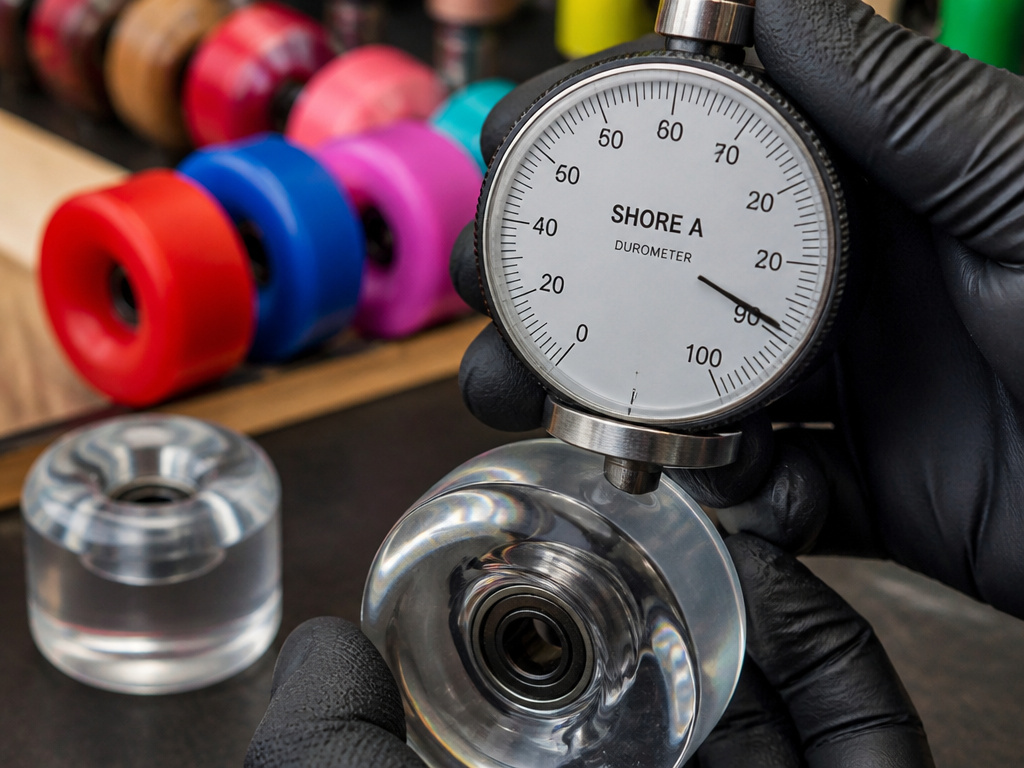
Once urethane proved itself, the focus shifted to tuning its properties. The key metric became hardness, measured on the Shore ‘A’ durometer scale from 0 (soft) to 100 (hard).
Fausto Vitello, a key figure in wheel manufacturing, explained the trade-offs clearly. Urethane’s natural state is a clear, whitish color. Adding dyes or pigments for cool colors takes up space in the wheel’s molecular structure that would otherwise be urethane. “Less urethane means less resiliency in the wheel,” he noted. For pure performance, a clear wheel rebounds faster.
The physics are straightforward. As you roll, the wheel flattens slightly under your weight. A resilient urethane snaps back to round quickly, pushing you forward. A softer or dyed wheel deforms more and rebounds slower, wasting energy. But go too hard, and you lose the shock-absorbing quality that made urethane great in the first place. A wheel that’s too hard just transfers the impact to the pavement, and your knees.
This understanding led to a proliferation of wheel shapes and durometers tailored for different styles. Cruising wheels got bigger and softer; street wheels stayed smaller and harder for better slide control. The evolution of skateboard wheel shapes and the development of the skateboard wheel hardness scale are direct results of this period of experimentation.
| Era | Common Wheel Specs | Primary Use | Key Limitation |
|---|---|---|---|
| 1950s-60s (Metal/Clay) | Metal rollers, clay composites | Basic sidewalk surfing | No traction, dangerous, jarring ride |
| Early 1970s (Urethane) | ~2″ diameter, loose bearings (Cadillac K-73) | Carving, pool riding | Basic design, limited size/hardness options |
| Late 1970s-80s (Tuned Urethane) | Variety of durometers (78a-100a), larger diameters | Street, vert, cruising | Colorants could reduce performance |
| Modern (Engineered Urethane) | Precise formulas, cores, profiles (52-75mm) | Specific styles (street, park, longboard) | Specialization requires multiple sets |
When Wheels Fail: A documented recall
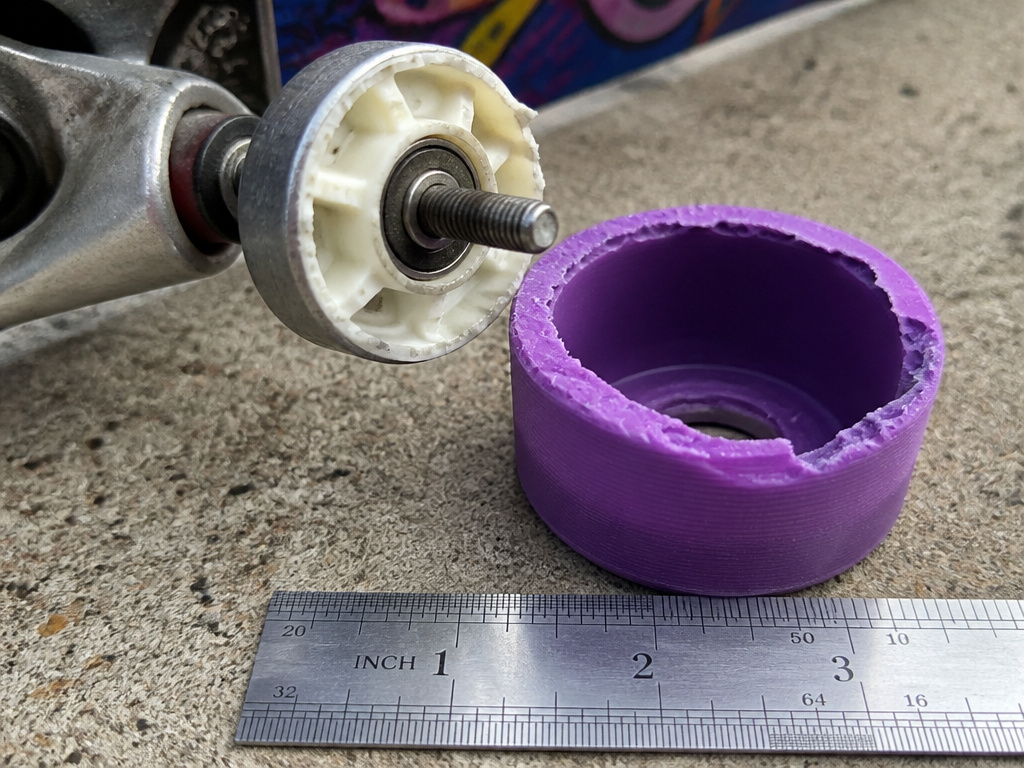
Not every innovation is a success. The history includes a clear case of a design flaw that led to government intervention.
In June 2009, the U.S. Consumer Product Safety Commission (CPSC) announced a recall of Loaded Boards Orangatang “In-Heat” wheels. The official CPSC skateboard wheel recall notice details the hazard: the wheel’s core could shear and blow out, causing the wheel to separate from the truck axle.
The recalled wheels were 75mm in diameter, sold in purple and orange sets of four, with durometers of 83a and 80a. There were 10 reports of this failure for wheels sold between March and April 2009. No injuries were reported, but the risk was serious enough for a full recall and free replacement program.
This incident underscores that wheel design is a safety-critical engineering challenge, not merely a matter of ride feel. The bond between the urethane and the inner core must withstand immense shear forces during slides and impacts. It’s a modern echo of the safety problems that plagued the metal-wheel era, solved now through better materials and quality control.
The People and Teams Who Pushed Limits
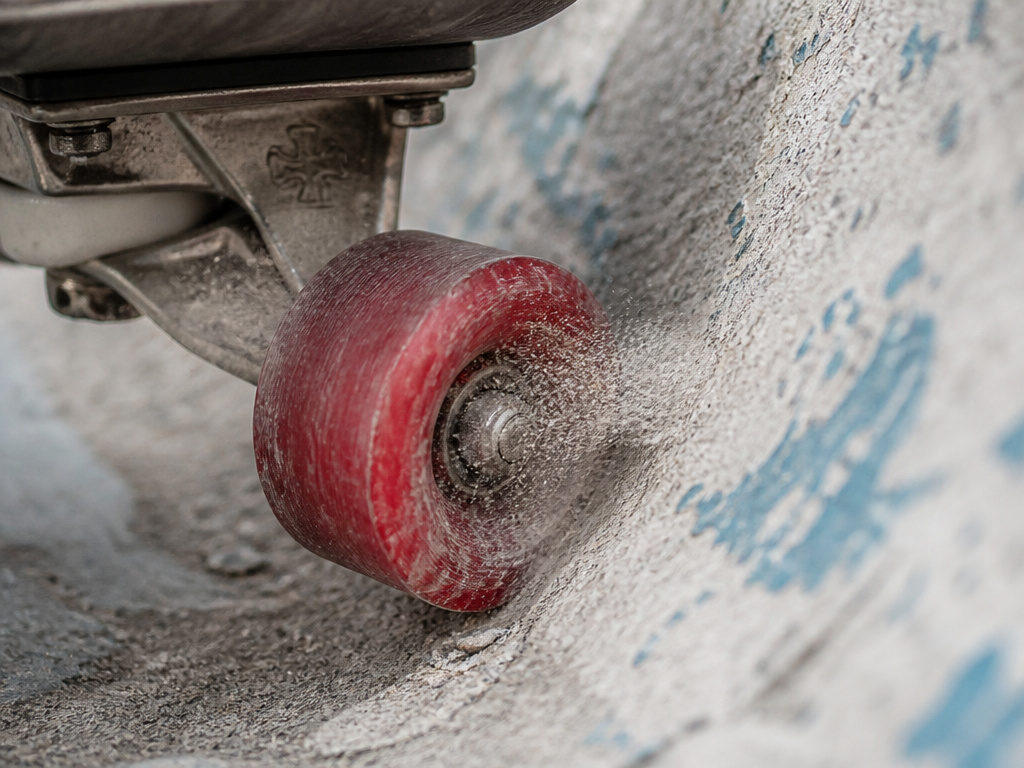
The Zephyr skateboard team, a group of 12, showed how the right wheels made a new style possible. In the mid-1970s, with urethane wheels now standard, they brought a low, aggressive, surfer-inspired approach to concrete pools and streets. Their style, later immortalized as the “Z-Boys,” was built on the carving control that only urethane could provide.
Their story is a key chapter in the broader history of skateboarding. It shows that technological change (the wheel) enabled cultural and stylistic change. You couldn’t slash the walls of a drained swimming pool on clay wheels; you’d slide out and crash. Urethane let them transfer surfing maneuvers to concrete, which in turn influenced everything from truck geometry to deck shape.
The relationship between gear and progression is a cycle. New wheels enabled new tricks, which created demand for wheels better suited to those tricks. This led to the specialized wheels we have today, where choosing between street vs park wheels is a fundamental decision for any skater.
The Future: Recycled Materials and New Science
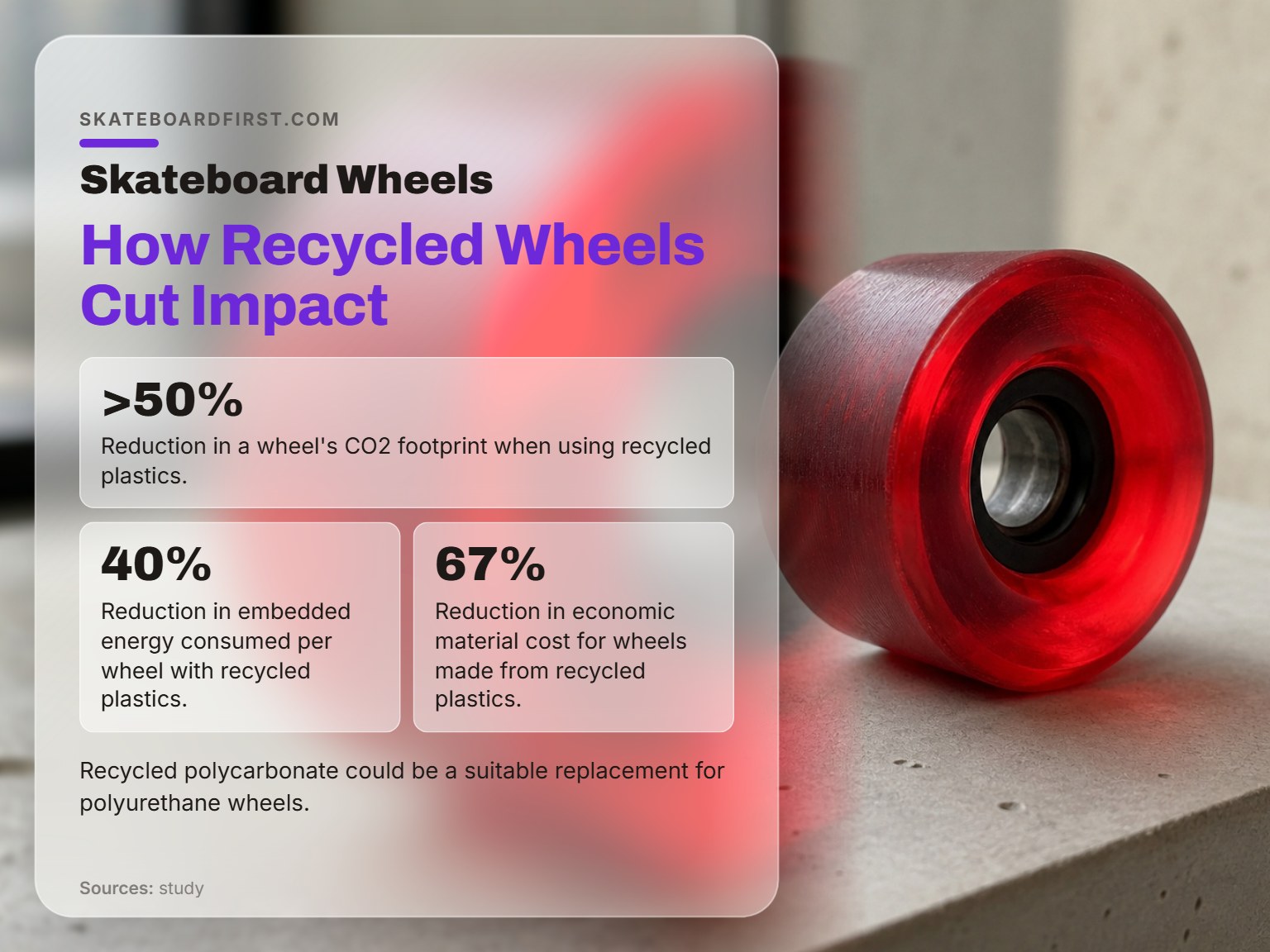
The next chapter in wheel history might be green. A 2012 study published in the WIT Transactions on Engineering Sciences asked if recycled plastics could replace polyurethane. Their peer-reviewed journal article on recycled wheels found that recycled polycarbonate performed similarly to urethane in friction and wear tests on asphalt.
The sustainability benefits are stark. Using recycled plastics for wheels could reduce a wheel’s CO2 footprint by over 50%, cut the embedded energy consumed by 40%, and lower economic material costs by 67%. Polyurethane itself is notoriously difficult to recycle, so this represents a potential paradigm shift for the industry.
This research points to a future where performance and environmental impact are compatible. This progress, driven by the need to make a better wheel for the riding people want to do, is a long way from nailing roller-skate wheels to a plank.
Frequently Asked Questions
What were skateboard wheels made of before urethane?
Before urethane, wheels were made of metal (steel) or clay-composite materials. Metal wheels, often taken from roller skates, offered a fast but dangerously rough ride with no traction. Clay wheels provided a slight grip improvement but were still brittle and delivered intense vibration.
Who invented the urethane skateboard wheel?
Frank Nasworthy is credited with commercializing the first urethane skateboard wheel. In 1970, he saw urethane rollerskate wheels, recognized their potential, and began selling them under the Cadillac Wheels brand. His innovation is widely seen as the catalyst for skateboarding’s resurgence in the 1970s.
What does the “a” mean in wheel hardness (e.g., 99a)?
The “a” refers to the Shore ‘A’ durometer scale, which measures the hardness of elastomers like urethane. The scale runs from 0 (very soft) to 100 (very hard). A higher number indicates a harder wheel that slides more easily but transmits more vibration. A lower number indicates a softer wheel that grips better and absorbs road shock.
Are colored wheels worse than clear wheels?
According to manufacturer advice from the 1970s, yes, potentially. Dyes or pigments take up space in the wheel’s urethane structure, which can reduce its resiliency (rebound). For maximum speed and performance, clear urethane is recommended. For most skaters, the difference is negligible, but it’s a noted trade-off.
How do I choose the right wheel size and hardness?
It depends entirely on your skating style and the surfaces you ride. Use a skateboard wheel size chart as a starting point. Smaller, harder wheels (52-54mm, 99a+) are standard for street skating where slide control is key. Larger, softer wheels (56mm+, 78a-87a) are better for cruising, longboarding, and rough pavement as they roll over cracks and provide a smooth ride.
Before You Go
The wheel’s journey is a physical argument between your board and the ground, solved one material at a time, not a list of dates. Steel lost. Clay cracked. Urethane won because it could both grip and let go.
That tension, between holding on and sliding, is where every trick lives. It’s why a modern wheel is a tuned instrument, not just a round thing. And it’s why the next shift might not be about going faster, but about making the ride sustainable for the long haul.
The board under your feet is a snapshot of that ongoing argument. Pick your side with your wheel hardness and wheel size, then go test it against the pavement.
