
How to Fall on a Longboard: Speed-Based Techniques
This post contains affiliate links. As an Amazon Associate, we earn from qualifying purchases.
To fall safely on a longboard, you must match your reaction to your speed. At low to moderate speeds (under 15-20 mph), bail off the board and perform a tuck-and-roll over your shoulder. At high speeds (over 30 mph), orient yourself face down and slide on protective pucks/pads. Never post your arms out straight to catch yourself, this is how wrists and arms break.
That distinction between a roll and a slide is a critical safety difference, separating walking away sore from a trip to the ER with a broken bone or worse. Knowing how to fall on a longboard is therefore critical. The data from trauma centers shows longboarders suffer skull fractures and traumatic brain injuries at a significantly higher rate than skateboarders.
What follows is the breakdown of those two falling worlds, the gear that makes each one survivable, and the one electric-board mistake that has nothing to do with skill.
Key Takeaways
- Falling technique is speed-dependent: roll under 20 mph, slide over 30 mph.
- Never post your arms out straight to catch a fall; it’s the fastest route to a broken wrist or collarbone.
- A properly fitted helmet can reduce brain injury risk by 80%, yet helmet use among injured longboarders is shockingly low (4-13.9%).
- One-third of all skateboarding injuries happen in the first week, making pre-practice on soft ground essential.
- For the Parsec Aero electric skateboard, the user manual warns, ‘Do not ride downhill with a fully charged battery.’
How to Fall at Low to Moderate Speed (<15-20 mph)
Your instinct will be to stick your arms out. That instinct is wrong, and it’s loud. I learned that the hard way trying to run out a wobble on a mild hill, my feet couldn’t keep up, I pitched forward, and my arm shot out on autopilot. A loud pop in my wrist and a month in a brace was the price for that half-second of reflex.
The correct move is a bail-and-roll. It feels unnatural because it is, until you’ve drilled it.
The low-speed sequence: As you feel the board go, jump clear off it with your feet aiming to hit the ground running. The moment your feet touch, you’re already committing to the roll, crouch low, tuck your chin to your chest, and lead with your shoulder, not your head or hands. Let your momentum carry you over your shoulder and across your back.
This isn’t a gymnastic forward roll. You’re not trying to come back to your feet. You’re trying to disperse the impact across the broadest surface, your back and shoulder, instead of letting one joint (your wrist, your elbow) absorb all the force. The American Academy of Orthopaedic Surgeons skateboarding safety guide explicitly recommends rolling to prevent your hands and arms from taking the full force.
Practice this on grass first. Start from your knees, then from a crouch. The goal is to make the tuck-and-roll your new, overridden instinct. When that wobble hits for real, you won’t have time to think.
High-Speed Falls (>30 mph) Are a Different Game
The rolling technique has a ceiling. Once you’re moving faster than about 30 mph, physics changes the game. You’re no longer falling vertically onto the pavement; you’re sliding across it horizontally at the speed of a car.
Where this goes sideways: Attempting a standard roll at 35 mph. The horizontal force is too great, and you’ll likely tumble uncontrollably. The prescribed action shifts to getting low and sliding on purpose.
Your job is to become a sled. As you come off the board, you want to orient yourself face-down, chest, belly, thighs, and get your protective gloves and knee pucks on the ground as fast as possible. These pucks, made of hard, slide-friendly plastic, are your brakes and your armor. They create friction to slow you down while protecting your skin from becoming hamburger meat.
| Aspect | Low-Speed Fall (<20 mph) | High-Speed Fall (>30 mph) |
|---|---|---|
| Primary Goal | Disperse vertical impact | Manage horizontal slide |
| Key Technique | Tuck-and-roll over shoulder | Orient face-down, slide on pads |
| Critical Gear | Helmet, knee/elbow pads | Full-face helmet, slide gloves, knee pucks |
| Practice Surface | Grass, soft mat | Smooth, clean pavement (with full gear) |
| Common Mistake | Posting arms out | Trying to roll or stand up mid-slide |
This is why downhill riders look like armored insects. The gear is functional, not fashionable. A full-face helmet, slide gloves with pucks, and knee pads with sliding caps are essential here, as they are your only interface with the asphalt.
The Gear That Actually Works
You can’t practice falling correctly without the right equipment. And not all pads are created equal.
First, the helmet is essential. A Brigham Young University trauma study found that skull fractures, traumatic brain injuries, and intracranial hemorrhage were significantly more common among longboarders than skateboarders. All three patient fatalities in that study were longboarders who sustained head injuries. Yet, among hospitalized longboarders, helmet use was abysmal, somewhere between 4% and 13.9%.
A bike helmet certified by CPSC, CSA, ASTM, or Snell is your baseline. For anything beyond casual cruising, a skate-specific helmet like the Triple Eight Certified or Pro-Tec Classic is better. They cover more of the back of your head. For downhill, you need a full-face helmet. It’s not a debate.
For pads, bulk isn’t better. You need mobility. 187 Killer Pads and Pro-Tec make knee and elbow pads designed for the impact and slide of concrete. They stay in place.
Then there are slide gloves. These are work gloves with hard plastic pucks sewn or strapped onto the palms. Slide gloves are available from various manufacturers. They let you put your hands down to steer a slide or to protect your palms in a fall without shredding them.
Wrist guards are the most underrated piece of kit. The Active & Safe resource lists arm fractures as a common injury in longboarding. Wrist guards are important protective equipment. It’s a small, simple brace that can stop the most common beginner injury cold.
The Electric Longboard Edge Case
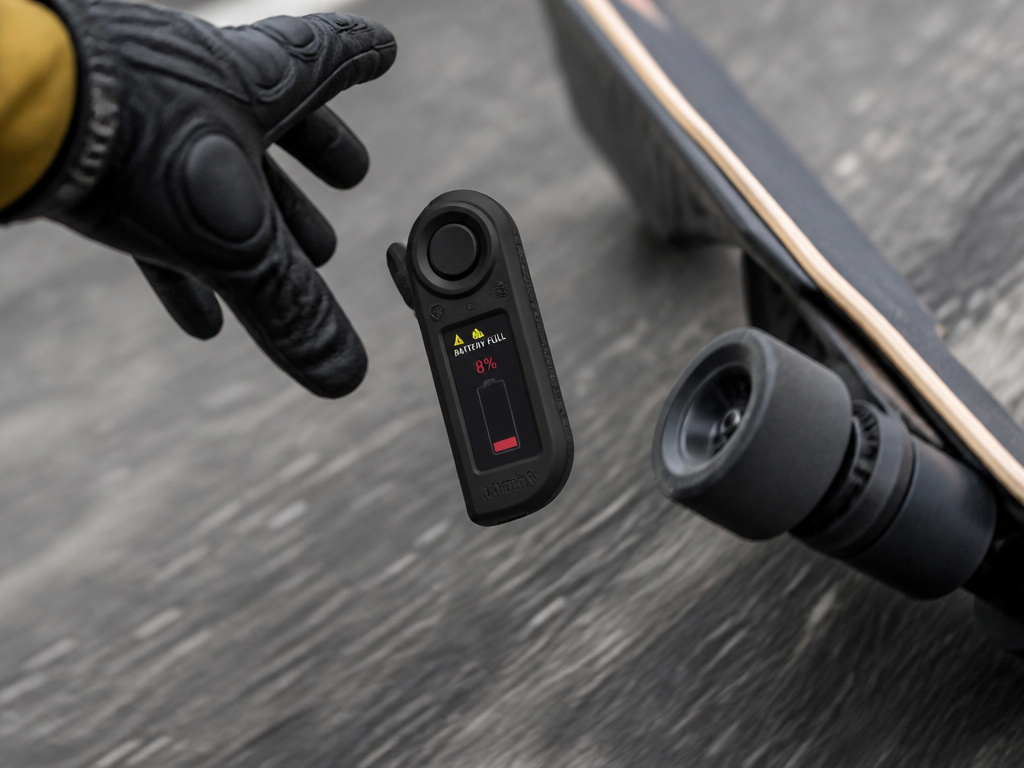
If you ride an electric board like a Onewheel or an electric longboard, there’s a falling hazard that has nothing to do with your technique. It’s in your battery.
The user manual for the Parsec Aero electric skateboard includes a specific, critical warning: “Do not ride downhill with a fully charged battery.” Why? Regenerative braking. When you brake going downhill, the motor acts as a generator, putting energy back into the battery. If the battery is already full, that energy has nowhere to go, which can cause the board to shut off unexpectedly to protect the electronics. You lose power and balance in the middle of a descent.
The U.S. Consumer Product Safety Commission (CPSC) recalled all models of Onewheel electric skateboards in September 2023 after four fatalities. For newer models, updating the app adds a safety alert feature. The original Onewheel and Onewheel+ models cannot be updated and, per the CPSC, “should not be used.”
The rule is simple: never start a downhill run on a full charge. Drain some battery charge first. This is a mechanical safeguard, like checking your truck bolts, not an optional tip.
Why This Matters: The Injury Data
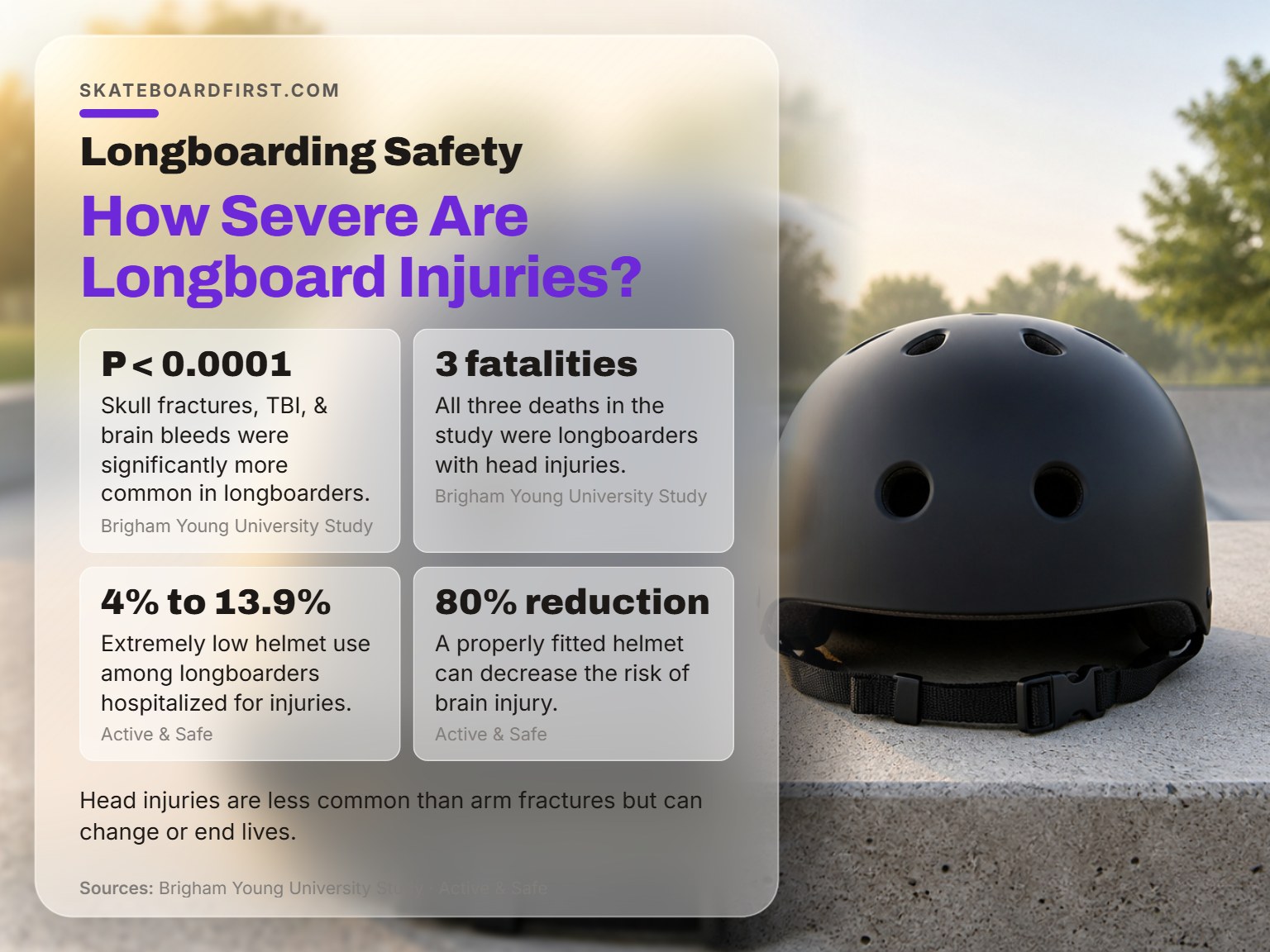
This is the documented outcome when things go wrong. The peer-reviewed data paints a clear picture.
The Brigham Young University study compared longboard and skateboard injuries at a Level II trauma center over five years. The findings were stark:
- Skull fractures, traumatic brain injuries (TBI), and intracranial hemorrhage (ICH) were significantly more common among longboard patients.
This longboarding injury epidemiology research suggests the higher speeds attainable on longboards, especially downhill, translate to more severe impacts. Your falling techniques and gear are your primary defense against becoming a statistic.
Arm fractures and skin abrasions are the most common issues, but the head injuries are the ones that change or end lives. This is why drilling the roll, investing in a real helmet, and knowing when to slide are the fundamentals of staying in the sport.
Frequently Asked Questions
What is the most common mistake when falling?
Posting your arms out straight to catch yourself. It’s a natural reflex, but it transfers all the force of the fall into your wrists, elbows, and shoulders, leading to fractures and hyperextensions. Train yourself to tuck and roll or slide instead.
Can I use a bike helmet for longboarding?
Yes, but ensure it has a CPSC, ASTM, CSA, or Snell certification. Bike helmets are tested for impacts at cycling speeds and angles. For more protection, especially at the back of the head, a certified skate helmet is a better choice for learning to ride a longboard.
How do I practice falling without hurting myself?
Start on a soft surface like grass or a gym mat. Practice the tuck-and-roll from your knees, then from a crouch. Wear your gear during practice to get used to the feeling. The goal is muscle memory, so when you start learning how to slide on a longboard or other skills, the safe reaction is automatic.
Are wrist guards really necessary?
The data says yes. Arm fractures are a leading injury. Wrist guards prevent the wrist from bending backwards on impact, which is the mechanism for many breaks. They’re cheap, unobtrusive, and highly effective for beginners working on how to stop on a longboard and other fundamentals.
What should I do immediately after a hard fall?
First, don’t jump up. Lie still for a moment and assess. Can you move your fingers and toes? Any sharp, localized pain? If you hit your head, even with a helmet, watch for signs of concussion: dizziness, nausea, confusion. Knowing how to recover from a skateboarding fall includes this immediate self-check.
Before You Go
The single biggest shift, beyond buying better pads, is accepting that falling is a skill, not a failure. One-third of skateboarding injuries happen in the first week, often because people are fighting the fall instead of managing it.
Spend twenty minutes on grass before your next session. Drill the roll until the tuck of your chin feels natural. Check your helmet’s certification sticker. Look at the American Academy of Pediatrics guide on skateboarding safety if you’re riding with kids.
Progress on a board means pushing limits. Protecting your head and your wrists is how you make sure you’re around to push them again next week.
