
How to Learn Grinds on a Skateboard: Step-by-Step
This post contains affiliate links. As an Amazon Associate, we earn from qualifying purchases.
Learning grinds on a skateboard starts with three things: a solid rolling ollie, a low waxed curb, and the commitment to lock your weight over the front truck. The 50-50 grind and the boardslide are the two foundational tricks every skater learns first, and they build the balance and confidence for everything more complex.
That commitment over the front truck is the whole game. Hesitate, and you stop dead on the curb. Commit, and the board slides. The difference isn’t in your feet; it’s in your head and hips. This guide on how to learn grinds on a skateboard walks you from the flatground drills that build that confidence to the moment you lock into your first grind and roll away.
What follows: the two tricks to learn first, the gear that actually helps, the step-by-step breakdown for a 50-50, the common mistakes that stop you cold, and a progression map for what comes next in your how to learn grinds on a skateboard journey.
Key Takeaways
- Start with a low, waxed curb and the 50-50 grind, it’s the most basic lock-in and teaches weight distribution for every other grind.
- Your rolling ollie must be higher than the curb you’re grinding; if you can’t ollie onto it, you can’t grind it.
- Wax the surface, but know that a freshly waxed curb sometimes needs a “break-in” pass before it slides smoothly.
- Speed is your friend, more speed creates more slide and makes balancing easier, but start with moderate pace.
- Lean forward, not back, keeping your weight centered over the board prevents the sudden stop that throws you off.
The Gear That Makes Grinding Easier
You can try to grind on any setup, but some gear choices lower the friction and raise your odds. This isn’t about buying skill; it’s about removing unnecessary hurdles.
A helmet should fit snugly but not tight enough to cause a headache. That’s your baseline. For the board itself, lighter trucks help. Brands often label these as ‘hollow’ or ‘light’ trucks. The baseplates on trucks marked ‘forged’ are strong yet light, which is a bonus for grinding. Your wheels matter too. Conical wheels are some of the best for grinding. Go for a harder durometer, 99a or harder, because harder wheels create less friction. Finally, your shoes. Vulcanized shoes are some of the best shoes for performing grinds.
You’ll also need skate wax. It reduces friction on the ledge or rail. A small block of dedicated skate wax will do. Don’t overthink it. The gear supports the skill; it doesn’t replace it.
Prerequisites: What You Need to Have on Lock
Before you ollie toward a ledge, you need a few fundamental skills on automatic. Trying a grind without them is like trying to bake bread before you know how to turn on the oven.
First, you must be comfortable pushing, riding, and stopping with confidence. If you’re still wobbly on flat ground, a curb will magnify that instability. Second, you need a solid rolling ollie. As one source puts it, “As long as you can ollie higher than the curb you’re going to grind, you’ll be alright.” If your ollie is only two inches high, find a one-inch curb. The math is simple. Third, get comfortable with an axle stall. This is just rolling up to a curb, lifting the front wheels onto it, and letting the back truck tap against the edge. It teaches you how to approach and what the “lock” feels like without the slide.
Where this goes sideways: Attempting a grind without a reliable ollie. You’ll either miss the ledge completely or land in a unstable position, guaranteeing a slip-out and a hard fall onto your hip or hands.
If you can check these three boxes, you’re ready. If not, spend your next session there. Rushing this step costs you weeks of frustration.
The Easiest Grinds to Learn First
Every skater’s grind journey begins with the same two tricks. They’re the foundation because they teach the two primary ways your board interacts with an edge.
The 50-50 grind is number one. Here, both trucks slide evenly along the obstacle. It’s the most straightforward lock-in. It builds the muscle memory for balancing during a slide. The boardslide is the other essential starter trick recommended for beginners. It teaches you how to shift your weight to the balls of your feet to prevent the wheels from catching.
The community agrees on this order. Start with the 50-50. It feels more natural for most people. Once you have that, the boardslide will make more sense.
| Trick | What You Learn | Best Obstacle to Start |
|---|---|---|
| 50-50 Grind | Weight distribution for a balanced slide, committing forward. | Low waxed concrete curb or ledge. |
| Boardslide | Controlling a perpendicular slide, preventing wheel-bite. | Low flat rail or wide ledge. |
| Noseslide | Precision locking with the front truck, a gateway to more advanced grinds. | Ledges after mastering 50-50s and boardslides. |
Start on Ledges and Curbs, Not Rails

Your first grind should happen on a curb, a parking block, or a low ledge. Rails are for later.
Ledges and curbs are much easier to learn on than rails. The reason is simple: surface area. A curb offers a wide, forgiving surface to lock onto. A round rail is a narrow metal cylinder. Miss your lock by an inch on a rail, and you slide right off. On a curb, you have a margin for error. The material matters too. Painted concrete and metal slide well. Some skaters even seek out granite ledges for a smooth grind. A rail, especially a round one, demands perfect alignment and commitment from day one. It’s a fast track to getting “sacked”, hitting the rail painfully, which is a notorious beginner risk.
I learned this the expensive way. I was so eager to grind a shiny new rail that I skipped the curb phase. Now I make everyone start on a curb. The sound of trucks sliding on concrete is the sound of progress; the sound of denim hitting steel pipe is the sound of a lesson learned too late.
So find a friendly curb. Make sure it’s not too high. Wax it up. That’s your training ground.
The 50-50 Grind: Your First Lock-In
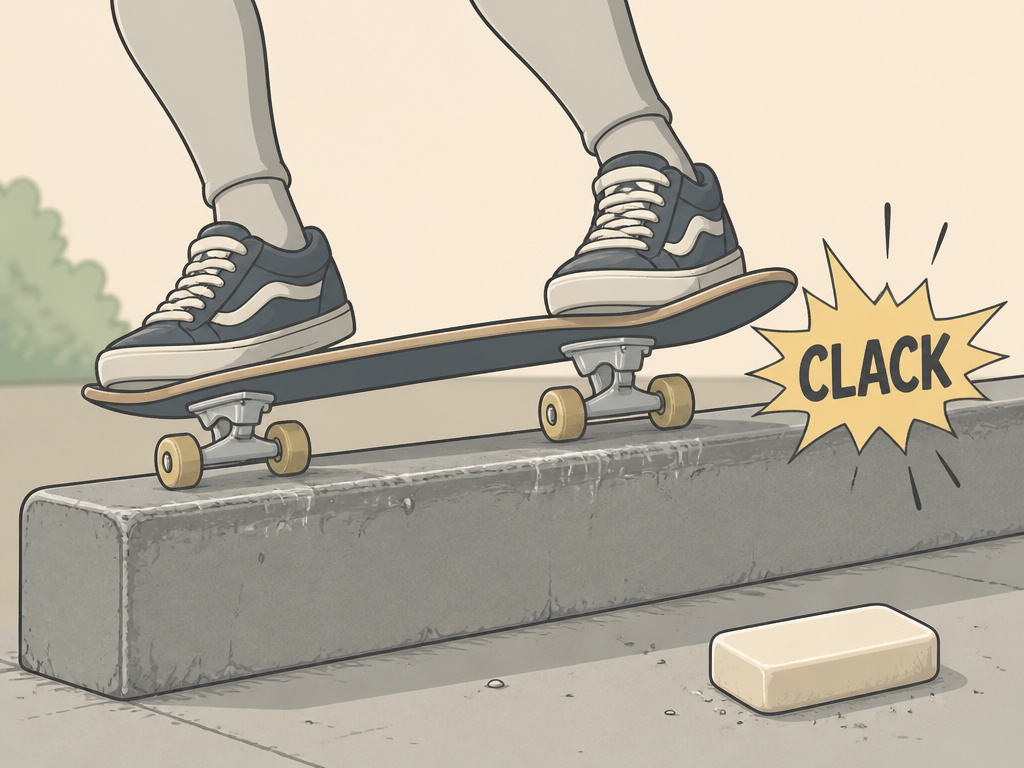
The 50-50 is the first and most important grind to understand. The 50-50 is your foundation.
Step 1: Find and Prep Your Ledge. Find a low curb that isn’t too high. It needs to be clean and dry. Now, wax it. Rub the wax along the edge in a few solid passes. There’s a nuance here: if it’s metal coping, it doesn’t need much wax, but put a fresh coat on it anyway. For concrete, you’ll need more. A freshly waxed curb sometimes has to “break in” before it grinds comfortably, so don’t be surprised if the first try feels sticky.
Step 2: Approach with an Angle. How you roll up is your first big decision. Sources disagree here, and that’s okay. Surfertoday.com recommends rolling at a slight angle toward the object. Rad Rat Video notes that rolling completely parallel is tough and suggests a sharper angle helps mount but loses speed, advising you to experiment.
Step 3: Ollie and Land Flat. You need a solid rolling ollie that is higher than the curb you’re grinding. Pop, level your board in the air, and aim to land with both trucks on the edge. Your feet should be over the bolts, knees bent. The goal is a “clack” as both trucks hit, not a staggered “clack-clack.”
Step 4: Lock Your Weight and Slide. This is the commit moment. As soon as you land, keep your knees bent so you’re in a low stance, and lean slightly forward. Your weight needs to be centered or slightly forward. Leaning back is the most common mistake; it makes the front truck lose grip, and you stop dead. If you’re moving with moderate speed, you’ll start to slide.
Step 5: Exit. As you reach the end, you can roll or ollie off the curb to land back on flat ground with bent knees. This keeps you in control and looks clean.
The part nobody mentions: Stationary practice is harder than rolling. Trying to land your back truck from a standstill is tough because you don’t have the approach angle helping you. Don’t get discouraged if stationary stalls feel impossible; they’re actually the harder version.
How to Commit and Overcome the Fear
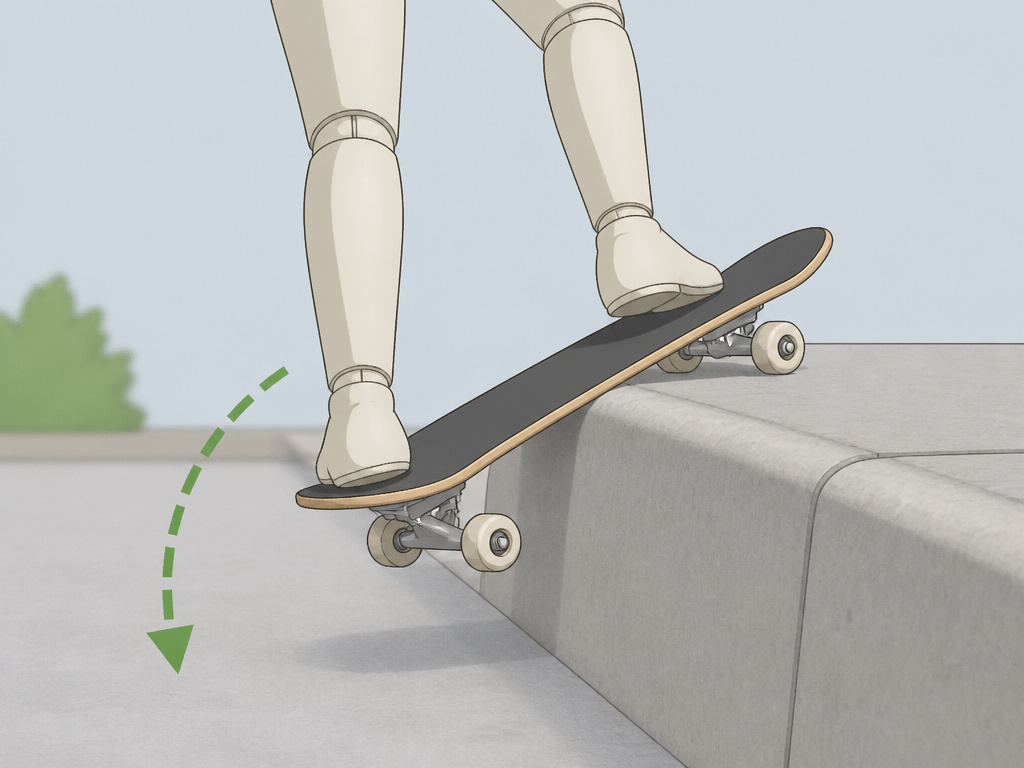
The mental block is real when figuring out how to learn grinds on a skateboard. You see the curb, you know the steps, but your body locks up. You hesitate at the lip. Everyone goes through this.
The fear usually stems from the unknown. What does the lock feel like? What if I slip out? The cure is to remove the unknown. Practice the axle stall until it’s boring. Roll at your curb, ollie, and just land with your back truck hanging off and your front wheels on top. Feel how the truck taps the edge. Do this fifty times. Then, try a slappy grind. This is where you don’t ollie at all; you just turn your front truck onto the curb at an angle and let it slide. It’s a low-commitment way to feel the slide.
Another drill: practice bailing. Intentionally ollie onto the curb and then jump off your board onto the ground. Learn how to step away safely. Knowing you can escape makes committing to the full grind less scary. Your brain needs to know the backup plan.
Troubleshooting Common Grind Mistakes

You’ll try, and you’ll fail. Here’s what’s likely going wrong and how to fix it.
- You slip out immediately. This almost always means you’re leaning back. Your weight is behind the board, so the front truck can’t grip. Fix: Consciously think “chest over knees.” Visualize driving your torso forward over the ledge.
- You can’t get the back truck up. Your ollie isn’t high enough, or your approach angle is too parallel. Fix: Use a lower curb. Practice ollies onto a curb that’s only an inch or two high to build the muscle memory. Try a slightly sharper approach angle.
- The grind feels sticky and slow. The surface isn’t waxed enough, or your wheels are too soft. Fix: Apply more wax. If you’re using wheels softer than 99a, consider switching to a harder set for grinding practice.
- The board turns sideways (boardslides unintentionally). You’re not landing with your board parallel to the ledge. Fix: Focus on your shoulders. Keep them parallel to the curb during your ollie. Your feet follow your shoulders.
Common mistake: Going too slow. You naturally want to go slow for safety, but too little speed means no slide. You just land and stop. Commit to a moderate, consistent push. As one source notes, “the faster you go, the farther you’ll grind.”
Progression: What to Learn After the 50-50 and Boardslide

Once you can consistently 50-50 a curb and boardslide a low rail, the world opens up. Here’s a logical order, endorsed by both guides and forums.
- Backside Noseslide. This is often the third trick people learn. It builds on the boardslide motion but focuses precision on the front truck.
- Frontside 5-0. A 5-0 grind is like a 50-50, but only your back truck grinds. It’s a natural step from a 50-50, requiring a slight shift of weight to the back foot.
- Backside Crooked Grind and Feeble Grind. These are more advanced locks. A feeble grind specifically requires having “backside 50-50s and boardslides on automatic” as a prerequisite, according to one trick tip. They combine elements of the tricks you already know.
The table below lays out a standard progression path. Don’t feel bound by it, but use it as a map.
| Progression Level | Tricks to Master | Key Skill Developed |
|---|---|---|
| Foundation | 50-50 Grind, Boardslide | Basic lock-in, weight shift, slide balance. |
| Intermediate | Noseslide, Frontside 5-0 | Precision locking, single-truck control. |
| Advanced | Crooked Grind, Feeble Grind, Smith Grind | Complex lock combinations, body rotation. |
Remember, this is a marathon. Learning one grind well is better than sketching out five. Each one teaches your body something new that makes the next one easier.
Common Grind Tricks
Start with the foundational grinds. The 50-50 grind, where both trucks slide evenly, is the first one to master. The boardslide is another essential early trick. Once these feel solid, you can build up to more complex grinds. A feeble grind involves grinding on your back truck while the front truck hangs over the obstacle. A crooked grind is similar but uses the front truck on the ledge. A 5-0 grind is done balancing on just the back truck. Always begin practicing these on low, short ledges or curbs, which are much easier to learn on than rails.
Frontside vs Backside Grinds
Every grind trick has a frontside and backside variation. Frontside means your chest faces the obstacle as you approach and slide. Backside means your back is to the obstacle. For beginners, a frontside 50-50 is often easier because you can see where you’re going. Sources disagree on the ideal approach angle: Surfertoday.com recommends a slight angle, while Rad Rat Video notes a parallel approach is tough and suggests experimenting with angles.
Frequently Asked Questions
What is the easiest grind to learn on a skateboard?
The 50-50 grind is universally the easiest. Both trucks slide evenly, which makes it the most stable and intuitive first lock-in. Start on a low, waxed curb.
How long does it take to learn your first grind?
It depends entirely on your existing ollie. If you have a solid rolling ollie, you might land a sketchy 50-50 in a single session. To get it consistent and comfortable, plan on a few weeks of dedicated practice.
Can I learn grinds without going to a skatepark?
Absolutely. Street spots like curbs, parking blocks, and low ledges are ideal for learning. In fact, many skaters recommend learning on curbs before ever attempting a skatepark rail. You can even build a grind rail for your driveway.
Why do I keep slipping out of my grinds?
You’re almost certainly leaning back. When your weight is behind your board, the front truck lifts and you lose grip. Focus on keeping your chest forward and your knees bent. Also, make sure you’re using enough speed and the ledge is properly waxed.
What’s the difference between a grind and a slide?
Grind uses the metal trucks of your skateboard to slide. A slide uses the deck (wood) of your board to slide. Grinds make a distinctive grinding sound; slides are quieter. The 50-50 is a grind; the boardslide is a slide.
Is 20 too late to learn skateboarding grinds?
Not at all. Age is less about physical ability and more about time and willingness to fall. Start with the basics, pushing, ollies, and progress at your own pace. The key is structured skateboarding practice and managing risk with protective gear.
The Bottom Line
Learning grinds is a puzzle where you already have most of the pieces. You need a solid ollie, a low curb, and the guts to shift your weight forward. Start with the 50-50. Wax the ledge. Commit over the front truck.
If you take one thing from this, let it be this: your first session isn’t about landing the trick. It’s about building the feeling. Practice axle stalls. Practice slappy grinds. Get comfortable bailing. The actual lock-in will come when your body stops seeing the curb as a threat and starts seeing it as a tool.
Your next step? Find a curb this week. Don’t even bring your board the first time. Just look at it. Figure out your approach path. Then come back with your board and try an axle stall. Small wins count.
