
How to Maintain an Electric Skateboard: Step-by-Step
This post contains affiliate links. As an Amazon Associate, we earn from qualifying purchases.
Maintaining an electric skateboard requires a weekly visual inspection of the drive belt, keeping All Terrain tyres between 30-45 PSI, and storing the battery at a partial charge (40-60%) for any period longer than a month. The process differs slightly between belt-drive and hub-motor boards, but a consistent routine prevents most common failures.
That 30-45 PSI spec isn’t a suggestion. Running tyres below that pressure flattens the contact patch, which the motor has to work harder to spin. Your range drops, and the motor heats up faster. The weekly belt check is the same story — a five-second glance can catch a stone before it shreds the belt or damages the motor pulley. A key part of how to maintain an electric skateboard is following these simple checks.
What follows is a straight breakdown of the maintenance schedule every manual agrees on, the one major point where they don’t (and what to do about it), and the simple tools that replace a professional service visit when you learn how to maintain an electric skateboard. By the end, you’ll know exactly what to check, when to check it, and why skipping the quiet steps costs you power and money.
Key Takeaways
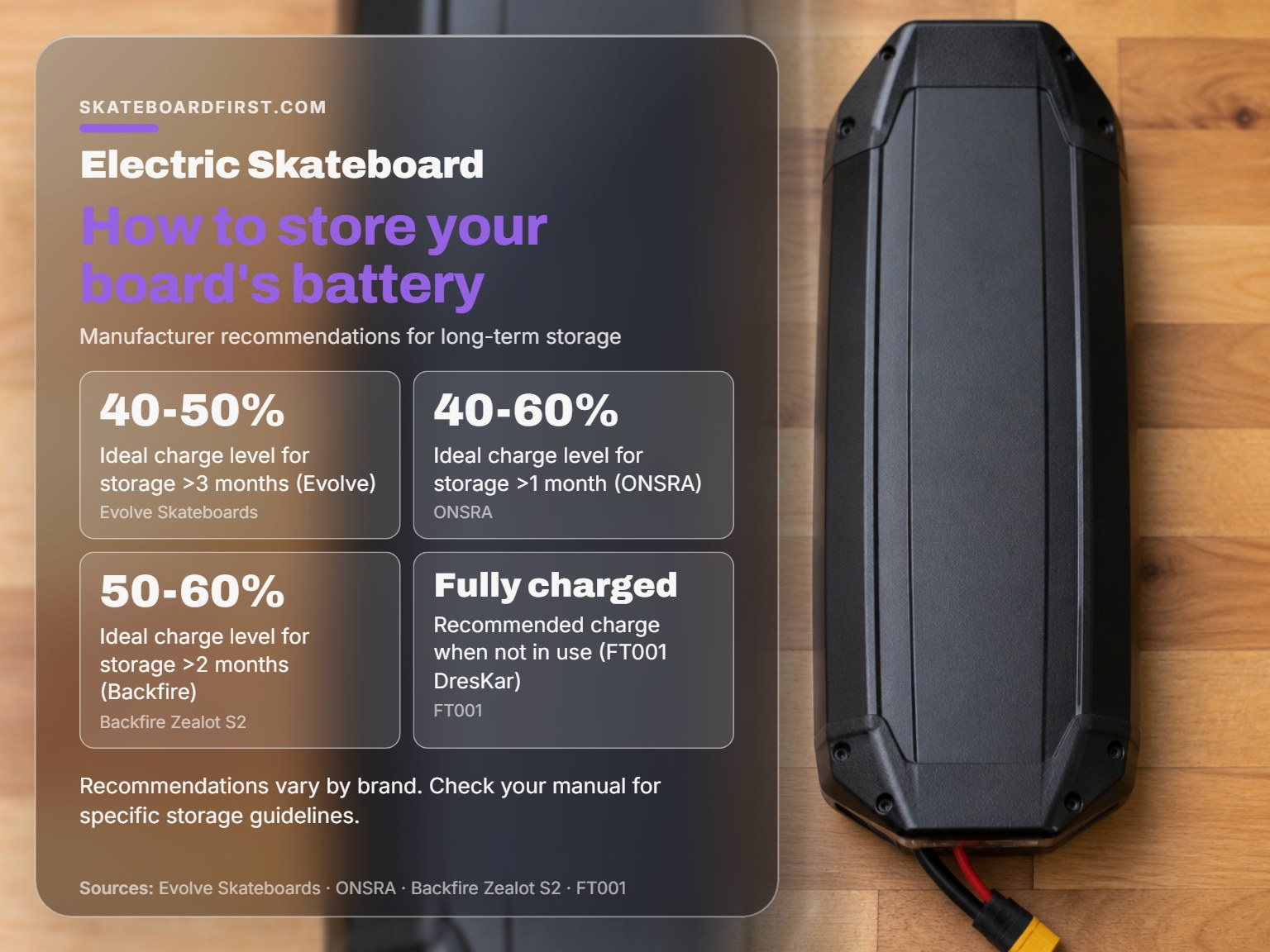
- Store your board’s lithium-ion battery at the level recommended by its manufacturer for long-term storage, as sources disagree: Evolve recommends 40-50% for storage over 3 months, ONSRA recommends 40-60% for over 1 month, Backfire recommends 50-60% for over 2 months, and FT001 (DresKar) recommends keeping it fully charged.
- Keep All Terrain tyres between 30-45 PSI; softer tyres sap range and strain the motor, reducing your ride time.
- Inspect drive belts weekly for stones, cracks, and tension; a stone caught in the pulley can strip the belt teeth in one ride.
- Clean bearings with a dedicated lubricant like “Bearing Cleaner & Lube” — household oils attract grit and will seize the bearings within weeks.
- Tighten all truck and wheel nuts after every few rides; vibration loosens them, and a lost wheel nut at speed is a guaranteed crash.
The Non-Negotiable Weekly Check
You don’t need a full toolkit for this. It’s a two-minute visual and tactile scan you do before you ride. The goal is to catch the small things that become big, expensive problems.
First, lift each wheel off the ground and spin it by hand. Listen for a gritty, grinding sound from the bearings. Feel for wobble in the wheel itself, which means a loose axle nut. Look at the drive belt if you have a belt-drive board. Is there a pebble wedged between the belt and the motor pulley? Can you see any cracks starting on the belt’s inner teeth? Finally, squeeze the All Terrain tyres. They should feel firm, not squishy.
A stone trapped in a belt drive doesn’t just make noise. It acts like a file, grinding down the belt’s teeth and the aluminum teeth on the motor pulley every time the wheel rotates. You’ll hear a rhythmic clicking first, then a sudden loss of power when the belt skips or snaps.
Skipping this check is how a $15 belt replacement turns into a $100 motor-pulley replacement. The process of how to maintain an electric skateboard is simple, but the consequence of skipping it isn’t.
The Tools You Already Own
You likely have most of what you need. A bicycle pump with a pressure gauge is essential for the tyres. A set of Allen keys (hex wrenches) fits most truck and motor-mount bolts. A small socket set or a skate tool handles the wheel nuts. For cleaning, keep a pack of microfiber cloths and some isopropyl alcohol. That’s it. You don’t need a workshop.
Battery Care: Where the Manuals Disagree
This is the most critical and most confused part of electric skateboard upkeep. The manuals from major brands give different, sometimes opposite, instructions.
The Evolve Skateboards manual says to store the battery at 40-50% charge for periods longer than 3 months. The ONSRA manual says 40-60% for storage longer than 1 month. The Backfire Zealot S2 manual says 50-60% for storage longer than 2 months. But the manual for the FT001 (DresKar) board says to keep your board battery fully charged when not in use.
So who’s right? For modern lithium-ion batteries, the partial-charge advice from Evolve, ONSRA, and Backfire is correct. Storing a battery at 100% charge for months puts constant stress on the cells, accelerating their chemical aging. Storing it fully discharged risks the voltage dropping so low that the battery’s protection circuit permanently disables it — a bricked battery.
| Brand | Storage Charge | Storage Duration | Rationale |
|---|---|---|---|
| Evolve, ONSRA, Backfire | 40–60% | >1–3 months | Minimizes cell stress, maximizes lifespan. |
| FT001 (DresKar) | 100% (Full) | When not in use | Manufacturer’s specific guidance. |
The safe rule for any board made in the last five years: if you’re not riding for a month or more, charge (or discharge) the battery to about halfway, then turn the board off. Check it monthly if you can. The ONSRA manual adds a specific warning: never leave the battery on the active charger, or the charger in the socket, for more than 48 hours.
Cold weather is a separate battery killer. The Evolve manual states cold temperatures reduce range, top speed, and acceleration. Exposing the battery to very low temperatures may cause permanent damage. If your board feels sluggish on a cold day, that’s normal. Bring it inside to warm up before charging.
Belt and Wheel Maintenance
Belt-drive and hub-motor boards share some maintenance needs, but belts add a few specific steps. Here are the details.
For Belt-Drive Boards (Evolve, ONSRA, Meepo Voyager)
The belt is a consumable part, like a tyre on a car. The FT001 manual is blunt: check the drive belt once a week. The drive belt needs to be replaced after 6 months of use.
Tension is everything. The ONSRA manual specifies keep belt tension at about 2 mm slack. Too loose, and the belt will skip under hard braking, making a distinct clack-clack sound. Too tight, and you’ll hear a high-pitched whine; the belt and motor bearings wear out prematurely.
Here’s the step-by-step for a belt check:
- Visually inspect: Look for cracks, fraying edges, or missing teeth on the belt’s inner surface.
- Check for debris: Remove any stones, twigs, or grit lodged between the belt and pulley.
- Test tension: Press the belt midway between the two pulleys. It should deflect about 2 mm. If it moves more, it’s too loose. If it doesn’t move, it’s too tight.
- Adjust: Loosen the motor mount bolts, slide the motor to adjust tension, and re-tighten. This is where your Allen keys come in.
Common mistake: Overtightening the belt to stop skipping. This adds massive strain to the motor shaft and its bearings. A correctly tensioned belt should not skip under normal braking. If it does, the belt is worn and needs replacement, not more tension.
Rotating the wheels is another often-missed step. The Evolve manual notes the drive wheels will wear the fastest. Swapping the front and rear wheels every few months evens out the wear pattern and makes your board feel more balanced.
For Hub-Motor Boards (Backfire G2, Meepo)
Hub motors are lower maintenance. There’s no external belt to check or adjust. Your focus shifts to the rear wheels, which are part of the motor itself. When the urethane sleeve wears down to the plastic hub, you replace the entire wheel/motor unit. Owners report getting significant mileage before this is needed. Your main job is keeping the wheel nuts tight and the bearings clean.
Cleaning and Bearing Care
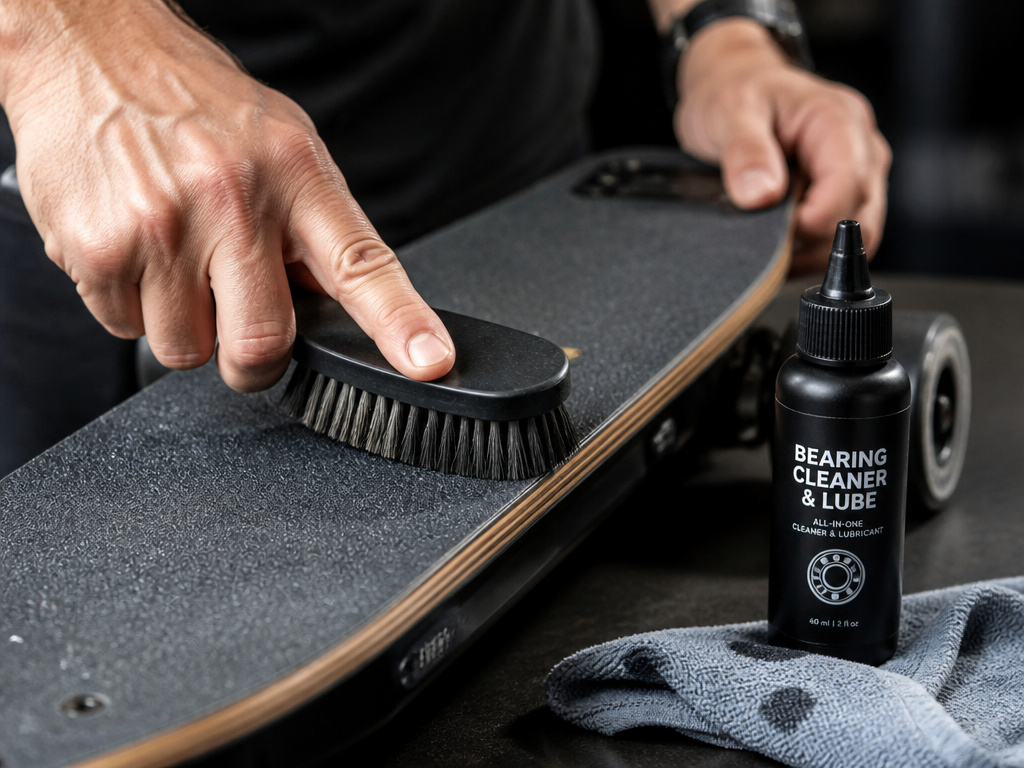
Dirt is the enemy of smooth rolling. After a ride on dusty paths, give your board a quick wipe-down.
The universal method is simple: use a damp cloth, then a dry one. The Evolve manual says clean your board from dust and dirt with a damp & dry cloth. The FT001 manual agrees: clean the electric skateboard with a slightly damp cloth and prevent water or dirt from entering electronic components. Never spray water directly on the board, and never submerge it.
For the grip tape, a stiff brush (a clean, dry dishwashing brush works) knocks loose dirt out. Forget the hose. Water forced into the deck’s plywood can cause it to delaminate over time.
Bearings need special attention. The FT001 manual is specific: use special maintenance oil ‘Bearing Cleaner & Lube’ for bearings. This is essential. Household oils like WD-40 or 3-in-1 oil are not designed for high-speed bearings; they attract dust and turn into a grinding paste. A dedicated skate bearing lubricant is cheap and lasts years.
A clean, lubricated bearing rolls freely and quietly. A dirty one feels sluggish, sounds gritty, and wastes battery power overcoming friction. Re-lubricating them is part of extending your skateboard’s life.
Hardware and Safety Checks
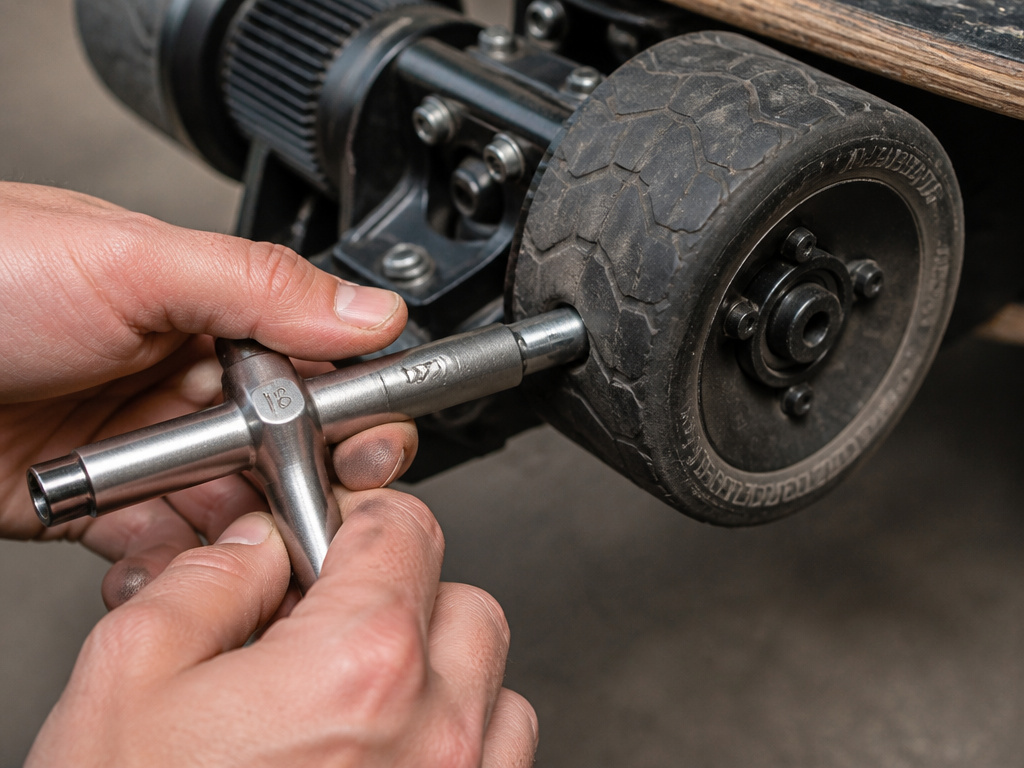
Vibration is a powerful loosening agent. Every bolt and nut on your board will eventually work itself loose.
The Evolve manual puts it clearly: always check all screws/nuts throughout the skateboard are tight. You are responsible for this. Make it a habit. After every few rides, go over the board with your skate tool or Allen keys:
- Truck mounting bolts (where the trucks attach to the deck)
- Kingpin nut (the main bolt in the truck)
- Wheel nuts
- Motor mount bolts (on belt-drive boards)
- Any remote or battery enclosure screws
A loose truck bolt can make the steering feel vague and dangerous. A lost wheel nut will send your wheel flying off mid-ride. This five-minute check is the best crash-prevention tool you have.
Tyre pressure is a performance spec, not just a comfort one. Both Evolve and ONSRA manuals state: keep All Terrain tyres between 30-45 PSI when riding. Below 30 PSI, the tyre deforms too much, increasing rolling resistance. Your motor works harder, your range drops, and you risk pinching the tube on a curb. Invest in a pressure gauge that reads PSI. It makes a difference you can feel in the ride.
Storing Your Electric Skateboard
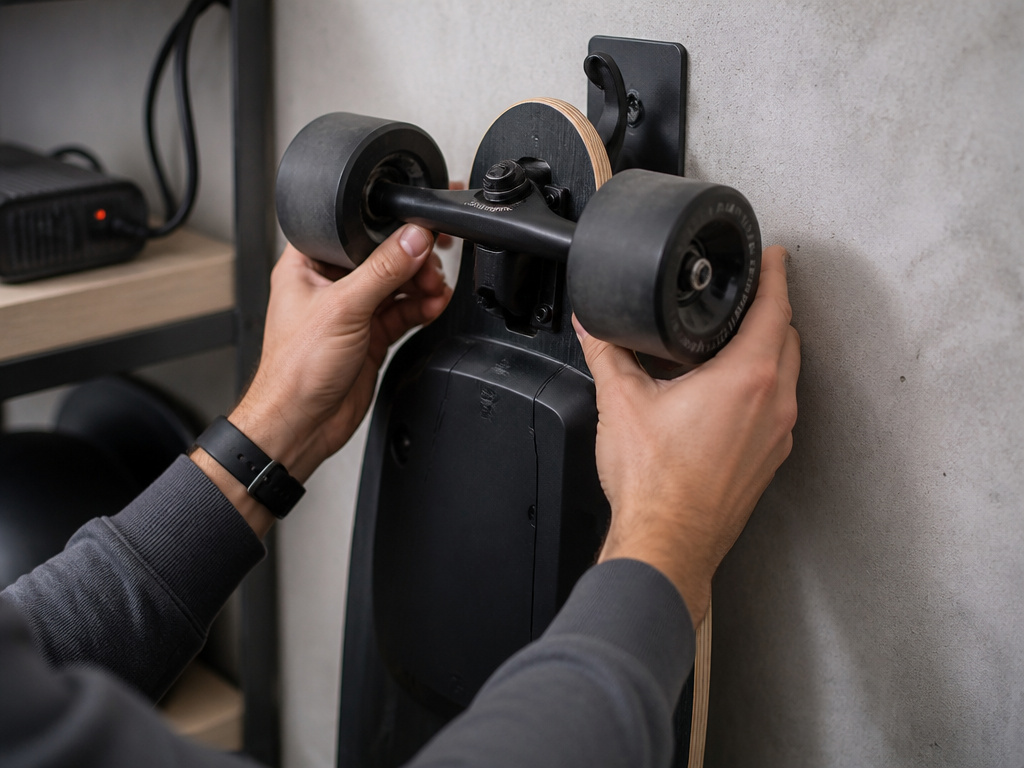
When you’re done riding for the season, a few steps will ensure your board wakes up healthy.
Then, find a storage spot. The manual says it plainly: store the board at room temperature. A dry garage or closet is perfect. Avoid damp basements or hot attics. Extreme heat can damage the battery; extreme cold can too.
For the board itself, give it a thorough clean and lubrication session before storing. This prevents corrosion or seized bearings over months of inactivity. Some owners place the board on a shelf or hang it on wall mounts to keep the wheels off the ground and prevent flat spots on the tyres.
If you followed a proper storage routine, pulling the board out next season should be as simple as charging it up and checking the tyre pressure.
Troubleshooting Common Issues
Sometimes, despite your best efforts, things go wrong. Here’s how to diagnose a few common problems.
The board won’t turn on or pair.
- Check: Is the battery completely dead? Charge it for an hour and try again.
- Check: Is the remote charged? The remote has its own battery.
- Re-pair: Turn both board and remote off. Turn the board on, then the remote. Follow the pairing steps (for Evolve, press and hold the MODE 1 button for one second; for ONSRA, hold the board’s power button for 5 seconds).
Reduced power or range.
- Check: Tyre pressure. Soft tyres are the #1 cause of unexpected range loss.
- Check: Belt tension (if belt-drive). A slipping belt wastes power.
- Check: Bearings. Spin the wheels. Gritty, slow-spinning bearings need cleaning.
- Consider: Battery age. All batteries lose capacity over time and with charge cycles.
Unusual noise from the drivetrain.
- Clicking/Clacking: A stone in the belt drive, or a loose motor mount bolt.
- High-pitched Whine: Belt is too tight.
- Grinding/Rumbling: Dry or damaged bearings.
Error codes on the remote (Evolve boards).
- ‘BATT ERR’: Communication error between battery and controller. Turn off and on. If persistent, contact support.
- ‘MAINTAIN BATT’: A battery cell is out of balance. Leave the board on the charger for an extended period (up to 48 hours max) to allow the battery management system to balance the cells.
- ‘MOTOR # ERR’: A fault detected in a motor. Check connections and ensure nothing is physically blocking the motor.
How to Ride an Electric Skateboard in the Rain
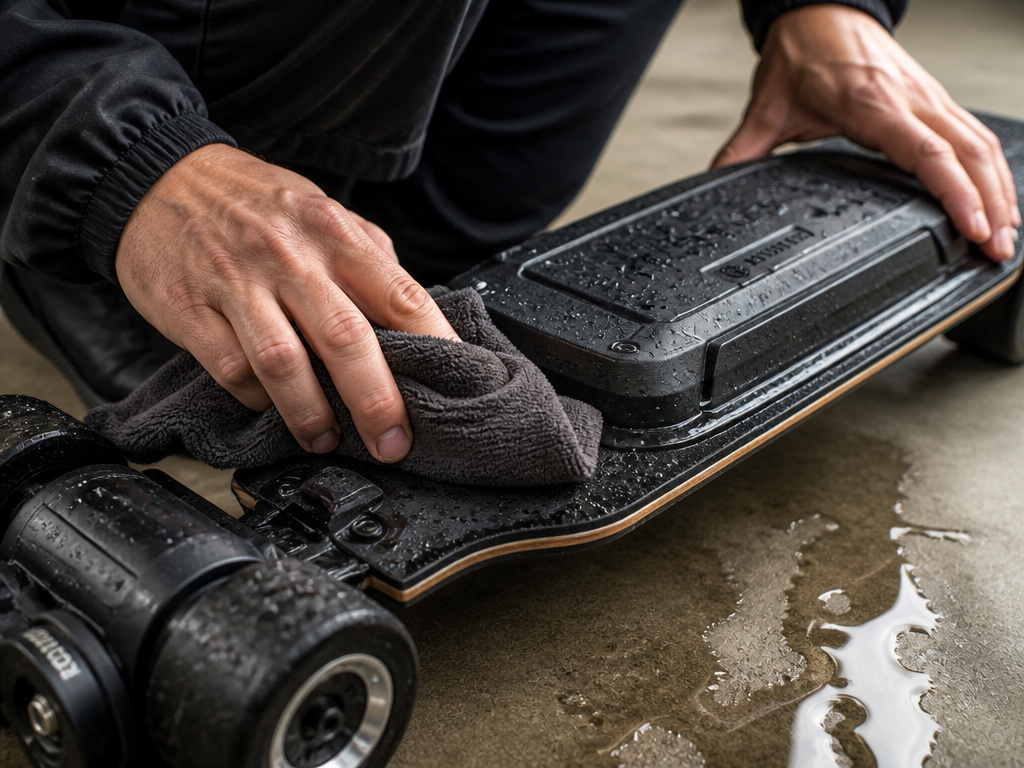
Water is the enemy of your board’s electronics. Manufacturers warn against riding in wet conditions because moisture can damage the battery, motor, and other components. If your board gets wet, clean it with a damp cloth and dry it thoroughly, taking care to prevent water from entering any openings. Storing your board at room temperature after drying helps prevent corrosion. While some boards can handle damp surfaces, no electric skateboard is designed to be submerged or ridden through puddles, as this can lead to immediate failure and void warranties.
What Tools Do I Need for Electric Skateboard Maintenance?
You don’t need many tools to handle most maintenance. A set of skate tools or Allen keys is essential for checking and tightening all the screws and nuts throughout the skateboard. For belt-drive boards, you’ll need these same tools to adjust belt tension and remove wheels for inspection. A tire pressure gauge is necessary if you have All Terrain tires, as they require specific PSI. A clean, dry cloth is needed for wiping down the deck and components. For bearing care, you may need a specific bearing cleaner and lubricant. With these basic tools, you can perform regular checks and keep your board running smoothly.
Frequently Asked Questions
How long do electric skateboards last?
With proper maintenance, the deck and trucks can last for years. The consumable parts have shorter lifespans: drive belts, wheels, and the battery will gradually lose capacity over time with regular use. Consistent belt maintenance and battery care are the keys to maximizing this.
Should I put WD-40 on my skateboard wheels?
No. Do not use WD-40 on skateboard bearings. WD-40 is a penetrant and water displacer, not a lubricant. It will thin out any existing grease, attract dirt, and quickly lead to bearing failure. Always use a lubricant specifically designed for skateboard or bicycle bearings, like the “Bearing Cleaner & Lube” mentioned in the FT001 manual.
Can I ride my electric skateboard in the rain?
Manufacturers strongly advise against it. Water can damage the motors, electronics, and battery, and such damage is not covered under warranty. If you get caught in a light drizzle, dry the board thoroughly afterwards, paying special attention to sealing vulnerable components. Avoid puddles and never ride through standing water.
My electric skateboard isn’t holding charge. What should I do?
First, check your charging habits. Are you consistently draining the battery to zero or storing it fully charged? Both degrade the battery. Try charging it fully, then riding it down to about 20% and recharging. If the problem persists after a few cycles, the battery may be reaching the end of its life. Reduced capacity is normal over time, but a sudden, severe drop may indicate a failing cell.
The Bottom Line
Maintaining an electric skateboard isn’t about weekly deep cleans. It’s about consistent, small habits. Check the belt for stones. Keep the tyres firm. Store the battery halfway. Tighten the nuts that vibrate loose.
The one rule that reframes everything: your board is a precision electric vehicle, not a toy. The manuals disagree on some specifics, but they all agree on that. Treating it with the same basic care you’d give an e-bike or a laptop — keeping it clean, dry, and charged properly — is what gets you years of reliable rides instead of a costly repair bill after one season.
Start with the weekly check. Everything else follows from there.
