
Skateboard Size for Adults: Key Takeaways
This post contains affiliate links. As an Amazon Associate, we earn from qualifying purchases.
For adults, the right skateboard size balances three things: a deck width that matches your foot for control (typically 8.0″ to 8.5″), a style that fits your skating goals (street vs. Transition), and personal comfort that only comes from trying a board. Shoe-size charts are a starting point, but the best size is the one that feels stable under your feet and lets you skate the way you want.
The numbers from shops and brands show a clear middle range. Sources provide different recommendations: for example, Tactics and Sizer Skateboards suggest a deck width of 7.5 to 8.0 inches for men’s shoe size 6.5 to 9, while CCS recommends 8.00” to 8.25” for men’s size 7.0 to 8.5. That width gives enough platform for balance without being so big it slows down your first ollie attempts. Where people get stuck is assuming the chart is a rule. It’s a suggestion. Your preference for a certain type of skating, flipping the board versus carving a bowl, changes the math, so the best skateboard size for adults often comes down to personal style.
What follows is a breakdown of where those width numbers come from, how to match your trucks and wheels, and a direct comparison of what each size range actually does for you. By the end, you’ll know whether to reach for an 8.0, an 8.25, or something wider, and how to build the rest of your board around that choice.
Key Takeaways
- Start with a deck width between 8.0″ and 8.25″ if you’re an adult beginner; it’s the most common, stable starting point.
- Match your truck axle width to your deck width within a quarter inch for proper control and to avoid wheel bite.
- Choose 54-55mm wheels as a beginner; they roll over cracks better than tiny street wheels but won’t feel clunky.
- Shoe size is a guide, not a rule. A US men’s size 9.5 could comfortably ride anything from 8.0″ to 8.5″ depending on skating style.
- Always try standing on a deck before buying if you can; your foot’s coverage and feel matter more than any chart.
Where Skateboard Sizing Charts Agree (And Where They Don’t)
Every major retailer and deck maker publishes a chart. They all point to the same middle ground but draw the lines in slightly different places. This is proof that sizing is a starting point, not a finish line.
The deck size chart from CCS is one of the most detailed. It recommends an 8.00” to 8.25” deck for a US men’s shoe size 7.0 to 8.5. Tactics and Sizer Skateboards recommend a deck width of 7.5 to 8.0 inches for a men’s shoe size 6.5 to 9. Notice the overlap? That’s your first clue.
Common mistake: Choosing a deck based solely on shoe size. A size 12 foot can ride an 8.25″ deck comfortably if the skater prefers technical flips, while a size 7 foot might pick a 9.125″ deck for landing big gaps. The chart gives you a baseline; discipline and preference give you the final answer.
Where do the guides disagree? Look at the upper end of common sizes. For a US men’s size 9.0-10.5, CCS suggests 8.25” to 8.50”. Opera Skateboards places skaters with size 9-11 feet in the 8.375″ to 8.6″ range. The difference is half an inch at most, but it highlights the split between a generic recommendation and one filtered by skating style. Opera’s guide explicitly ties width to activity: “If you mostly flip the board, go narrower. If you mostly pump, carve or grind coping, go wider.”
Your shoe size gets you in the ballpark for the skateboard size for adults. What you want to do with the board decides your seat.
The 8.0″ Sweet Spot for Most Adult Beginners
If you want one answer and you have an average build, pick an 8.0-inch deck. This width is the default for a reason. It offers a stable platform for learning to push, turn, and stop, without being so wide that it becomes unwieldy for your first trick attempts.
His toes and heels hung way over the edges, and he couldn’t find his balance. The difference showed up in the first session, he could stand comfortably and actually focus on pushing instead of wobbling. The lesson wasn’t that bigger is always better. It was that inadequate foot coverage undermines confidence immediately.
An 8.0-inch deck provides enough surface for most adult feet to achieve that coverage. Your back foot should cover the tail comfortably, with your toes near one edge and your heel near the other. That physical check beats any chart.
Why an 8.0″ deck works for learning:
- Stability: A wider platform can provide more balance, making those initial shaky pushes more manageable.
For a deep dive on how your body dimensions play in, see our guide on skateboard size for your height.
How Your Skating Style Changes the Width Equation
Deck width is about both your body and your board’s job. A board built for fast, technical flip tricks has different needs than one built for stable, flowing carves in a bowl. This is where the generic shoe-size chart ends and your personal plan begins.
Technical Snippet: Sources disagree on the ideal narrower range for technical street skating: some guides define it as 7.75” – 8.25”, while Opera Skateboards reserves 7.375″ – 7.75″ specifically for ‘flip-trick-heavy street.’ The reduced weight and surface area make the board quicker to spin and flick. For transition, bowl, or vert skating, a wider deck from 8.25″ up to 9.125″ provides a more locked-in feel and stability at speed, with more platform for landing.
The Element brand guide notes that street skaters usually opt for a width between 7.75 and 8.5 inches. That’s a broad range because “street” can mean slow, technical ledge tricks or fast, powerful gap jumps. The former often uses a narrower board, while the latter might use a wider one for landing security.
Use this table to match width to your primary goal:
| Deck Width Range | Best For | Feels Like |
|---|---|---|
If you’re brand new and don’t have a style yet, lean towards the all-around street range. It’s easier to adapt from a stable 8.25″ to a trick-focused 8.0″ later than it is to learn balance on a board that’s too nimble from day one. For more detail, see our article on the best size for street skating.
Matching Trucks and Wheels to Your Deck
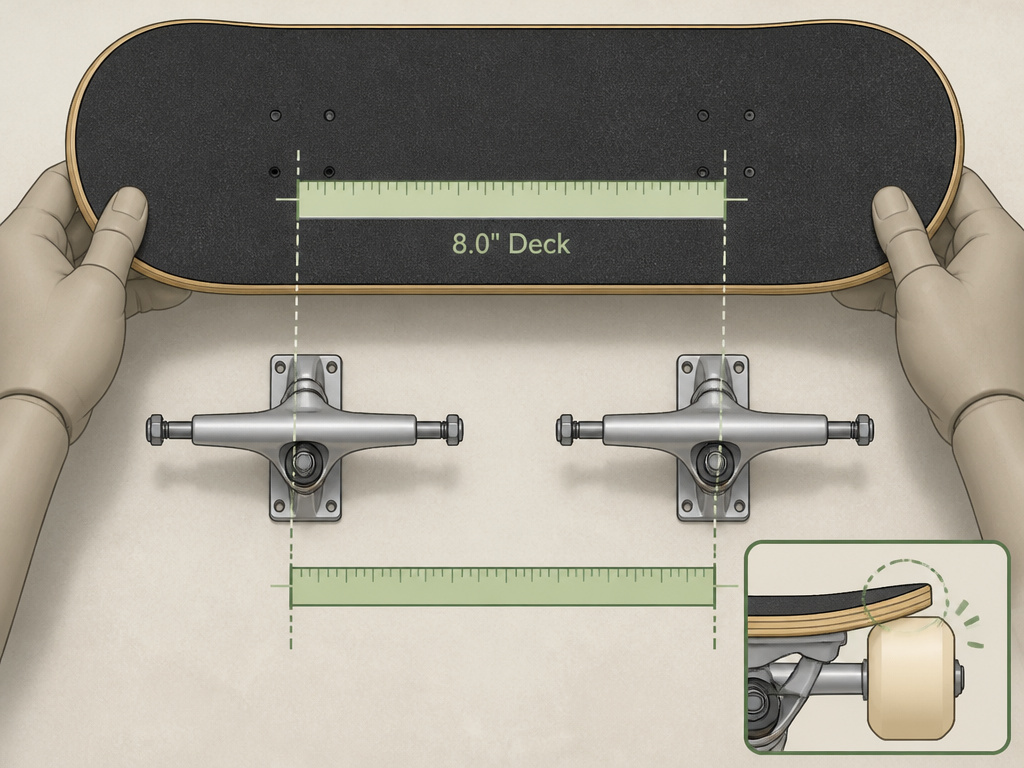
Your deck width decides your truck size. Get this wrong and the board will feel off, either twitchy or unresponsive. The rule from manufacturers is straightforward: your truck axle width should be within about a quarter inch of your deck width.
For an 8.0″ deck, you’d look for trucks with an axle width labeled for 8.0″ decks. Pairing a wide deck with narrow trucks hurts your balance and can cause wheel bite, when the wheel touches the deck during a turn, throwing you off. The U.S. Consumer Product Safety Commission notes that keeping trucks properly tightened improves stability at higher speeds, and that starts with the right fit.
Wheels are the other half of the equation. The evo guide states the most common range for street and park is 50mm to 60mm, with beginners advised to start in the middle at 54-55mm. Here’s how it ties together:
Smaller wheels (50-53mm) are slower and get caught on cracks more easily, which is frustrating when you’re just learning to push. Larger wheels add speed and smoothness but also raise your ride height. Stick to the middle of the range initially. You can always change wheels later.
The CPSC skateboarding safety fact sheet emphasizes checking your equipment before each session. Loose trucks or mismatched hardware are a real hazard. Speaking of hardware, the most common bolt size is 7/8″ for setups without riser pads. You’ll need a 3/8″ socket tool to tighten them.
What About Deck Length, Concave, and Other Specs?
Deck width gets all the attention, but length and concave shape influence feel, too. For adult beginners, these are secondary concerns, but knowing the basics prevents surprise.
Most standard street skateboards have a deck length between 28 and 33 inches. As the Element guide says, length has far less impact on your skating than width does. A very tall rider might prefer a deck at the longer end of that range (like 32.5″) for a more comfortable stance, but a difference of an inch or two won’t make or break your learning curve. The wheelbase, the distance between the inner truck mounting holes, is a subset of length and affects how quickly the board turns. A shorter wheelbase feels twitchier; a longer one feels more stable. Most complete boards come with a standard, middle-of-the-road wheelbase.
Concave is the curve from edge to edge of the deck. A deeper concave gives you more locked-in feel for flip tricks and carving. A mellow concave is more forgiving for foot placement. As a beginner, you likely won’t notice the difference until you’ve ridden for a few weeks. When you do start to notice, you’ll have a preference. Until then, don’t sweat it.
If you’re curious about the specifics, our deck length guide covers this in detail. The main thing is to not let these specs paralyze you. Pick a complete skateboard from a brand like Element or Real in your target width, such as an 8.0″ complete, and you’ll get a coherent, rideable setup where all these parts already work together.
Cruiser, Longboard, or Standard Skateboard?
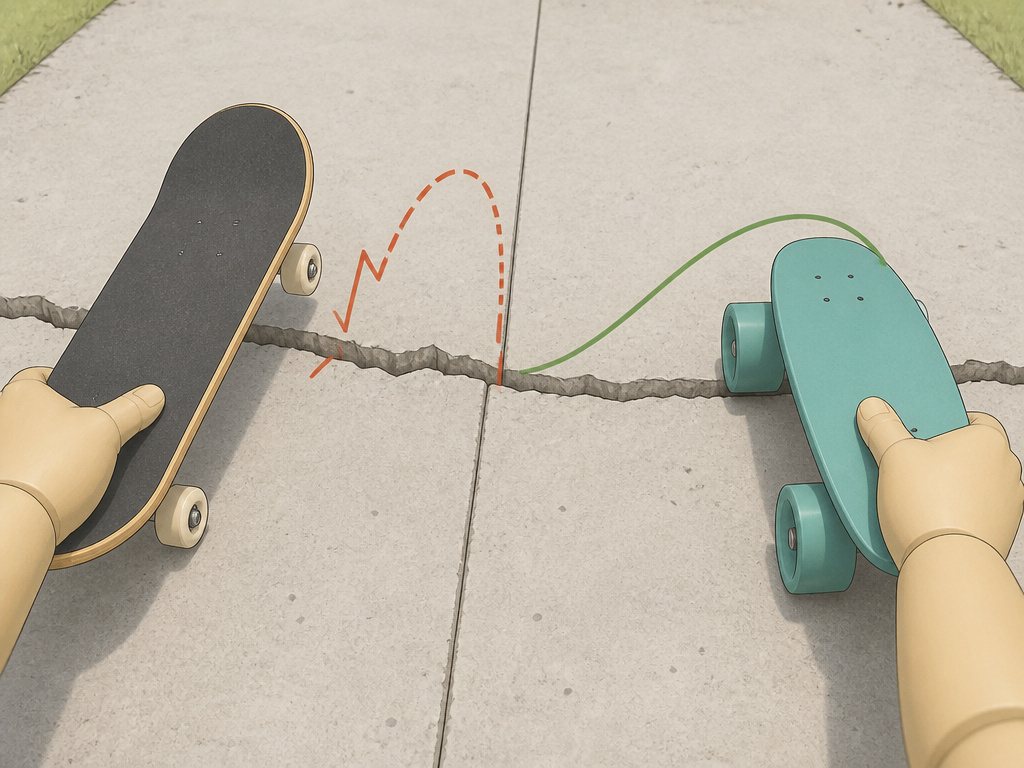
Adults often ask about skateboard size because they want a board for transportation, not tricks. This is a crucial distinction. A “cruiser” skateboard is built for smooth, comfortable riding over distance. It typically has a wider, often shaped deck, much larger and softer wheels (60mm+), and sometimes a kicktail for maneuvering.
A standard skateboard (a “popsicle” deck) is built for tricks. Its smaller, harder wheels are for park and street performance, not comfort on rough asphalt. Trying to use a standard skateboard as a daily commuter over cracked sidewalks is a bumpy, slow affair.
If your goal is purely transportation, a dedicated cruiser or a small longboard is a better fit. These boards use different sizing conventions, often measured by full length (like 30″ or 33″) rather than just width. The medical guidelines from the American Academy of Orthopaedic Surgeons guide stress using appropriate protective gear, which is just as important for a commuter as for a trick skater.
For adults who want to learn tricks and also cruise around, one approach is to get a standard skateboard and a second set of larger, softer wheels to swap on for longer rides. This is cheaper than buying two complete boards and teaches you how to maintain your gear.
How body height/weight influences size choice
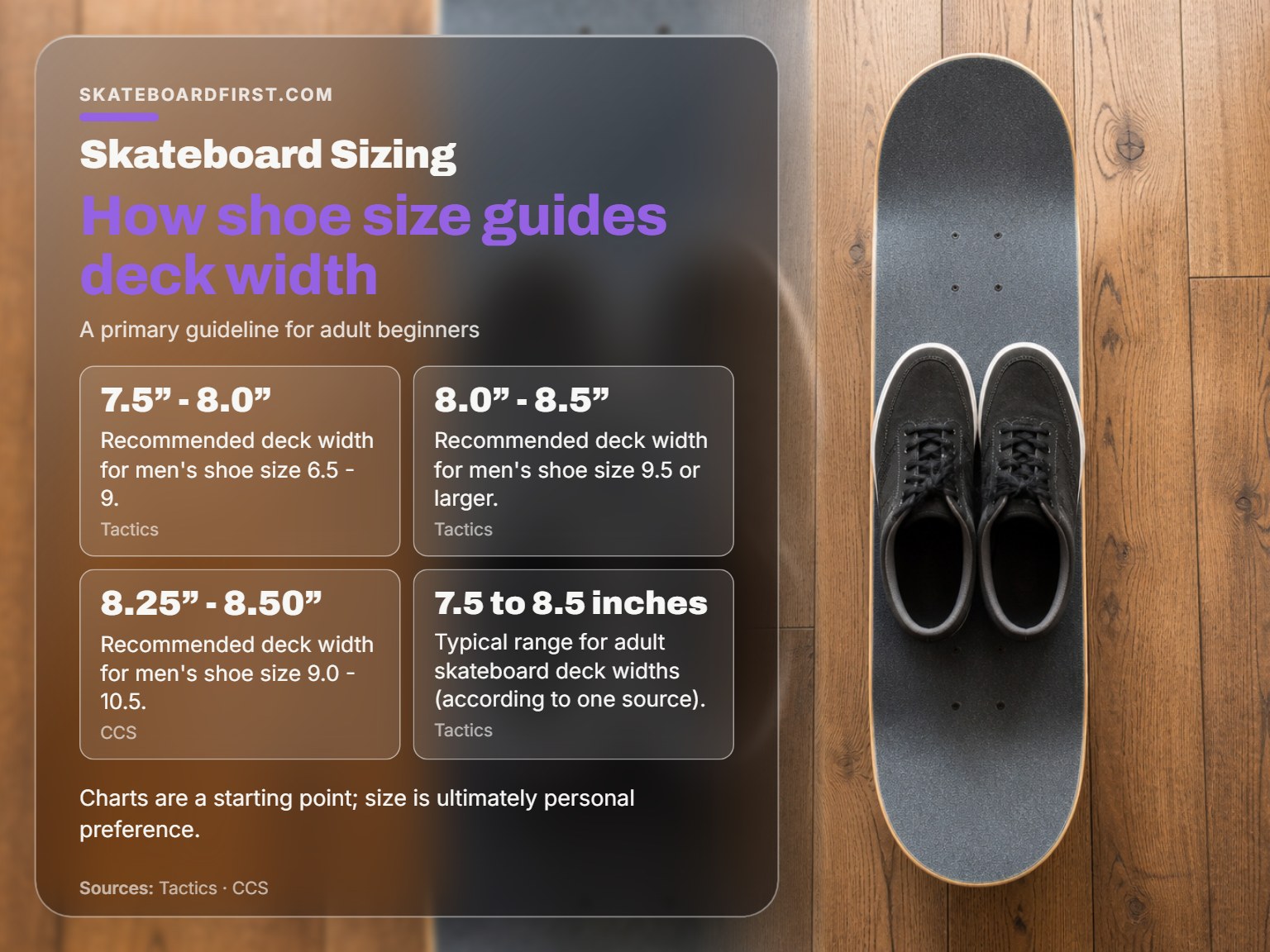
Your physical build guides your deck choice, but shoe size is the most common starting point. Most sizing charts use your shoe size to recommend a deck width range. A larger foot size generally correlates with needing a wider deck for comfortable foot placement and control. Your height and weight can reinforce this choice; a taller or heavier rider often benefits from the increased stability of a longer or wider board. However, this is a guideline, not a rule. The goal for the skateboard size for adults is to find a board where your back foot covers the tail comfortably, with your toes near one edge and your heel near the other.
Frequently Asked Questions
What is the adult size skateboard?
There is no single adult size. The most common range for adult men is a deck width between 8.0″ and 8.5″. For women, it’s often between 7.75″ and 8.25″. Your shoe size, height, and preferred skating style refine this range to your personal best fit.
Is an 8.25 skateboard too big?
For most adults, an 8.25″ skateboard is a very popular size that offers a great balance of stability for learning and enough flick for tricks. It might feel a bit slower to flip than an 8.0″ deck, but many skaters prefer the extra landing room and control.
Is a 31 inch skateboard for adults?
Yes, a 31-inch skateboard length is common and suitable for adults. Deck length matters less than width. Most standard decks fall between 31″ and 32.5″ long. A 31″ deck is on the shorter side, which can feel more maneuverable, while lengths up to 33″ offer a more stable platform.
How long should my skateboard be if I’m 5’7″?
At 5’7″, you have a wide range of suitable deck lengths. A deck between 31.5″ and 32.5″ long would be a typical, comfortable fit. Your shoe size and whether you prefer a narrower or wider stance are more important factors than your height alone.
Should I get a 7.75 or 8.0 skateboard?
If you’re an adult beginner, choose the 8.0″ skateboard. The 7.75″ width is better suited for younger skaters, very small feet, or experienced skaters who want maximum flick speed for technical flip tricks. The 8.0″ provides noticeably more stability, which is valuable when you’re starting.
Before You Go
Ignore anyone who says you must pick a deck based on a formula. The guides from CCS, Tactics, and Opera all end with the same line: it’s personal preference. Their charts get you close, but your feet and your goals make the final call.
If you’re stuck between an 8.0″ and an 8.25″ deck, get the 8.25″. The tiny bit of extra stability will help you more in the first month than the tiny bit of extra flick speed will hurt you. You can always go narrower on your next deck. The most common mistake isn’t picking the “wrong” size; it’s picking a size based on a pro’s setup instead of your own needs.
One actionable step: if you can’t visit a shop, trace your shoe on a piece of paper, measure the width in inches, and compare it to deck widths online. If your foot measures close to 8 inches wide, you have your answer. Then, go find a deck you like the look of in that size. The excitement to ride a board you think looks cool is a real, tangible part of learning. Start there.
