
Skateboard Size for Height and Weight: How to Choose
This post contains affiliate links. As an Amazon Associate, we earn from qualifying purchases.
Skateboard size for height and weight starts with two official weight classes: Class A for riders 20-100kg (~44-220lbs) and Class B for riders 20-50kg (~44-110lbs). For a stable start, most adult beginners should choose a deck between 8.0 and 8.5 inches wide, matching truck axle width to the deck, and use wheels in the 54-55mm range.
That classification comes from the TY/T 3801.1-2024 sports standard and ROCES product documentation. It’s a safety ceiling, not a fitting guide. Your feet still need room on the board, and your riding style decides how nimble or planted the deck feels.
What follows: the official weight rules, why retailer size charts disagree, how to match trucks and wheels to your build, and the one adjustment that stops speed wobble before it starts.
Key Takeaways
- Official standards classify boards by rider weight (Class A: 20-100kg, Class B: 20-50kg), a safety baseline many guides miss.
- For adult beginners, a deck width between 8.0 and 8.5 inches offers the best balance of stability and control, regardless of precise height.
- Always match truck axle width to your deck width; a mismatch hurts balance and wheel clearance.
- Wheel size matters for comfort: beginners should start with 54-55mm wheels for a smoother ride over cracks.
- Speed wobble often comes from loose trucks and a rear-weighted stance; tightening trucks slightly and leaning forward calms it down.
Official Weight Classes vs. Personal Preference
The TY/T 3801.1-2024 Chinese sports standard and ROCES documentation citing EN13613:2009 both specify weight classes, but with different definitions: TY/T 3801.1-2024 defines Class A for 20-100kg and Class B for 20-50kg, while ROCES defines Class A for up to 100kg and Class B for up to 50kg. If you see a board marked Class B, it’s engineered for a younger or lighter rider.
The TY/T 3801.1-2024 standard defines skateboard classification by user weight: Class A for 20-100kg, Class B for 20-50kg. This provides a manufacturer safety rating for load capacity, distinct from fit or performance guidelines.
That’s a safety rating, not a sizing chart. The American Academy of Orthopaedic Surgeons notes that “some [skateboards] are rated for the user’s weight,” but most buying guides treat size as pure preference. Retailers like Tactics.com explicitly say deck sizing is “no exact science” and encourage experimentation. So you have a safety ceiling on one side and a world of personal taste on the other.
Where does that leave you? Start with the ceiling. If you weigh over 100kg (220lbs), you should ensure your board meets a Class A rating. Then ignore the class label and focus on deck width, which is where your height and shoe size come in.
Deck Width: The Shoe Size Debate
Deck width is the measurement across the board, usually between 7.7 and 9.0 inches for standard street boards. It’s the main number in skateboard size charts, like this skateboard size chart. Your foot needs enough room to feel secure, but not so much that the board becomes cumbersome to flip, which is a key part of the skateboard size for height and weight consideration.
Here’s where sources disagree. Look at the recommendations for a men’s shoe size 9.5:
| Source | Recommended Deck Width | Notes |
|---|---|---|
| evo.com | 8.0 inches or more | For shoe size 9+ |
| Element Brand | 8.0 inches or more | For shoe size 9.5+ |
| Tactics.com | 8.0 to 8.5 inches | For shoe size 9.5 or larger |
The difference is small but telling. One uses shoe size 9 as the threshold, another uses 9.5. This is why I tell beginners not to fixate on the chart. These are starting points. A better rule is to visit a shop and stand on a few decks. You’ll feel the difference between an 8.0 and an 8.5 instantly. The wider deck feels more stable underfoot; the narrower one feels quicker.
For adults, I lean toward the wider recommendation. A deck in the 8.0 to 8.5 inch range is a safe, middle-of-the-road choice for most men. If you’re looking for more precise guidance on skateboard size for adults, that’s the number I’d circle. For lighter adults or those with smaller feet, a 7.75-inch to 8.0-inch deck can work well for a more responsive board.
Common mistake: Choosing a deck based solely on shoe size without standing on it. Your stance width and personal balance matter more than the chart. A deck that’s too narrow for your stance will feel twitchy, especially when you’re learning to roll.
How Height and Weight Change the Setup
Height and weight don’t directly dictate deck width, but they change the forces on your board, making the skateboard size for height and weight a dynamic equation. A taller, heavier rider puts more force and stress on the board. That doesn’t mean you need a massive deck, but it does mean you need to pay attention to your truck and wheel choices.
For heavier riders (over 90kg / 200lbs):
A wider deck (8.5 inches or more) provides a more stable platform. More importantly, you need durable trucks. Quality trucks from reputable brands handle the stress better. You might also consider a skateboard setup for heavy riders that includes harder bushings to prevent the board from feeling too squirrely under your weight. Softer wheels can also absorb vibration better, making rough pavement more comfortable.
For lighter riders (under 60kg / 130lbs):
You have more flexibility. A narrower deck (7.75 to 8.25 inches) is easier to flick for tricks. You can use standard bushings and might prefer a slightly softer wheel for grip without sacrificing too much speed. The main advantage is that you can often get away with a lighter, more responsive setup. If you’re a very light adult beginner, our guide to a skateboard setup for light riders covers the specifics.
The CPSC fact sheet notes that “longer boards increase stability” and “boards with wider hangers (axle width) give riders greater control.” This is crucial for taller riders. Taller riders may want to consider a deck with a longer wheelbase (the distance between the trucks). This gives you more room for your feet and makes the board feel less twitchy at speed. You don’t need a longboard, but avoiding the shortest wheelbase options helps.
Matching Trucks and Wheels to Your Size
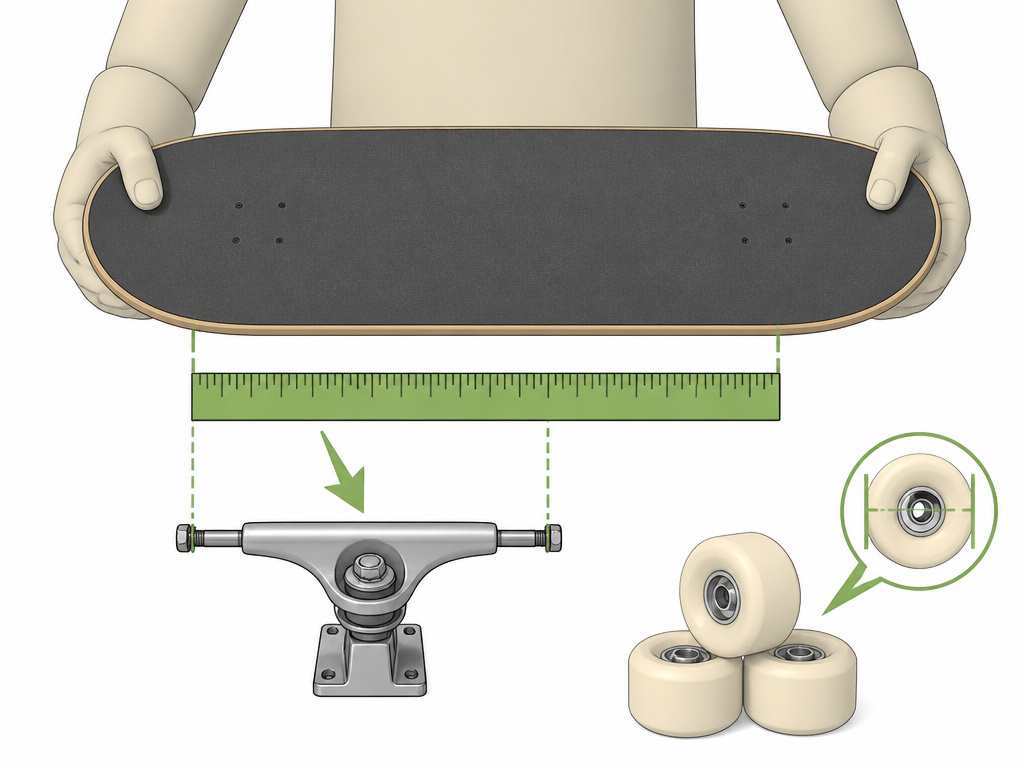
Your deck is just the platform. The trucks and wheels determine how it handles your weight. This is the step most beginners skip, and it’s the reason two people with the same deck can have completely different experiences.
Truck Width Rule: Match the truck axle width to your deck width. If you have an 8.25-inch deck, get trucks with an axle width around 8.25 inches. Most truck manufacturers size their trucks by axle width. A mismatch causes problems. Trucks that are too narrow reduce stability and make the board prone to wheelbite (the wheel rubbing against the deck). Trucks that are too wide make the board heavier and less nimble.
Wheel Size for Beginners: Wheel diameter is measured in millimeters. For street and park skating, the most common range is 50mm to 60mm. Beginners should start in the middle, around 54-55mm. Why? Smaller wheels (50-52mm) are lighter and better for technical tricks but get caught on cracks more easily. Larger wheels (56mm+) roll faster and smoother but add weight and height. That 54-55mm sweet spot gives you a bit of smoothness without sacrificing too much pop. If you’re a heavier rider, a 56mm wheel can handle rough ground better.
Hardware and Bearings: These are less about your size and more about proper assembly. Hardware (the bolts) comes in 7/8 inch (for no riser pads) or 1 inch (for 1/8 inch risers) lengths. Any decent brand works. Bearings are the same—avoid the cheapest, but you don’t need ceramics. A mid-range bearing will spin fine for years.
The 3-Step Fit Check Before You Buy
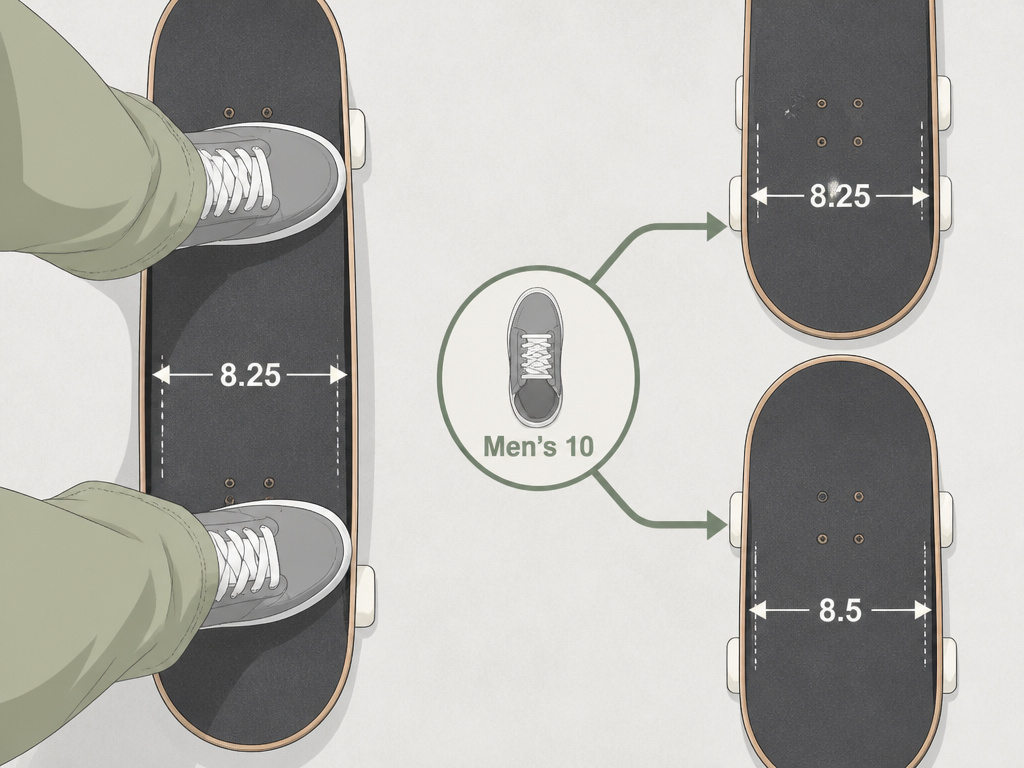
You can read every deck size chart online, like this deck size chart, but your body will give you the final answer. Do these three checks, in order.
- Weight Check: Confirm your weight falls within the board’s class rating (Class A or B). This is a safety must-do.
- Stance Test: Go to a shop. Stand on a deck in your natural skating stance. Your feet should be near or on the bolts, with your toes and heels not hanging off the edge excessively. You should feel balanced, not cramped or stretched.
- Component Match: Verify the truck axle width matches the deck width. Check that the wheel size (52-56mm for beginners) and hardness suit the terrain you’ll skate most.
If you can’t visit a shop, use your shoe size as the initial filter, then lean toward the wider option within that range. For example, if you wear a men’s size 10, start with an 8.25-inch or 8.5-inch deck. This method works well for measuring a skateboard when you buy online, as shown in the guide on how to measure for a skateboard.
What Most People Get Wrong About Stability
Stability isn’t just about deck width. It’s about how all the parts work together under your weight. The most common mistake I see is a rider choosing a wide deck but pairing it with narrow trucks or wheels that are too small. The deck feels dead and unresponsive, or it gets speed wobble easily.
Speed wobble is that terrifying shimmy that happens when you’re going downhill or fast. The CPSC fact sheet explains it happens when a board “begins to shimmy from side to side unexpectedly.” The fix isn’t just a wider deck. It’s truck tightness and stance.
Trucks that are too loose for your weight will wobble more. If you’re a heavier rider, you might need to tighten your kingpin nut a quarter-turn more than a lighter friend. More importantly, your stance matters. If your weight is too far back on the board, the front truck can become unstable. Leaning forward slightly, bending your knees, and keeping your weight centered over the bolts increases stability dramatically.
Where this goes sideways: Ignoring truck tightness. Loose trucks might feel cool for turning, but if you’re over 180lbs and your trucks are floppy, you’ll get speed wobble on any slight decline. Tighten them just enough so you can still turn comfortably, but the board doesn’t shake when you stand on it.
Skateboard size charts for height, age, and shoe size
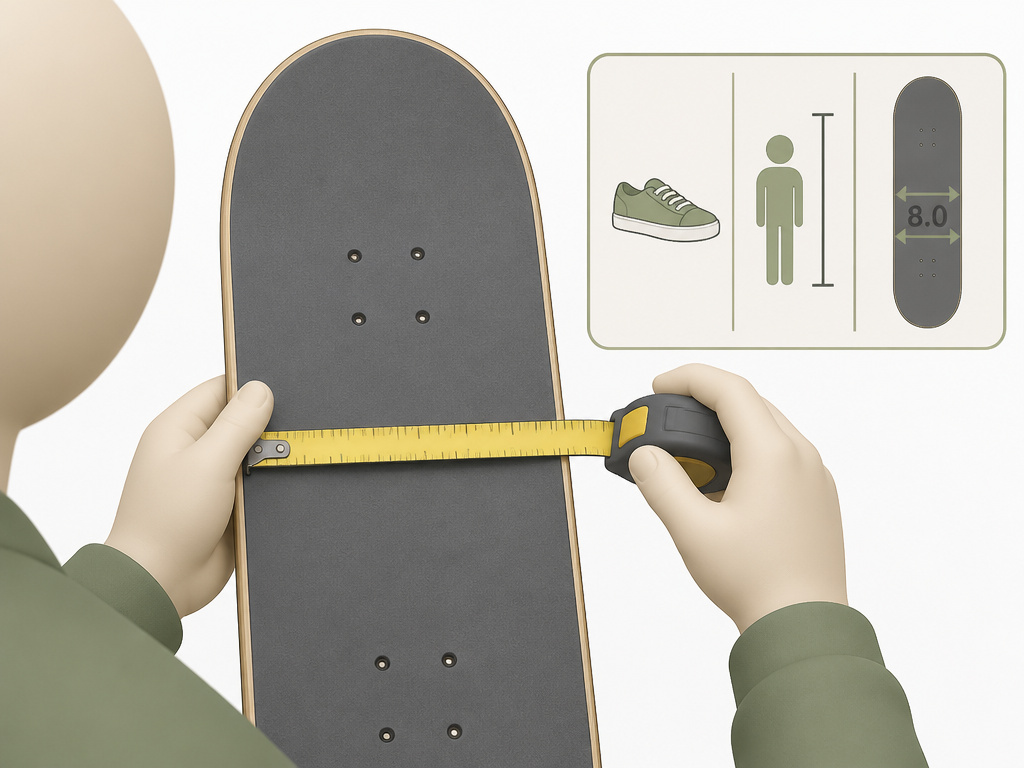
General sizing charts from retailers offer starting points based on common correlations. For adults, a men’s shoe size of 9 or 9.5 often aligns with a deck width of 8 inches or more. For younger riders, suggestions vary: some sources suggest decks ≤7″ for age 8 or younger, while others suggest decks around 7-7.375″ for children under age 6. These charts provide a useful baseline, but they are not strict rules. Multiple guides emphasize that sizing is largely a matter of personal preference and comfort, encouraging riders to try different setups to find what feels best for their stance and control.
Choosing a skateboard size for street skating or transition
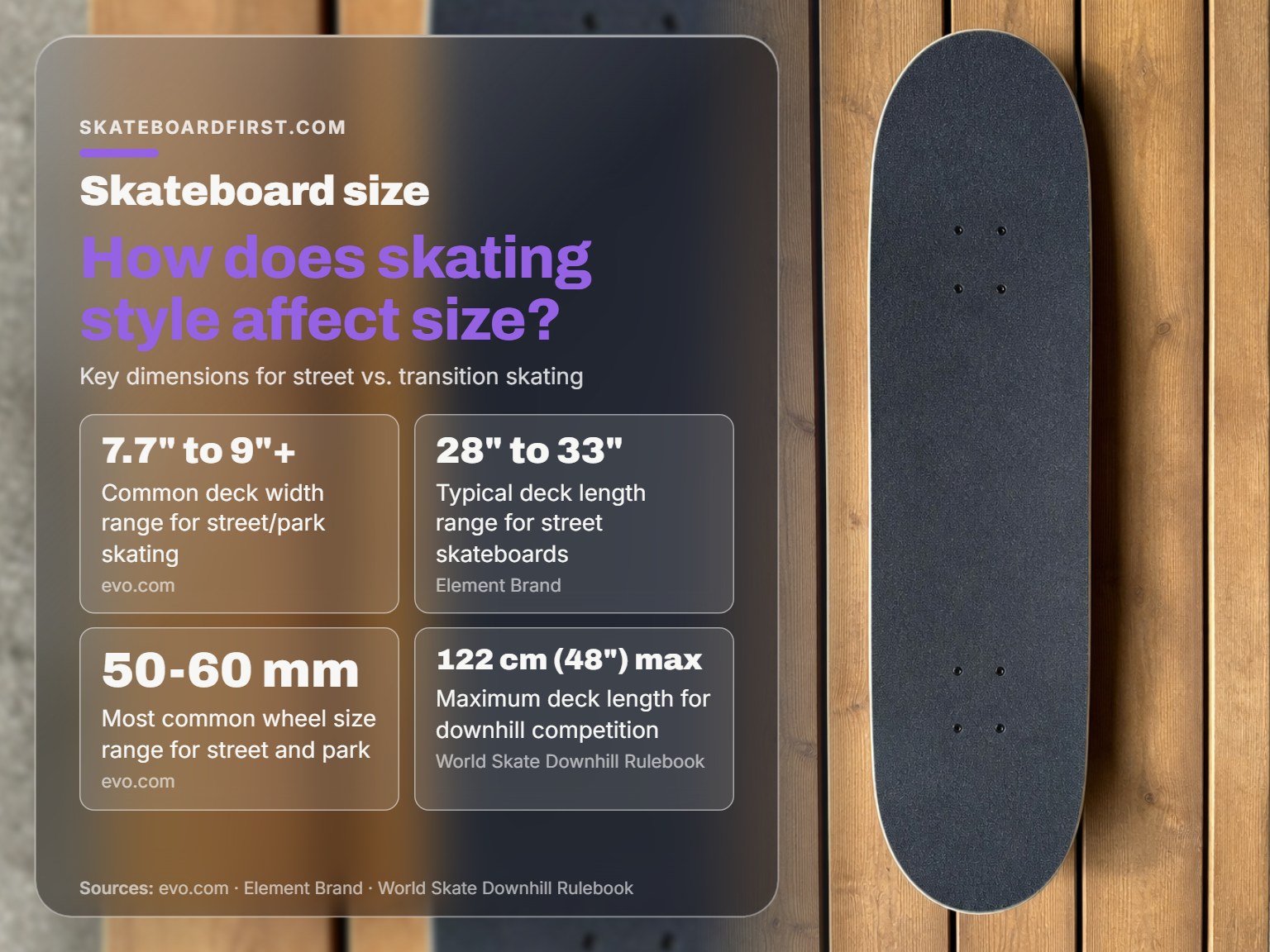
Your primary style of skating guides your size choice. For technical street skating involving flip tricks, a narrower and lighter deck offers quicker flick and response. For transition skating in bowls and ramps, a wider deck provides more stability and surface area for landing. Longer boards also increase stability, a trait beneficial for higher speeds. While competition rules for disciplines like downhill specify exact maximum dimensions, for most street and park skating, the choice revolves around this trade-off between maneuverability and control based on where you’ll ride most.
Frequently Asked Questions
What size skateboard do I need for my height?
Height is a secondary factor. Primary factors are weight (for safety class) and shoe size (for deck width). A good rule for adults between 5’4″ and 6’2″ is to start with a deck between 8.0 and 8.5 inches wide. Taller riders within that range might prefer the wider end for stability.
Is an 8.25 skateboard too small?
For most adult beginners, an 8.25-inch deck is not too small. It’s a very popular, do-everything size. It might feel narrow if you have very large feet (size 12+), but for the average adult foot (size 9-11), it’s an excellent starting point that works for both street and park skating.
How long should my skateboard be if I’m 5’7″?
Deck length matters less than width. Most street skateboards are between 28 and 33 inches long. At 5’7″, any deck in that range will be fine. Focus on finding a width you’re comfortable with; the length will follow. A very short board might feel twitchy, while a very long one might feel sluggish for tricks.
What if I’m overweight and want to start skateboarding?
First, check the weight class. Look for a Class A board (rated for up to 100kg / 220lbs). Start with a wider deck (8.5 inches or more) for stability. Prioritize a setup with strong trucks and consider softer, larger wheels (56mm+) for a smoother ride. Our guide on skateboarding for overweight beginners covers the specifics, including gear choices and initial exercises.
Does deck width for shoe size really matter?
It’s a useful starting point, but it’s not a law. The goal is to have enough board under your feet to feel secure. If you have smaller feet, a narrower deck might feel fine. If you have larger feet, a wider deck provides more security. Use shoe size to narrow down options, then let your personal feel on the board make the final call. For a deeper dive, see our article about deck width for shoe size.
The Bottom Line
Start with the safety rule: know your weight class. Then, for your first board, pick a deck width between 8.0 and 8.5 inches. Match your truck axle width to that deck. Add 54-55mm wheels. That’s the baseline setup that works for the vast majority of adult beginners.
The what size skateboard question has no single answer, but it does have a reliable process. Your perfect size is the one that feels stable when you roll and responsive when you want to turn. It’s okay if your first deck isn’t perfect. You’ll learn what you like. The next one will be closer.
