
How to 50-50 Grind on a Skateboard: Step-by-Step
This post contains affiliate links. As an Amazon Associate, we earn from qualifying purchases.
To 50-50 grind on a skateboard, you need a solid rolling ollie, approach a low ledge at a slight angle, ollie onto it with both trucks landing evenly, maintain a balanced stance over your trucks with knees bent, and exit by shifting your weight back to lift the front truck off or by riding off the side. The speed of your approach dictates the length of your grind, and a well-waxed ledge makes the slide smoother.
Most guides, like Skateboards.com and Rad Rat Video, agree on a slight angle when explaining how to 50-50 grind on a skateboard. Most sources, like Skateboards.com and Rad Rat Video, advise a slight angle, while some may imply a more direct approach. That angle isn’t just stylistic, it’s the mechanical difference between a clean lock-on and your back truck bouncing off the curb. Getting it right means understanding how your board’s momentum interacts with the edge.
What follows: the three essential prerequisites, the step-by-step breakdown that reconciles conflicting advice, the sensory cues that tell you it’s working, and the most common failure modes, plus how to fix them before you even step on the board.
Key Takeaways
- Approach at a slight angle, not straight on, to help your back truck lock onto the ledge cleanly, a parallel approach often causes the tail to bounce off.
- Rad Rat Video suggests metal coping doesn’t need much wax but to apply a fresh coat anyway, while LiveAbout recommends wax if the ledge or rail is too rough.
- Bend your knees deeply and keep them bent through the entire grind; staying low keeps your center of gravity over the trucks and prevents the board from sticking or slipping out.
- Skateboards.com advises shifting weight back and lifting the front truck, while skatedeluxe notes you can also come off at the end or off the side.
- Start on a low ledge and master the stall, landing with both trucks on the obstacle without sliding, before adding speed for the grind.
What You Need Before You Even Try
You can’t build the second floor without a foundation. For a 50-50, that foundation is a reliable, rolling ollie. Not a stationary one where you land awkwardly, but one you can do while moving at a comfortable pace. The Rad Rat Video tutorial is blunt: you need to be able to ollie higher than the curb you’re aiming for. If you can’t clear the height, you’ll slam into the face of the ledge every time.
Before you start: A 50-50 grind involves sliding on a hard surface. Wear your helmet and wrist guards. A stalled grind can stop the board dead, pitching you forward onto concrete. That’s not a maybe, it’s the default outcome for the first two dozen attempts.
Beyond the ollie, there’s a related skill most tutorials treat as optional: noseslides. The Rad Rat Video source argues they “help quite a bit for the sake of getting comfortable with sliding, but they aren’t completely required.” I’d sharpen that: if you can comfortably land and hold a noseslide on a low ledge, you’ve already solved the scariest part of a 50-50, committing your weight over the front truck while moving. It’s a huge confidence shortcut. If noseslides feel miles away, don’t sweat it. A solid ollie is the absolute must-have.
Your setup matters for learning how to 50-50 grind on a skateboard, but not in the way you might think. You don’t need the hardest durometer wheels or the loosest trucks. You need a board that feels familiar. If you’ve been learning on an 8.0″ deck, now isn’t the time to switch to an 8.5″. Consistency in your equipment removes one variable from an already tricky equation.
The Step-by-Step Approach
Here’s where the sources disagree on how to 50-50 grind on a skateboard, and you need to know why. Some guides, like the one from LiveAbout, tell you to “move forward on your board, picking up as much speed as you can” and aim right at the start of the ledge. Others, like Skateboards.com and skatedeluxe, specify an approach “at a slight angle, almost parallel.”
The direct approach looks right in your head. In practice, it often makes your tail clip the ledge as you ollie up. The board rotates slightly in the air, and you land crooked. The slight angle allows your back truck to swing up and onto the ledge more naturally. It uses the board’s width to your advantage.
| Step | Action | Key Detail (Why-Layer) |
|---|---|---|
| 1. Approach & Set-Up | Roll towards the ledge at a comfortable speed, approaching at a slight angle. | The angle helps your hips and shoulders align with the board’s length, making the ollie motion more of a lift than a hop to the side. |
| 2. The Ollie | Pop your ollie, aiming to get both trucks over the ledge, not just onto it. | You need clearance. Ollieing higher than the ledge ensures the trucks land on top, not into the face, which stops the board instantly. |
| 3. Landing & Lock-In | Land with your feet over the bolts, knees bent, shoulders aligned with the board. | Skateboards.com stresses keeping “your shoulders aligned with the board and look ahead, not down.” Looking down pulls your weight forward, a sure way to stick and fall. |
| 4. The Grind | Stay low and balanced as you slide. | skatedeluxe notes your feet should be “on top of each truck” with your “back foot slightly towards the tail” for control. |
| 5. The Exit | As you reach the end, shift weight back slightly and lift the front truck. | Skateboards.com says this “lift the front of the board” action is how you pop off cleanly. skatedeluxe adds you can also “come off at the end of the ledge or off the side.” |
The grind itself should sound like a low, gritty hiss, not a loud screech. A screech usually means you’re leaning too far forward or back, putting pressure on the edge of the hanger instead of the center. That’s the sound of friction fighting you, it’ll stop the slide fast. A grind that feels like the board wants to keep moving is a sign of proper technique.
Wax, Ledges, and the Right Obstacle
Not all ledges are created equal. A rough, concrete curb that hasn’t been skated is a grind killer. This is where wax comes in. LiveAbout says wax “lets you grind smoother and quicker,” and it’s optional. Rad Rat Video says “wax the curb up a lot,” but adds a crucial edge case: “If it’s metal coping, it doesn’t need much. But put a fresh coat on it anyway.”
Where this goes sideways: Waxing a metal coping as heavily as a concrete ledge. The metal is already slick; too much wax creates a layer so slippery your trucks can’t bite, causing you to slide out unpredictably. A light coat is plenty.
Your first obstacle should be a low ledge. LiveAbout explicitly recommends “using a ledge, rather than a rail” for learning. The reason is width. A ledge gives you a margin for error left and right; a rail is a thin line of metal. Fall off a ledge, you might stumble. Fall off a rail, you’re hitting the ground from a higher pivot point. Master the 50-50 grind on a ledge before even thinking about transferring the skill to a grind a rail.
If you don’t have a suitable ledge or rail nearby, consider a DIY project. Building a practice ledge or a DIY grind rail gives you control over the height and waxing perfectly, turning practice into a repeatable drill.
Common Mistakes and How to Fix Them
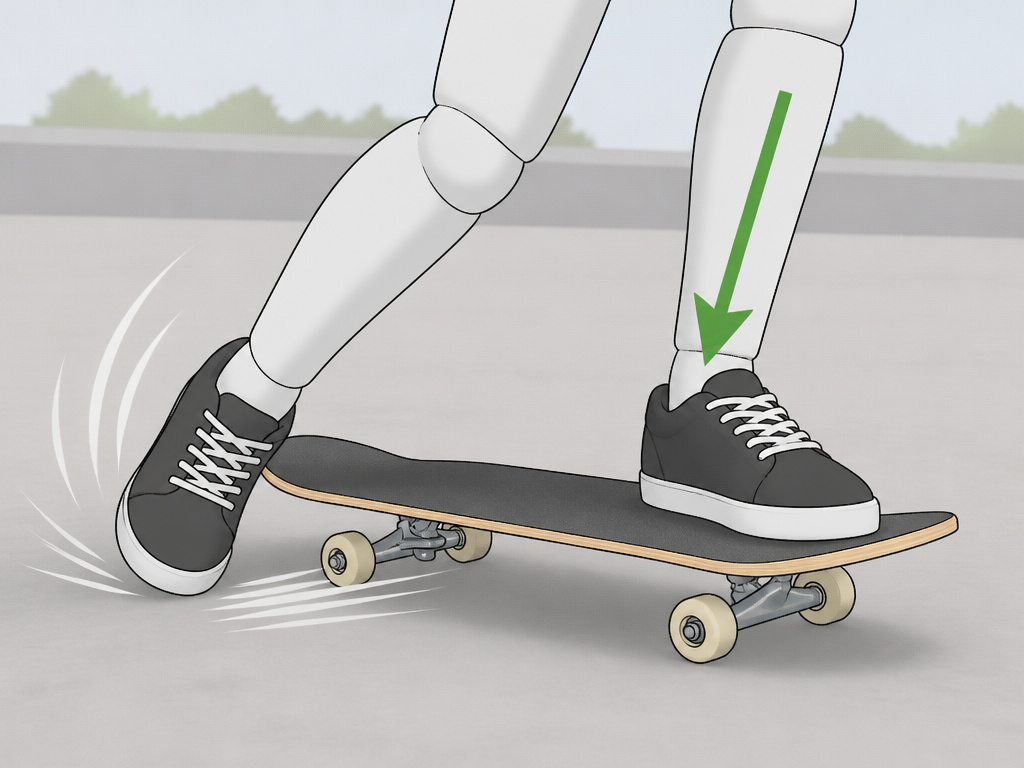
You will make these errors. Everyone does. Knowing what’s happening physically helps you correct it on the next try.
Mistake 1: The board stops dead on the ledge.
- Cause: You’re going too slow, or you didn’t ollie high enough. LiveAbout states plainly: “If you are going too slow, your board just stops and doesn’t grind.”
- Fix: Add a bit more speed. The physics is simple, more momentum equals a longer slide. Also, consciously aim your ollie to clear the ledge’s top. Visualize landing on it, not into it.
Mistake 2: You land crooked and immediately fall off.
- Cause: Your shoulders aren’t aligned with the board. As you ollie, you’re twisting your upper body to look at the ledge.
- Fix: This is where the “look ahead” advice is gold. Pick a spot at the end of the ledge or just beyond it and stare at it during your approach, ollie, and grind. Your body will follow your gaze.
Mistake 3: The board slips out from under you mid-grind.
- Cause: Incorrect weight distribution. Are you leaning back? The skatedeluxe guide warns against having your balance “too far back to avoid slipping.”
- Fix: Focus on keeping your weight centered directly over the bolts. A good drill is to practice stationary stalls on the ledge, finding the point where you can balance without the board wanting to tip forward or backward.
Mistake 4: You can’t commit to the exit and get stuck.
- Cause: Fear of the drop-off. Exiting a grind requires a small pop or a turn, which feels like you’re jumping off into space.
- Fix: Rad Rat Video suggests a workaround: “try grinding all the way to the end and dropping off.” Ride it off like a curb. Once that feels comfortable, the small pop of the front truck will feel less drastic. This is also the point where learning a 5-0 grind first can pay off, as it teaches precise control on the back truck.
Frontside 50-50s on Transition
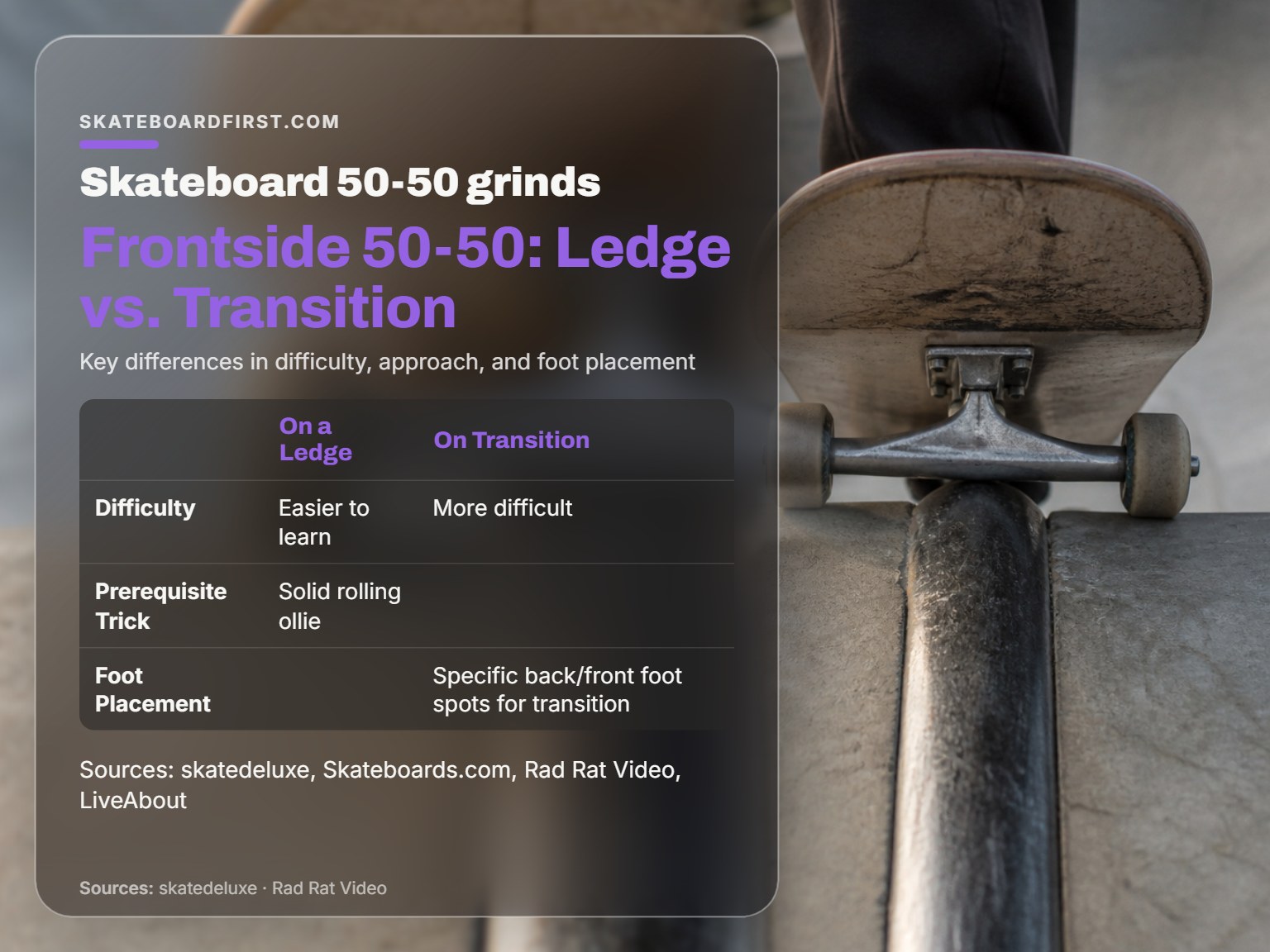
Once you’ve locked down 50-50s on a street ledge, the game changes on transition (ramps, quarter pipes). skatedeluxe points out a reversal: “Unlike ledge skating, this time Frontside 50-50’s are more difficult than Backside ones.”
The reason is visibility. On a ledge, you approach facing the obstacle (frontside). In a ramp, a frontside 50-50 means your back is to the coping as you grind, requiring a blind commitment and a different weight shift. The guide recommends being able to do Frontside 5-0’s first, as that trick teaches you how to lock your back truck onto the coping from that blind approach.
The foot placement is more specific too: “Put your back foot in the middle of your tail slightly closer to the bolts of your back truck, while your front foot should be placed between the middle of your board and the bolts of your front truck.” The exit is also distinct, you “lift your front truck off the coping by lifting up slightly on the back truck and come out of the grind, turn your hips, and leave the coping down into the ramp.”
Progression: What to Learn Next
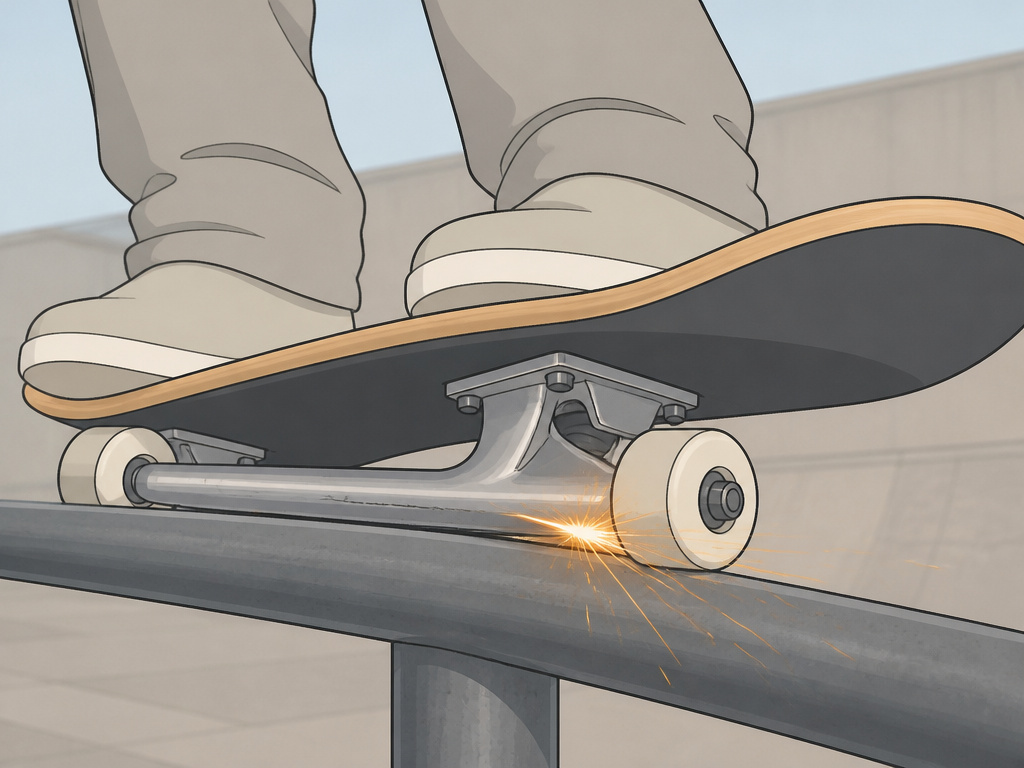
The 50-50 is your gateway. After it feels automatic on your favorite ledge, start varying it.
- Try it on a rail. Take the same mechanics to a practice rail. The feeling is different, more precise, less forgiving.
- Learn a 5-0. This is a backside grind on just your back truck. It builds directly from the balance you learned in the 50-50.
- Attempt a feeble grind. A feeble grind combines your front truck on the ledge with your back truck hanging off, teaching you how to manipulate each truck independently.
- Add style. Once the grind is solid, try exiting with a small kickturn, an ollie out, or even a shove-it. The 50-50 is a stable platform for these additions.
The most important progression rule isn’t about the next trick, though. It’s about practice structure. I used to grind on one trick for hours until I landed it. My legs would get shaky and my form would break down, so I wasn’t learning anything. Now I work in short rounds of about ten serious attempts and then take a break. Your brain needs the downtime to cement the muscle memory.
Frequently Asked Questions
Is a 50-50 grind the easiest grind?
Yes, it’s widely considered the most basic and foundational grind. It uses both trucks symmetrically, which is more stable than grinds that balance on one truck, like a 5-0 or nosegrind. It’s the logical first step after mastering a solid ollie.
How much wax should I use on a ledge?
Use enough to create a smooth, slick surface. For rough concrete, you may need several passes of a wax block. For smooth marble or painted concrete, less is needed. For metal coping, a very light coat is sufficient, over-waxing metal can make it too slippery to control.
Why does my board stop grinding after a few inches?
The two most common reasons are insufficient speed and poor weight distribution. You need enough momentum to carry the slide. Also, if you’re leaning too far forward or back, you create friction on one edge of the truck hanger, which acts as a brake. Focus on staying centered.
Can I learn a 50-50 grind without knowing how to noseslide?
Absolutely. Rad Rat Video notes noseslides help but aren’t required, while other sources only mention a solid ollie as a prerequisite. A consistent, rolling ollie is the only mandatory skill.
What’s the difference between a frontside and backside 50-50?
It depends on the obstacle. On a ledge, a frontside 50-50 means the obstacle is in front of you as you approach. A backside 50-50 means you turn your back to the obstacle as you ollie onto it. Most beginners find frontside easier on ledges because you can see what you’re grinding.
Before You Go
One rule most guides skip: if you haven’t landed a single 50-50 after thirty focused attempts in a session, stop. Go back to ollieing onto the ledge and holding a stall. The problem is almost always in the set-up, your speed, your angle, or your ollie height. No amount of trying the full trick will fix a broken approach. Drill the component.
Your next session, bring a block of wax. Find a low, smooth curb you can session alone. Your only goal is to land three 50-50 grinds where you hear that low hiss for at least two feet. Don’t worry about style, don’t worry about the exit. Just lock on and slide. That hiss is the sound of the trick working, and it’s the best feedback you’ll get. Everything else, longer grinds, bigger obstacles, stylish exits, builds from that one sound.
