
How to Fall on a Skateboard Safely: The 4-Step Drill
This post contains affiliate links. As an Amazon Associate, we earn from qualifying purchases.
To fall safely on a skateboard, follow the four-step sequence agreed upon by the U.S. Consumer Product Safety Commission, National Safety Council, and other major safety bodies: crouch down to reduce fall height, aim to land on fleshy body parts like your thigh or shoulder, roll to dissipate force, and relax your muscles to avoid breaks. This technique cuts injury severity, but it must be practiced on grass until it’s automatic.
The goal is to spread the impact across distance and softer tissue, which transfers force away from a single joint. This is the core principle of how to fall on a skateboard safely.
What follows: the exact drill, the gear that actually works (and what’s overhyped), and the two common situations where the standard advice fails unless you see them coming.
Key Takeaways
- Practice the crouch-roll-relax sequence on grass before skating on concrete; muscle memory is the only thing that works at speed.
- A certified skateboarding helmet cuts traumatic brain injury risk by 45%, but it must fit snugly and be level on your head.
- Wrist guards protect against the most common skate injury, broken wrists from outstretched arms, while evidence for elbow and knee pads is thin.
- More than half of fall injuries start with irregular pavement; scan ahead and avoid streets, sidewalks, and parking lots.
- Speed wobble throws you before you can react; mitigate it by crouching low, riding forward, and keeping trucks properly tightened.
The 4-Step Fall Drill Everyone Agrees On
The CPSC, National Safety Council, and Parachute prescribe similar actions for falling safely. They work because each step solves a specific physical problem.
If you feel like you’re about to lose control, crouch down so you don’t have as far to fall. Try to land on the fleshy parts of your body. Try to roll rather than absorbing the force with your arms. Try to relax your body rather than going stiff. Practice falling on a soft surface or grass. . National Safety Council guidelines
Crouch down. This focuses on reducing the distance your head and torso travel toward the ground. Land on fleshy parts. Your thigh, butt, or shoulder has muscle and fat to absorb and distribute force. Your wrist, elbow, or knee is a bony lever that snaps. Roll. Converting a direct impact into a rolling motion spreads the force over a longer time and across a larger surface area. Think of it as skidding a bike tire instead of slamming it into a wall. Relax. Tense muscles are brittle. A relaxed limb can bend and move with the impact, which is why drunks sometimes walk away from crashes, their floppiness is a terrible life strategy but an effective impact buffer.
Your First Practice Sessions
Find a patch of grass. Wear your helmet and any pads.
- Crouch and Drop. From a standing position, crouch low and let yourself tip sideways onto your thigh and shoulder. Don’t put your hands down. Do this ten times, alternating sides. The goal is to bypass the arm-catch reflex.
- Add the Roll. From the crouch, tip and immediately roll over your shoulder onto your back. Let the momentum carry you. If you feel a jarring stop, you’re not relaxed enough.
- Simulate a Pitch. Kneel on the grass, then lean forward as if the board shot out. Practice landing on your forearms (with wrist guards on) and rolling.
- At the Skatepark. Before your session, take two deliberate falls on the flatground. It reboots the muscle memory. I do this every time I skate a new park, it feels silly but it works.
That’s how the National Safety Council documented 71,023 emergency room visits for skateboarding injuries in the 15–24 age group in 2024.
Gear That Actually Helps (And What’s Overhyped)
Safety gear is a force multiplier for good technique, specifically the technique of how to fall on a skateboard safely. It is not a replacement for it. The right gear works with the fall drill; the wrong gear gives false confidence.
| Gear | What It Does | Critical Spec | If You Skip It |
|---|---|---|---|
| Skateboarding Helmet | Cuts risk of traumatic brain injury by 45% (Parachute). Covers more of the back of the head for multi-impact. | Hard shell with foam interior, snug fit with fastened chin strap (CPSC). Must be level, not tilted back. | A loose helmet can come off on impact. A bike helmet isn’t rated for multiple skate crashes. |
| Wrist Guards | Absorb shock and prevent the wrist from bending back. Protect against the most common injuries: broken bones and sprains (Parachute). | Rigid splint on the palm side, secure strap system. | Outstretched arms bear full body weight. The wrist hyperextends, and the small bones in the forearm take the hit. |
| Elbow/Knee Pads | May protect from abrasions and direct impacts. | Little research to show they are effective at preventing serious injury (Parachute). | Can create a false sense of security, leading to harder falls. The joint can still twist or hyperextend around the pad. |
The CPSC calls wrist guards “especially important.” That’s the agency’s way of saying they prevent the emergency room visit that happens ten times more often than a head injury. Brands like Triple Eight and 187 Killer Pads make models that don’t slip.
A helmet is essential. The CPSC puts it bluntly: wearing one “can mean the difference between life and death.” But it has to be a skate-specific helmet. As Parachute notes, a skateboarding helmet shouldn’t be used for bike riding unless the label says so, the impact standards and coverage areas are different.
Where this goes sideways: Assuming pads make you invincible. I’ve seen beginners in full armor throw themselves down stairs because they felt protected.
Where the Standard Advice Fails
The four-step drill for how to fall on a skateboard safely assumes you have a second to react. Two common situations steal that second.
Speed Wobble: The Shimmy That Throws You
The CPSC defines speed wobble as when a skateboard “begins to shimmy from side to side unexpectedly.”
Mitigation beats reaction. The CPSC’s ways to reduce risk are all pre-fall:
- Ride forward and crouch low on your board.
- Keep trucks, wheels, nuts, and mounting screws tightened properly.
Fighting it usually amplifies the oscillation.
Irregular Surfaces: The Invisible Tripwire
Parachute cites a research study finding that “irregular riding surfaces accounted for more than half of skateboarding injuries due to a fall.” A pebble, crack, or wet patch stops the wheel dead. The board stops. You don’t.
The fall here is a forward pitch, often onto outstretched hands.
Scanning beats bracing. Before you ride, inspect the area for holes, bumps, rocks, and debris, as the CPSC advises. Develop a habit of looking ahead, not at your feet. This is why every safety body says to avoid skateboarding on city streets, public sidewalks, and parking lots. Skate only in supervised parks designed for it.
Before You Start: The Non-Negotiables
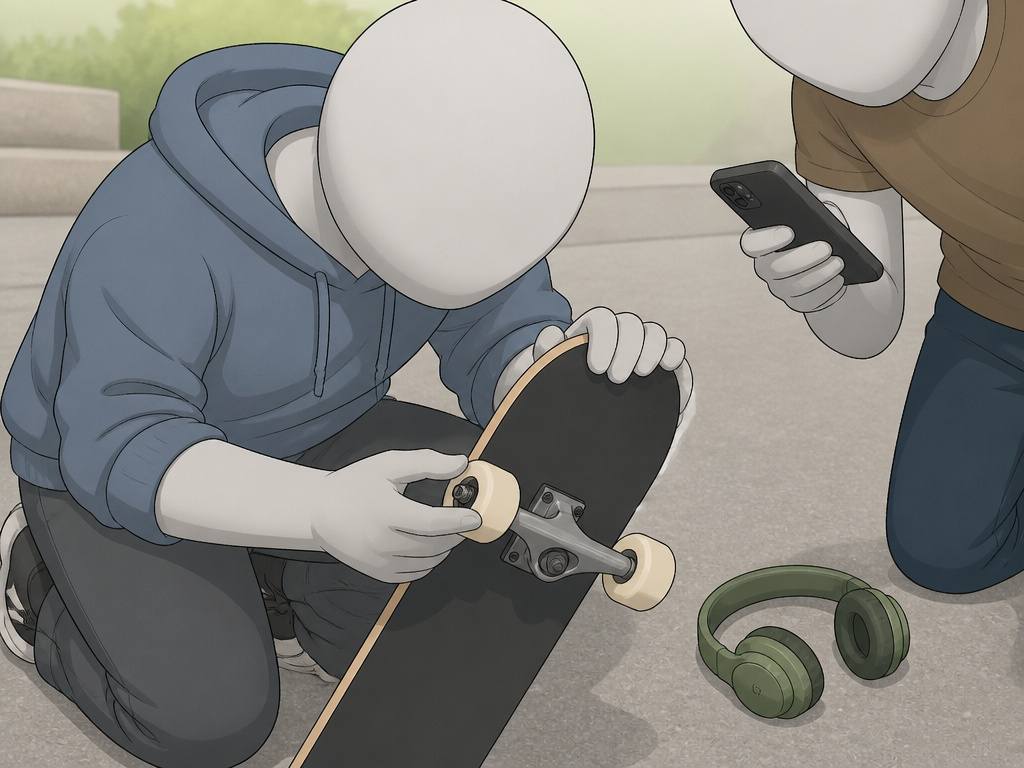
Falling safely is a skill layered on top of basic safety habits.
Before you start: Skateboarding sent 295,067 people to emergency rooms in 2024 (National Safety Council). These rules keep you out of that statistic. 1. Never ride in the street. Collisions with vehicles are among the most severe accidents. 2. Never ride alone. Bring a friend and a phone. 3. Never use headphones. You need to hear board sounds, traffic, and other riders. 4. Inspect your board before every session. Check for excessive play, broken parts, and that bearings are singly or doubly sealed to keep dirt out (Parachute).
Age and supervision rules vary by source: the American Academy of Pediatrics says children under 5 should not skateboard at all; the National Safety Council says children 6 to 10 should not skateboard without adult supervision; the CPSC says children under 8 should be supervised closely; and Parachute says children ages five to 10 should always be supervised.
How to Bail (And When You Should)
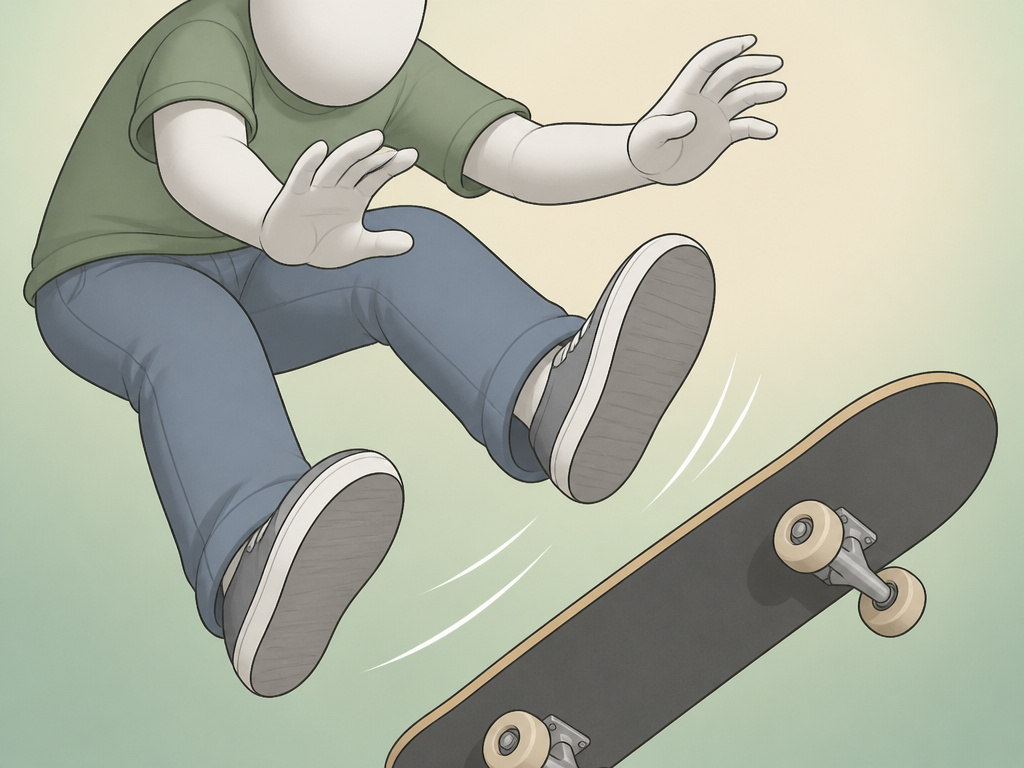
Bailing is a controlled abandonment of the board. You see the fall coming and choose to step or jump away. It’s a different skill from falling, but it uses the same principles.
The goal is to separate your feet from the board while staying upright or transitioning into a controlled fall. If you can’t run it out, you’re already in a fall, crouch and roll.
Reddit communities like r/NewSkaters are full of riders emphasizing that bail is a proactive skill.
This ties directly to overcoming the mental hurdle. Learning a reliable safe bailing technique is how you lose fear and start attempting new moves.
Frequently Asked Questions
Why do I keep falling when I’m not even doing tricks?
The National Safety Council notes that most injuries happen in falls caused by rocks and irregular surfaces. This is why the Parachute study found over half of injuries start with bad ground. Scan ahead, stick to smooth skateparks, and make sure your board’s bearings are sealed and wheels are appropriate for the terrain.
Do elbow and knee pads really help?
According to Parachute, “there is little research to show that they are effective” at preventing serious injury. They can protect against scrapes and direct impacts, but they don’t prevent joint sprains or fractures from twisting forces. Wrist guards and helmets have much stronger evidence. If you wear pads, don’t let them trick you into taking bigger risks.
What’s the difference between falling on a skateboard and a longboard?
The techniques are identical, but the scenarios differ. Longboard falls often happen at higher speeds from speed wobble. The CPSC’s advice to crouch and keep trucks tight is even more critical.
How do I protect my head if I can’t get my arms down in time?
This is exactly why the crouch is the first step in the National Safety Council skateboarding tips. A skateboarding helmet is multi-impact and covers the back of the head. For detailed strategies on orientation, see our guide on how to protect your head during a fall.
How can I teach my child to fall safely?
Start on a soft surface or grass. Use games to teach the crouch-and-roll motion without the fear of concrete. The CPSC skateboarding safety fact sheet emphasizes close supervision for children under 8. Frame it as a fun skill, like learning to tumble in gymnastics. Our resource on teaching children to fall safely breaks it down by age group.
What should I do right after a hard fall?
First, don’t jump up. Lie still for a moment and mentally scan your body. Can you move your fingers and toes? Any sharp pain? If you hit your head, even with a helmet, stop skating for the day. For steps on assessment and recovering after a skateboarding fall, including when to seek medical help, we have a full post-fall protocol.
The Bottom Line
Falling safely involves managing the energy of the hit so your body can handle it. The four-step drill is your toolkit, but the tool only works if you’ve practiced it on grass until the response is automatic.
One threshold changes everything: if you haven’t deliberately practiced falling on a soft surface, you are not prepared to fall on concrete. Your first real spill will be a reaction, not a technique.
That’s why the American Academy of Orthopaedic Surgeons PDF and every other authority lead with “practice on a soft surface.” The gear, the helmet that cuts brain injury risk by 45%, the wrist guards that stop the most common break, is your backup system. Your primary safety system is the muscle memory you build in the yard.
Go push down the block once today. But first, spend five minutes in the grass.
