
How to Progress Faster at Skateboarding: The 4-Week Ladder
This post contains affiliate links. As an Amazon Associate, we earn from qualifying purchases.
To progress faster at skateboarding, follow a deliberate skill ladder: start with pushing, turning, and stopping, then add kickturns and basic carving, before introducing the stationary ollie and then a rolling ollie. Skipping a rung, like attempting ollies before you can comfortably ride, actually slows you down by reinforcing unstable motor patterns.
The ladder works because it forces skill transfer, mastering a movement in a low-stakes environment before adding speed or obstacles. A 2022 study on informal learning in skateboarding found skaters who got a trick “mastered in one situation before trying it elsewhere” progressed more reliably. A key question for many is how to progress faster at skateboarding. The rest of this guide maps that research onto a practical weekly plan, complete with the off-board exercises and session structures that turn plateaus into launchpads.
What follows: a four-rung skill ladder, the science behind why boring reps beat rushed tricks, a template for a 60-minute session, and how to use rest as a tool, not a setback.
Key Takeaways
- Follow a 4-week progression ladder, mastering each fundamental skill before adding the next. Rushing to tricks before you can ride comfortably builds instability into your muscle memory.
- Structure your sessions with a warm-up, focused drills, and free skate. This balance between focused practice and playful application drives faster skill acquisition.
- Incorporate planned rest to prevent overuse injuries and break mental blocks. Research shows injured skaters have measurably worse balance; strategic rest prevents overuse injuries and can break mental blocks.
- Use video analysis to diagnose your own technique. Filming yourself and reviewing it can be more effective than guessing why a trick isn’t landing.
- Skate with others whenever possible. The 2022 “Show Me, Tell Me” study found skaters in coach-free environments appoint informal leaders and learn through “mutual interest groupings”, your progress accelerates in a community.
The 4-Week Progression Ladder (and Why It Works)
I spent a month trying to kickflip before I could ollie. My board went sideways more than it flipped, and I rolled away from exactly zero attempts. It was frustrating, loud, and a complete waste of time. Compare that to the kid I watched spend three weeks just pushing, carving, and turning in a tennis court. When he finally tried an ollie, his form was clean and repeatable by the second session. Boring wins, annoyingly.
That experience mirrors the finding from the 2022 “Show Me, Tell Me” study, which highlighted how skaters use cognitive skill transfer. They master a movement in one context before applying it elsewhere. Your brain needs the stability of a fundamental skill as a foundation before it can layer complex motor commands on top.
The part nobody mentions: Rushing to a trick like an ollie before you’ve cemented your pushing and turning means you’re trying to balance on a wobbly platform. Your brain spends its energy just staying upright, leaving none for the pop and slide. Master the platform first.
Here is the ladder. Treat each week as a minimum, not a maximum. Move on only when the skill feels automatic.
| Week | Primary Focus | Key Drill | Move On When… |
|---|---|---|---|
| 1 | Pushing, Turning, Stopping | Push for 50 feet, execute a smooth carve, come to a controlled stop with your back foot. Repeat for 30 minutes. | You can look ahead while you push, not at your feet. |
| 2 | Kickturns & Basic Carving | Practice kickturns on flat ground, then use them to carve back and forth across a gentle slope. | You can link four kickturns in a row without putting a foot down. |
| 3 | The Stationary Ollie | Practice the pop, slide, and level motion without rolling. Use a crack or grass to keep the board still. | You can land with both feet on the bolts 10 times in a row. |
| 4 | The Rolling Ollie | Start at a slow roll. Focus on the same pop and slide, letting the board’s momentum help with the leveling. | You can ollie over a painted line on the ground while rolling, and land with control. |
The sensory reality check is in Week 1. A proper push has a rhythm: the thump-thump-thump of your pushing foot hitting the ground is even, not frantic. If you hear a scramble, you’re not balanced.
How Skateboarding Science Says You Should Practice
The CPSC notes that you can lose control at any speed. That’s a safety warning and a learning principle. If you’re at the edge of your control, your brain is in survival mode, not skill-acquisition mode. The Reddit skater who advised to “go just beyond your current zone, but not too far” nailed it.
This is where structured practice sessions pull ahead of just “skating around.” A 2022 peer-reviewed analysis of informal coaching environments found that even without formal coaches, skaters used tools like demonstration, mental imagery, and deliberate drills. They weren’t just rolling aimlessly; they were engaged in a cognitive process.
How to Structure a 60-Minute Session for Maximum Gain
This template applies the research on how to progress faster at skateboarding. It turns a vague “go skate” into a tool for effective practice.
- Warm-Up (15 minutes): Ride around at a casual pace. Do some light stretches for your ankles, wrists, and calves. The goal is to raise your heart rate and remind your muscles of the movement patterns. This isn’t the time for hard tricks.
- Focused Drills (30 minutes): Pick ONE element from your current week on the ladder. If it’s Week 3, that’s 30 minutes of stationary ollies. Repetition with slight variation (pop a little higher, try to level more) builds the internal representation the study describes.
- Free Skate / Play (15 minutes): This is essential. Just ride around, try to manual a curb, go fast down a slight hill. It’s where you apply the drilled skill in a dynamic, fun context. This balances the work and keeps motivation high, which is critical for long-term consistency.
Common mistake: Skating until you’re exhausted and calling it a good session. Fatigue degrades your form, and you end up practicing mistakes. A fresh, focused hour beats three hours of sloppy, tired skating every time.
The why-layer here is motor learning 101. Drills in the first half of your session, when you’re fresh, encode the correct technique. Free skate at the end tests that technique under real-world conditions. Missing either half slows progress.
The Off-Board Work That Fuels On-Board Progress
Your body is the engine. A 2021 study in the International Journal of Environmental Research and Public Health delivered a specific, sourced number: healthy skateboarders had better balance than did injured professional and amateur skateboarders. Protecting your body with conditioning isn’t extra credit; it’s what keeps you on the ladder.
The Reddit advice to “look up correct form for squats” points in the right direction. You need strength and stability, not just skate-specific skill.
- For Pop & Power: Box jumps and squat jumps. They train the explosive extension from your ankles, knees, and hips that powers an ollie.
- For Balance & Stability: Single-leg balances on a wobble board or cushion. Hold for a period of time on each leg. This directly trains the proprioception, your body’s sense of its position in space, that a 2021 postural control study linked to skateboarding performance.
- For Injury Prevention: Wrist strengthening exercises and ankle mobility drills. The CPSC specifically calls out that wrist guards are especially important for skateboarders. Strong wrists handle falls better.
This involves doing 10 minutes of targeted work, three times a week, to support the hours you spend on the board. It’s a key part of how to progress faster at skateboarding and how you break a plateau caused by physical limitation.
Using Your Brain (And Your Camera) to Learn Faster
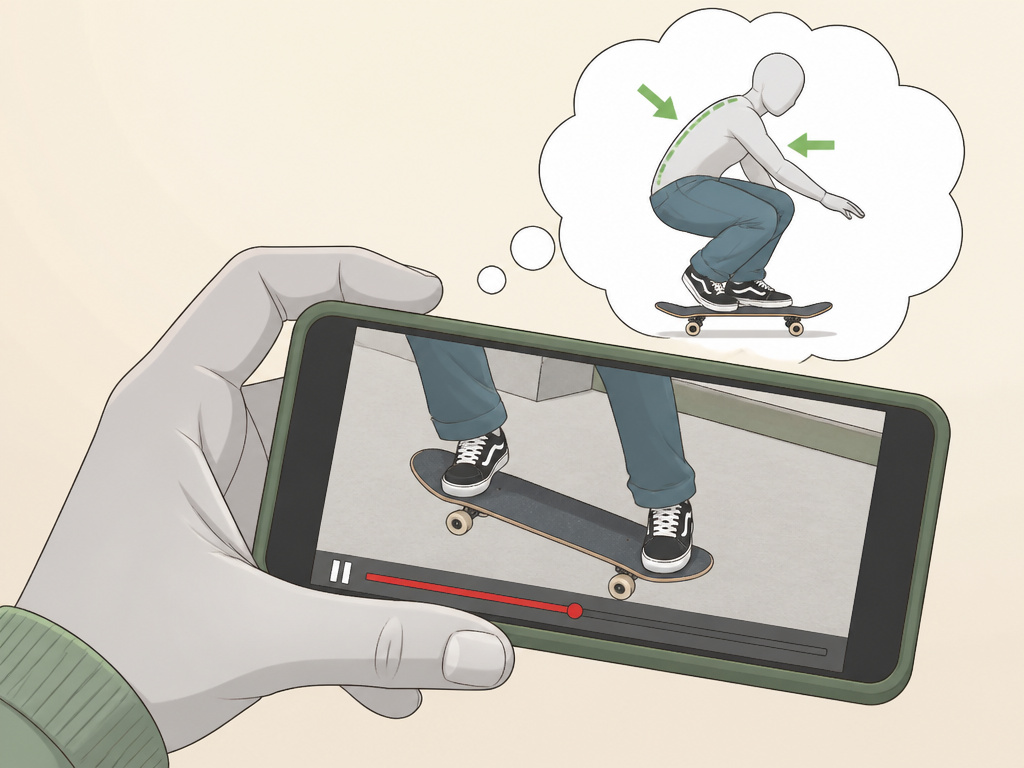
Skateboarding is a mental sport. The “Show Me, Tell Me” research found skaters used imagery and analogy to enhance skill storage. One participant in the study said, “When I started, I hammered the stance-push-stop basics at home. Only then did I feel comfortable to go out to the park.” They were mentally rehearsing.
You can harness this in two ways.
First, film yourself. Use your phone for a 30-second clip of your current drill. Watch it immediately. Your brain often lies about your posture; the video tells the truth. Are your shoulders square? Is your back straight? This self-analysis is a powerful tool for tracking progress and diagnosing flaws.
Second, rest strategically. I took a week off after being stuck on frontside 180s. Came back and landed them within two sessions. Rest seems to let the body consolidate what the brain was overthinking. A planned lighter week every couple of months is a tool for staying motivated and avoiding burnout.
Where this goes sideways: Watching pro skate videos for an hour, feeling super motivated, then skating with that hyped-up energy for 60 minutes until you’re wiped out. The Reddit skater who said “my sessions barely last an hour” after watching videos was experiencing this. Motivation is a spark, not fuel. Use a structured session plan for the fuel.
The Gear That Actually Helps (And What’s Overrated)
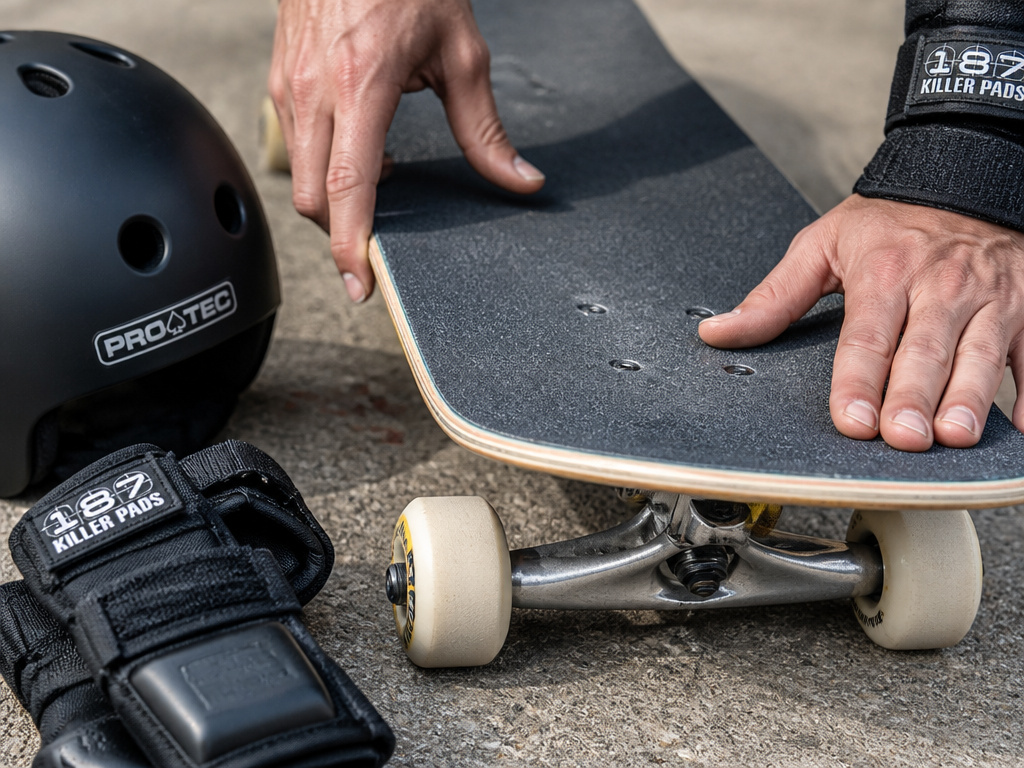
Your equipment should support the ladder, not complicate it. The CPSC notes that longer boards increase stability and boards with wider hangers give riders greater control. For a beginner, that often means a stable, predictable setup. This setup is stable, predictable, and lets you focus on skill, not fighting your board.
- Reach For: A shop-built complete from a skate shop. It ensures the trucks are fitted correctly and the wheels aren’t dead plastic.
- Skip For Now: Expensive ceramic bearings or ultra-hard wheels. Decent bearings and wheels will serve you perfectly through the entire progression ladder. The money is better spent on a helmet designed for skateboarding (hard shell with foam interior) and wrist guards, the CPSC states that wearing a helmet can mean the difference between life and death.
The biomechanics matter. A scientific review of skateboarding variables breaks down the physics of tricks.
Frequently Asked Questions
How long does it take to progress in skateboarding?
There’s no universal timeline, but the 4-week ladder provides a structured benchmark. If you practice consistently using a structured approach, you can expect to progress. Progress then depends on how you layer skills. The key is consistent, deliberate practice over raw hours.
Is 25 too late to start skateboarding?
No. While youth offers flexibility, adults bring patience, discipline, and often a better ability to analyze movement. The progression ladder and off-board conditioning are especially valuable for adult beginners. The main difference is a higher priority on safety gear and warm-ups to protect a body that doesn’t bounce as easily.
Does skating help ADHD?
Anecdotally, many skaters with ADHD report that the intense focus required for landing a trick, the immediate feedback, and the physical exertion are beneficial. The structured, goal-oriented nature of the progression ladder can also provide a satisfying framework that aligns well with some ADHD management strategies. It’s not a treatment, but it can be a positive, engaging activity.
How do I get past being scared to commit to a trick?
Fear is the most common plateau. The Reddit advice to “fall more” is blunt but points to exposure. Start by building confidence in a controlled way: practice the trick on grass or in a crack first, then at a slow roll, then gradually add speed. Learning how to fall safely, rolling out of a fall rather than bracing with stiff arms, is a skill in itself. Finally, fully committing is often a binary choice; hesitation guarantees a fall.
The Bottom Line
Progress is a ladder. Stick to the four-week sequence, support it with structured sessions and off-board work, and use your brain as much as your body. The most counterintuitive step might be the last one: when you feel stuck, put the board away for a few days. Let the consolidation happen. Then come back, set a specific goal for that session, and climb the next rung.
