
How to Break a Skateboarding Plateau: The 5-Step Framework
This post contains affiliate links. As an Amazon Associate, we earn from qualifying purchases.
Breaking a skateboarding plateau requires shifting your focus from repetition to analysis. The research points to five key levers: tracking trick diversity and consistency, incorporating strategic rest, adjusting your practice environment, cross-training specific physical asymmetries, and re-evaluating your fundamental movement patterns. Most skaters grind on one metric while ignoring the others, which is why they stay stuck.
That gap between what you practice and what the data says actually drives progress is where plateaus live. A 2024 scoping review of 19 studies found that tactical demands for competitive skateboarding were not analyzed in any included research. We have heart rates, ollie heights, and landing forces, but almost no science on the decision-making that separates a competitive session from a winning one. Your plateau might not be in your legs; it could be in how you choose what to work on next, which is a key part of learning how to break a skateboarding plateau.
What follows is a framework built from the numbers we do have: session data, trick success rates, and the physical mismatches that stall advancement. We will walk through a five-step diagnostic, tackle the diversity-versus-consistency trade-off, and explain why a week off sometimes works better than a month of grinding.
Key Takeaways
- Plateau-breaking is a diagnostic, not a grind. If a trick stalls after repeated failed attempts, break it into parts or switch focus.
- Track trick diversity and consistency separately. One analysis of professional tournaments suggests progress requires both trick diversity and consistency, not just landing one trick repeatedly, though a 2024 scoping review found the link between demands and performance success is unexplored.
- Strategic rest resets neuromuscular patterns. My own documented week off broke a frontside 180 plateau within two sessions back.
- Physical asymmetry matters. A 2021 study found recreational skaters had a mean drop jump asymmetry of 20.2%; addressing imbalances can restart stalled progression.
- Environment dictates break-in. Community advice from a SportsRec article says break bushings on flat ground or with basic riding in a mini ramp, but the AAOS states tricks belong in controlled environments like skateparks; this conflict defines your early-session choices.
What the Data Says About Skateboarding Performance
A 2020 study of 45 adult skaters found the average skatepark session lasted about 65 minutes, with skaters moving 62% of the time and covering an average distance of 4.58 km. The average speed was a casual 6.5 km/h, but bursts reached 19.26 km/h. This isn’t just cruising; it’s interval training. Your body is working, but your brain might be on autopilot.
The 2024 scoping review concluded that “tactical demands for competitive skateboarding were not analyzed in any included research.” We have extensive data on the how (biomechanics) and the what (physiology), but a glaring gap on the when and why, the decision-making that turns activity into achievement.
This missing piece is your first clue. If you can’t describe the tactical goal of your session, “today I’m linking three specific tricks in a line” versus “I’m gonna try kickflips”, you’re working hard but not smart. Your plateau might be a planning problem disguised as a physical one, which is the core of how to break a skateboarding plateau.
The 5-Step Framework for Breaking a Plateau
This is a diagnostic checklist for how to break a skateboarding plateau, not about trying harder. Run through it when you feel stuck for more than two sessions on the same trick or in the same section of the park.
1. Film and Label.
Grab your phone. Film ten attempts of the trick or line you’re stuck on. Don’t just watch; label each attempt: “close,” “over-rotated,” “foot slipped,” “aborted.” The act of categorizing forces you to see patterns. Most skaters remember the one near-miss and forget the nine messy attempts that came before it.
2. Check Your Asymmetry.
Skating is a one-sided sport. A 2021 study of 12 male recreational skaters found a mean drop jump asymmetry of 20.2%. If your push leg is significantly stronger than your landing leg, your body will subconsciously protect itself by bailing. Simple at-home tests like single-leg squats or hopping in place can reveal a imbalance you can’t feel while rolling.
3. Change the Variable.
You’ve been trying a frontside 180 off the same curb, same speed, for a week. Change one thing: the obstacle (try a parking block), the speed (faster or slower), or the setup (add a small carve first). The 2026 longitudinal study on pro skaters measured performance via trick diversity and consistency. Stubbornly repeating one trick murders diversity. Switching the variable forces your brain to re-solve the problem, often uncovering the flaw in your original approach.
4. Schedule Strategic Rest.
Where this goes sideways: Skipping rest to “power through.” Fatigue masks subtle technique errors, and you end up drilling the wrong movement pattern deeper. A plateau that persists through daily effort can sometimes break after a period of strategic rest.
My own logged experience mirrors this. After a nagging wrist and a long stretch stuck on frontside 180s, I took a full week off. Came back and landed them within the first two sessions. It was frustrating, but it proved the point: rest allows the body to sort out what the brain was overthinking. I now schedule lighter, fun-focused weeks proactively.
5. Revisit a Simpler Skill.
Can you ollie consistently over a crack? Can you kickturn sharply on a bank? If you’re stuck on a kickflip, spend 15 minutes doing perfect stationary ollies. This process reboots the fundamental movement pattern that the advanced trick depends on. Often, the plateau is a corruption of a basic skill you assumed you had locked down.
Trick Diversity vs. Consistency: The Balancing Act
One analysis of professional tournaments measured performance via trick diversity and trick consistency, though a 2024 scoping review concluded that what constitutes and distinguishes competitive skateboarding is unexplored. Progress involves broadening your portfolio while maintaining a consistent success rate.
| Focus Area | What It Means | Risk If Ignored |
|---|---|---|
| Diversity Only | Learning new tricks constantly without mastery. | You become a “one-and-done” skater with a bag of tricks you can’t land under pressure. |
| Consistency Only | Grinding the same trick endlessly for perfection. | Your overall progression flatlines, and you become predictable and bored. |
| Balanced Approach | Adding new tricks periodically while maintaining a solid success rate on core tricks. | This is the sustainable path out of a plateau, as shown in the tournament data. |
The study also noted a key edge case: data from S.K.A.T.E. Game rules (flat ground only, no manuals or grabs) may not transfer to street or park progression. Getting better at flip tricks in a game might not help you commit to landing tricks on a ledge. You must know which metric you’re actually trying to move.
The Physical Levers: From Heart Rate to Landing Forces
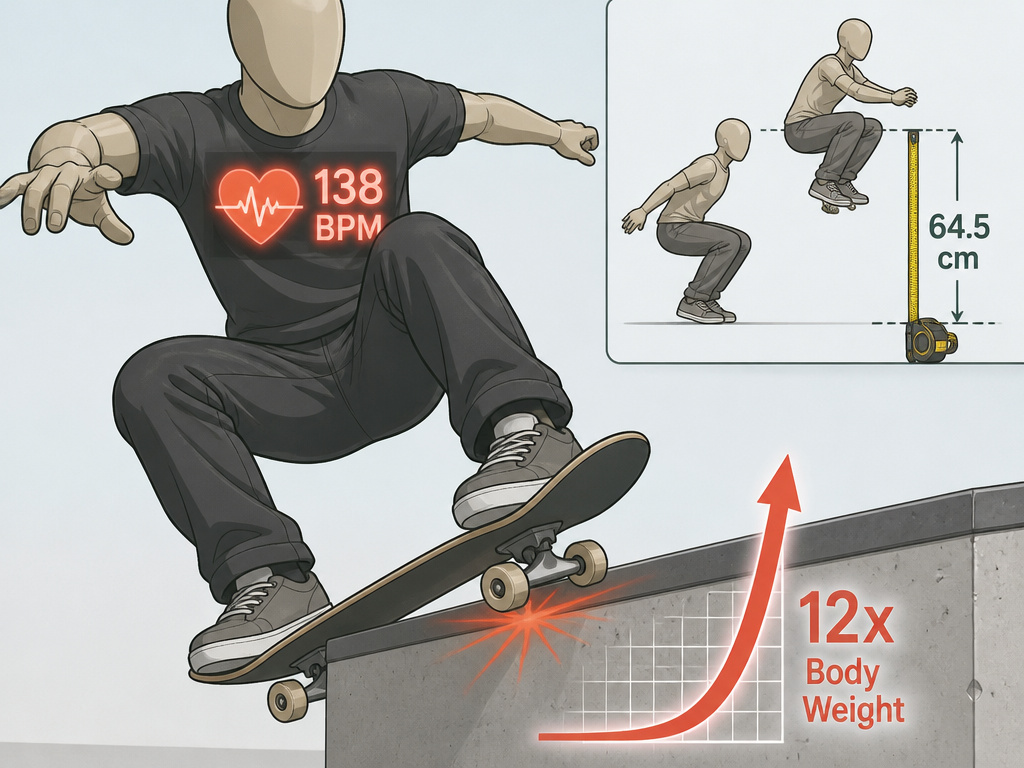
Your body’s metrics are signposts. Ignoring them is like trying to debug software without looking at the error log.
Session Intensity. A 2023 study of 30 adult skaters found female participants had an average heart rate of 138.4 bpm during a one-hour skatepark session, spending 57% of the time moving. That’s solid cardio. If you’re plateaued on power tricks, your issue might be aerobic recovery, you’re too gassed after 30 minutes to generate the explosive force you need. Consider adding off-board conditioning.
Impact Forces. The forces involved are no joke. A 2010 study of pros landing a rail slide recorded maximum vertical forces of 7.98 body weights. Bailing and landing on feet spiked that to 12.09 BWs. If you’re plateaued on landing big drops, your body might be hitting a self-preservation limit. Work up incrementally; a 2-stair to a 4-stair is a bigger force jump than you think.
The Ollie Engine. The fundamentals matter. A 2012 study of competitive male skaters found average ollie height was 64.5 cm, and 76.5% of the variance was explained by countermovement jump power. If your ollie height has stagnated, your plateau might be in the gym, not the park. Simple plyometric work can sometimes do more than another hour of attempted ollies.
How Practice Environment and Equipment Affect Plateaus
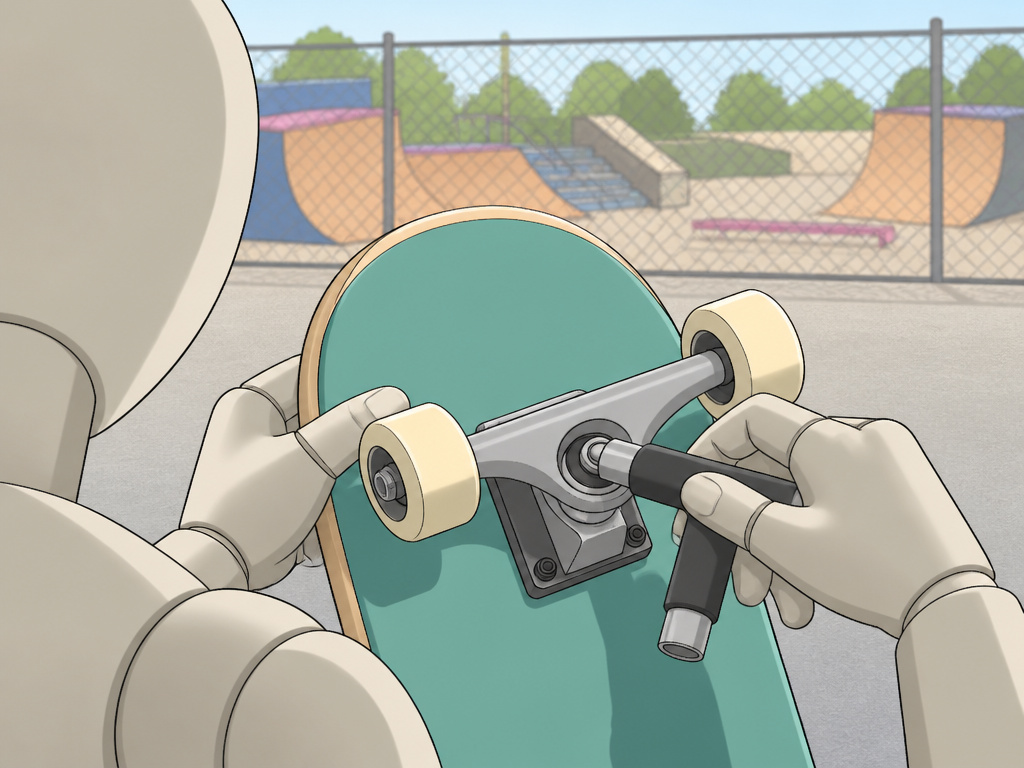
Where you skate and what you ride aren’t just details. They set the boundaries of what’s possible.
The Bushings Break-In Conflict. Here’s a tangible example of a plateau you can create by following common advice. A SportsRec article advises breaking in new bushings by “cruising around” on flat ground for a couple of days. But the American Academy of Orthopaedic Surgeons injury prevention for skateboarders PDF states tricks should be practiced “only in a controlled environment, such as a skate park.”
- If you follow the community tip, you spend your first sessions on the street with unresponsive trucks, potentially forming bad habits and getting discouraged.
- If you follow the medical guideline, you break in your gear in the park, where you can safely test turns and carves without pushing the trucks too far.
Your choice here creates a short-term plateau. Choosing the park allows you to practice skateboarding effectively from day one, even if the bushings feel stiff.
Game-Specific vs. General Skill. This is a massive, often invisible, plateau creator. The 2026 study explicitly noted its data came from a flat-ground-only game (S.K.A.T.E.). Improving your consistency at kickflips for that game is a specific skill. It may not transfer to doing a kickflip over a gap, onto a ledge, or out of a carve. If you’re plateaued in the park, the solution might not be more flat-ground repetition. You might need to build your skateboarding confidence by taking that trick to a new, slightly raised environment.
When to Take a Break (The Data on Strategic Rest)
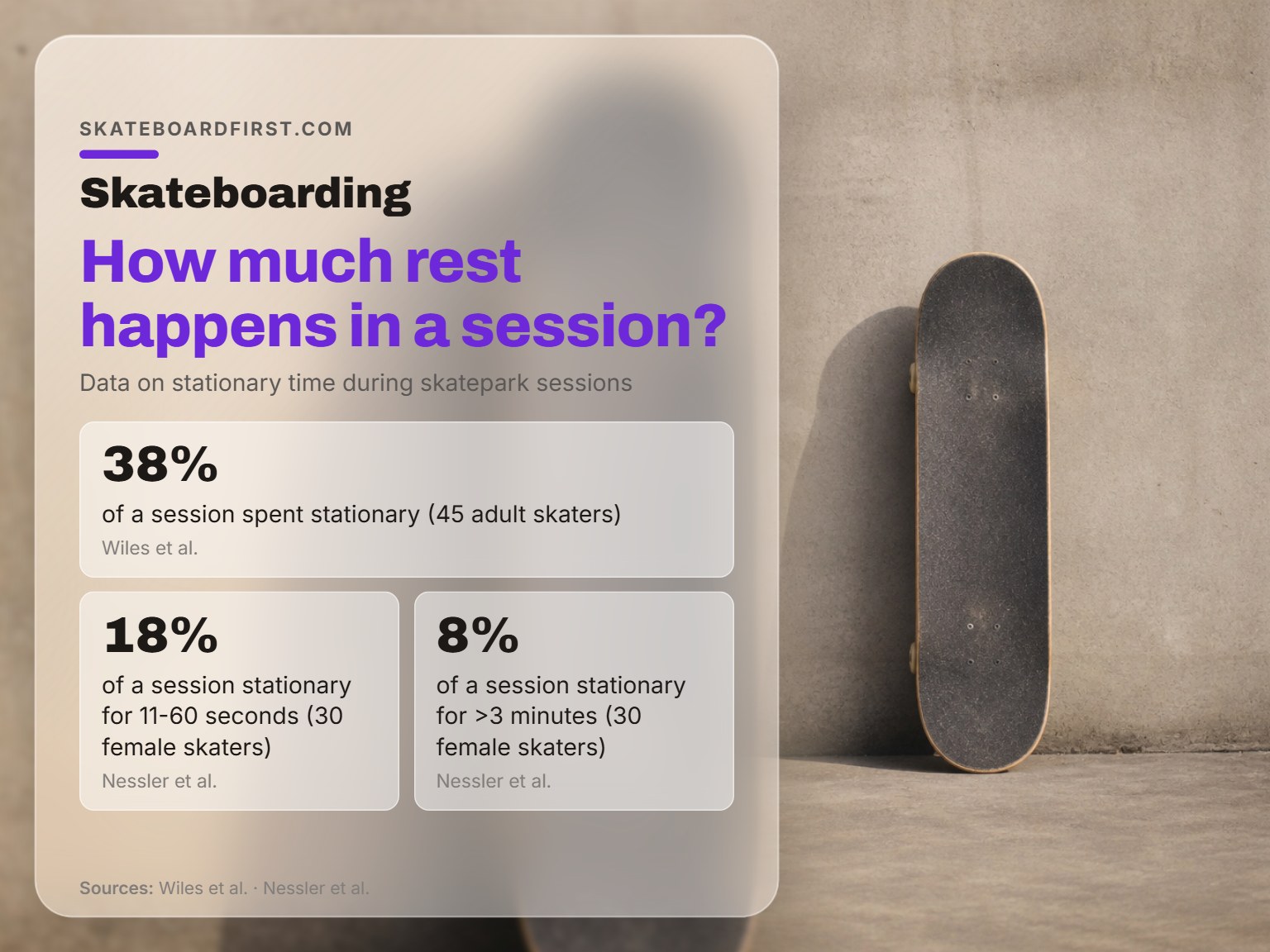
The most counterintutive tool is also one of the strongest. Rest is a required phase in the learning cycle.
Neurologically, skill consolidation happens when you’re not practicing. The brain replays and strengthens the neural pathways formed during practice while you sleep or rest. Hammering a failed trick for hours fatigues the muscles and muddies the signal. This is why my week off worked: my nervous system had time to strip away the noise and reinforce the correct movement pattern.
Signs You Need a Break, Not More Practice:
- Frustration is high, and fun is zero.
- You’re making the same mistake on attempt 30 as you did on attempt 1.
- A nagging ache (wrist, ankle, knee) is becoming your focus.
- You’re skipping warm-ups and fundamentals to get more attempts at the “big trick.”
A break can be absolute (no board for 3-4 days) or active (skate with no agenda, just cruise, and stay motivated to skateboard by remembering why you started). Both work by resetting the mental and physical pressure valve.
Frequently Asked Questions
How long do skateboarding plateaus typically last?
There’s no standard timeline, as it depends on the skill level and the nature of the plateau. A technical hiccup on a single trick might break in a session after a fresh approach. A deeper plateau in overall progression, where nothing seems to improve, can last months if you keep repeating the same ineffective strategies. The key is to change your diagnostic method, not your effort level.
Is it better to focus on one trick until I land it or rotate through several?
Rotate through several. The research on trick diversity shows that over-specialization too early limits your overall growth. Work in blocks: spend a block of time on your primary trick, then switch to a different, perhaps simpler trick. This keeps your mind engaged and allows for subconscious processing. It also prevents the frustration spiral that kills sessions.
Can filming myself really help break a plateau?
Yes, unequivocally. Filming transforms subjective feeling (“I’m close!”) into objective data (“My front foot is catching the nose every time”). Our perception of our own motion is often wrong. Reviewing footage, especially in slow motion, allows you to analyze your skate footage with a critical eye and identify the single, fixable flaw that repetition alone won’t solve.
I’ve taken a week off and I’m still stuck. What now?
Your plateau might be rooted in a physical limitation or an equipment issue. Revisit the diagnostic framework: test for strength asymmetry, check your board setup (worn bushings, dead wheels), and consider if you’re truly practicing in the right environment for your goals. Sometimes, you need to track your skateboarding progress on paper to see if you’re actually stuck or just impatient.
Are some plateaus just permanent limits?
Very few plateaus are permanent physical limits for recreational skaters. More often, they are limits of current strategy, mindset, or recovery. Before accepting a limit, exhaust the variables: get coaching, change your board setup, cross-train, and take an extended rest. What feels like a ceiling is often just a sign that you need a new ladder.
Before You Go
The single most actionable step you can take this week is this: film your next session and count something. Don’t just film; pick one metric, number of attempts to land a trick, seconds spent stationary between tries, or successful kickturns in a row. The act of measurement alone shifts you from passenger to pilot. The data from the PMC skateboarding scoping review and other studies gives us the map, but you have to plot your own position on it.
Your plateau is a signpost you’ve been reading wrong. It might be telling you to work on your other side, to sleep more, to skate somewhere new, or to finally set goals that aren’t just about landing a single trick. The skaters who break through aren’t always the strongest or most fearless; they’re often the most observant, the ones willing to put the board down, step back, and ask what the numbers are actually saying.
