
How to Land Kickflips Consistently: The 3-Week Rule
This post contains affiliate links. As an Amazon Associate, we earn from qualifying purchases.
Landing kickflips consistently requires three things: a solid ollie, a flick that starts in the right spot, and the commitment to keep your feet over the board as it spins. A 2023 biomechanics study quantified the perfect flick at 7.1 Newtons of force applied 0.029 seconds into the jump, producing a roll angle of -362.59° in 0.453 seconds.
The difference between a lucky flip and a reliable one is in those milliseconds and millimeters. You can have the pop and the flick, but if your weight isn’t centered when you leave the ground, the board shoots away every time. This is the core challenge of how to land kickflips consistently.
What follows is a breakdown of the two main flick techniques, a troubleshooting table for where your board is landing, and a three-week practice framework that moves from stationary reps to rolling consistency.
Key Takeaways
- Master the ollie first. Secrets of Skateboarding states this outright: moving to kickflips before clean ollies is why the board won’t flip correctly.
- Commitment fixes one-footed landings. If the board flips but you land with one foot, Secrets of Skateboarding identifies this purely as a “matter of commitment.”
- Jump more up than forward. Red Bull’s guide emphasizes an upward jump vector to keep the board underneath you, correcting the board-landing-in-front problem.
- Use your knees to absorb impact. Landing stiff-legged is a fast track to ankle pain; Red Bull notes to use your knees to absorb the shock, while Skateboarding.com / Dominick Walker emphasizes landing with all four wheels touching down simultaneously.
The Flick Is Everything (And Experts Disagree Where It Starts)
Your front foot does all the work after the pop. Get its starting point wrong, and the board either rockets or barely spins.
The flick force starts at 0.029 seconds in the modeled sequence. In a modeled perfect flip, a flick force (F) of 7.1 N produces a roll angle of -362.59° at 0.329 seconds. . Yuchen Zhong, Chongqing BI Academy (Study)
That’s the technical snippet. For your feet, it translates to a quick, sharp kick. The real debate is where your foot should be to make that happen.
Skateboarding.com / Dominick Walker says place your front foot an inch below the bolts at a 45-degree angle, while the Your heel hangs off slightly. This puts your toes in the “pocket” where the nose curves up.
Red Bull Editorial Team says place the ball of your front foot behind the front trucks. This is higher on the board, nearer the bolts.
Both work, but they create different flick paths. The pocket method (below the bolts) gives you more board to slide up before the flick, often creating a slower, more controlled spin. The bolt-area method can produce a faster, snappier flick but requires more precision to avoid kicking the board away.
I’ve seen more beginners find success starting with the pocket method. It builds the muscle memory of sliding up the board before kicking out, which is the core of a good kickflip tutorial. The board stays closer to your feet.
Your Jump Direction Decides Where the Board Lands
You pop, you flick, and the board does a perfect rotation… Three feet in front of you. This is a jump vector problem, and sources contradict each other on the fix.
Red Bull is clear: “You should be jumping upward more than forward.” Their logic is sound, if you jump forward, your body travels away from the board’s starting point. The board flips where you left it.
Secrets of Skateboarding offers a different fix for the same symptom: “If the board lands in front of you, simply jump forward a little to stay over your board,” while the Red Bull Editorial Team advises “You should be jumping upward more than forward.”
Who’s right? It depends on your mistake.
Common mistake: Leaning your shoulders forward during the pop. Your head and torso go ahead of the board, so you jump “away” from it. The fix is to jump straight up.
If you are stationary and centered but the board still shoots forward, your flick might be pushing it. In that case, a slight forward jump with your knees up can help you chase it down. For many skaters, the Red Bull advice is the correction. Jumping up, not out, keeps the board in your immediate space.
This is where filming yourself pays off. Are you popping and then leaning toward your nose? Or are you popping straight up and watching the board spin away? A skate video analysis will show you which error you’re making.
Troubleshooting Your Kickflip Landing
Most landing issues trace back to your balance during the pop. This table matches the symptom with the cause and the prescribed fix, drawing directly from the Secrets of Skateboarding troubleshooting guide.
| Symptom | Likely Cause | The Fix |
|---|---|---|
| Board lands behind you | Leaning too far forward during the pop | Keep your back straight, head aligned over the board. |
| Board lands in front of you | Not staying over the board; jumping away from it | Jump upward more than forward; think “ollie” and keep weight centered. |
| Board lands to your heelside (north) | Weight is leaning toward your heels | Center your weight; lean slightly toward toes if needed. |
| Board lands to your toeside (south) | Popping the board sideways, not forward | Focus on popping the tail straight down, moving the board forward toward your front foot. |
| You land one-footed | Pure commitment issue; pulling a foot away | Commit to putting both feet down; practice landing with the board only, then add the flip. |
The “one-footed landing” is a mental barrier, not a technical one. Your brain is protecting you from a perceived fall. The only cure is repetition in a safe environment, which is where tools like Skater Trainers or practicing on grass can build the neural pathway that says “landing on this spinning board is safe.”
The 3-Week Consistency Framework
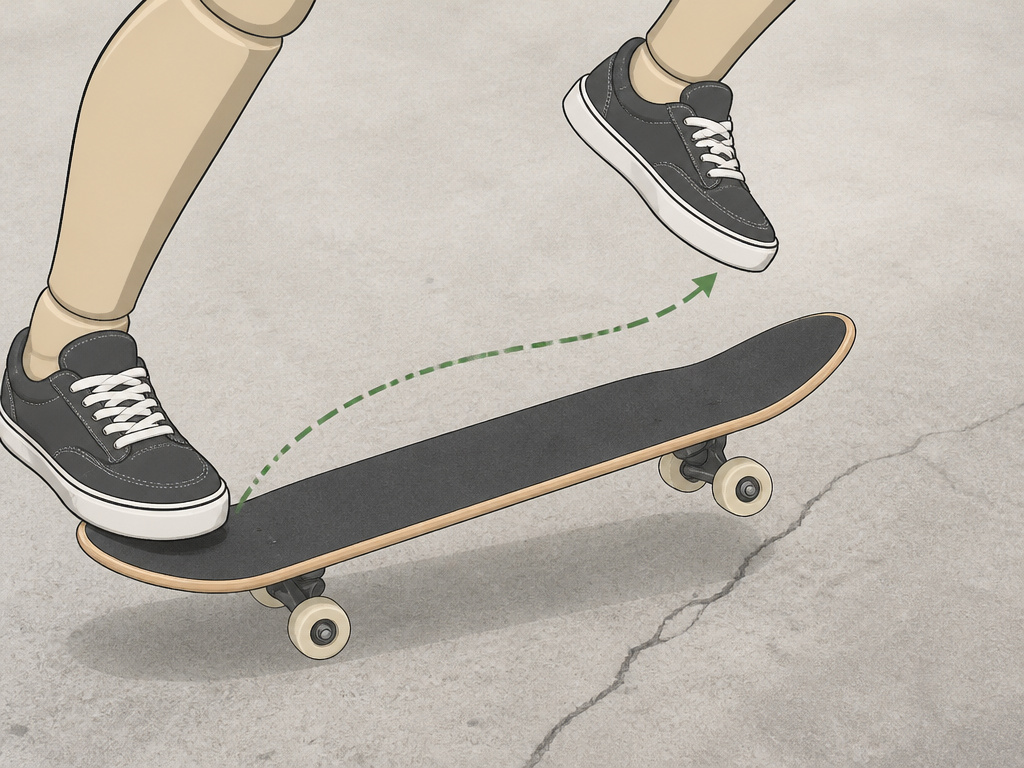
Aspiring to “consistent kickflips” is vague. Aiming to land a specific number of attempts within a set timeframe is more achievable. This framework borrows from the documented SkaterTrainer.com experiment, where a skater practiced 100 kickflips with wheel-locking trainers to build muscle memory without the fear of the board rolling away.
Week 1: Stationary & Deconstructed
- Goal: Isolate the flick motion and land with both feet on a non-moving board.
- Drill 1: Without popping, stand on the tail and practice flicking your front foot off the pocket. Watch the board spin. Get used to the wrist-snap motion.
- Drill 2: Do the full trick but focus on landing with your front foot only, catching the board with your back foot. Secrets of Skateboarding suggests this for dialing in catch timing.
- Practice: 20-30 attempts per session, 3-4 sessions this week. Use a crack or Skater Trainers to hold the board still.
Week 2: Introducing Motion
- Goal: Transfer the stationary skill to a slow, rolling trick.
- Drill 1: Hippy jump over a small object (a stick, a crack), adding a slight flick motion. Land bolts. This builds confidence in leaving the board and returning to it.
- Drill 2: Do kickflips while rolling into grass. The soft landing removes consequence, letting you focus on the full rotation and foot catch.
- Practice: 15-20 rolling attempts per session, 3 sessions this week. Prioritize control over height.
Week 3: Commitment & Repetition
- Goal: Achieve a measurable consistency rate (e.g., 5/10 on concrete).
- Drill: The “25 Attempts” test. As in the SkaterTrainer experiment, try 25 kickflips on flat ground and count how many you land cleanly. Record the number. Do not move on to other tricks this session.
- Focus: After each attempt, note one thing: Was my pop good? Did I flick from the pocket? Did I jump up? This turns practice into effective training.
- Practice: Take the test 2-3 times this week, with rest days in between. The goal is to see the number go up.
This structured approach moves you from understanding the mechanics to owning the mechanics of how to land kickflips consistently.
Stationary vs. Moving: The Real Progression

A Reddit thread in r/NewSkaters was split: some argued you should never learn tricks stationary; others said it’s a valid first step. Both are right, but for different stages.
Stationary kickflips are a learning drill, not the end goal. They let you dissect the foot motions without the added variable of balance and momentum. The problem is, your muscles learn a static pattern. When you roll, you need to re-learn the timing and weight distribution slightly.
Moving kickflips from day one are harder but build the correct final muscle memory for how to land kickflips consistently immediately. The risk is higher frustration and slower initial progress.
The hybrid approach in the 3-Week Framework is the winner. Use stationary reps in Week 1 to wire the flick. Use Week 2 to translate it to a slow roll. By Week 3, you’re working purely on consistency with your rolling kickflip. This bridges the gap without cementing bad habits.
How Your Setup Affects Consistency
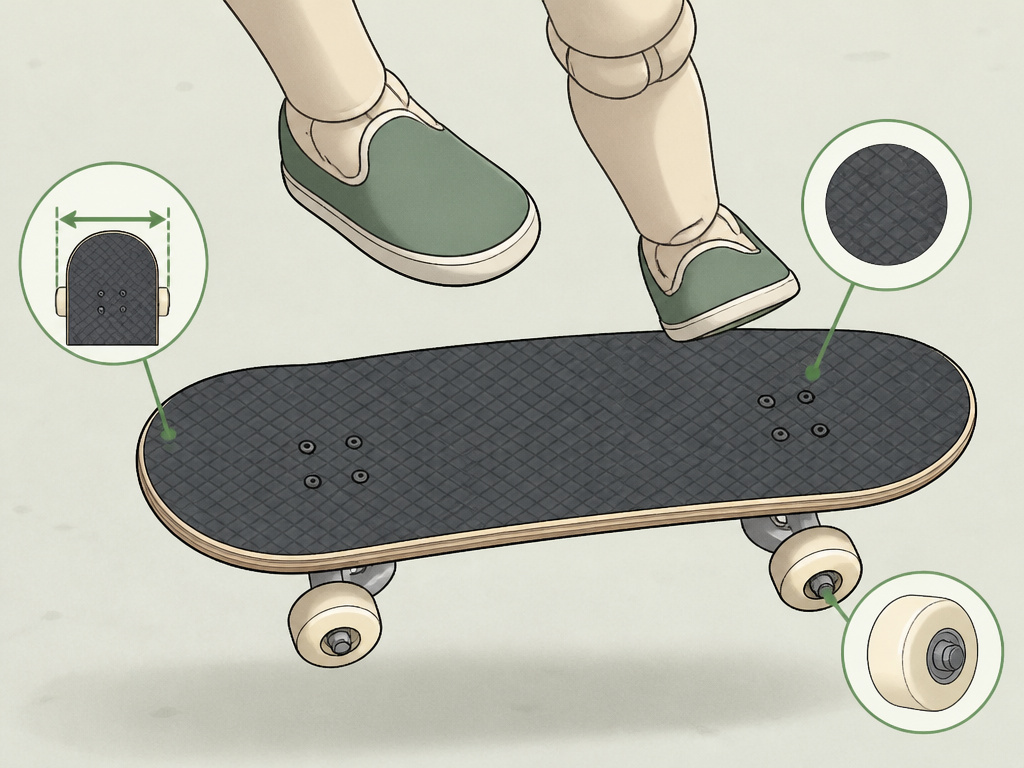
Your gear won’t teach you the trick, but it can make learning it harder or easier.
Deck Width: A deck that is too narrow for your stance can be less stable for landing. A deck with adequate width provides a more forgiving landing platform. This isn’t about performance; it’s about error margin.
Grip Tape: Worn-out or cheap grip tape means your feet slip during the slide. Fresh, coarse grip tape gives a positive lock for your front foot. If you’re fighting for traction mid-flick, re-grip your board.
Wheel Hardness: Wheel hardness can affect how the board feels on different surfaces. Softer wheels may absorb vibration and provide a more stable base on rough ground.
Bearings and Trucks: These matter less for the trick mechanics but everything for your confidence. If your trucks are wobbly or your bearings are slow, pushing to your spot feels like work, and you’ll start each session tired. A stable, smooth-riding board removes friction from the learning process.
Think of your setup as the foundation. You can build a great kickflip on a mediocre board, but you’re building on sand. A predictable, reliable board is solid ground.
The Mental Hurdle: Committing to the Landing

The technical fixes are straightforward. The mental block is the real wall. I filmed myself once and the head drop was obvious. I’d been blaming my feet for about a month when the problem was my eyes pulling my whole upper body off-center.
The author’s documented experience notes that looking down ruins landings. Your shoulders follow your gaze. If you stare at the spinning board, your torso twists and you land off-balance. The fix is stupidly simple: pick a spot on the ground a few feet ahead and look at it through the entire trick. Your body will stay stacked over the board.
Commitment is the willingness to accept the potential fall. Tools like Skater Trainers or grass practice reduce the perceived risk, letting your body learn that landing on the board is the safe outcome. The fear of falling is rational, but you can manage it. The path to solid mental commitment is through graduated exposure, small wins that prove to your lizard brain that you can do this.
How to lift your feet up after the pop
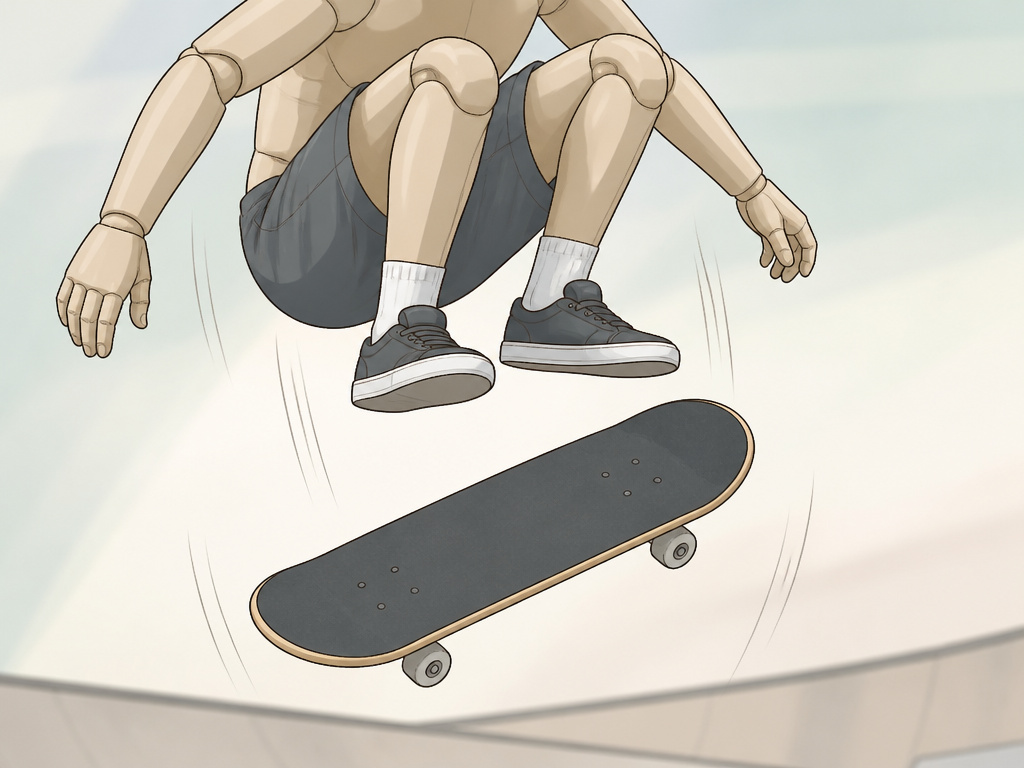
After you pop and flick, your job is to get out of the way. This means lifting both feet up high and fast. Jump upward more than forward to give the board the space it needs to complete its full rotation. If you don’t lift your feet enough, your shoes will catch the board and stop the flip. Think about bringing your knees up toward your chest. The board needs that airborne time to spin freely beneath you. Once the flip is complete, you guide your feet back down, aiming to position them over the hardware to absorb the impact of the landing.
Frequently Asked Questions
Why am I not landing my kickflips?
The three most common reasons are insufficient ollie height, incorrect flick location (causing a rocket flip), and lack of commitment (pulling a foot away). Use the troubleshooting table above to diagnose your specific symptom.
What percent of people can land a kickflip?
There’s no reliable published statistic. In skateboarding communities, it’s considered a foundational trick, but a large percentage of casual skaters never achieve consistent kickflips due to the commitment and practice time required.
How to commit to landing a kickflip?
Reduce the consequence. Practice on grass or with wheel-locking trainers to remove the fear of the board rolling out. Focus on landing with just your front foot first, then both. Your brain needs to learn that landing on the board is the safest option.
How long does it take to land a kickflip?
The first accidental landing can happen in a few days or weeks. Building consistency typically requires months of regular, focused practice for most beginners, assuming a solid ollie is already in place.
Before You Go
The data from the SJISR kickflip biomechanics study gives us a target: a 7.1 Newton flick applied 0.029 seconds into a jump. Your job is to translate that force and timing into a foot motion you can repeat.
Forget about hitting a perfect kickflip every try. Aim for a measurable consistency rate, and improve it by one landing per week. That’s how you build a trick that doesn’t abandon you when you need it. Start your next session by filming five attempts. The gap between what you feel and what you see on video is where progress lives.
