
What Size Skateboard Should I Get? A Clear Starting Point
This post contains affiliate links. As an Amazon Associate, we earn from qualifying purchases.
Many guides, like those from evo and CCS, suggest picking a deck width that matches your shoe size as a baseline, then adjusting for your height and preferred skating style. However, Skate Warehouse UK argues height is more important for beginners. For most adult beginners, an 8.0″ to 8.25″ deck offers a common starting point for balance and control.
That advice is the consensus from major retailers, but it glosses over a real debate. Some shops swear by shoe size. Others tell beginners to ignore it and focus on height. The charts from CCS, Skates USA, and Element Brand don’t even agree on the recommended width for a common shoe size like a US Men’s 8. This is why the question ‘what size skateboard should i get’ is so common.
This guide cuts through the noise. We’ll compare the official charts, explain where they conflict, and show you how to test the feel for yourself. By the end, you’ll know how to read any sizing chart, match your trucks and wheels, and spot the storage mistakes that warp a deck before you ever ride it.
Key Takeaways
- Start with a deck width roughly as wide as your foot is long, it’s the most common beginner baseline, though height-based charts from Skates USA offer a competing view.
- Match your truck axle width to your deck width for proper wheel alignment and stability; a mismatch makes the board feel twitchy or catch on grinds.
- Begin with wheels in the 54-55mm range, smaller wheels (50-54mm) get caught on cracks easier, while larger wheels add weight that slows flip tricks.
- Store your deck away from heat and damp; warping from a hot car or garage can ruin the pop and flat spots faster than any curb slam.
- For high-speed riding, the CPSC recommends longer decks and wider trucks to mitigate speed wobble.
Shoe Size to Deck Width: The Contested Baseline
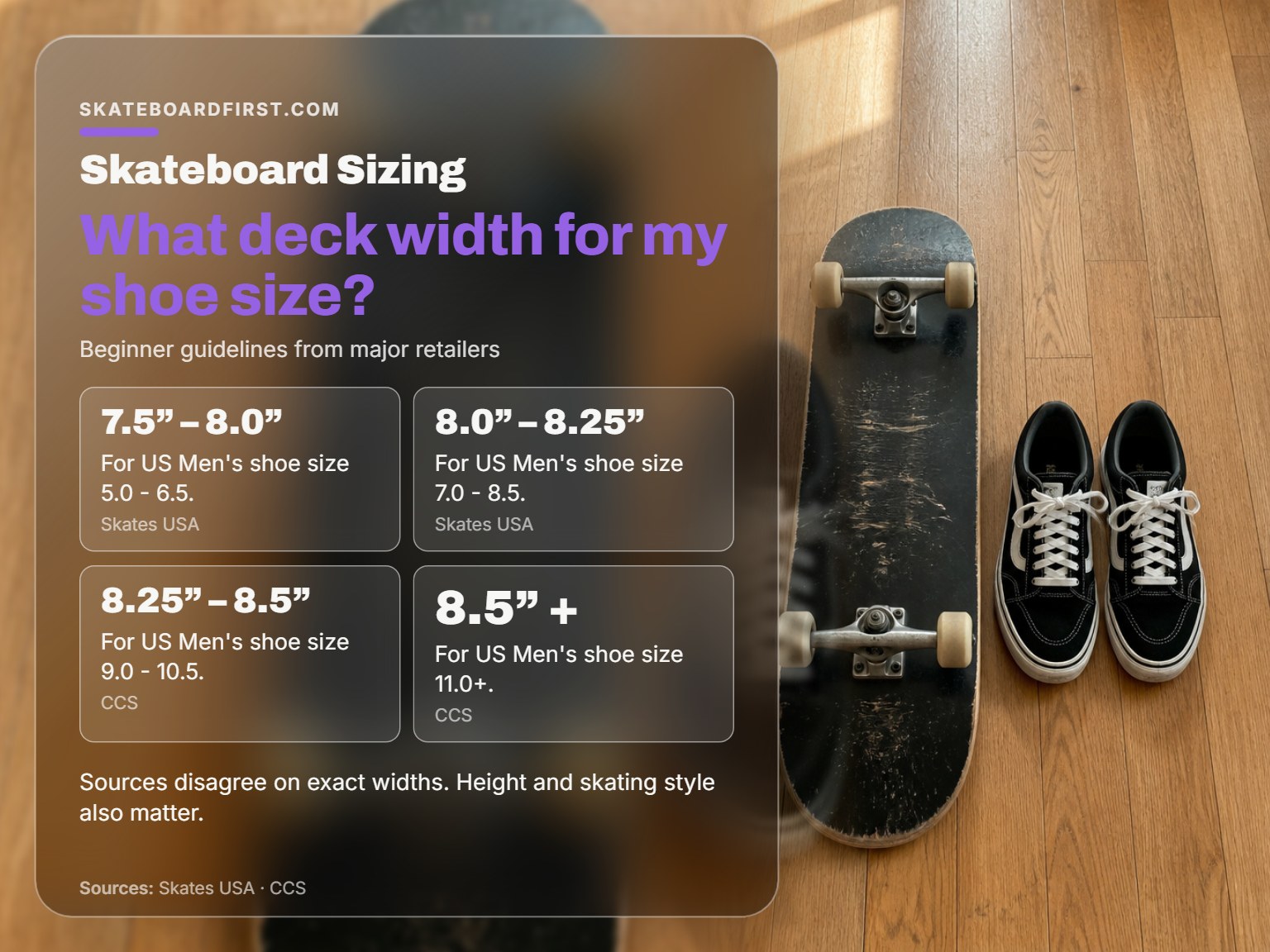
Most sizing guides, including those from evo and CCS, tell you to start with your shoe size. The logic is simple: your foot needs a platform. Too narrow, and your toes and heels hang off, hurting balance. Too wide, and the board feels sluggish underfoot.
The chart from CCS is one of the most specific, breaking it down by shoe size ranges.
| US Men’s Shoe Size | Recommended Deck Width |
|---|---|
| 4.5 or smaller | 7.00″ – 7.38″ |
| 5.0 – 6.5 | 7.50″ – 8.00″ |
| 7.0 – 8.5 | 8.00″ – 8.25″ |
| 9.0 – 10.5 | 8.25″ – 8.50″ |
| 11.0+ | 8.50″+ |
Where this goes sideways: Pairing a wide deck with narrow trucks. The wheels sit too far inside the deck’s edge, which feels unstable and makes the board prone to tipping on carves. It also kills your ability to grind on coping or ledges.
This seems straightforward, but here’s the first conflict. Look at a US Men’s size 8. CCS says 8.00″ – 8.25″. Skates USA, however, recommends 7.5″ – 7.8″ for men’s sizes 7-8. That’s a half-inch difference. Which one is right? They both are, because CCS and Skates USA are starting from different assumptions about rider height and preference.
The disagreement gets louder with Skate Warehouse UK, which directly contradicts the shoe-size-first advice for beginners. Their guide states height is more important, arguing you can technically ride any width deck. This is the core tension in every beginner ‘what size skateboard should i get’ discussion online.
So what should you do? Use shoe size as your entry point, not your final answer. An 8.0″ deck is a safe middle ground for most adult men. If you have size 10 or larger shoes, Skates USA notes you’ll likely feel more stable on a deck 8.25″ or wider. For a deeper dive on matching your physique, our guide on choosing a skateboard size based on your height and weight explores this in detail.
Height, Age, and the Alternative Charts
If shoe size charts feel limiting, look at the ones based on height and age. These are particularly useful for younger skaters or adults who feel their shoe size puts them in an awkward middle zone.
Skates USA provides one of the most detailed height-based breakdowns. For a rider between 5’3″ and 5’8″, they recommend a deck width of 7.5″ – 8.0″. If you’re over 6’1″, they suggest 8.25″ – 9.0″. The logic is that a taller rider has a higher center of gravity and a wider stance, so a bigger platform provides more control.
Age-based charts, like the one from evo’s kids’ section, blend height and development stage.
| Age Range | Rider Height | Recommended Deck Width |
|---|---|---|
| 5 or younger | Under 3’4″ (102 cm) | 7.0″ – 7.5″ |
| 6 – 8 years | 3’5″ – 4’4″ (102-130 cm) | 7.5″ – 7.75″ |
| 8 years and older | 4’5″ – 5’2″ (130-160 cm) | 7.75″ – 8.25″ |
Common mistake: Choosing a board based solely on a child’s excitement over a graphic. A board that’s too big is unwieldy and discouraging. A proper skateboard size chart by age helps you balance fun with function.
The charts are serving different purposes: one for growing youths, one for developed teens and adults. This is why asking “is a 7.5″ deck good for a 12-year-old?” has no single answer, it depends entirely on that specific kid’s height and shoe size. For adult riders, our dedicated resource on skateboard size for adults translates these principles into clear recommendations.
Skating Style: Street, Transition, and Cruising
Your planned riding style should push your final choice up or down an eighth of an inch. The general rule is narrower for technical street, wider for stable transition and cruising.
Element Brand notes that street skateboarding usually opts for a deck width between 7.75 and 8.5 inches. The smaller end of the common street range (7.75″ – 8.5″) is often preferred for flip tricks. The board is lighter, and it flips faster under your feet. A wider board generally feels heavier and less nimble for flip tricks compared to a narrower one.
I learned this the hard way trying to teach kickflips on a 9″ old-school shape. The board was a boat. It was stable for carving, but getting it to spin was a leg workout. We switched to an 8.25″ popsicle deck, and the student landed his first flip within a week.
For transition skating, ramps, bowls, pools, a wider deck (8.25″ and up) gives you more surface to land on and distributes your weight better during high-speed carves. If your main goal is cruising from point A to point B, a board with softer, larger wheels (often a cruiser complete) is the way to go. For those focused on technical street spots, our article on the best skateboard size for street skating dives into the nuances.
Matching Trucks, Wheels, and Hardware
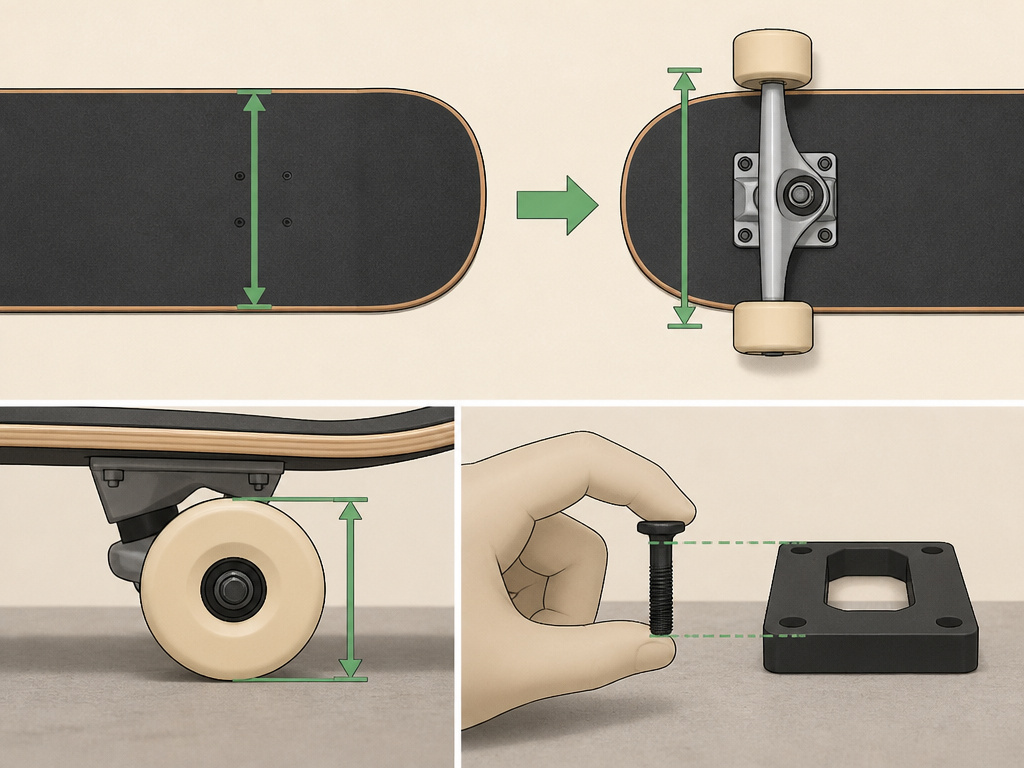
Your deck width decides your truck size. Get this wrong, and the whole setup feels off.
Truck axle width should match the width of your deck. Truck brands size their trucks with axle widths such as 8.0″ or 8.5″. The goal is for the truck axle width to match the width of your deck. A mismatch between truck axle width and deck width can make the board feel unstable or affect its performance.
Wheel size is the next lockstep choice. For street and park skating, the most common range is between 50mm and 60mm. Beginners should start in the middle, around 54-55mm. Here’s why: smaller wheels (50-54mm) are slower and more prone to getting caught on cracks or pebbles. Larger wheels (above 60mm are usually for longboards or cruisers) can cause wheel-bite without riser pads.
Finally, hardware, the bolts that hold it all together. The most common sizes are 7/8″ (for no risers) and 1″ (for 1/8″ risers). If you use riser pads, you will need longer hardware (like 1″ for 1/8″ risers).
How to Actually Test the Feel

All these charts are just paper. The final test happens under your feet.
If you have a local skate shop, go in. Ask if you can stand on a few different decks. Don’t just stand still, assume your pushing stance. Feel where the ball of your back foot sits on the tail. Notice how much toe and heel hang you have. Some toe and heel overhang is normal.
The part nobody mentions: Your first board sets your baseline. If you start on an 8.0″, that will feel “normal.” Switching to an 8.25″ will feel huge and stable. Switching to a 7.75″ will feel tiny and twitchy. Your brain adapts to your first reference point.
If you’re buying online and can’t test, lean on the return policy. Or, use the detailed deck size chart on our site to cross-reference your measurements. The goal is to minimize the guesswork. Remember, the ultimate guide for choosing your first skateboard walks you through this entire decision process.
Edge Cases and Important Warnings
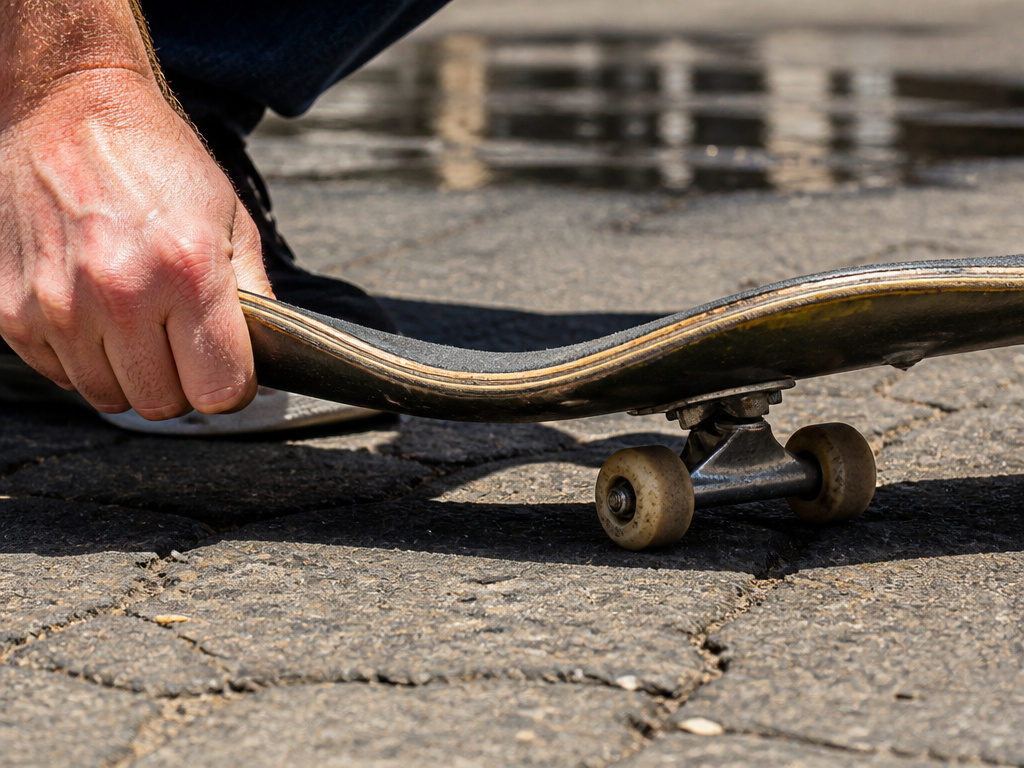
Two things most sizing guides skip: speed wobble and deck storage.
Speed wobble is that violent, uncontrollable shaking that can happen at higher speeds, often when riding downhill. According to the CPSC skateboarding safety fact sheet, longer boards and wider trucks provide more stability and can help mitigate this hazard. If you plan on doing any hill bombing, consider a longer board and wider trucks for stability.
Deck storage sounds trivial until you pull a warped board out of the garage. Both evo and the Skate Labs PDF warn against storing decks in temperature extremes, a hot car, a damp cold garage, or near a heater. The laminated maple plies can warp when exposed to temperature extremes. A warped deck will never pop right and can develop flat spots that kill your roll.
Putting It All Together: A Quick-Start Table
For the beginner who just wants a starting point, this table offers general guidelines based on common chart recommendations. Use it as a launchpad, not a prison.
| Your Profile | Recommended Starting Deck Width | Why It Works |
|---|---|---|
| Adult Beginner (Men’s shoe 8-10) | 8.0″ – 8.25″ | Balances stability for learning with enough width for good foot placement. |
| Adult Beginner (Men’s shoe 11+) | 8.25″ – 8.5″ | Extra width accommodates larger feet, providing a more stable platform. |
| Teen/Young Adult (Shoe 6-8) | 7.75″ – 8.0″ | Aligns with common height for this age, offering a nimble yet controllable size. |
| Younger Skater (Under 5′ tall) | 7.0″ – 7.75″ | A smaller, lighter board is easier for a smaller person to maneuver and flip. |
| Focused on Transition/Bowls | 8.25″+ | Wider surface aids in landing stability and control during high-speed carves. |
| Focused on Technical Street Tricks | 7.75″ – 8.125″ | Lighter, narrower deck flips faster and requires less effort for rotations. |
What skateboard width should I get for my shoe size?
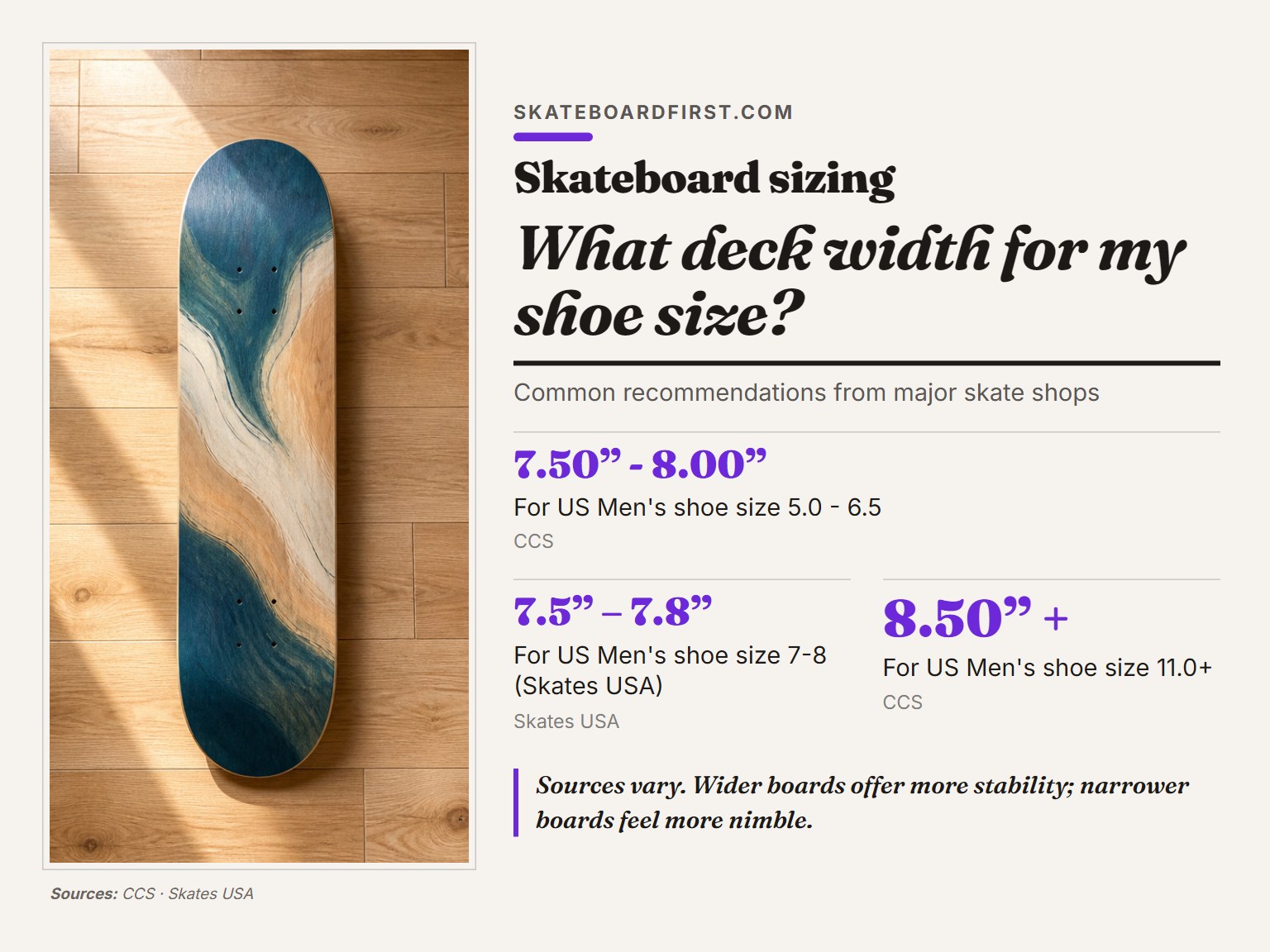
Most sizing charts use shoe size as a starting point. For a US men’s shoe size 5.0 to 6.5, common recommendations point to a deck between 7.50 and 8.00 inches. If you wear a size 7.0 to 8.5, recommendations vary: Skates USA suggests 7.5” – 7.8”, while CCS suggests 8.00” – 8.25”. For sizes 9.0 and above, the guidance shifts to wider decks, often 8.25 inches or more. These wider boards offer more stability. A narrower deck within these ranges will generally feel more nimble for technical tricks.
Frequently Asked Questions
How do I know which size skateboard to get?
Start with your shoe size using a chart like CCS’s, then cross-reference with your height using a chart like Skates USA’s. The overlap in the recommended ranges is your target zone. If possible, stand on decks in that zone at a shop to feel the difference.
Is an 8.25 skateboard good for beginners?
Yes, an 8.25″ deck is an excellent choice for many adult beginners. It’s wide enough to feel stable, especially for riders with shoe sizes above 9, yet it’s still within the common range for all-around skating.
Is 8.5 too big for street skating?
It depends on your goals. For pure technical street skating focused on flip tricks, an 8.5″ deck is on the larger side and will be heavier to flip. However, for street skating that includes ledges, rails, and general cruising, a wider deck can provide more stability. It’s not too big; it’s just better suited for power and control over hyper-technical flicks.
How long should my skateboard be if I’m 5’7″?
Deck length matters less than width for most street skating. Most popsicle decks range from about 28 to 32 inches long. At 5’7″, a deck width in the range suggested for your height (like 7.75″ – 8.0″ per Skates USA for 5’3″ – 5’8″) is a good starting point. Your focus should be on the width (likely between 7.75″ and 8.25″ for your height) and the wheelbase (the distance between truck mounting holes), which affects turn responsiveness. A shorter wheelbase feels twitchier, a longer one feels more stable.
The Bottom Line
Ignore anyone who says there’s only one right way to size a skateboard. The charts disagree because rider preference is the final variable.
Start with an 8.0″ deck if you’re an average-sized adult beginner. It’s the safest bet. Match it with trucks that have an 8.0″ axle, 54mm wheels, and 7/8″ hardware. Ride that for a month. If it feels twitchy, go up to an 8.25″ next time. If it feels like a boat, try a 7.75″.
Your first board is a tool for learning what you like. The goal isn’t to pick the perfect size forever. It’s to pick a size that lets you start skating tomorrow. Everything else, the preferences, the style, the tiny adjustments, comes from the miles you put on it.
