Is Skateboarding Hard to Learn? The Real Timeline
This post contains affiliate links. As an Amazon Associate, we earn from qualifying purchases.
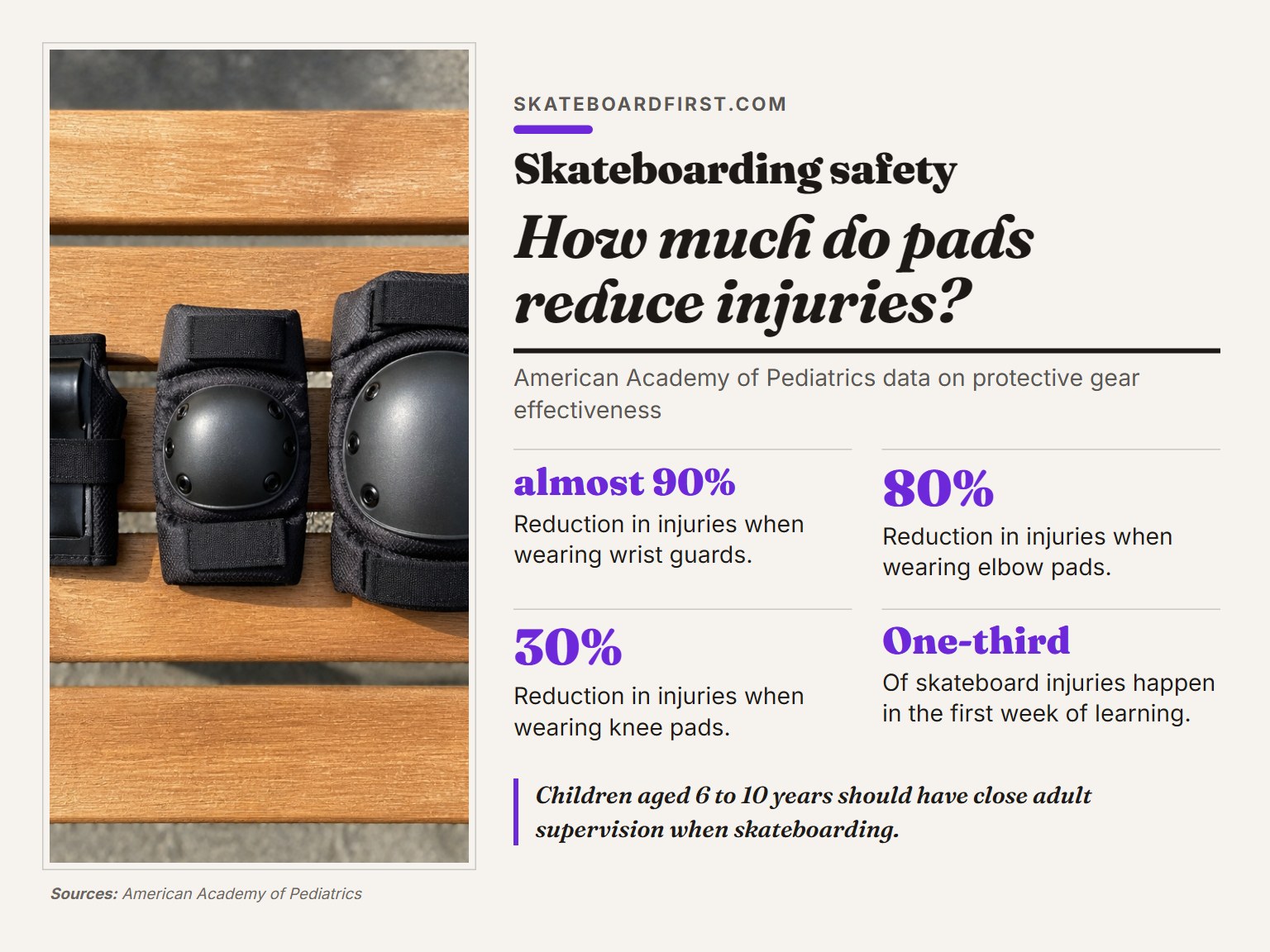
Skateboarding is hard to learn because it demands a unique combination of dynamic balance, fine motor control, and mental resilience that most beginners don’t possess. One-third of all skateboarding injuries happen in the first week, according to the American Academy of Pediatrics, which tells you everything about the initial difficulty spike. The basics, pushing, turning, stopping comfortably, take focused practice.
That first-week injury stat isn’t a scare tactic. It’s a data point that shows why your approach matters more than your natural talent. A common question is skateboarding hard to learn, and the process is largely informal and self-regulated, a fact confirmed by a scoping review in the Journal of Sports Sciences, which means you are your own coach from day one.
What follows is a breakdown of why it feels so hard, a realistic timeline from zero to cruising, the gear that actually helps (versus what holds you back), and the mental shifts that separate those who stick with it from those who park the board in the garage after two weeks.
Key Takeaways
- One-third of injuries happen in the first week, your initial approach is critical for safety and confidence.
- Spend your first month only pushing, turning, and stopping; attempting tricks early teaches bad habits and increases injury risk.
- Skateboarding is much harder than riding a bike because it requires constant micro-adjustments for balance on a small, unstable platform.
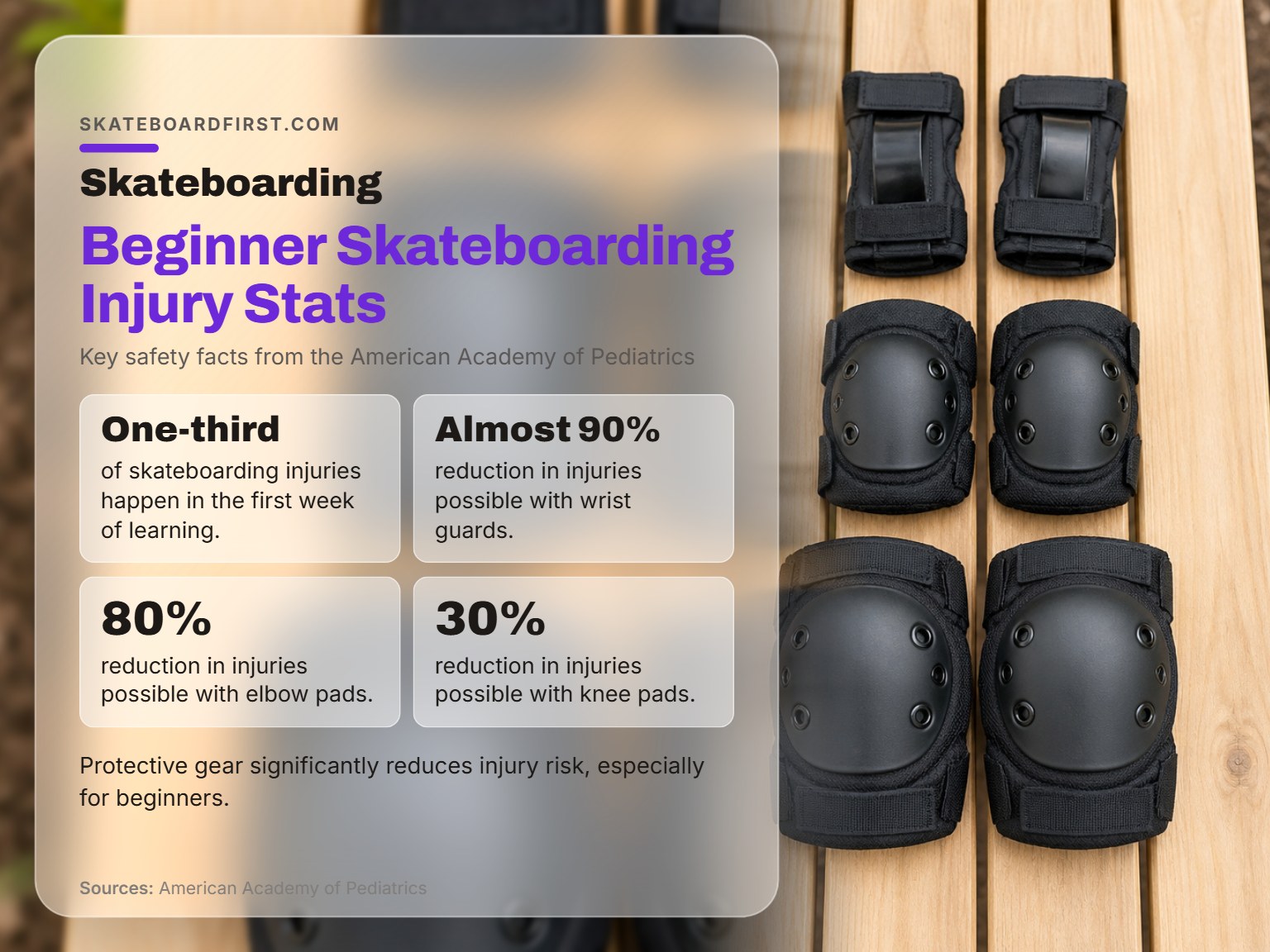
- Wrist guards reduce injuries by almost 90%, making protective gear essential for learning.
Why Skateboarding Feels So Hard (The Physics and Psychology)
You stand on a piece of wood with four wheels. It wants to roll in any direction except the one you intend. Your brain is wired for bipedal stability, not for managing a rolling pivot under your feet. This is the core conflict.
The sport isn’t built on raw strength. It’s built on proprioception, your body’s sense of where its parts are in space, which is a core reason the is skateboarding hard to learn question has such a clear answer. A Sports Medicine study pinpointed the ollie as a high-risk maneuver for ankle injury precisely because it requires a precise, timed sequence of foot pressure shifts while the board is in motion. Get the sequence wrong by a few milliseconds, and the board rockets away or doesn’t leave the ground. That level of fine motor control under dynamic conditions is what makes even basic tricks difficult.
Before you start: Skateboarding involves high-impact falls. Wrist guards can reduce injuries by almost 90%, elbow pads by 80%, and knee pads by 30%, per the American Academy of Pediatrics. A certified helmet is mandatory. Never skate on wet or oily surfaces, as traction loss is immediate and unpredictable.
The learning environment itself is unstructured. Unlike sports with formal coaching pathways, a Frontiers in Psychology study of 91 skateboarders found learning happens in a “coach-free environment,” which is a fundamental part of the is skateboarding hard to learn equation. You watch, you try, you fail, you adjust. This self-teaching method is powerful for long-term ownership of skills, but it’s brutally inefficient at the start. There’s no one to instantly correct your foot placement or weight distribution, which is why so many beginners struggle with the same fundamental errors.
How Long Does It Actually Take to Learn the Basics?
Throw out the idea of “learning skateboarding” as a single event. You learn layers. The first layer, riding with basic control, has a surprisingly consistent timeline among adult beginners.
Most new skaters need between 10 and 20 hours of focused practice to move from “wobbly first push” to “comfortably cruising around the block.” This aligns with anecdotal reports from forums like r/NewSkaters, where users report taking “five hour-long sessions before being able to start pushing and not bail immediately out of fear.”
Here’s a realistic phase breakdown for an adult practicing 4-5 times a week:
| Phase | Goal | Typical Time Investment | What Mastery Looks Like |
|---|---|---|---|
| Acclimation | Stand on the board without holding anything; find your stance (regular or goofy). | 1-2 hours | You can step on and off the board without it shooting away. You know which foot feels natural in front. |
| Basic Propulsion | Make a few consecutive pushes, place your back foot on the board, and roll in a straight line. | 3-6 hours | You can push 50-100 feet in a controlled line without stepping off. The motion starts to feel less deliberate. |
| Foundational Control | Initiate basic turns (carves) by leaning your weight; control speed with foot braking. | 6-10 hours | You can navigate slight curves on a path, slow down reliably, and stop without jumping off. You stop looking at your feet. |
This timeline assumes you’re on a proper skateboard. A warped deck with sticky, low-quality bearings can double these times. I gave myself a full month for only pushing, carving, and stopping on flat ground. It felt tedious in week two. But by week three, I stopped looking at my feet, and my pushes became automatic. That automaticity is the foundation everything else is built on.
The part nobody mentions: Your first few sessions will feel profoundly awkward. After 20 minutes on my first day, I could go about 5 feet max before losing balance. That’s normal. Your brain is building new neural pathways for balance on a moving platform. The feeling of incompetence is temporary, but it weeds out a lot of people in the first week.
Skateboarding vs. Other Sports: A Difficulty Comparison
Is it harder than biking? Yes, categorically. The Reddit community consensus is that skateboarding is much harder than riding a bike. A bike is stable on two wheels when moving; it wants to stay upright. A skateboard is unstable on four wheels; it wants to tip or spin. Learning to ride a bike is about managing momentum. Learning to skateboard is about creating and controlling instability every second you’re on the board.
The difficulty curve is also inverted compared to many sports. In soccer or basketball, you can quickly grasp the basic object interaction (kicking, dribbling) and play a simple game. In skateboarding, the basic interaction, standing and rolling, is the primary skill you drill for weeks. There’s no “game” until much later. This delayed gratification is a major mental hurdle.
The research backs this up. Studies like the one published in Springer Nature’s Forum Kinder- und Jugendsport describe a multi-phase process model of movement learning for park skating, where skaters cycle through cognitive and motor learning phases repeatedly. You don’t just learn a trick and move on; you learn it, lose it under pressure, and have to relearn its components. This iterative, non-linear progression is why direct comparisons to traditional sports often fall short.
The Gear That Helps vs. The Gear That Hurts
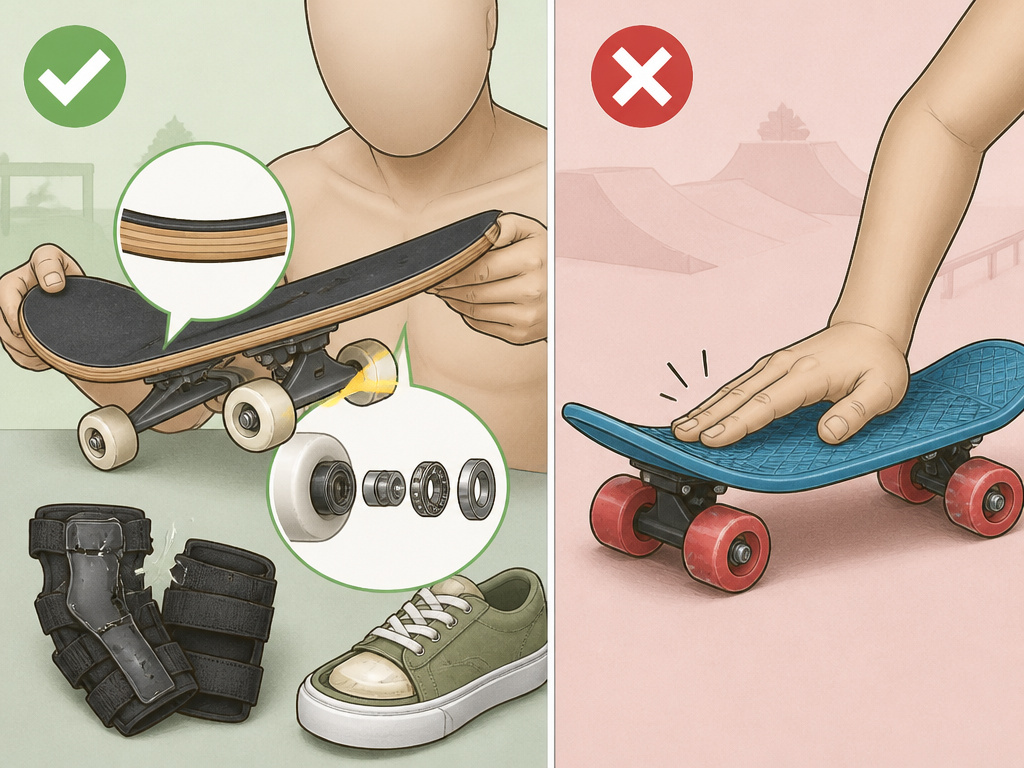
Your equipment decides whether you’re learning skateboarding or fighting a piece of sporting goods-shaped frustration. This is where my strongest opinion lives: a $60 department-store complete is worse than no board at all.
A real skateboard from a reputable brand like Element, Santa Cruz, or Mini Logo has several non-negotiable features:
- A concave maple deck that provides locked-in foot feel.
- Precision bearings (rated ABEC 3 or 5 is fine) that roll with minimal push.
- Proper polyurethane wheels (around 52-54mm, 99A hardness for street) that grip and slide predictably.
A toy-store board has a warped plastic deck, gritty steel bearings that seize up, and hard plastic wheels that either slip out or grip suddenly. It teaches you that skating is about muscling a dead object around. You’ll conclude you’re bad at it, when the gear was bad from the start.
I won’t recommend a helmet or pads as a “maybe.” The AAP data is clear: wrist guards reduce injuries by almost 90%. For an adult learner whose wrists aren’t conditioned for falls, that’s the difference between a two-day soreness and a six-week cast. The social anxiety of wearing gear lasts five minutes. A broken wrist lasts months.
Footwear matters more than beginners think. Vulcanized sole shoes (like classic Vans) are flexible and board-feel oriented, but they offer little impact protection. A cupsole shoe (like many from Etnies or DC) has more structured cushioning. For your first six months, the cupsole will save your ankles and your enthusiasm. Board feel is a luxury for after you’ve learned how to stay on the board.
The 5 Most Common Beginner Mistakes (And How to Fix Them)
Most early struggles come from a small set of correctable errors. Fixing these will accelerate your learning timeline more than any secret trick tip.
-
Looking Down at Your Feet. Your head is heavy. Looking down pulls your weight forward, over your toes, making you unstable.
- Fix: Pick a point 10-15 feet ahead on the ground and focus on it. Your peripheral vision will handle the board. Trust it.
-
Stiff, Straight Legs. Locked knees turn your body into a rigid pole balanced on a ball. The board’s vibrations and shifts have nowhere to go but into a wobble.
- Fix: Bend your knees. Always. A slight athletic crouch lowers your center of gravity and lets your legs act as shock absorbers.
-
Pushing Mongo (With Your Front Foot). This is when you push with the foot that stays on the board, requiring a full foot repositionment after every push. It kills stability and momentum.
- Fix: Train from day one to push with your back foot. Your front foot stays pointed forward near the front bolts, ready to steer.
-
Fear-Based Leaning Back. When scared, beginners lean back onto their rear foot, lifting the front trucks. This makes steering impossible and leads to the board shooting out.
- Fix: Consciously keep your weight centered, or even slightly forward. A front-heavy stance is more stable and controllable.
-
Skipping the Basics for Tricks. The siren call of the ollie is strong. Attempting it before you can ride fluidly means you’re learning a complex jump on top of an unstable foundation.
- Fix: Follow a logical progression of tricks. Master the roll-away first. Then practice lifting the nose (manual), then the tail (nose manual). These are the weight-control building blocks for the ollie.
These mistakes are universal because they’re intuitive reactions to instability. Unlearning them is your first real strategies for faster progression.
How Your Mindset Changes the Difficulty
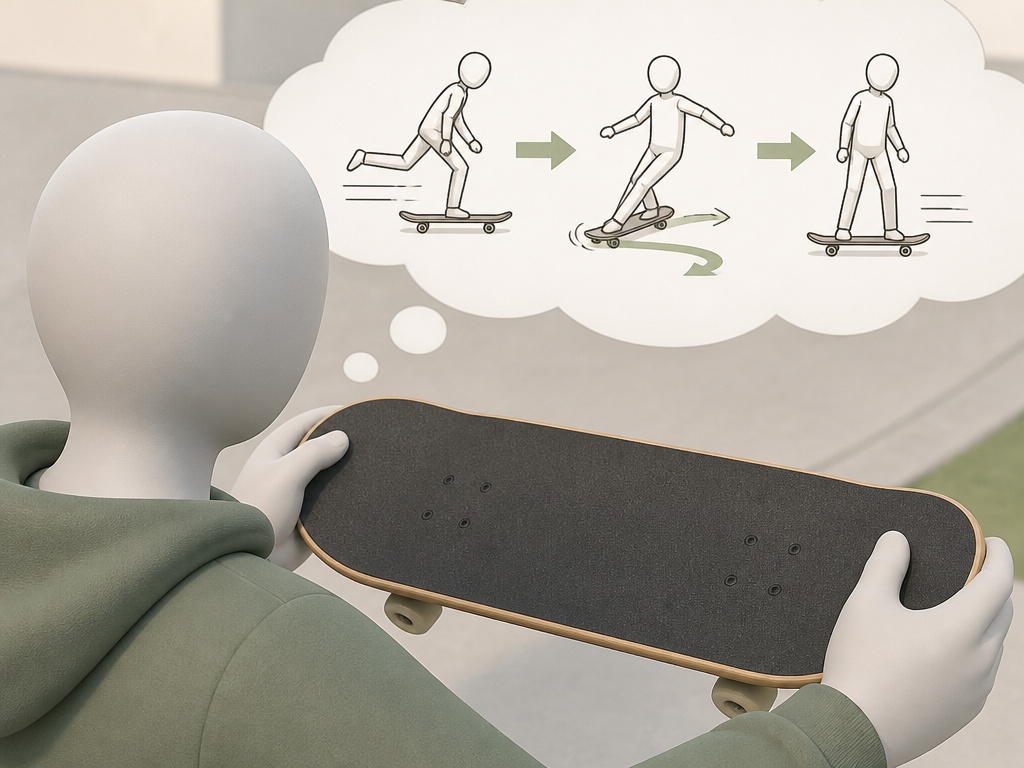
The physical challenge is only half the battle. Your mental approach can double the difficulty or cut it in half.
A study of skateboarders in Frontiers in Psychology found that many used Imagery/Mental Practice. Before trying a new maneuver, they’d visualize the sequence repeatedly. This isn’t mystical; it primes the neural pathways. Spending five minutes visualizing a smooth push-turn-stop sequence before your session can make the physical execution feel more familiar.
Embrace the fall. It’s not failure; it’s data. Every fall tells you a limit you reached, too much speed for your turning skill, off-balance on the push, weight too far back. The skaters who overcome fear fastest are the ones who learn to practice effectively by analyzing each bail. “Why did I fall?” is a more useful question than “How do I not fall?”
Where this goes sideways: Comparing your day-one progress to edited Instagram clips or even skaters at your local park. You’re seeing their decade of accumulated trial and error, not their first 20 hours. An anecdotal YouTube source notes that less than one percent of skaters can do an ollie. Adjust your expectations to the real-world, not the highlight reel.
Finally, understand the informal coaching environment. In the absence of a formal teacher, skaters appoint informal leaders, the person at the park who explains things clearly. Don’t be afraid to ask respectful questions. Most experienced skaters remember the struggle and will offer a quick tip. That single cue about shoulder alignment or foot placement can save you weeks of frustration.
When Are You Ready for the Skatepark?
The park is intimidating. Knowing when you’re ready can prevent a confidence-crushing experience.
Don’t even think about a skatepark until you have absolute control on flat ground. The AAP advises that children aged 6 to 10 need close adult supervision at parks; the same principle of graduated challenge applies to adults. You’re ready for beginner park features when you can consistently do the following on flat asphalt without thinking:
- Push at a moderate speed and foot-brake to a complete stop.
- Execute controlled left and right carves (turns) without slowing down.
- Comfortably ride over small cracks and pebbles without losing your balance.
- Step off the board safely at speed (the “run-out”).
Your first park visit should be during off-hours (weekday mornings). Go not to skate the ramps, but to practice your flat-ground skills on the smooth, uninterrupted concrete. Get used to the space. Watch how others flow. The park is a tool for building confidence, not a proving ground. When a small bank ramp starts to look inviting rather than terrifying, you’re on the right path.
Frequently Asked Questions
How long does it take to learn how to skateboard?
There is no single answer, as “learning” is layered. To feel comfortable cruising and performing basic maneuvers, most adults need 10-20 hours of practice. To learn foundational tricks like the ollie, add several months of consistent, focused sessions on top of that riding competence. The journey never really ends, which is part of the sport’s appeal.
Is 25 too late to start skateboarding?
No. Sources disagree on the age advantage for learning: some argue starting younger offers advantages in fearlessness and injury resilience, while others point to the patience and analytical benefits of being older. The key is managing risk with full protective gear and listening to your body. Many of the most dedicated community skaters started in their 20s or later.
Why is skateboarding so hard for me?
It’s hard for everyone at the start. You’re learning a highly specialized form of dynamic balance on an unstable platform, largely through self-directed trial and error. The most common specific reasons include improper foot placement, stiff legs, looking down, and using low-quality equipment that fights your every move. Address those, and the difficulty will gradually decrease.
Can I teach myself skateboarding?
Yes, absolutely. The vast majority of skaters are self-taught, a fact supported by research in the Journal of Sports Sciences. The process relies on observation, imitation, repetition, and analysis of failure. Use online video tutorials for conceptual understanding, but rely on your own physical repetition and sensory feedback to build the muscle memory. A guide to teaching yourself is entirely feasible.
How long does it take to learn how to skate well?
“Skating well” is subjective. To ride with style and fluidity and land basic tricks consistently, expect to invest years of regular practice. Progression is non-linear; you’ll have rapid bursts of improvement followed by frustrating plateaus. The long-term realistic timeline for learning is measured in years, not months.
The Bottom Line
Skateboarding is hard. The first week will likely confirm that. But the difficulty is specific and conquerable. It’s not about being a natural athlete; it’s about committing to the awkward first phase where you can’t go five feet without stepping off.
Your single most important decision happens before you ever step on the board: buying real equipment from a skate shop, not a toy aisle. Your second is committing your first month to nothing but pushing, turning, and stopping. Your third is strapping on a helmet and wrist guards every single session.
The stats tell a clear story, one-third of injuries happen early, and protective gear dramatically reduces the severity. Your job is to listen to that data, not the voice that says tricks come first. Master the roll. The pop, the flip, the grind, they all come later, and they come easier if the foundation is solid. Start small, then build.
